# 1 position
UEI College-Stockton - Electrician.
certificate or diploma

Audited and Verified:
Our Editorial and Data Verification Process
Research.com uses government datasets, official education statistics and primary institutional information to support its career and degree guides. Our review process checks factual accuracy, occupational definitions, source dates and the requirements associated with the credentials discussed.
How This Article Was Fact-Checked
Our editorial team verifies salary estimates, employment projections, education requirements and program information against original data providers and official organizations. Salary figures are checked against the relevant occupational definitions and reporting periods. Information about licensure, accreditation and required in-person training is reviewed separately.
Fact-checked and verified on:

Co-Founder and Chief Data Scientist

Reviewed by Karolina Broda
Fact-Checker and Data Verification
Choosing electrician training in Stockton means looking beyond the school name: a certificate, an apprenticeship, and an associate degree can lead to very different costs and work experience. The U.S. Bureau of Labor Statistics projects electrician employment to grow 9.2% nationally from 2025 to 2035, but entering the trade in California still requires planning for supervised work and state certification. The Research.com team of data scientists created the Best Electrician Trade Schools in Stockton for 2027 ranking to help students identify programs worth considering. This guide explains how to compare them - and when an apprenticeship may be the better investment.
Expect electrical theory paired with physical practice: reading plans, installing raceway and wiring, testing circuits, and working safely with tools and energized-system hazards. A school program generally supplies structured instruction and labs. A registered apprenticeship combines classroom instruction with paid, supervised jobsite work over a longer period. Neither should be judged solely by the credential printed at completion.
For Stockton applicants, the central question is how instruction connects to qualifying work under California rules. San Joaquin Delta College represents a public-college option to investigate; UEI College-Stockton represents a career-school option. Confirm each currently offered electrician-related program, its exact award, schedule, lab facilities, and electrician-trainee eligibility directly with the provider and the California Department of Industrial Relations (DIR). A registered apprenticeship or employer-supported trainee position may fit better if earning while learning is essential.
The following comparison separates credentials from the experience needed to progress in the occupation.
| Pathway | What it typically provides | Best fit and principal limitation |
| School certificate or diploma | Focused instruction and labs; a school-awarded credential | Fits someone seeking preparation before or alongside employment; does not itself establish qualifying jobsite experience. |
| Associate degree | Electrical coursework plus broader college requirements; an academic degree | Fits someone who values broader coursework or a college credential; usually takes more time than a focused certificate. |
| Registered apprenticeship | Related instruction, paid supervised work, and an apprenticeship completion credential | Fits someone ready for a longer work-and-training commitment; entry and placement depend on sponsor requirements and openings. |
| Employer-supported electrician trainee route | Supervised work alongside required approved-school enrollment where applicable | Fits someone who can secure a qualifying employer; the trainee must maintain the required registration and schooling. |
Electricians work for electrical contractors on residential and commercial construction, in building maintenance, and on industrial systems (U.S. Bureau of Labor Statistics). In Stockton, compare programs against the work you intend to pursue: the San Joaquin County area offers access to construction and facility-maintenance employers, while some opportunities may require commuting to jobsites beyond the city. That makes transportation and scheduling part of the training decision, not just a later job-search concern.
Ask whether a program has local contractor relationships or apprenticeship connections and what those relationships actually provide. A referral, interview, or placement service is not a job guarantee. If you want to work on complex industrial controls rather than primarily residential installation, inspect the equipment used in labs and ask whether students practice troubleshooting motors and control circuits.
The U.S. Bureau of Labor Statistics reports a $63,190 national median annual wage for electricians in May 2025. That is the midpoint for employed electricians at all experience levels - not an entry wage, a Stockton wage, or a forecast of what a particular program's graduates will earn. For a local comparison, check the latest BLS Occupational Employment and Wage Statistics for the Stockton-Lodi metropolitan area and compare the same electrician occupation and reference year with California figures.
Pay also depends on whether you are a beginning apprentice, an experienced certified electrician, or a supervisor; hours, employer, specialty, and applicable wage agreements matter. When estimating a program's return, compare a realistic early-career wage with your current earnings and account for the time needed to gain supervised experience. Do not use the national median as the immediate payoff for a short certificate.
A focused certificate can take substantially less time than an associate degree, but program length varies by clock hours, schedule, and required courses. Registered apprenticeships generally span multiple years because participants complete instruction while accumulating supervised jobsite experience. In California, the general electrician certification experience standard is 8,000 qualifying work hours, followed by the required examination under the applicable route (California DIR). Finishing a shorter school program does not erase that experience requirement.
Before choosing an accelerated option, request its published clock or contact hours, weekly lab schedule, expected completion time for part-time students, and explanation of how graduates obtain qualifying work. A short program can be useful preparation, but it should not be confused with becoming a certified electrician within that same period. Readers comparing other short occupational credentials can explore 12 month certificate programs that pay well; California electrician certification has its own, longer experience requirements.
Online instruction can cover code concepts, calculations, and some plan-reading exercises. It cannot by itself demonstrate safe installation, meter use, conduit work, or supervised performance on a jobsite. An on-campus or hybrid program is more useful when it provides accessible labs and a clear route to required in-person work. For a Stockton student, a distant "online" program may become expensive if its practical sessions require repeated travel.
Ask a hybrid provider which activities happen remotely, where labs take place, how attendance is recorded, and whether its instruction qualifies for the California electrician-trainee route you intend to use. Institutional accreditation, when applicable, is a separate question from that eligibility. General lists of best accredited non profit online universities are not a substitute for verifying an electrician program's hands-on training and California requirements.
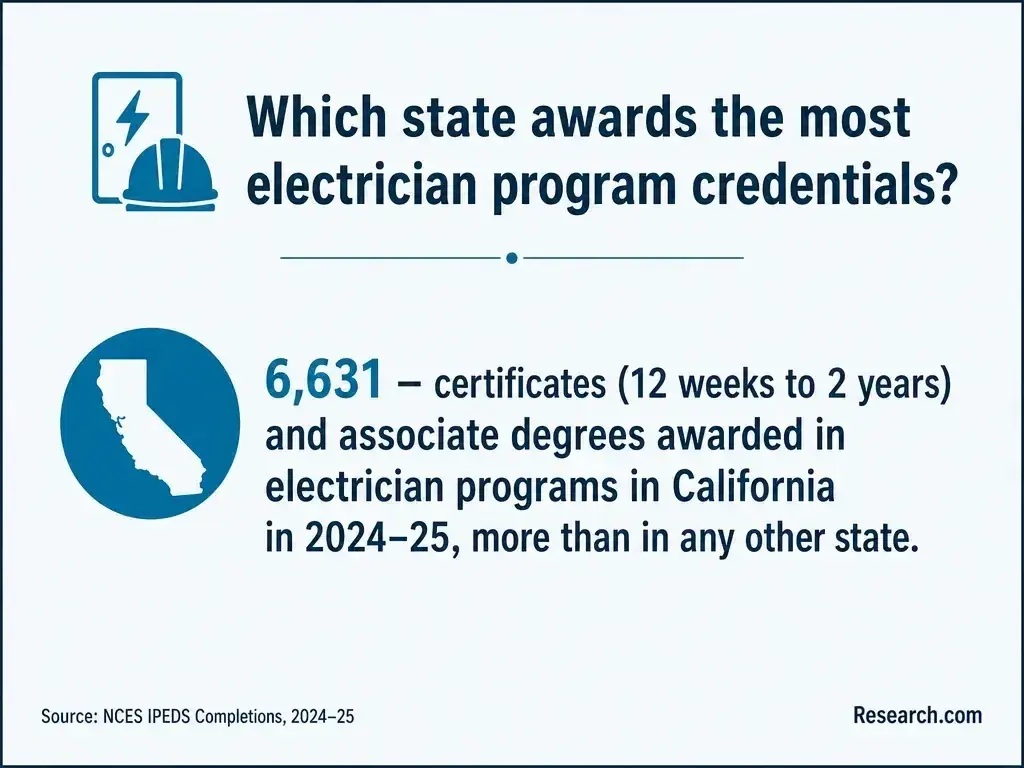
There is no dependable single "average" that represents Stockton certificates, associate degrees, and paid apprenticeships alike. Their prices and cash flows are structured differently. Request a current, itemized cost of attendance from each school and an explanation of pay, required purchases, and instruction costs from each apprenticeship sponsor.
The comparison below shows why a tuition quote alone cannot tell you which route costs less to reach employment.
| Cost or offset | What to verify | Why it changes the decision |
| School charges | Tuition, mandatory fees, materials, and any resident-rate eligibility | A lower advertised tuition may exclude necessary charges. |
| Work readiness | Tools, PPE, books, supplies, transportation, and examination or application fees | These expenses can arise before full-time earnings begin. |
| Time and financing | Schedule, foregone earnings, borrowing, and likely time to completion | A faster program is not automatically a better investment if it creates more debt or leaves an experience gap. |
| Offsets | Paid apprenticeship work, employer support, grants, scholarships, and aid eligibility | Support can lower out-of-pocket cost, but availability differs by provider and student. |
Check federal-aid eligibility through Federal Student Aid and ask about California community-college aid or local workforce funding where applicable; do not assume every training provider participates. To assess return on investment, compare total costs and debt with likely earnings over a reasonable time horizon, accounting for your current wages, completion probability, time in training, and the delay before higher earnings. Discounting future earnings matters when comparing a paid apprenticeship with a shorter, upfront-cost program.
The award depends on the pathway: a school may award a certificate or diploma, a community college may offer an associate degree, and a registered apprenticeship awards a completion credential. None is automatically a California electrician certification. That state occupational credential depends on meeting the applicable eligibility requirements and passing the examination (California DIR).
Keep four checks separate when evaluating a provider: institutional accreditation concerns the institution; state school authorization concerns permission to operate; approval of instruction for an electrician-trainee route concerns that specific California training requirement; and apprenticeship registration concerns the work-based program. Relevant industry recognition can signal curriculum value, but it replaces none of those checks. Ask for the precise name of the award and written confirmation of which, if any, California requirement the instruction meets.
Schools and apprenticeship sponsors set their own entry criteria, so check the current application rather than assuming one standard applies everywhere. Ask about prior schooling, math readiness, age or work-eligibility rules, physical demands, application windows, and any assessment or interview. An apprenticeship may also require a sponsoring employer or placement before work hours begin. Admission to a school is not the same as admission to an apprenticeship or eligibility for California certification.
If you have previous coursework or electrical work experience, ask whether the provider grants transfer credit, prior-learning credit, or advanced standing - and whether DIR or an apprenticeship sponsor will recognize the underlying training or experience. Credit toward a school award does not necessarily reduce required qualifying work hours. Resources about top college degrees for seniors online address a different kind of educational choice; career-changing adults should verify electrician-specific entry and practical requirements instead.
A useful curriculum connects electrical calculations and code reading to work students can perform safely: identifying conductors, assembling circuits, installing wiring methods, using test instruments, interpreting diagrams, and diagnosing faults. The U.S. Bureau of Labor Statistics identifies troubleshooting, technical knowledge, physical coordination, and safety awareness as important to electricians' work.
Inspect the lab rather than relying on a course title. Ask students or instructors which installations they actually build and test, how instructors assess safe practices, and whether the equipment reflects your intended specialty. Someone targeting industrial maintenance should look for relevant motors and controls practice; someone seeking construction work should assess installation, plan-reading, and jobsite preparation. Classroom code coverage matters, but it is not a substitute for supervised practice.
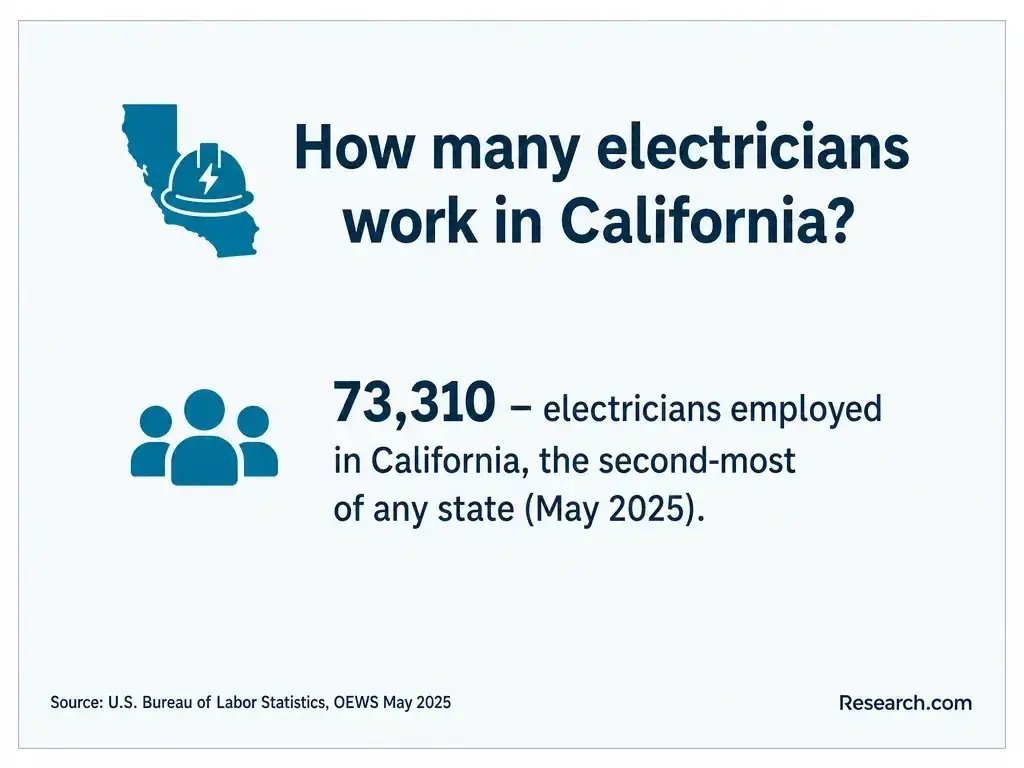
California requires state electrician certification for covered electrical work performed for C-10 electrical contractors, with distinct provisions for registered apprentices and registered electrician trainees working under the required supervision (California DIR). A trainee route involves enrollment in an approved school and registration with DIR; a registered apprenticeship follows its own regulated training structure. For general electrician certification, DIR sets qualifying experience and examination requirements. Check the rules for the specific work and category you intend to pursue before enrolling.
Electrician certification is also different from a C-10 electrical contractor license, which applies to contracting businesses under the California Contractors State License Board. A school certificate, an apprenticeship credential, institutional accreditation, and an optional industry certification do not independently grant either state credential. Ask DIR or the relevant sponsor to confirm how a proposed program and supervised job will fit your intended route.
Start with the job you want and work backward through California's training and experience rules. Then compare San Joaquin Delta College, UEI College-Stockton, and available registered apprenticeship or employer-supported routes on the same goal: the training, supervised experience, total cost, and schedule required to progress. A ranking can narrow the search; it cannot confirm that a particular opening, instructor, or employer placement is available when you apply.
Use these questions with admissions staff and apprenticeship coordinators to uncover gaps before committing money or time:
Watch for claims that a certificate makes you "licensed," placement promises without terms, or prices that omit required equipment. School authorization and accreditation deserve verification, but neither alone establishes occupational eligibility. If a search mixes electrician training with cheap online master degree programs, compare only pathways relevant to electrical work; a low price in an unrelated program says nothing about the investment needed here.
An entrant may begin as a registered apprentice or eligible electrician trainee, build supervised experience, and pursue California certification in the appropriate category. With experience, electricians may specialize in construction installation, service and troubleshooting, industrial equipment, or building systems. Supervisory work and contracting require additional experience and, for operating a contracting business, separate contractor-licensing considerations (California DIR; California Contractors State License Board).
Choose training that exposes you to the setting you want, not merely the quickest credential. Troubleshooting can involve focused independent tasks, while installations and jobsites require close coordination and communication. Readers exploring career paths for introverts should consider those day-to-day differences rather than assume all electrician roles offer the same work environment.
The U.S. Bureau of Labor Statistics projects 9.2% national employment growth for electricians from 2025 to 2035. That supports investigating the trade, but it is not a Stockton-specific vacancy forecast or a promise of placement. Local hiring depends on construction cycles, maintenance needs, contractor workloads, and the availability of supervised entry positions.
Before paying for training, check current Stockton-Lodi job postings and apprenticeship recruitment notices for the experience, schedule, and transportation they require. Treat a program's employer connections as more valuable when it can explain how students reach supervised work - not simply when it cites the national growth figure.
Education is a significant investment, so the Research.com team evaluates programs against others in the same occupation and location rather than comparing unrelated schools nationwide. The ranking includes only programs with completions reported to IPEDS. That makes it useful for comparing eligible programs, but it does not capture every registered apprenticeship, employer training route, or other provider.
Best-program scores consider student outcomes; earnings and return on investment; costs and debt; and quality and recognition. Programmatic accreditation or relevant industry recognition accounts for 20%, institutional accreditation for 10%, and student support for 10%. The remaining 60% covers outcomes, earnings, and costs, with weights distributed by an entropy-based method that gives more weight to indicators that vary more across programs. Most-affordable-program rankings use only tuition, attendance cost, debt, and federal loan default rates, also weighted by that method; accreditation and other quality indicators are not part of that score. These are different comparisons, not interchangeable endorsements.
The team draws on the following databases and organizations to check program information and relevant recognition. Some listed health-care organizations apply to other occupations in Research.com's broader ranking work; they are not electrician licensing or approval bodies.
This approach helps readers compare measurable outcomes while recognizing its limits: school-wide earnings or debt figures may not describe a particular electrician cohort. Before enrolling, verify the current program's price, practical training, and California eligibility directly. More detail on the ranking approach appears in Research.com's methodology.
# 1 position
# 2 position

# 3 position
No single trade-school credential is required for every route. Registered apprenticeships and eligible electrician-trainee pathways also provide ways to gain instruction and supervised experience. Confirm the route that applies to your intended work with California DIR.
No. A certificate documents completion of a school program; California electrician certification has separate qualifying experience and examination requirements (California DIR).
Online classes may cover theory, but installation skills and qualifying supervised work require in-person participation. Verify any hybrid program's labs and California eligibility before enrolling.
A paid apprenticeship suits someone able to secure a place and commit to work-based training. A school program may help someone build foundational skills first or study around other obligations. Compare access to supervised work, total costs, earnings while training, and time to your goal.
Not necessarily. The BLS national median was $63,190 in May 2025 and includes experienced workers. Check the latest Stockton-Lodi occupational wage data and expect starting pay to differ from the median.