# 1 position


Audited and Verified:
Our Editorial and Data Verification Process
Research.com uses government datasets, official education statistics and primary institutional information to support its career and degree guides. Our review process checks factual accuracy, occupational definitions, source dates and the requirements associated with the credentials discussed.
How This Article Was Fact-Checked
Our editorial team verifies salary estimates, employment projections, education requirements and program information against original data providers and official organizations. Salary figures are checked against the relevant occupational definitions and reporting periods. Information about licensure, accreditation and required in-person training is reviewed separately.
Fact-checked and verified on:

Co-Founder and Chief Data Scientist

Reviewed by Karolina Broda
Fact-Checker and Data Verification
Choosing electrician training in Spokane means checking more than a school's name: Washington requires documented experience and certification before independent electrical work. The U.S. Bureau of Labor Statistics projects 9.2% national growth in electrician employment from 2025 to 2035, making the choice of training route timely. The Research.com team of data scientists created its Best Electrician Trade Schools in Spokane for 2027 ranking to help students identify programs worth considering. This guide helps prospective students and career changers compare school, apprenticeship, cost, and licensing pathways before committing.
Expect electrical theory alongside supervised practice: interpreting plans, installing and testing circuits, choosing materials, and working safely around energized systems. A school-based certificate may offer labs and a structured introduction; a registered apprenticeship combines classroom instruction with paid, documented work under qualified supervision. The credential and the work experience are different things.
Spokane Community College is a local public-college option to investigate, but applicants should confirm its current electrical program title, lab schedule, credential, and any apprenticeship connection directly with the college. Union-sponsored, nonunion, and employer-connected apprenticeships may also be available in the area. Seats, hiring, and entry schedules can change, so compare actual openings rather than assuming every route starts immediately.
A useful distinction is whether training prepares you to apply for an apprenticeship or is itself part of a registered apprenticeship. Under Washington Department of Labor & Industries (L&I) rules, general journey-level applicants need qualifying, documented experience and classroom instruction; finishing a school course does not by itself authorize independent electrical work.
Electrical contractors serving Spokane and Spokane Valley provide opportunities in residential construction, commercial buildings, service work, and industrial facilities. Maintenance employers and public infrastructure projects may offer related work, but the tasks a trainee can perform depend on supervision and Washington certification rules (Washington L&I). Ask a prospective sponsor whether its assignments will provide the type of documented experience needed for your intended certificate - not merely whether it offers "electrical work."
Some Spokane-area workers also consider jobs across the Idaho border. That can expand a job search, but Idaho and Washington have separate licensing rules. Verify how out-of-state hours would count before relying on an Idaho placement for a Washington certification goal (Washington L&I).
A verified, comparable Spokane-area electrician median is not available here, so the national figure is a benchmark rather than a local pay quote. The U.S. Bureau of Labor Statistics (BLS) reports a $63,190 median annual wage for electricians in May 2025. That figure includes experienced workers and should not be used as an expected first-year apprentice salary.
For a practical local estimate, request the current wage progression from each apprenticeship sponsor or employer. Compare starting pay, scheduled increases, hours likely to be available, benefits, and travel costs. A paid route can improve cash flow during training even if its initial hourly wage is below the occupation-wide median.
A school certificate's length depends on its curriculum and schedule; it is not the same as the time required to become a Washington general journey-level electrician. Washington L&I generally requires 8,000 hours of qualifying electrical experience for that certification, including required commercial or industrial experience, plus prescribed classroom instruction and an examination. A registered apprenticeship typically spreads work and instruction across multiple years. Specialty certificates follow different experience rules.
Ask a school for its actual clock or credit hours and a sponsor for its work-hour and classroom schedule. Also ask whether the school instruction is accepted toward your intended pathway and who records your work hours. An accelerated classroom schedule cannot accelerate supervised experience you have not completed.
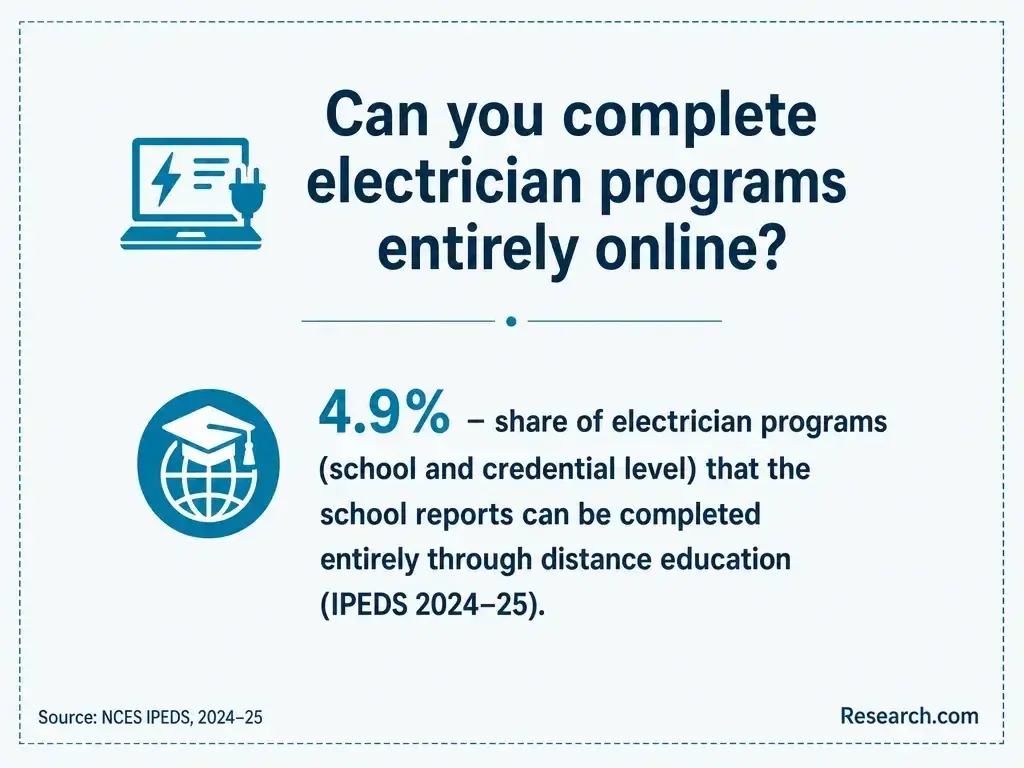
Electrical theory, code study, and some assignments can be delivered online. Wiring, testing, troubleshooting, safe tool use, and the supervised work required for Washington certification must be practiced in person. A fully online course should therefore be treated as a supplement unless the provider can show how it connects to approved instruction and qualifying field experience (Washington L&I).
For someone balancing a job with training, hybrid study can reduce classroom travel but not trips to labs or worksites. Check the location and frequency of required attendance before paying; Spokane-area placements may involve commuting beyond the campus. Searches for a fastest online associates degree can help clarify academic scheduling preferences, but speed or online delivery alone does not establish electrical licensing eligibility.
There is no reliable single Spokane-wide average covering college programs, private training, and paid apprenticeships. Published tuition is only one part of the decision: request a current, itemized estimate from each provider and check whether resident tuition applies. An apprenticeship may pay wages while you train, although it can still charge for books, tools, or other requirements.
These costs determine what you must pay to become job-ready, not just what appears on a tuition page:
Ask Spokane Community College about current program charges and aid eligibility; ask apprenticeship sponsors for wage schedules and required purchases. Washington's financial-aid programs and workforce services may help eligible applicants, but availability depends on the person and training route (Washington Student Achievement Council; Washington State Employment Security Department). Compare net costs and likely debt over the full training period, not just the first term.
Possible outcomes include a school certificate, an associate degree where a program awards one, or a registered-apprenticeship completion credential. None is interchangeable with a Washington electrician certificate. The state occupational certificate is tied to the applicable experience, classroom, and examination requirements administered by Washington L&I.
Before enrolling, get the exact credential name in writing. Ask whether instruction can count toward apprenticeship requirements, whether prior learning or work can receive documented credit, and whether any college credit articulates into a later program. An industry training certificate may be useful to employers without replacing state certification; institutional accreditation likewise does not establish licensing eligibility.
School and apprenticeship entry standards differ. A college may require an application, placement steps, and prerequisites; an apprenticeship sponsor may assess math readiness, interview applicants, and require evidence that they can meet worksite requirements. Confirm each provider's current criteria rather than assuming admission to a class secures an apprentice job.
Washington also regulates work after entry: trainees need the appropriate state trainee status and supervision, and general journey-level applicants should verify the registered-apprenticeship rules and any exceptions that apply to them (Washington L&I). If you already have electrical experience, seek a written assessment of whether it can be documented and credited before repeating training or accepting a placement.
A useful curriculum connects electrical calculations and code interpretation to hands-on installation and fault-finding. Look for instruction in circuits, conduit and wiring methods, reading drawings, measuring and testing, grounding, and workplace safety. These are occupational competencies, not proof that a graduate has completed state-required field hours (U.S. Bureau of Labor Statistics; Washington L&I).
Ask to see the lab sequence and how performance is assessed. A program that names troubleshooting but offers little access to tools or supervised practice is materially different from one that requires students to diagnose faults. For an apprenticeship, ask what types of jobs trainees rotate through; a narrow set of assignments may not supply the experience needed for the certificate you want.
Yes. Washington regulates electrical work through L&I. A trainee may work only under the applicable trainee and supervision rules; independent work requires the appropriate state electrician certification. General journey-level and specialty certificates have different scopes and requirements. Washington also separately regulates electrical contractors, so an individual electrician certificate is not by itself permission to operate a contracting business (Washington L&I).
Check your intended certificate type before selecting training. Confirm the current rules for registered apprenticeship, qualifying experience, classroom instruction, examination, and applications directly with L&I. School authorization, institutional accreditation, industry recognition, and apprenticeship registration answer different questions; none automatically substitutes for an occupational certificate. A directory of a nonprofit accredited online university, for example, cannot verify Washington electrical certification eligibility.
Start with the certificate and work you want, then work backward to the training that supplies the required instruction and experience. A school program may suit someone who needs foundational lab practice before applying for work. A registered apprenticeship may fit someone ready for a longer, paid work-and-classroom commitment. Neither path is best solely because it is faster, cheaper, or higher ranked.
Use these checks when comparing a school with an apprenticeship sponsor:
A red flag is a promise that a short course or online credential alone will make you a licensed electrician. Another is an earnings claim that treats an occupation-wide median as a graduate starting wage. Rankings can help identify programs to investigate, but your decision should turn on verified eligibility, practical training, affordability, and a workable route into supervised employment. A search for which is the easiest masters degree addresses a different educational goal; it cannot answer those electrician-specific questions.
A common progression is supervised trainee, certified specialty electrician or general journey-level electrician, then more specialized or supervisory work as experience grows. Residential, commercial, industrial, service, and maintenance settings differ in equipment, schedules, and the experience they can provide. Match a training placement to the work you intend to do and the Washington certificate required for it (Washington L&I; U.S. Bureau of Labor Statistics).
Additional responsibilities or running an electrical contracting business can involve further experience and regulatory requirements; they are not automatic outcomes of school completion. If you are comparing electrical work with other skilled occupations, a list of trade school careers can help frame the choice, but verify each occupation's local entry rules separately.
BLS projects 9.2% growth in U.S. electrician employment from 2025 to 2035. This is a national projection, not a forecast of Spokane vacancies or a guarantee of an apprenticeship opening. It supports considering the trade, but applicants still need to assess local sponsor capacity and employer hiring (U.S. Bureau of Labor Statistics).
For a Spokane decision, compare current apprentice postings, sponsor application windows, and the types of projects employers expect trainees to work on. That matters more to your time-to-entry than national growth alone. Ask whether a sponsor can offer enough varied, documented hours to support your intended Washington certification.
Investing in training is a significant decision. Research.com designed this ranking to compare electrician programs with other eligible programs in the same occupation and location, using multiple measures rather than tuition or reputation alone. Only programs with completions reported to the Integrated Postsecondary Education Data System (IPEDS) are included; a registered apprenticeship or other provider may be a valid option even if it does not appear in the ranking.
For best-program rankings, the team evaluates completion and full- and part-time retention; earnings one year after completion and earnings relative to annual attendance cost; tuition, attendance cost, debt - including debt held by students who withdrew - and federal loan default rates; and accreditation, relevant industry recognition, and student support. Relevant programmatic accreditation or industry recognition receives 20% of the score, institutional accreditation 10%, and student support 10%. Outcomes, earnings, and costs account for the remaining 60%, with weights distributed through an entropy-based method that gives more weight to indicators that vary more across programs. Most-affordable rankings use only cost and debt measures, weighted by the same method; they do not score accreditation or other quality measures.
The ranking draws on the following sources. Some cover occupations beyond electrical work and should not be mistaken for electrician-specific approvals:
The ranking can narrow a shortlist, but it cannot establish that a particular course satisfies Washington's experience or classroom requirements. Readers should verify those points before enrolling. More detail on the ranking approach appears on the Research.com methodology page.
# 1 position
# 2 position
No. School can provide valuable instruction and lab practice, but Washington certification also requires qualifying, documented experience and other requirements for the certificate sought (Washington L&I).
Choose an apprenticeship if you want paid, structured work and can secure a suitable placement. A school certificate may help you build skills first. Verify that either route supports your intended Washington certificate.
Ask the provider to identify its classroom hours, apprenticeship relationship, and experience-recording process in writing. Check those claims against current Washington L&I requirements before paying.
No, not as a complete route to Washington certification. Theory may be online, but practical skills and qualifying supervised electrical work require in-person participation (Washington L&I).
It may. Eligibility depends on the student, provider, and program. Ask the school or sponsor about aid, grants, employer support, paid training, and required out-of-pocket purchases before enrolling.