# 1 position


Audited and Verified:
Our Editorial and Data Verification Process
Research.com uses government datasets, official education statistics and primary institutional information to support its career and degree guides. Our review process checks factual accuracy, occupational definitions, source dates and the requirements associated with the credentials discussed.
How This Article Was Fact-Checked
Our editorial team verifies salary estimates, employment projections, education requirements and program information against original data providers and official organizations. Salary figures are checked against the relevant occupational definitions and reporting periods. Information about licensure, accreditation and required in-person training is reviewed separately.
Fact-checked and verified on:

Co-Founder and Chief Data Scientist

Reviewed by Karolina Broda
Fact-Checker and Data Verification
The cheapest electrician program is not necessarily the least expensive route to a job: tools, travel, and unpaid training can change the calculation. Electricians earned a U.S. median of $63,190 in May 2025, according to the U.S. Bureau of Labor Statistics (BLS). For prospective students and career changers, this guide compares Florida training routes, costs, and licensing implications. It also accompanies the Most Affordable Electrician Trade Schools in Florida for 2027 ranking, created by the Research.com team of data scientists to help students identify programs worth considering.
Expect instruction in electrical theory, circuits, blueprint reading, code use, and jobsite safety, followed by supervised practice with wiring and test equipment. The key distinction is where practical experience happens: a school certificate may provide shop labs, while a registered apprenticeship combines related instruction with paid work under experienced electricians. An employer-sponsored route may also start with on-the-job training. These routes are not interchangeable merely because each teaches electrical fundamentals.
Florida public technical programs, community colleges, private career schools, union training centers, and apprenticeship sponsors serve different schedules and career goals. A short certificate can suit someone seeking an entry-level helper role; an apprenticeship better fits someone ready for sustained worksite training. If considering an associate-level pathway, ask whether its additional coursework leads to a relevant credential or apprenticeship credit. An accelerated associate degree is not a substitute for supervised electrical practice.
Potential workplaces include residential and commercial electrical contractors, industrial facilities, building-maintenance teams, and contractors installing electrical systems for new construction or renovations. BLS describes electricians as installing, maintaining, and repairing power, communications, lighting, and control systems. In Florida, compare a program's employer contacts with the work available within a realistic commute: a classroom near home offers less value if required worksite training is difficult to reach.
Ask whether placements involve construction, service calls, or industrial maintenance. Those settings use overlapping fundamentals but develop different habits and equipment familiarity. School training may support a helper or apprentice application; it does not, by itself, authorize someone to contract independently for electrical work.
There is no single reliable wage for a newly trained electrician across Florida. The BLS U.S. median for electricians was $63,190 in May 2025; it describes workers across experience levels nationwide, not Florida beginners. Use Florida-specific occupational wage estimates from the Florida Department of Commerce or BLS when comparing prospective work locations, and check the estimate's reference year and whether it describes all electricians or entry-level workers.
A paid apprentice may earn wages while learning but typically earns less than an experienced electrician. When comparing offers, examine the wage progression, benefits, expected weekly hours, travel between jobsites, and whether tools are supplied. A higher advertised hourly rate may not compensate for irregular work or a longer commute.
A school certificate can be substantially shorter than an apprenticeship, but there is no universal Florida electrician-school clock-hour requirement that makes every certificate equivalent. Ask each provider for its published clock hours, weekly schedule, lab hours, and completion timeline. Part-time attendance may preserve earnings while extending the time before you can seek electrical work.
A registered apprenticeship is a longer work-and-instruction commitment, with its required hours and progression specified in the sponsor's registered standards. The U.S. Department of Labor describes the conventional apprenticeship model as approximately 2,000 hours of on-the-job learning and 144 hours of related instruction per year; verify the actual Florida sponsor's requirements rather than assuming those figures apply unchanged to every program. School graduates should ask whether prior coursework earns advanced standing - never assume it will.
Online delivery can work for some theory, calculations, and code-related instruction. It cannot replace physically installing circuits, using meters, following lockout procedures, or responding safely to a supervisor on a jobsite. A hybrid option is credible only if it clearly identifies where supervised labs and work-based training occur, who evaluates them, and how students reach those sites.
Open admission and online access address different questions. An online college open enrollment listing, for example, does not establish that an electrician program provides hands-on competencies or meets a particular apprenticeship sponsor's standards. Before paying for a remote course, ask what practical work it requires and which credential it actually awards.
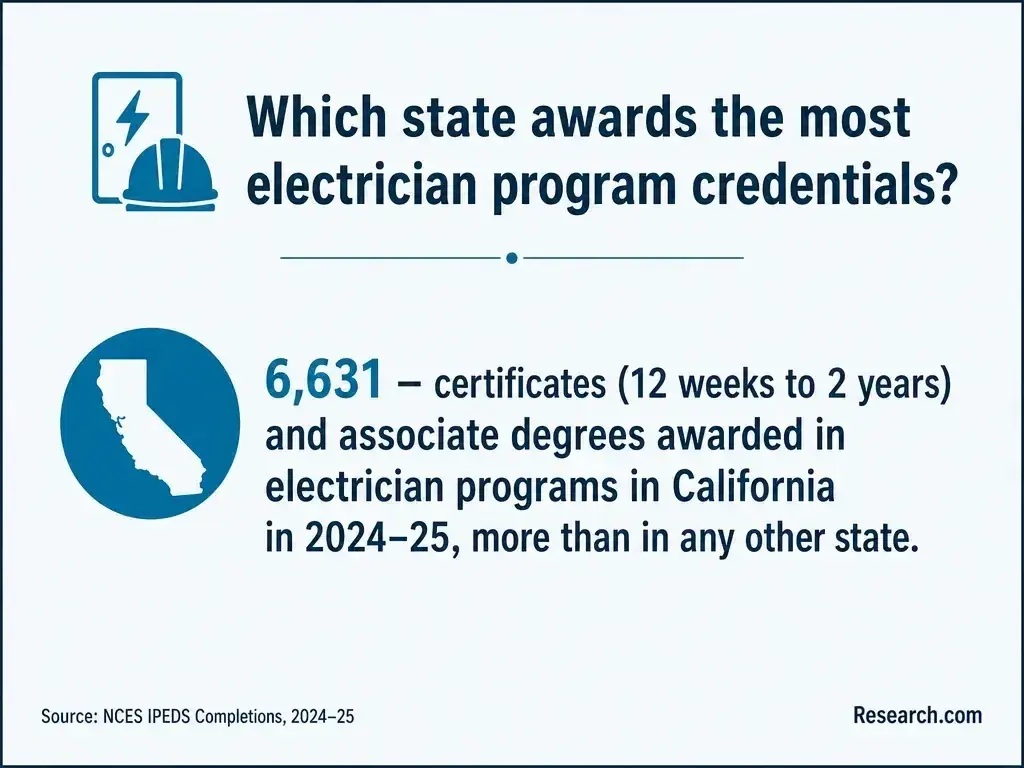
No defensible single average covers Florida public certificates, private-school programs, and paid apprenticeships: they have different pricing and wage structures. For a useful comparison, request a total cost to become job-ready, not just tuition. Florida residency may affect public-college tuition, while a paid apprenticeship may offset training expenses with wages. Confirm each provider's current price and residency rules directly.
The following cost components reveal why the lowest advertised tuition may not produce the lowest net cost.
| Cost or offset | What to verify |
| School charges | Tuition, mandatory fees, books, software, and lab materials |
| Jobsite preparation | Tools, meter, personal protective equipment, and replacement supplies |
| Attendance and entry | Travel to labs or worksites, any required screening, and applicable examination or application fees |
| Offsets | Grants, scholarships, eligible aid, employer-paid instruction, and apprentice wages |
| Time cost | Earnings forgone while attending classes or waiting for a placement |
Federal aid depends on both student and program eligibility; a provider's general claim that it accepts aid does not mean its particular electrician offering qualifies. Lists of inexpensive online universities that accept financial aid cannot answer that trade-program question. Ask the financial-aid office for the program's eligibility and your written cost estimate, then compare net cost after aid and expected training wages.
The credential depends on the route: a school may award a career certificate or diploma; a college may offer an associate credential; a registered apprenticeship leads to a completion credential under its registered standards. An NCCER credential, where offered, documents specified training or assessments. None should be described as a Florida electrical contractor license or assumed to replace locally required journeyman qualifications.
Request the exact credential name in writing, then ask prospective employers or apprenticeship sponsors whether they recognize it and award credit for it. Avoid confusing an electrician certificate with unrelated dual degree programs: the decisive questions here are demonstrated electrical skills, supervised experience, and eligibility for the role you intend to pursue.
Requirements vary by provider. A school may assess reading and math readiness or require a prior school credential; an apprenticeship sponsor may additionally use an aptitude assessment, interview, work-eligibility check, or employer hiring process. Physical jobsite demands and reliable transportation matter because instruction and supervised work may occur at different locations. Check each provider's published requirements before treating an open-admission school and a competitive apprenticeship as equivalent options.
For a career changer, the practical question is when paid work begins. Ask a sponsor whether admission guarantees placement, how long applicants typically wait for assignment, and whether prior electrical coursework changes the entry level. Ask a school whether its labs have prerequisites that could delay completion.
Core training commonly connects electrical calculations and circuit theory to safe installation: reading drawings, selecting materials, bending or installing raceway, making connections, testing circuits, and identifying faults. Students should practice interpreting the electrical code edition used in instruction and explain how the program updates lessons as code requirements change. BLS identifies troubleshooting, physical skill, and safety awareness as important electrician competencies.
Compare assessed practice, not just topic lists. Ask to see the lab sequence, equipment students actually use, student-to-instructor supervision, and any documented employer worksite component. A course that teaches code vocabulary without meaningful installation and testing practice may be useful preparation, but it is not equivalent to supervised field training.
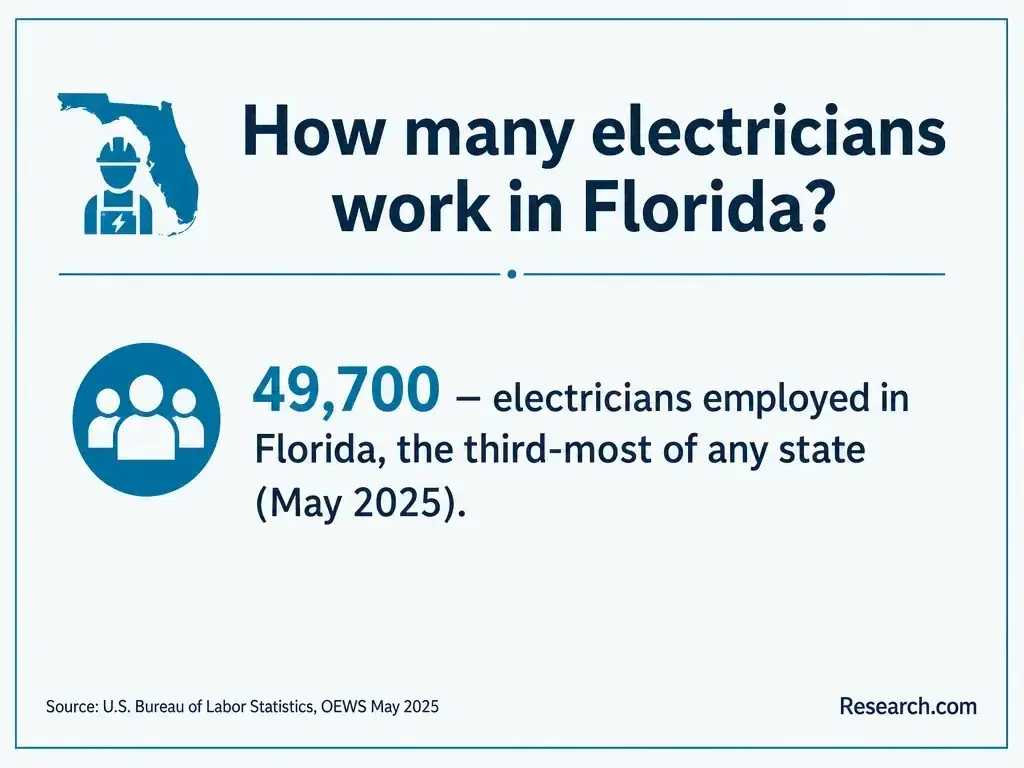
Florida distinguishes working in the trade from operating as a licensed electrical contractor. The Florida DBPR regulates state-certified electrical contractors and state-registered contractors working within their authorized local jurisdictions. Journeyman registration and qualification are administered locally rather than through one uniform statewide school-graduation license. Requirements for a particular position can therefore depend on the work performed and the jurisdiction; verify them with the relevant local authority and DBPR before planning an independent contracting career.
Institutional accreditation concerns the school. State school authorization concerns permission to operate. Apprenticeship registration concerns a sponsor's training standards. Industry certification can document skills. None automatically substitutes for contractor licensure, required experience, or an examination. DBPR sets experience and examination requirements for contractor applicants, so keep records of supervised work and ask whether your intended training can be documented toward the license category you may eventually pursue.
Start with the job you want and the route that can get you there. A lower-cost public certificate may suit someone who needs structured fundamentals before applying for work; a registered apprenticeship may suit someone prepared for a longer commitment that combines wages with supervised experience. Neither wins solely because of its institutional label or position in an affordability ranking.
Use these checks before enrolling; each resolves a common and potentially costly mistake.
Assess the investment over a realistic time horizon: consider completion probability, your current earnings, likely earnings while training, post-training opportunities, debt, and the value of earlier entry into paid work. Discounting future earnings matters when one route takes much longer than another. Searches for unrelated options such as quick masters programs will not establish whether an electrician course provides the practical experience this occupation requires.
A common progression is helper or apprentice, then increasingly independent installation and troubleshooting work as experience grows. Experienced workers may focus on commercial systems, industrial maintenance, controls, or supervision. Starting an electrical contracting business is a separate regulatory step, not an automatic result of finishing an apprenticeship or earning a certificate; Florida DBPR licensing requirements apply.
Choose initial training with the next step in mind. Someone aiming for industrial troubleshooting should seek substantial diagnostic practice, while someone interested in contracting should preserve verifiable experience records and learn the applicable DBPR license requirements. Optional industry credentials may strengthen a particular specialization, but they should not be confused with mandatory authorization to perform regulated work.
BLS projects 9.2% U.S. electrician employment growth from 2025 to 2035. That is a national projection, not a Florida placement rate. For a local decision, consult the Florida Department of Commerce's current occupation projections and compare openings in places where you could commute or relocate. Construction contractors, maintenance employers, and apprenticeship sponsors may recruit differently, so ask providers which employers actually interview their trainees.
Demand does not remove entry barriers: employers still need people who can work safely, arrive at jobsites reliably, and develop supervised experience. An affordable program is a stronger investment when it helps you meet those expectations without taking on more debt than your likely early-career wages can support.
Investing in training is a consequential decision, so the Research.com team uses documented data and a consistent comparison group rather than treating every advertised electrician course as equivalent. Programs are evaluated against other programs in the same occupation and location. Only programs with completions reported to the Integrated Postsecondary Education Data System (IPEDS) are eligible; a registered apprenticeship absent from IPEDS is not thereby inferior or unapproved.
The most affordable ranking scores costs and debt only: tuition, cost of attendance, median student debt, and federal loan default rate. Indicator weights are distributed using an entropy-based method, which assigns more weight to measures that vary more across programs. Accreditation and other quality indicators do not enter this affordability score. Consequently, readers should use the ranking to build a cost-conscious shortlist, then verify practical training and career fit separately.
Research.com's separate best programs methodology considers student outcomes, earnings and return on investment, costs and debt, and quality and recognition. Its current weights are 20% for occupation-relevant programmatic accreditation or industry recognition, 10% for institutional accreditation, 10% for student support, and 60% for outcomes, earnings, and costs, with the last group distributed by the entropy-based method. Measures include completion and full- and part-time retention, earnings one year after completion and relative to annual attendance cost, tuition, attendance cost, debt including for students who withdrew, and loan default rates.
The following data sources inform the ranking methodology. Some recognition sources cover other occupations and should not be mistaken for electrician-program approval.
These sources help readers compare reported costs consistently, but college-oriented datasets do not cover every union, employer, or apprenticeship route. Research.com explains its approach further on its methodology page.
# 1 position
# 2 position

# 4 position

# 5 position

# 6 position

# 7 position

# 8 position
# 9 position

# 10 position

# 11 position
# 12 position

# 13 position
# 14 position
# 15 position
# 16 position
# 17 position

# 18 position
# 19 position
# 20 position
Not necessarily. A registered apprenticeship or employer-supported training can provide another entry route. Compare access to supervised work, related instruction, cost, and the credential awarded before choosing.
No. Florida DBPR contractor licensing has separate experience and examination requirements. Local journeyman rules may also matter for your intended work.
You may complete some theory remotely, but installation, testing, and supervised work require in-person practice. Verify where and how a hybrid program provides it.
It can reduce net cost because you earn while training, but compare wages, fees, tools, travel, admission timing, and the longer commitment. Request the sponsor's written terms.
Ask for the full cost, exact credential, lab and worksite hours, authorization status, aid eligibility, and evidence that local employers or apprenticeship sponsors recognize the training.