# 1 position


Audited and Verified:
Our Editorial and Data Verification Process
Research.com uses government datasets, official education statistics and primary institutional information to support its career and degree guides. Our review process checks factual accuracy, occupational definitions, source dates and the requirements associated with the credentials discussed.
How This Article Was Fact-Checked
Our editorial team verifies salary estimates, employment projections, education requirements and program information against original data providers and official organizations. Salary figures are checked against the relevant occupational definitions and reporting periods. Information about licensure, accreditation and required in-person training is reviewed separately.
Fact-checked and verified on:

Co-Founder and Chief Data Scientist

Reviewed by Karolina Broda
Fact-Checker and Data Verification
The cheapest electrician program may not be the least expensive route to a job: tools, travel, unpaid training time, and access to paid work all matter. The U.S. Bureau of Labor Statistics projects 9.2% national growth in electrician employment from 2025 to 2035, making training choices timely. This guide helps prospective students and career changers compare North Carolina programs, apprenticeships, costs, and licensing implications. It also accompanies the Most Affordable Electrician Trade Schools in North Carolina for 2027 ranking, created by the Research.com team of data scientists to help students make an informed choice about programs worth considering.
Expect electrical theory taught alongside supervised practice: reading plans, measuring circuits, installing wiring and devices, applying the electrical code, and working safely around energized systems. A useful program lets you handle tools and troubleshoot faults in a lab; classroom instruction alone cannot establish jobsite competence. Ask how many scheduled hours are spent in shops or labs and whether students can obtain employer placements.
The main pathways differ in what they provide. The comparison below separates a school credential from paid work experience, which is often the deciding factor for someone who needs to earn while learning.
| Pathway | What you receive | Best fit and key limitation |
| Community-college certificate or diploma | Focused classroom and lab training; a school credential | Useful for building entry-level skills, but not necessarily a paid job or documented field experience |
| Associate degree in an electrical field | Broader technical coursework and an academic degree | Useful if its added coursework fits your goal; usually a larger time commitment than a short certificate |
| Registered apprenticeship | Paid supervised work, related instruction, and an apprenticeship completion credential | Strong fit for learning on the job; entry depends on sponsor openings and selection requirements |
| Employer-sponsored entry | Paid work with training determined by the employer | Can reduce upfront school costs; confirm how instruction and experience are documented |
A school program can be worthwhile if it provides substantial lab access and a credible route to local employers. If you already have an apprenticeship offer with structured instruction, compare what additional skills a separate school credential would buy before paying for both. Providers, including public colleges, private career schools, union training centers, and employers, should be judged on their actual training arrangements rather than their labels.
Potential workplaces include residential and commercial electrical contractors, industrial plants, facilities-maintenance teams, and construction projects. The work changes with the setting: a residential crew may emphasize wiring and service upgrades, while an industrial employer may need motor controls and equipment troubleshooting. The U.S. Bureau of Labor Statistics describes electricians as installing, maintaining, and repairing electrical power and control systems.
Location affects the opportunities you can realistically use. A nearby college lab may be convenient, but an apprenticeship or first job could require daily travel to changing worksites. Compare the commute to training and likely employers; ask placement staff and apprenticeship sponsors where participants actually work. For a wider view of careers in trade school, keep in mind that electrician training is especially dependent on practical, supervised work.
Pay varies by experience, employer, specialty, and work location. The U.S. Bureau of Labor Statistics reports a $63,190 national median annual wage for electricians in May 2025. That is the midpoint for employed electricians across experience levels - not an expected wage for a newly trained North Carolina worker. Apprentices generally earn while training, but their wage arrangements depend on the sponsor and employer.
For a local decision, request the wage range for the jobs a program actually places students into, or the written wage progression for an apprenticeship. Compare that evidence with the cost of attendance and commuting. Avoid treating a national median - or an experienced contractor's earnings - as a promise of first-year pay. If speed to earnings is your main concern, discussions of the quickest degree to make the most money address a different educational choice; an electrician apprenticeship may instead let you earn during training.
Length depends on the credential and schedule. A focused certificate generally takes less time than a diploma or associate degree; part-time attendance extends the calendar even when required coursework is unchanged. A registered apprenticeship combines related instruction with supervised employment over a longer period. Ask for the current catalog's credit or contact-hour requirements and the sponsor's written apprenticeship standards rather than relying on a generic completion-time estimate.
Speed has a trade-off. A short program may get you into the applicant pool sooner, but it may offer less lab time or no direct route into paid fieldwork. A longer program is worthwhile only if its additional technical content, work connections, or credential fits the work you intend to pursue. Working adults considering accelerated online programs for working adults should check which electrical labs still require attendance and whether the faster schedule leaves enough time for practice.
Online instruction can cover code concepts, calculations, diagrams, and some safety theory. It cannot replace hands-on assessment of wiring, testing instruments, fault diagnosis, or safe work practices. A hybrid option may reduce trips for classroom sessions, but students still need accessible labs or supervised worksites. Do not assume an entirely online certificate supplies the practical experience an employer or apprenticeship sponsor expects.
Before enrolling, ask the provider to identify every required in-person session, its location, and whether evening or weekend access exists. For rural students, fewer classroom trips may help, but a distant lab or worksite can erase that advantage. The best format is the one you can finish and use to demonstrate competence - not simply the one with the most remote coursework.
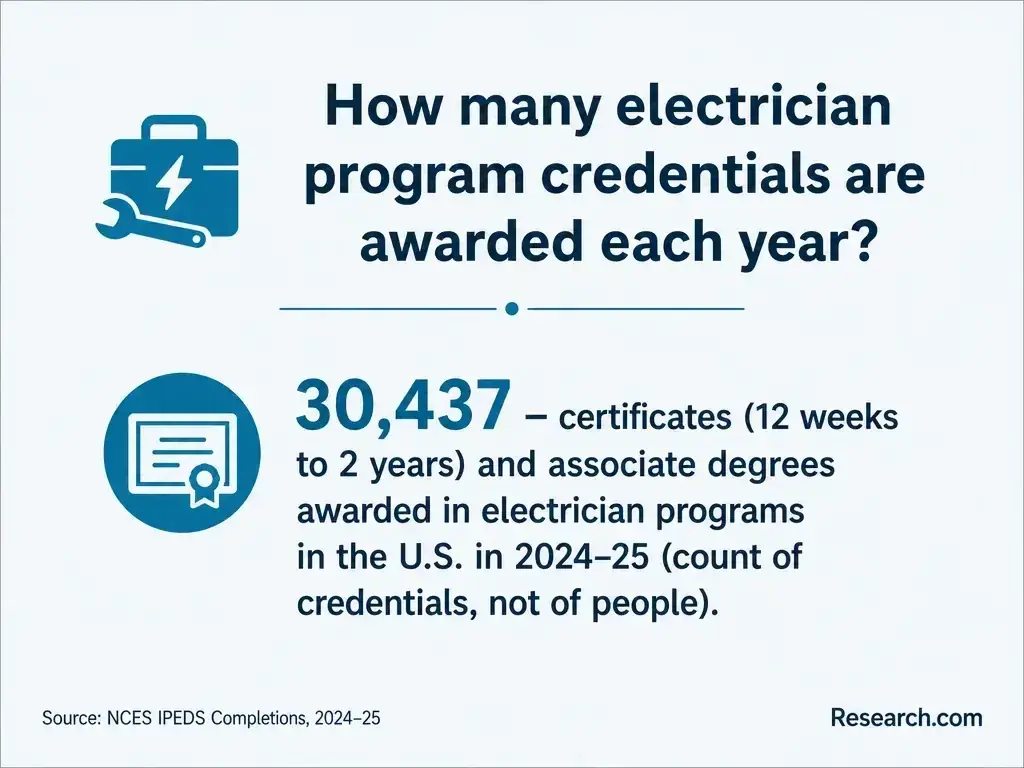
There is no single reliable statewide price that covers community-college credentials, private programs, and paid apprenticeships on equivalent terms. Published tuition is only part of the cost. To compare options fairly, obtain a current, program-specific estimate for your residency status and intended schedule; 2027 charges may differ from an earlier catalog.
Your comparison should include charges needed to finish training and become ready for work, not just the advertised rate:
Subtract only aid you are actually eligible to receive. Ask the financial-aid office about federal aid eligibility for the specific program, North Carolina assistance such as the Next NC Scholarship where applicable, and local workforce funding through NCWorks. Ask apprenticeship sponsors whether instruction or tools are covered and what wages trainees receive. Federal Student Aid, the North Carolina State Education Assistance Authority, and NCWorks describe eligibility for their respective assistance; admission to a school alone does not establish it.
Affordability also depends on completion probability, debt, baseline and post-training earnings, program duration, and when earnings begin. For an investment comparison, account for the time value of money rather than assuming the lowest tuition produces the best return. A guide to the best certificate programs that pay well can broaden a career search, but electrician credentials still need to be evaluated against their hands-on and work-entry requirements.
Check the exact award in the program catalog: it may be a certificate, diploma, or associate degree. A registered apprenticeship instead provides documented work-based training, related instruction, and a completion credential under its sponsor's standards, according to Apprenticeship.gov. An employer's internal training record is not necessarily the same credential.
These distinctions matter when seeking work. Ask whether courses can be stacked toward a longer college credential, whether prior learning can be assessed for credit, and whether apprenticeship instruction can receive college credit under a specific agreement. Do not assume credit transfers automatically. Institutional accreditation, a construction-training credential such as one associated with NCCER, apprenticeship registration, and a state contractor's license establish different things; none should be advertised as interchangeable.
Requirements vary by provider and pathway. A college may use an application and placement process; a registered apprenticeship sponsor sets its own selection criteria and may assess math preparation, availability for work, and ability to reach jobsites. Employers set their own hiring conditions. Verify the current requirements directly rather than assuming admission to a school also secures an apprenticeship position.
Prepare to discuss your schedule, transportation, comfort with practical work, and math skills. Ask whether prior electrical experience changes placement or credit, whether a separate apprenticeship application is needed, and when labs are offered. A program you can enter but cannot attend consistently is unlikely to be the cheapest option in practice.
Core instruction typically connects electrical calculations and blueprint reading to installation, testing, and troubleshooting. Safety, appropriate use of meters, wiring methods, motors or controls where included, and application of the electrical code are important workplace skills. The U.S. Bureau of Labor Statistics identifies technical reading, problem-solving, and physical work as relevant to electricians' duties.
Compare course descriptions with your intended job. If you want industrial maintenance, look for meaningful controls and troubleshooting practice; if you expect residential construction work, examine installation labs and code application. Ask to see the equipment students use and how instructors assess practical skills. Similar credential names do not establish equivalent shop time or preparation.
North Carolina regulates electrical contracting through the North Carolina State Board of Examiners of Electrical Contractors. Working on a crew under an appropriately licensed contractor is different from offering electrical contracting services independently. The board administers contractor license classifications with their own scope and qualification rules; a school certificate is not a contractor's license, and graduation does not automatically establish examination or experience eligibility.
If independent contracting is your goal, review the board's current classification, experience, examination, and application requirements before choosing training. Ask whether supervised work can be documented in the form you will need later. Institutional accreditation concerns the school; state school authorization concerns permission to operate; apprenticeship registration concerns a work-training program. None replaces the occupational license required for covered contracting work. Check with the board and the relevant local authority if a job or employer mentions a local credential.
Start with the job you want, then compare programs on the training and work experience that job requires. The affordability ranking can identify options to investigate, but it cannot tell you whether a lab schedule, apprenticeship connection, or commute fits your circumstances.
Use these questions when contacting admissions staff and apprenticeship coordinators; request written answers where costs or work arrangements are involved:
Confirm accreditation with the accreditor and school authorization with the appropriate North Carolina regulator; confirm licensing implications with the state board. Watch for claims that an online-only course makes you job-ready, that admission guarantees an apprenticeship, or that an experienced worker's wage is typical starting pay. If comparing electrician work with other long-term earning routes - including the question of which masters degree makes the most money - keep the decision here grounded in the time, debt, and paid experience required for electrician entry.
A common starting point is supervised installation or maintenance work, followed by broader responsibilities as practical experience grows. Depending on an employer's work, an electrician may concentrate on residential service, commercial construction, industrial controls, or facilities maintenance. Additional responsibility can lead toward crew supervision or, for someone who meets North Carolina's applicable requirements, licensed electrical contracting.
Choose training with that progression in mind. A short certificate may help you seek an entry-level role; an apprenticeship provides structured paid experience; a broader college credential may suit someone who values additional technical coursework. Optional industry credentials can demonstrate particular skills, but they do not replace experience or a contractor's license where one is required. Ask prospective employers which evidence of skill they recognize.
The U.S. Bureau of Labor Statistics projects 9.2% growth in electrician employment nationally from 2025 to 2035. This supports considering the occupation, but it is not a North Carolina placement forecast and does not mean openings are equally accessible in every county or specialty. Construction schedules, maintenance needs, and employer hiring practices shape local opportunities.
Before committing, compare current postings within commuting distance with the skills taught by your shortlist. Ask sponsors whether they have nearby work and whether travel between sites is expected. A program with strong practical training and reachable employer connections may be more valuable than a cheaper option whose graduates must travel farther to find a first supervised role.
Investing in training is an important decision, so Research.com designed its ranking to compare electrician programs with other programs in the same occupation and location. The team checks multiple education and occupational sources to improve the ranking's quality, credibility, and accuracy. Only programs with completions reported to IPEDS are eligible; an apprenticeship or other provider missing from the ranking is not necessarily unavailable or unsuitable.
Most affordable rankings use tuition, cost of attendance, median student debt, and federal loan default rate. An entropy-based method assigns more weight to indicators that differ more across eligible programs. Accreditation and other quality indicators do not contribute to this affordability score. That distinction matters: a low rank number is a starting point for comparing costs, not proof that a program supplies the practical training or work experience you need.
Research.com also publishes best programs rankings using a different model. Those consider completion and full-time and part-time retention; earnings one year after completion and earnings relative to annual attendance cost; tuition, attendance cost, debt - including debt held by students who withdrew - and loan default; plus accreditation, relevant industry recognition, and student support. Programmatic accreditation or relevant industry recognition receives 20%, institutional accreditation 10%, and student support 10%. The remaining 60% is distributed among outcomes, earnings, and cost indicators using the entropy-based method.
The ranking draws on the following sources. Some serve Research.com rankings across multiple trades and health occupations; their inclusion does not make a health-care accreditor an electrician-program authority.
Use the ranking to narrow a cost-conscious shortlist, then confirm current program charges, lab access, employer connections, and credential outcomes directly with each provider. More detail on the ranking process appears in Research.com's methodology.
# 1 position
# 2 position
# 3 position

# 4 position

# 5 position
# 6 position

# 7 position

# 8 position
# 9 position
# 10 position

# 11 position
# 12 position
Electrician
Delivery mode: Online Option Available
86.93
/ 100
Final score
Accreditation
Institutional accreditation from Southern Association of Colleges and Schools Commission on Colleges.
James Sprunt Community College earned a Research.com Affordability Score of 86.93/100, with $1,984 annual in-state tuition among the verified supporting factors.
# 13 position

# 14 position

# 15 position
# 16 position
# 17 position
# 18 position
# 19 position
# 20 position
Electrician
Delivery mode: On Campus (May Include Online Courses)
84.64
/ 100
Final score
Accreditation
Institutional accreditation from Southern Association of Colleges and Schools Commission on Colleges.
Catawba Valley Community College earned a Research.com Affordability Score of 84.64/100, supported by $2,427 annual in-state tuition and $4,750 median student debt.
Compare a nearby community-college program with registered apprenticeships and paid employer training. An apprenticeship may reduce upfront costs through wages, while a college program may offer easier access to introductory labs. Include tools and travel in either comparison.
Not necessarily. Sponsors set their own entry criteria and provide related instruction. Ask each sponsor whether prior coursework helps applicants or can count toward its training requirements.
You can study some theory online, but wiring, testing, and safe tool use require practical instruction or supervised work. Confirm exactly where and when a hybrid program provides those components.
No. North Carolina electrical contractor licensing is handled separately by the North Carolina State Board of Examiners of Electrical Contractors. Check the requirements for the license classification you intend to pursue.
Only if its additional coursework, lab practice, or employer connections advance your goal enough to justify the extra time and cost. Compare the actual curriculum and work opportunities, not just credential length.
Confirm the total charges, required tools, lab location and schedule, exact credential, aid eligibility, and whether paid work is arranged or merely suggested. Get important claims in writing.