# 1 position


Audited and Verified:
Our Editorial and Data Verification Process
Research.com uses government datasets, official education statistics and primary institutional information to support its career and degree guides. Our review process checks factual accuracy, occupational definitions, source dates and the requirements associated with the credentials discussed.
How This Article Was Fact-Checked
Our editorial team verifies salary estimates, employment projections, education requirements and program information against original data providers and official organizations. Salary figures are checked against the relevant occupational definitions and reporting periods. Information about licensure, accreditation and required in-person training is reviewed separately.
Fact-checked and verified on:

Co-Founder and Chief Data Scientist

Reviewed by Karolina Broda
Fact-Checker and Data Verification
Choosing affordable electrician training in North Platte means comparing more than tuition: you need hands-on practice, a workable route to apprenticeship, and training that fits Nebraska's licensing rules. The Research.com team of data scientists created its Most Affordable Electrician Trade Schools in North Platte for 2027 ranking to help students identify programs worth considering. Electrician employment is projected to grow 9.2% nationally from 2025 to 2035 (U.S. Bureau of Labor Statistics). This guide helps prospective students and career changers compare costs, credentials, paid training, and the path to independent work.
Expect a mix of electrical theory, code interpretation, safety, and supervised practice with wiring and testing equipment. A school program can build skills before or alongside employment, but it is not the same thing as a registered apprenticeship: an apprenticeship pairs related instruction with paid, supervised work under an approved training arrangement (U.S. Department of Labor). For a North Platte student, the decisive question is where the labs meet and how the program connects to local employers or qualifying work experience.
The pathways below lead to different credentials and different amounts of workplace experience. Compare the credential you receive and the work you can do while earning it.
| Pathway | What it typically provides | Best fit and main limitation |
| College certificate or diploma | Focused classroom and lab training; a school credential | Useful for building entry-level skills; confirm how, if at all, coursework counts toward Nebraska experience requirements. |
| Associate-level electrical program | Broader technical and general coursework; an academic associate credential | May suit students seeking a wider technical foundation; typically takes more time and expense than a shorter credential. |
| Registered apprenticeship | Paid, supervised work plus related instruction; an apprenticeship completion credential | Fits students ready to work while training; entry depends on openings and sponsor requirements. |
| Employer-sponsored entry route | Job-specific training under an employer | Can reduce upfront school costs; verify supervision, apprentice registration, and documentation of qualifying experience. |
Mid-Plains Community College is the local college to check for current electrical offerings, campus location, lab access, and employer connections. Do not assume a similarly named credential elsewhere contains equivalent shop time. Broad lists of short online certificate programs that pay well are not evidence that an electrician course supplies the practical work this occupation requires.
Potential work settings include electrical contractors serving homes and businesses, construction projects, facility maintenance, industrial sites, and utility-related operations. These employers can require different skills: residential installation emphasizes branch circuits and service work, while industrial maintenance may put more weight on motors, controls, and troubleshooting (U.S. Bureau of Labor Statistics, Occupational Outlook Handbook).
North Platte's location matters because a student may have fewer nearby lab sites or apprenticeship openings than in a larger metro area. Ask prospective employers and sponsors where jobsites are, whether travel is paid, and whether a position provides the supervision and experience records needed for Nebraska licensure. School training can help secure an interview, but it does not replace an employer's hiring requirements.
The U.S. median annual wage for electricians was $63,190 in May 2025 (U.S. Bureau of Labor Statistics). That is a national, occupation-wide midpoint - not a North Platte wage or an expected starting salary. It includes workers at different experience levels and in different industries, so use a written local apprentice or entry-level offer when judging whether training costs are manageable.
Pay can change substantially as a worker gains experience, obtains a journeyman license, takes on specialized work, or moves into supervision. Compare offers on hourly rate, expected hours, benefits, travel, and who pays for tools and instruction. A paid apprenticeship with a lower initial wage may be financially stronger than unpaid full-time study if it lets you earn and document supervised experience at the same time.
There is no single program length: a focused certificate may take less time than an associate-level program, and full-time attendance is faster than part-time study. A registered electrician apprenticeship generally takes several years because classroom instruction is paired with extensive supervised work (U.S. Bureau of Labor Statistics, Occupational Outlook Handbook). For a North Platte student, commuting to labs or jobsites can also determine whether a nominally faster schedule is realistic.
Ask for the current catalog's required credits or contact hours, the number of in-person lab sessions, and the expected schedule - not just a completion date. Then ask the Nebraska State Electrical Division whether the specific education and documented work experience you plan to obtain can count toward your intended license. School completion and time to independent practice are different timelines.
Online delivery can work for portions of electrical theory, calculations, or code study. Wiring, safe tool use, testing, fault-finding, and supervised jobsites require in-person practice. A hybrid program is useful when its lab location and schedule are accessible; an entirely online course should not be treated as proof of practical competence or Nebraska licensing eligibility (U.S. Bureau of Labor Statistics; Nebraska State Electrical Division).
Before enrolling, request a breakdown of remote instruction, required labs, and any arranged worksite training. Search results for top ranked online universities may help readers evaluate remote-study features, but they cannot establish that an electrical program offers local hands-on access. For someone working shifts in North Platte, the best format is the one whose required in-person sessions they can actually attend.
A defensible North Platte-wide average cannot be given without comparable, current prices for the available school and apprenticeship routes. Request a written, program-specific estimate instead. Tuition alone can miss mandatory fees, books, tools, safety gear, consumable materials, transportation to labs and jobsites, examination and license applications, and earnings forgone while studying.
For a fair comparison, calculate the amount you expect to pay after confirmed aid and employer contributions, then consider income earned during training. Eligible college students can check federal aid with Federal Student Aid; job seekers can ask Nebraska workforce staff about applicable training assistance. Aid and apprenticeship wages depend on individual and program eligibility. A page about a cheap online bachelor's degree uses a different cost and credential framework and should not be used to estimate electrician entry costs.
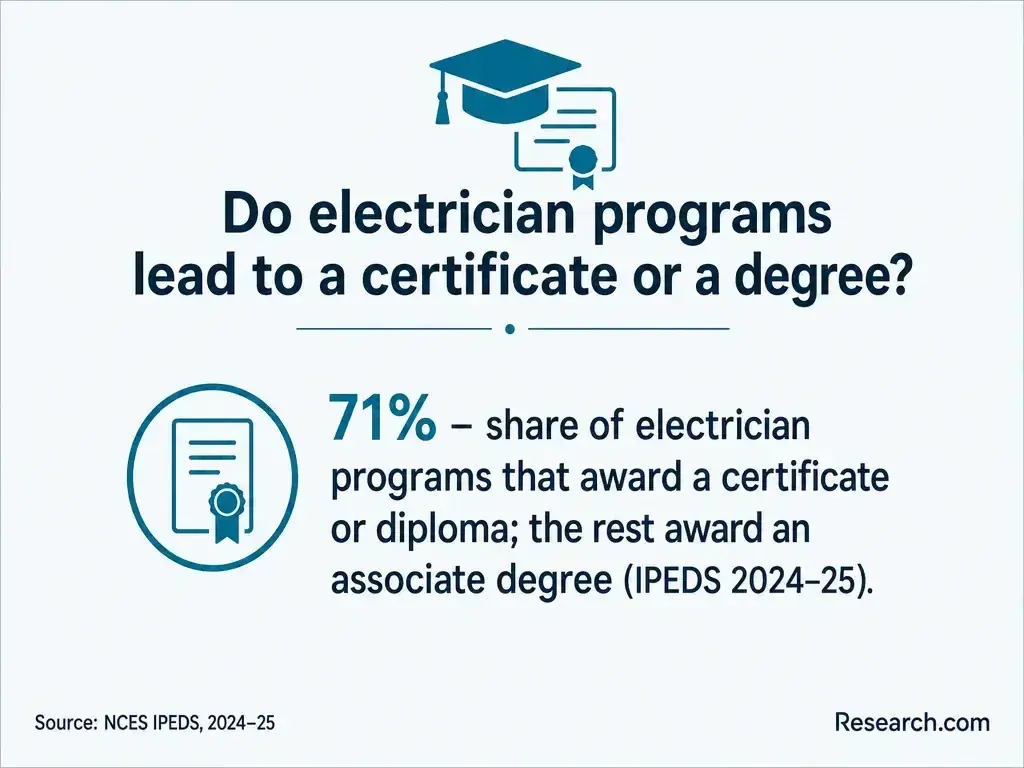
The credential depends on the route: a school may award a certificate, diploma, or associate degree; a registered apprenticeship leads to its own completion credential. Neither is a Nebraska journeyman license. Ask Mid-Plains Community College to identify the exact award in its current catalog and ask any apprenticeship sponsor whether its program is registered (Mid-Plains Community College; U.S. Department of Labor).
Institutional accreditation concerns the school, while apprenticeship registration concerns a work-based training program. Industry credentials, such as those associated with NCCER, document particular training or skills; they do not replace state occupational licensure (NCCER; Nebraska State Electrical Division). If you may continue training later, also ask whether completed coursework can transfer or receive advanced standing and get the answer in writing.
Requirements vary by provider. A college may set admission and course-placement conditions; an apprenticeship sponsor may require an application, assessment, interview, and the ability to reach jobsites. Employers may impose additional hiring and safety requirements. Check the current requirements directly with Mid-Plains Community College or the sponsor rather than assuming that admission to school also secures an apprenticeship place.
Before paying a deposit, confirm the start date, any math prerequisites, physical demands of lab and field work, and whether you must independently find an employer. If work is part of your licensing plan, ask how you will register as an apprentice and who will verify your experience with the Nebraska State Electrical Division. That question can reveal whether an attractive short course actually advances your intended career.
Relevant instruction covers circuits, electrical measurements, wiring methods, blueprint reading, code use, safety, and troubleshooting. Lab quality matters: students need opportunities to assemble and test circuits, use meters correctly, identify faults, and practice safe procedures - not only watch demonstrations (U.S. Bureau of Labor Statistics, Occupational Outlook Handbook).
Ask for a course outline and a description of individual practice time, equipment, and instructor feedback. If your goal is industrial maintenance rather than residential construction, check for motors and controls content and for employers offering that work. A shorter program is a good value only if it teaches the skills needed for the specific entry role you intend to pursue.
Nebraska regulates electrical work through the Nebraska State Electrical Division. Apprentices must follow the state's registration and supervision rules; progression to a journeyman license requires qualifying experience and an examination under the applicable state rules (Nebraska State Electrical Division). A school award, institutional accreditation, or optional industry certificate does not itself authorize independent electrical work.
Before choosing training, identify the license category that matches your goal and confirm the Division's current experience, education-credit, documentation, and examination rules. Ask a prospective employer who will supervise your work and maintain records. This is especially important if you plan to train outside Nebraska or move later: do not assume coursework, experience, or a license transfers automatically.
Start with the job you want and work backward to the required practice and license. The cheapest listed school is not necessarily the least expensive path to employability, particularly if its schedule prevents paid work or its labs require a long commute. Likewise, a fast course has limited value if you still need to arrange supervised experience afterward.
Use these questions when speaking with Mid-Plains Community College, employers, or apprenticeship sponsors; request answers in writing so you can compare like with like:
Verify institutional accreditation separately from Nebraska licensing rules. Treat guaranteed-wage claims, vague lab descriptions, and promises that an online certificate alone makes you licensed as red flags. General affordability searches - including cheap masters degrees online - do not answer the electrician-specific questions above.
A common progression is supervised apprentice work, qualifying experience and examination for journeyman licensure, then broader responsibility in installation, troubleshooting, or maintenance (Nebraska State Electrical Division). With further experience, workers may pursue supervisory, contracting, or specialized roles, subject to the applicable licensing and employer requirements. These are possible paths, not outcomes a school credential guarantees.
Choose coursework to match the first step: construction-focused labs for an installation role, or controls and diagnostics for maintenance. If your goal is to leave electrical work for office management, an accelerated online associates business degree addresses a different career decision; it is not an alternative way to gain supervised electrician experience.
U.S. electrician employment is projected to grow 9.2% from 2025 to 2035 (U.S. Bureau of Labor Statistics, Employment Projections). That national projection supports considering the trade, but it is not a forecast of North Platte openings. Local hiring depends on contractors' projects, maintenance needs, and available apprenticeship positions; a national trend cannot tell you when an employer will take on a new trainee.
Before committing to a schedule or loan, check current local postings and speak with potential sponsors about upcoming apprentice intake and jobsite travel. If openings nearby are limited, decide whether you can commute or relocate during training. That practical constraint may matter more to your return on investment than the national growth rate.
Investing in electrician training is an important decision, and an affordable program is useful only if its price and debt measures are credible. Research.com compares programs with other programs in the same occupation and location; only programs with completions reported to IPEDS are eligible. For this most affordable ranking, the team evaluates tuition, cost of attendance, median student debt, and federal loan default rate. An entropy-based method assigns more weight to cost and debt measures that differ more across eligible programs. Accreditation, support services, and earnings are not part of this affordability score.
The team uses the following sources in its broader data collection and verification. Some cover other trades and do not constitute electrician-program approval or a Nebraska licensing endorsement:
The ranking helps readers narrow their cost comparison, not declare a cheapest route to licensure. IPEDS does not cover every apprenticeship, employer program, or training provider; absence from the ranking is not a quality judgment. Readers should verify current program availability, actual charges, and Nebraska experience requirements before enrolling. Research.com provides further detail on its ranking methodology.
# 1 position
# 2 position
Compare a paid apprenticeship or employer-sponsored role with the full net cost of a school program. Include tools, travel, fees, and earnings during training; the lowest tuition may not produce the lowest total cost.
No. Nebraska licensing has separate experience and examination requirements. Confirm how any school training fits your intended license with the Nebraska State Electrical Division.
Theory may be offered online, but wiring, testing, safety practice, and supervised work require in-person participation. Verify lab access and work arrangements before enrolling.
Choose an apprenticeship if you can secure a suitable paid position and want to build supervised experience while learning. School can help you develop skills first, but ask how it connects to qualifying work.
It can be if the program provides accessible hands-on training, fits your licensing plan, and costs less than the value it adds over your available paid-training options. Compare written costs and schedules before deciding.