# 1 position


Audited and Verified:
Our Editorial and Data Verification Process
Research.com uses government datasets, official education statistics and primary institutional information to support its career and degree guides. Our review process checks factual accuracy, occupational definitions, source dates and the requirements associated with the credentials discussed.
How This Article Was Fact-Checked
Our editorial team verifies salary estimates, employment projections, education requirements and program information against original data providers and official organizations. Salary figures are checked against the relevant occupational definitions and reporting periods. Information about licensure, accreditation and required in-person training is reviewed separately.
Fact-checked and verified on:

Co-Founder and Chief Data Scientist

Reviewed by Karolina Broda
Fact-Checker and Data Verification
Choosing electrician training in Pratt means comparing more than tuition: you need hands-on experience, a workable route into paid employment, and training that fits local licensing rules. The U.S. Bureau of Labor Statistics projects 9.2% national growth for electricians from 2025 to 2035, making the choice timely. This guide explains costs, credentials, apprenticeships, and career prospects. It also accompanies the Most Affordable Electrician Trade Schools in Pratt for 2027 ranking, created by the Research.com team of data scientists to help students make an informed choice about programs worth considering.
Expect instruction in electrical theory, circuits, wiring methods, code use, testing, and jobsite safety, paired with supervised work using tools and equipment. A classroom credential can prepare you to seek an entry-level job or apprenticeship, but it does not replace the field experience an employer or licensing jurisdiction may require.
In Pratt, check the occupation before comparing prices. Pratt Community College offers electrical power technology training associated with electric utility work. Utility lineworkers install and maintain power lines; building electricians wire premises. Ask the college whether a particular program prepares students for building-electrical work, linework, or both, and whether any coursework receives credit from an electrical apprenticeship sponsor. Similar-sounding electrical credentials are not interchangeable.
The main pathways differ in what you receive while learning:
| Pathway | Typical credential or result | Best fit and key trade-off |
| School-based electrical certificate or diploma | School credential and supervised lab practice | Useful for foundational skills; confirm its connection to paid work and required experience. |
| Electrical associate-degree program, if available | Academic degree plus electrical coursework | May offer broader study; generally requires more time and expense than a short credential. |
| Registered electrician apprenticeship | Paid, structured work and related instruction; completion credential | Strong fit for learning on the job; entry depends on sponsor openings and selection. |
| Employer-sponsored entry route | Employer training; credential varies | May reduce upfront school cost; verify supervision, instruction, and whether experience counts locally. |
Building-electrician work can involve residential construction, commercial installations, agricultural facilities, and maintenance of existing buildings. Pratt's smaller labor market makes the location and travel requirements of a job or apprenticeship especially important: ask where worksites are, whether travel time is paid, and whether the sponsor can offer steady supervised hours.
Utility work is a separate option for someone drawn to poles, distribution systems, and outdoor crews. Do not assume a utility-focused program qualifies you for a building-electrician opening - or the reverse. The U.S. Bureau of Labor Statistics classifies electricians and electrical power-line installers and repairers as distinct occupations, so compare each program with the job postings you intend to pursue.
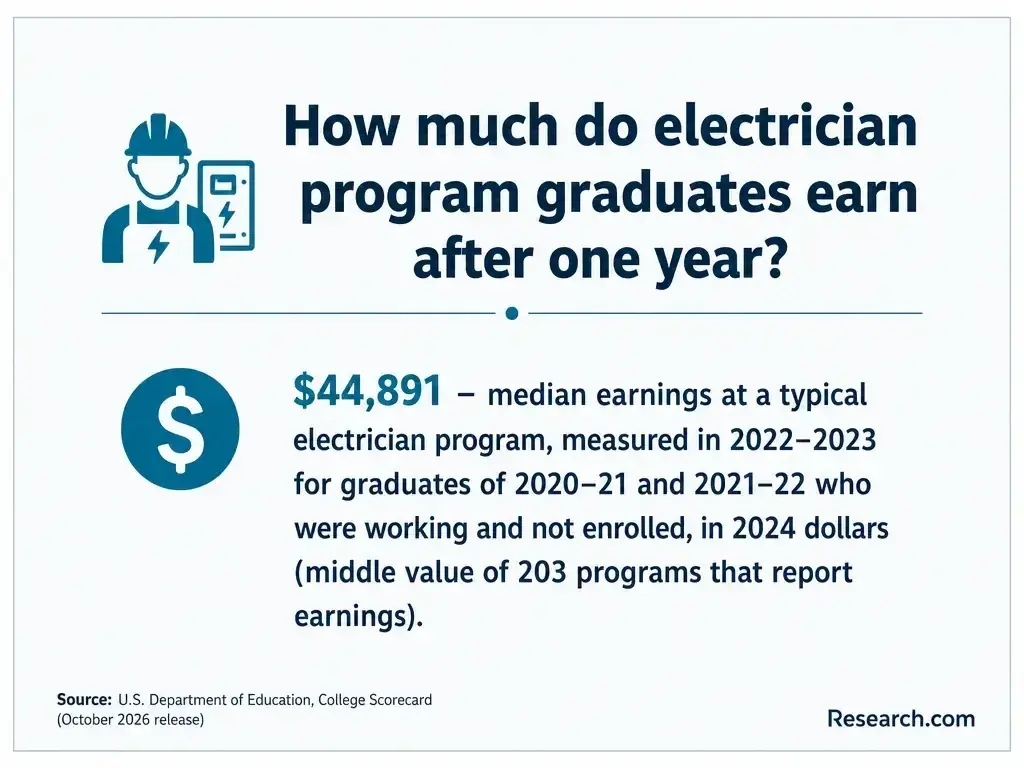
The U.S. Bureau of Labor Statistics reports a $63,190 national median annual wage for electricians in May 2025. Half of employed electricians nationally earned more and half earned less. It is not a Pratt wage quote, an apprentice rate, or a prediction of what a new certificate holder will earn.
For a realistic local estimate, request current apprentice and journey-level pay scales from prospective employers or sponsors. Compare the starting rate, scheduled increases, expected weekly hours, travel, and benefits - not just a posted top rate. If a program targets utility linework, use wage information for that occupation rather than the electrician median.
A school certificate may take less time than an associate-degree program, but the calendar alone does not show how close either gets you to independent electrical work. Ask for the published number of classroom and lab hours, the schedule for working students, and whether completing the program provides documented credit toward an apprenticeship.
Registered apprenticeships combine paid fieldwork with instruction and commonly take several years. Federal standards call for at least 2,000 hours of structured on-the-job learning, with 144 hours of related instruction per year recommended (U.S. Department of Labor). An electrical course can shorten the time needed to learn fundamentals without automatically shortening a sponsor's work-experience or local licensing requirements.
Online study can suit electrical theory, code reading, and some mathematics. It cannot substitute for supervised practice terminating conductors, using test instruments, identifying hazards, or working safely on an actual jobsite. A hybrid option is useful only if its required labs and field placements are accessible from Pratt and fit your work schedule.
Before paying for remote coursework, get a written description of in-person lab hours, equipment access, practical assessments, and any employer placement. Check whether a prospective apprenticeship sponsor accepts the instruction. A fully online completion certificate should not be treated as evidence of practical competence or local licensing eligibility.
There is no reliable single Pratt-wide average that covers school programs and paid apprenticeships on comparable terms. Published tuition also does not show the full cost of becoming job-ready. For a 2027 start, request a current, itemized quote directly from each provider rather than treating an earlier catalog price as a 2027 offer.
Use the same cost categories for every option so that a shorter course does not appear cheaper only because it leaves essential expenses out:
| Cost or offset | What to confirm |
| School charges | Tuition, mandatory fees, materials, and payment deadlines |
| Work-ready equipment | Tools, test instruments, protective equipment, and replacement costs |
| Career-entry expenses | Exams or applications, if required, plus travel to labs and worksites |
| Financial offsets | Grants, eligible student aid, employer-paid training, and apprentice wages |
| Time cost | Work hours or earnings forgone while attending classes or traveling |
Ask Pratt Community College about current aid eligibility for the specific program, and check Kansas workforce services for training assistance. Federal student aid depends on the institution, program, and student meeting eligibility rules (Federal Student Aid). A paid apprenticeship can lower upfront cost, but compare its wages and schedule with the time it takes to complete.
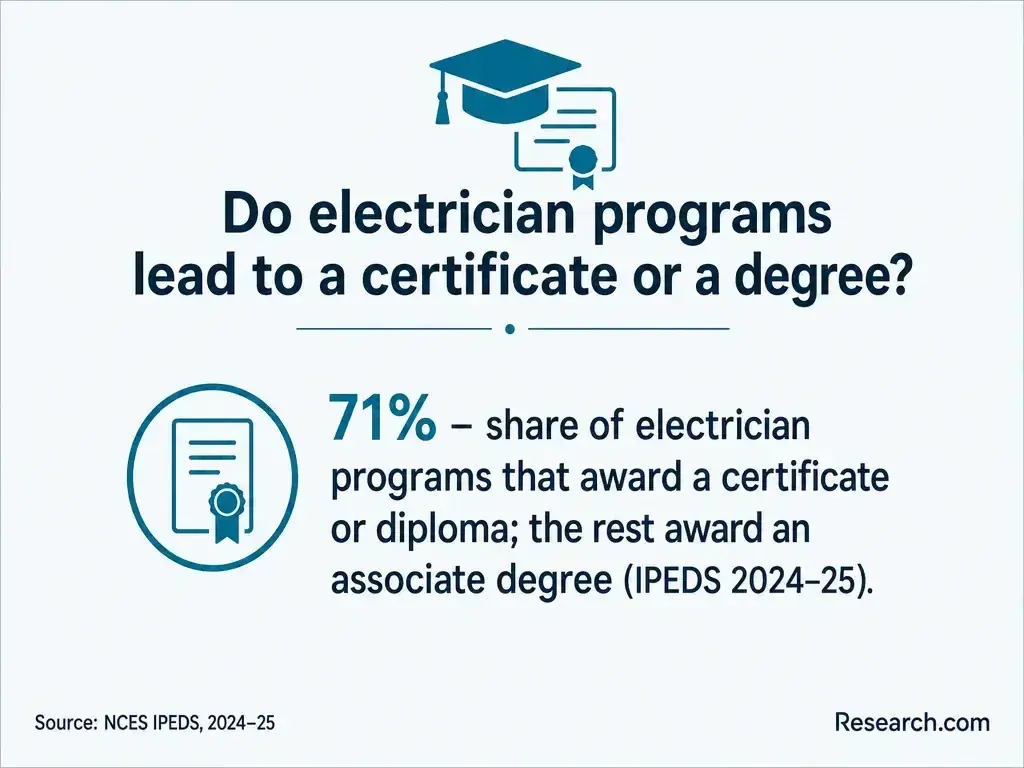
It depends on the pathway: a school might award a certificate, diploma, or associate degree; a registered apprenticeship issues a completion credential after its requirements are met (U.S. Department of Labor). An employer's training record and an optional industry certificate are different again. Ask for the exact credential name and whether it identifies building-electrical training or utility-line training.
Institutional accreditation concerns the school. State authorization concerns permission to operate. Industry recognition concerns a particular curriculum or credential. Apprenticeship registration concerns the work-and-instruction program. None, by itself, is an electrician occupational license or a promise that a local authority will accept your experience. Ask the intended employer or apprenticeship sponsor which credentials it recognizes before enrolling.
Requirements vary by provider and pathway. Schools may require an application, prior educational records, and placement into appropriate mathematics or technical coursework. Apprenticeship sponsors set their own eligibility and selection procedures, which may include an aptitude assessment, interview, and ability to reach worksites. Confirm the current requirements with the specific provider rather than assuming admission to a course also secures an apprenticeship place.
For hands-on work, ask about safety training, physical demands, driver's-license expectations for traveling crews, and any employer screening. If you have previous electrical coursework or relevant work, request a written evaluation of transfer credit or advanced standing. A school's award of credit does not necessarily mean an apprenticeship sponsor or local licensing authority will reduce its separate experience requirement.
Building-electrical training typically develops the ability to read plans, calculate electrical loads, select wiring methods, install and test circuits, follow applicable electrical code, and work safely around energized systems. Practical assessment matters: ask how often students build, troubleshoot, and test installations rather than only watching demonstrations. These are central electrician duties described by the U.S. Bureau of Labor Statistics.
A utility-focused curriculum instead emphasizes distribution equipment, climbing or aerial work, and outdoor line safety. For either path, look for instruction in communication, documenting work, and coordinating with other trades. New equipment and control systems make troubleshooting skills valuable, but a course covering newer technology is most useful when students can practice on the equipment they may encounter at work.
Do not assume a school credential alone permits independent electrical work. Kansas does not use one statewide electrician license that replaces local requirements; electrical licensing and contractor rules can depend on the jurisdiction where the work is performed. Before choosing training, confirm current apprentice registration, supervised-experience, examination, and contractor requirements with the City of Pratt and any other jurisdiction where you expect to work. A nearby job across a jurisdictional boundary may be governed differently.
Industry certificates can demonstrate particular skills, but they are not substitutes for a required local license. Likewise, completion of a registered apprenticeship documents training without automatically granting permission to contract independently. Ask a prospective sponsor how it records your work hours and which local licensing examinations or applications its graduates typically pursue.
Start with the job you want - building electrician or utility lineworker - then compare training routes against that goal. An affordable school program can be worthwhile if its labs, schedule, and employer connections help you enter supervised work. A paid apprenticeship may be the better investment if you can secure a place and need income while training. Neither choice is automatically best because of its provider type or ranking position.
Use these questions to test the claims that most affect your decision:
A common mistake is choosing the lowest tuition without checking whether it leads to the required hands-on experience. Another is reading national electrician wages as expected first-year pay. Compare completion likelihood, debt, apprentice earnings, and your likely work schedule over several years before deciding whether the investment makes sense.
For building-electrical work, a practical progression is supervised entry-level work, apprenticeship, and - where local rules provide for it - journey-level qualification. Experienced workers may move into troubleshooting, maintenance, estimating, supervision, or contracting after meeting any applicable local requirements. Utility linework has a different training and advancement track; choose it deliberately rather than treating it as the same occupation.
Optional technical credentials may help demonstrate specialized skills, but the useful one is the credential a prospective employer recognizes for the work you want. Lists about what certification pays the most cannot tell you whether a particular certificate replaces supervised electrical experience; ask the hiring employer before paying for one.
The U.S. Bureau of Labor Statistics projects 9.2% growth in electrician employment nationally from 2025 to 2035. That indicates demand across the country, not a count of openings in Pratt. In a smaller market, the immediate question is whether local contractors or apprenticeship sponsors have positions available when you are ready to enter.
Check current openings by occupation and worksite, then ask sponsors how they handle gaps between projects and travel outside Pratt. If you are willing to commute or relocate, compare the pay increase with transportation and housing costs. That gives the national outlook a practical meaning without assuming national growth will produce a nearby offer.
Investing in training is a consequential decision. Research.com created this ranking to help readers compare affordable options against other electrician programs in the same location, rather than against unrelated trades. The team reviews multiple education and industry sources to support the ranking's quality, credibility, and accuracy.
Most affordable rankings score costs and debt: tuition, cost of attendance, median student debt, and federal loan default rate. Weights are assigned using an entropy-based method, under which indicators that differ more across programs receive more weight. Accreditation, student support, earnings, and completion are not included in this affordability score; a low rank number should not be mistaken for proof of licensing eligibility or strong outcomes. Only programs with completions reported to IPEDS are eligible, so the ranking does not cover every apprenticeship or training provider.
The ranking draws on the following data sources. Some industry and accrediting sources cover other trades and do not establish approval of an electrician program.
Use the ranking to narrow your cost comparison, then verify each program's current price, electrical curriculum, practical training, and connection to an apprenticeship. More detail on the ranking process is available in Research.com's methodology.
# 1 position
# 2 position
Not necessarily. A registered apprenticeship or supervised employer route may provide a path into the occupation. Confirm the requirements of the employer, sponsor, and local jurisdiction where you intend to work.
Do not assume so. Electrical power technology may target utility work. Ask the college for the current curriculum and credential, then confirm whether a building-electrical apprenticeship sponsor accepts any of its coursework.
Online lessons can teach theory, but electrical installation and safety require supervised practical training. Check the in-person requirements and whether the intended employer or apprenticeship sponsor accepts the program.
It can reduce upfront school costs because apprentices earn wages while training. Compare required supplies, travel, pay, instruction costs, and time to completion before deciding which route costs you less overall.
Not automatically. A certificate documents school training; local rules may also require supervised experience, an examination, or a separate application. Verify requirements where you plan to work before enrolling.