# 1 position


Audited and Verified:
Our Editorial and Data Verification Process
Research.com uses government datasets, official education statistics and primary institutional information to support its career and degree guides. Our review process checks factual accuracy, occupational definitions, source dates and the requirements associated with the credentials discussed.
How This Article Was Fact-Checked
Our editorial team verifies salary estimates, employment projections, education requirements and program information against original data providers and official organizations. Salary figures are checked against the relevant occupational definitions and reporting periods. Information about licensure, accreditation and required in-person training is reviewed separately.
Fact-checked and verified on:

Co-Founder and Chief Data Scientist

Reviewed by Karolina Broda
Fact-Checker and Data Verification
Choosing an affordable electrician program in Coffeyville means looking beyond tuition: you need hands-on training, a route into paid work, and a credential that fits local requirements. The U.S. Bureau of Labor Statistics projects 9.2% national growth in electrician employment from 2025 to 2035. This guide explains the costs, training routes, wages, and licensing questions behind your decision. It also accompanies the Most Affordable Electrician Trade Schools in Coffeyville for 2027 ranking, created by the Research.com team of data scientists to help students identify programs worth considering.
Expect electrical theory paired with supervised practice: interpreting plans, installing and testing circuits, using meters, following safety procedures, and applying the electrical code. The deciding question is whether that practice occurs only in a classroom lab or continues into an apprenticeship or employer worksite. Electricians generally learn through an apprenticeship, although some begin with technical-school training, according to the U.S. Bureau of Labor Statistics.
These pathways serve different starting points. A similarly named certificate does not necessarily provide the same amount of field experience as another program.
| Pathway | What it provides | Best fit |
| Pre-apprenticeship or short certificate | Foundational instruction and labs; may help with apprenticeship entry but does not itself confer journeyman status. | Someone testing the occupation or strengthening an application. |
| Community college or technical-school program | Structured coursework and shop practice; the award may be a certificate or, if offered, an associate degree. | Someone who wants a defined curriculum before or alongside supervised employment. |
| Registered apprenticeship | Paid, supervised work plus related technical instruction and a completion credential. | Someone ready to work while building documented experience. |
| Direct employer entry | Paid helper or trainee work, with instruction and advancement varying by employer. | Someone with access to an employer willing to train and document hours. |
For a Coffeyville student, ask Coffeyville Community College which electrical offerings are currently available, where labs meet, what credential each awards, and whether employers or apprenticeship sponsors recognize its coursework. Do not assume that enrollment includes an apprenticeship placement or credit toward locally required experience.
Potential workplaces include electrical contractors serving homes and businesses, industrial facilities, utilities, and employers with maintenance departments. The work differs: construction electricians install and modify building systems, while industrial maintenance roles may emphasize motor controls, troubleshooting, and production equipment. U.S. Bureau of Labor Statistics occupational descriptions distinguish these duties; a student interested in industrial work should check for controls and troubleshooting labs rather than choosing a program solely for its general wiring classes.
Coffeyville's smaller labor market makes an employer connection especially consequential. Ask programs whether their field placements and hiring relationships are in town, elsewhere in southeast Kansas, or across a state line. If you expect to commute into Oklahoma, verify that jurisdiction's licensing and apprenticeship rules separately; Kansas training or local permission does not automatically transfer.
A reliable Coffeyville-specific electrician median is not established here. The U.S. Bureau of Labor Statistics reports a $63,190 national median annual wage for electricians in May 2025. That is the midpoint for employed electricians at all experience levels nationwide, not a starting wage, an apprenticeship wage, or a local pay estimate.
For a useful local comparison, request current apprentice or helper wage steps from prospective sponsors and ask nearby employers about starting pay, overtime, and travel. Compare those figures with your present earnings: a paid apprenticeship may reduce the income lost during training, while a shorter school program may still require an extended period of lower-paid supervised work.
A short introductory program can finish before an apprenticeship does, but time to finish school is not time to independent electrician work. The U.S. Bureau of Labor Statistics describes electrician apprenticeships as generally lasting four or five years, combining on-the-job training with classroom instruction. A certificate's length, contact hours, and schedule depend on the actual offering; confirm all three with the provider.
Ask an apprenticeship sponsor whether prior coursework earns advanced standing, and obtain the answer in writing before paying tuition. Credit is sponsor-dependent. Even if you are comparing what is the fastest associates degree to get, the faster academic award is not automatically the faster route to documented electrical work experience.
Electrical theory, code study, and some calculations can be taught remotely. Wiring, safe tool use, meter work, fault-finding, and supervised installations require equipment and in-person observation. An online-only course therefore should not be treated as equivalent to a program with substantial shop instruction or as a substitute for field experience.
For a Coffeyville resident, a hybrid format may save trips for theory classes while still requiring travel to labs or worksites. When reviewing accredited online trade schools, ask where practical assessments occur, how often attendance is required, and who records any supervised work hours. Institutional accreditation addresses the school; it does not, by itself, establish apprenticeship credit or permission to perform regulated electrical work.
There is no defensible single Coffeyville average without current, comparable prices for the available programs. A published tuition figure alone also misses much of the expense of entering this trade. Ask each provider for an itemized estimate covering enrollment through completion and any transition into supervised work.
The following costs affect whether a seemingly inexpensive option remains affordable. They may be charged by a school, paid to another organization, supplied by an employer, or avoided altogether, depending on the pathway.
| Cost or offset | Why it matters |
| Tuition and mandatory fees | Compare the complete program price, including any resident-rate conditions. |
| Tools, meter, PPE, books, and materials | Check what is included, what must be purchased, and whether tools remain yours. |
| Exams, applications, and required screening | These can arise later and vary with the job or licensing jurisdiction. |
| Travel and lost earnings | Lab commutes and unpaid class time can change the value of a lower tuition price. |
| Grants, eligible aid, and paid training | Net cost may fall through aid or apprenticeship wages; eligibility is individual. |
Check federal-aid eligibility with the school and Federal Student Aid; not every short program qualifies. Ask about Kansas workforce-training assistance and employer tool support as well. A search for what's the easiest degree to get will not answer the electrician-specific cost question: compare the price of reaching employable skill and documented experience, not just the price of an award.
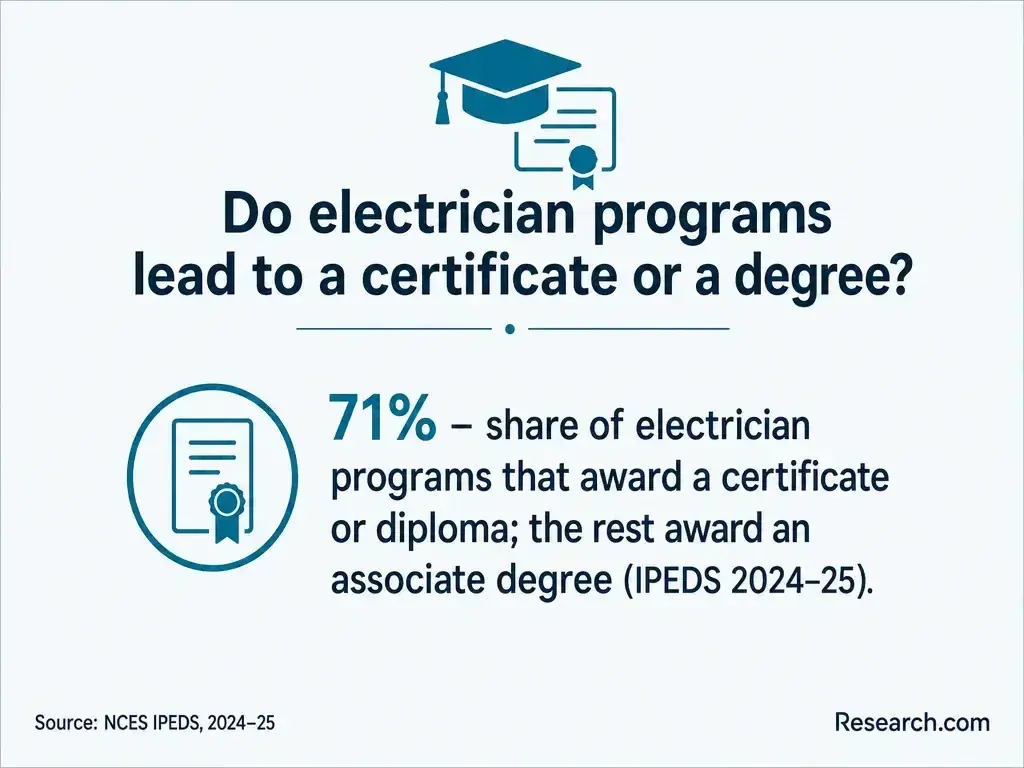
The credential depends on the pathway: a school may award a certificate or an associate degree if that specific program is offered, while a registered apprenticeship awards a completion credential through its sponsor. An employer may instead document training and work history. None of those labels, standing alone, is a local electrician license or proof that every employer will accept the same experience.
Before enrolling, ask for the exact credential name and a record of completed coursework, lab hours, and any employer-supervised hours. That documentation matters more to progression in this trade than the speed implied by unrelated searches such as one year masters program.
Requirements vary by provider and pathway. School applicants should confirm the current academic entry standard, placement requirements, minimum age, application dates, and whether tools or safety gear are needed before the first lab. Apprenticeship sponsors can have separate selection procedures and may require evidence that an applicant can safely perform the work; employment can also depend on a driver's license, travel availability, or employer screening. Verify requirements with the specific school or sponsor rather than assuming admission to one means entry to the other.
If you are changing careers, ask whether existing technical coursework or documented electrical work can earn placement or advanced standing. Have an apprenticeship sponsor confirm in writing which hours, if any, it will accept. Prior experience is valuable, but unverified credit should not be built into a time or cost estimate.
A useful entry-level curriculum connects electrical math and circuit theory to reading plans, selecting materials, installing conductors and devices, testing systems, and working safely under the applicable electrical code. The U.S. Bureau of Labor Statistics identifies blueprint reading, testing, installation, and repair as core electrician tasks. For industrial goals, look for motor controls and troubleshooting; for construction, inspect the amount of practical installation work.
Ask to see the course outline and lab schedule. The strongest comparison is not simply whether two programs both teach "electrical fundamentals," but how students demonstrate safe, supervised competence and whether the instruction aligns with the work local employers actually assign to new hires.
Do not assume a school certificate permits independent electrical work. Kansas does not operate a single statewide electrician license covering every locality; local authorities may set licensing or permitting rules for work in their jurisdictions (Kansas Office of Revisor of Statutes; City of Coffeyville). Before choosing a program, ask the Coffeyville authority responsible for electrical permits which work a trainee may perform, what supervision is required, and which experience, examinations, or credentials matter for the work you intend to do. Confirm the rules again for any other city or state where you plan to work.
Keep the categories separate: institutional accreditation concerns a school; an industry certificate recognizes particular training; registered-apprenticeship status concerns a training arrangement; and occupational licensing or local permission governs regulated work. An online course or a search for phd in one year cannot replace the supervised experience or jurisdiction-specific permission your electrical career may require.
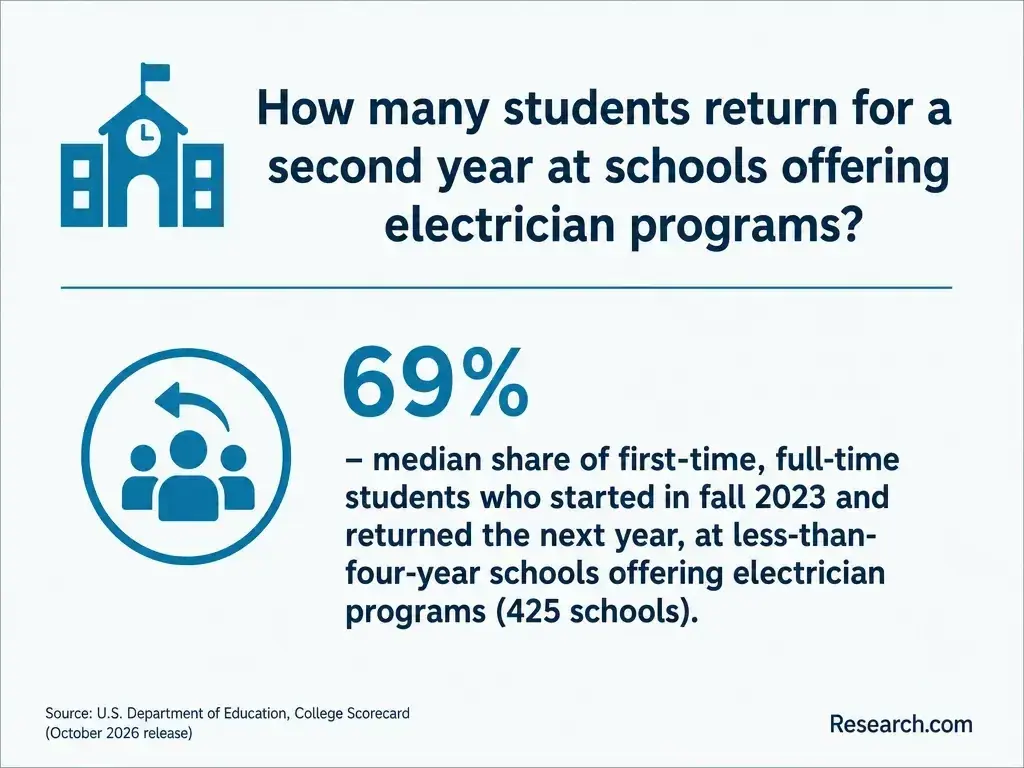
Start with your intended job - residential installation, commercial construction, or industrial maintenance - then compare the training and supervised-work route needed to reach it. The most affordable ranking is a cost-focused shortlist, not a verdict on lab quality, employer recognition, or licensing eligibility. A school program is more compelling when its practical instruction and employer connections solve a need that direct entry into paid training would not.
Use these questions before committing money or leaving a job:
Confirm institutional accreditation and school authorization separately from apprenticeship registration and local work requirements. Be wary of guaranteed job or licensing claims, an unexplained "all-online" practical curriculum, or a price quote that excludes required supplies. To judge return on investment, consider your current earnings, completion prospects, debt, expected apprentice wages, time to independent work, and how long you expect to remain in the occupation - not tuition or an experienced worker's median wage alone.
Common first steps are electrical helper, trainee, or apprentice roles under supervision. With documented work experience and any required local approvals, electricians may move into residential or commercial installation, industrial electrical maintenance, troubleshooting, or crew leadership. Supervisory work and independent contracting can bring additional business and jurisdiction-specific obligations; a school credential does not confer those privileges automatically.
Choose training to match that progression. A short certificate may help you enter an apprenticeship, whereas someone targeting industrial equipment should seek stronger controls and diagnostic instruction. Ask employers what skills they expect from a new trainee and what experience they require before assigning independent tasks.
The U.S. Bureau of Labor Statistics projects 9.2% growth in U.S. electrician employment from 2025 to 2035. That national projection supports investigating the trade, but it does not measure openings in Coffeyville or guarantee a nearby apprenticeship. Demand in a smaller market can depend heavily on particular construction projects, industrial employers, and the number of contractors accepting trainees.
Test the local outlook before enrolling: speak with potential sponsors and employers about upcoming apprentice intakes, travel territory, and the skills they need. If suitable openings require a regional commute, include that expense and time in your training decision rather than treating a national growth figure as a local placement forecast.
Investing in training is an important decision, especially when the lowest advertised tuition may not be the lowest cost of becoming job-ready. Research.com compares programs in the same occupation and location so readers can assess realistic alternatives. Only programs with completions reported to the Integrated Postsecondary Education Data System (IPEDS) are eligible; that rule means the ranking is not a complete directory of apprenticeships, employer training, or every local provider.
The most affordable ranking scores tuition, cost of attendance, median student debt, and federal loan default rate. An entropy-based method gives more weight to cost indicators that differ more across eligible programs. Accreditation, training quality, and employment outcomes are not part of this affordability score. Research.com's separate best programs rankings use student outcomes, earnings, costs, support, accreditation, and relevant industry recognition; readers should not mistake those different scores for one another.
The Research.com team draws on the following databases and recognition sources in its trade-program ranking work. Some sources cover other occupations and should not be interpreted as electrician-program approval or licensing authorities.
This sourcing and occupation-specific comparison help narrow a shortlist, not certify that a program satisfies a particular employer's or jurisdiction's rules. Readers can learn more about the ranking process on the Research.com methodology page, then confirm current prices and practical-training arrangements directly with each provider.
# 1 position
# 2 position
Not necessarily. Paid apprenticeship and employer-training routes exist. Compare their entry requirements and supervised-work opportunities with what a school program offers (U.S. Bureau of Labor Statistics; Apprenticeship.gov).
Not automatically. Include tools, fees, travel, lost earnings, and debt, then check whether the program provides useful lab practice and a credible path into supervised employment.
You may study theory online, but electrical installation and testing require in-person practice. Confirm where labs occur and whether any work experience is recognized by your intended sponsor or jurisdiction.
Do not assume so. Ask the local electrical permitting authority about supervision, work permissions, and any applicable licensing or examination rules before relying on a school credential.
Choose a certificate if its instruction helps you qualify for the work you want and its cost makes sense. A paid apprenticeship may be preferable if you can enter one directly and want supervised field experience while earning wages.