
# 1 position
Most Affordable Electrical Technician Schools & Training in California for 2027
Audited and Verified:
Our Editorial and Data Verification Process
Research.com uses government datasets, official education statistics and primary institutional information to support its career and degree guides. Our review process checks factual accuracy, occupational definitions, source dates and the requirements associated with the credentials discussed.
How This Article Was Fact-Checked
Our editorial team verifies salary estimates, employment projections, education requirements and program information against original data providers and official organizations. Salary figures are checked against the relevant occupational definitions and reporting periods. Information about licensure, accreditation and required in-person training is reviewed separately.
Fact-checked and verified on:

Co-Founder and Chief Data Scientist

Reviewed by Karolina Broda
Fact-Checker and Data Verification
Choosing an affordable electrician program in California means looking beyond tuition: the training must also help you gain practical experience and meet state certification requirements. The U.S. Bureau of Labor Statistics projects 9.2% national employment growth for electricians from 2025 to 2035, making this a timely career decision. This guide explains costs, credentials, apprenticeships, and career prospects. It also features a Most Affordable Electrician Trade Schools in California for 2027 ranking, created by the Research.com team of data scientists to help students make informed choices about programs worth considering.
Key findings about electrician degrees in California
- The cheapest school is not necessarily the cheapest route to certification: compare tuition and required supplies against paid apprenticeship wages and the time needed to accumulate qualifying work experience.
- For California's general electrician certification, the state requires qualifying experience and an examination; the Department of Industrial Relations identifies 8,000 hours of qualifying work experience for the general-electrician classification. A school certificate alone is not certification.
- Electricians' U.S. median annual pay was $63,190 in May 2025, according to the U.S. Bureau of Labor Statistics. That occupational median is not a prediction of a newly trained Californian's starting wage.
Table of Contents
- Most Affordable Electrical Technician Schools & Training in California for 2027
- What can I expect from an electrician trade school program in California?
- Where can I work with an electrician trade school training in California?
What can I expect from an electrician trade school program in California?
Expect instruction in electrical theory, code, safety, and installation methods, with labs where you practice using tools and testing equipment. The crucial distinction is whether the program is a standalone school credential, training that supports registration as a California electrical trainee, or part of a registered apprenticeship that combines classroom learning with paid, supervised work. These routes do not produce the same work experience or credential.
This comparison shows what each common pathway contributes to career entry. Confirm the details with a provider before assuming similarly named programs offer equivalent training.
| Pathway | Typical training and credential | Best fit and main limitation |
| Community college or career-school program | Classroom and lab instruction leading to a certificate, diploma, or, where offered, an associate degree | Useful for building fundamentals or preparing to seek trainee work; enrollment alone does not supply all qualifying job experience. |
| Registered apprenticeship | Structured classroom instruction and paid, supervised on-the-job training; apprenticeship completion credential | Strong fit for people ready to learn while working; entry may involve an application process and available employer placements. |
| Employer-supported trainee route | Supervised work alongside required enrollment in a state-approved training program, when using California's electrical-trainee pathway | Can suit someone with a willing employer; the student must verify enrollment, registration, supervision, and progress requirements. |
Public colleges, private career schools, union-affiliated sponsors, and employers can all play a role. If you need income immediately, investigate apprenticeships before paying for a full-time school program. If you first need electrical fundamentals or help finding an employer, a lab-rich school program may justify its cost.
Where can I work with an electrician trade school training in California?
Electricians work for electrical contractors and in building construction, maintenance, manufacturing, and public facilities, according to the U.S. Bureau of Labor Statistics. California students can also look for employers working on building electrification, solar and battery installations, and electric-vehicle charging infrastructure. The work available depends on local projects and the employer's needs; a solar-focused course, for example, is not a substitute for broad electrical experience.
Location changes the practical value of a program. In a large metro area, compare the commute to labs and jobsites as well as the availability of apprenticeship openings. In a less densely served area, an affordable local program may save travel costs, but you may need a wider job search to find the supervised experience required for certification. Ask providers where students actually obtain work placements, not merely which industries appear in their brochures.
A verified California wage figure should come from the California Employment Development Department or the U.S. Bureau of Labor Statistics' state occupational estimates for a specified year and location. Without a comparable current state figure, the sound national benchmark is the U.S. Bureau of Labor Statistics' $63,190 median annual wage for electricians in May 2025. Half of employed U.S. electricians earned more and half earned less; it is not a California starting-pay estimate.
When evaluating an offer, compare its apprentice or trainee wage schedule with your present earnings, expected hours, benefits, travel expenses, and the point at which raises become available. An established electrician's occupational median should not be used to calculate a new entrant's immediate return on tuition. Local labor demand, union agreements, specialization, and experience can all affect pay.
School-based certificates and diplomas vary by provider and schedule; an associate degree generally takes longer because it includes additional coursework. A short course can teach useful basics, but course length and time to certification are different questions. For California general-electrician certification, the Department of Industrial Relations identifies 8,000 hours of qualifying work experience, along with the applicable examination requirement. Do not assume classroom hours automatically replace those work hours.
Registered apprenticeships commonly span several years because they integrate related instruction with supervised work. If speed matters, ask how soon you could begin paid work, not just how quickly you could finish classes. A part-time program may preserve income but extend the time needed to complete instruction; an accelerated program may finish classes sooner without shortening the experience required for certification.
Online instruction can work for electrical theory, calculations, code study, and some exam preparation. It cannot by itself demonstrate safe wiring practices, conduit work, troubleshooting with test instruments, or performance on a supervised jobsite. Campus and hybrid programs can provide labs; apprenticeships add actual workplace practice. Compare the amount and location of hands-on training rather than treating "hybrid" as a guarantee of sufficient practical experience.
Before enrolling in a remote course, ask who provides the labs, how often you must attend in person, and whether the school appears on California's approved list if you intend to register as an electrical trainee. California's Department of Industrial Relations sets trainee and certification rules; an online completion certificate alone does not establish eligibility. For readers comparing other short credentials, certificate programs that pay well without a degree illustrate a broader option, but electrician training still requires occupation-specific practical experience.
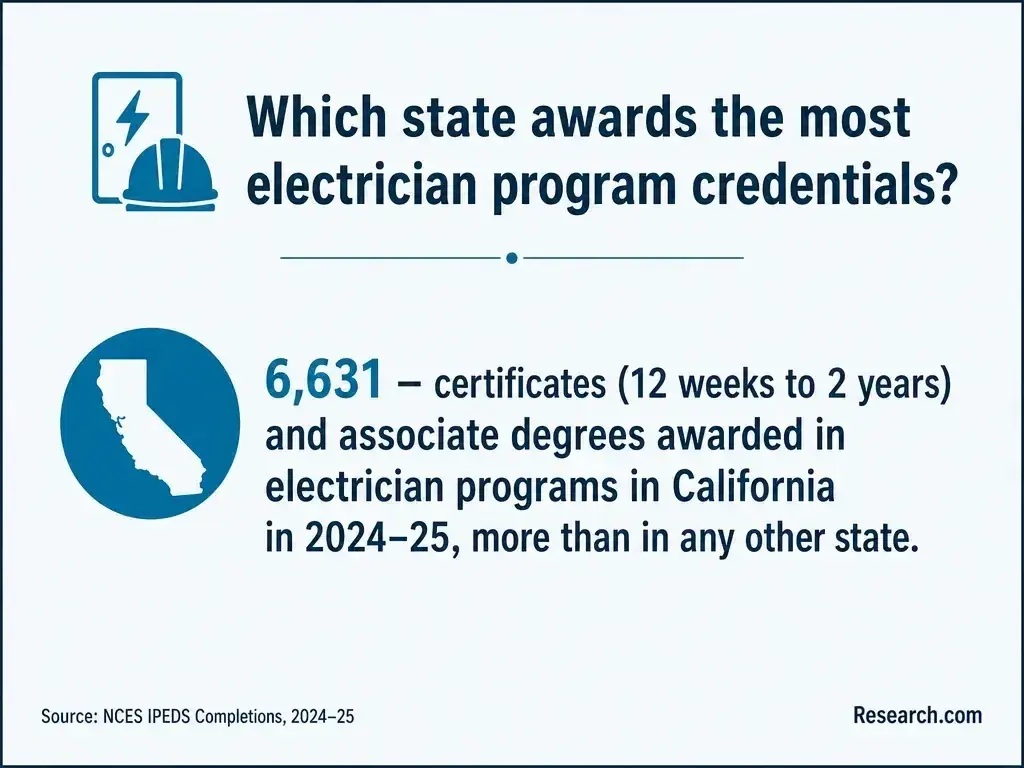
There is no single reliable statewide price that covers community college programs, private career schools, and paid apprenticeships on the same basis. Request each provider's total cost to reach your intended next step, not just its tuition quote. Residency can affect public-college tuition, while an apprenticeship may pay wages during training but still involve commuting and tool expenses.
Build a written budget that includes mandatory fees, books and code materials, tools, testing equipment, work boots and other personal protective equipment, transportation to labs and jobsites, and applicable examination or registration fees. Add lost earnings if attendance would reduce your work hours. Then subtract confirmed grants, scholarships, employer support, and apprentice wages; do not count aid for which your specific program is ineligible.
Federal Student Aid eligibility depends on the institution and program, not simply on whether a school offers online classes. Readers searching for cheap online universities that accept fafsa should apply that same eligibility check to any electrician program they consider. Ask the financial-aid office whether your exact credential qualifies, and check California community-college aid and workforce-funding options before borrowing.
The credential depends on the route: a school may award a certificate, diploma, or associate degree; a registered sponsor may award an apprenticeship completion credential; and the state issues electrician certification to applicants who meet its classification-specific requirements. These are separate credentials. A school award documents education, while state certification concerns the legal requirements for the electrical work covered by California's rules.
Ask whether coursework can count toward another provider's program or whether prior training or experience qualifies for advanced standing. Get any transfer or apprenticeship-articulation agreement in writing before paying. Also distinguish institutional accreditation from state school authorization, approved electrical-trainee training, apprenticeship registration, and occupational certification: none automatically substitutes for the others. A list of nationally accredited universities, for instance, cannot establish whether an electrician program meets California's trainee rules.
School admission rules vary. Providers may require an application, evidence of prior schooling, a placement assessment, or readiness for math and physically demanding lab work; confirm the actual requirements with each program. Apprenticeship sponsors set their own application and selection procedures, which may include testing, interviews, and the ability to travel to jobsites. Acceptance into a school should not be confused with acceptance by an employer or apprenticeship sponsor.
California's electrical-trainee route has an additional regulatory step: the Department of Industrial Relations requires trainee registration and enrollment in an approved school, along with work under the required supervision. If a school markets itself as a route to trainee employment, ask it to identify its approved program, explain registration and renewal, and describe how students find supervised work. Do this before you commit to nonrefundable costs.
A useful entry program connects electrical theory to work a trainee will perform: reading plans, calculating loads, identifying conductors and circuits, installing wiring methods, using meters, and finding faults safely. Instruction should address the electrical code and jobsite safety, with labs that require students to assemble, test, and correct their own work. The U.S. Bureau of Labor Statistics identifies installation, inspection, testing, and repair as core electrician duties.
Ask for the lab syllabus and observe the equipment if possible. A program heavy on videos but light on supervised practice may be useful for theory or exam review, yet a poor stand-alone preparation for jobsite tasks. For a faster first credential, 12 month certificate programs that pay well offer a broader comparison; in electrical work, judge any short program by what skills it teaches and how it connects to qualifying experience.
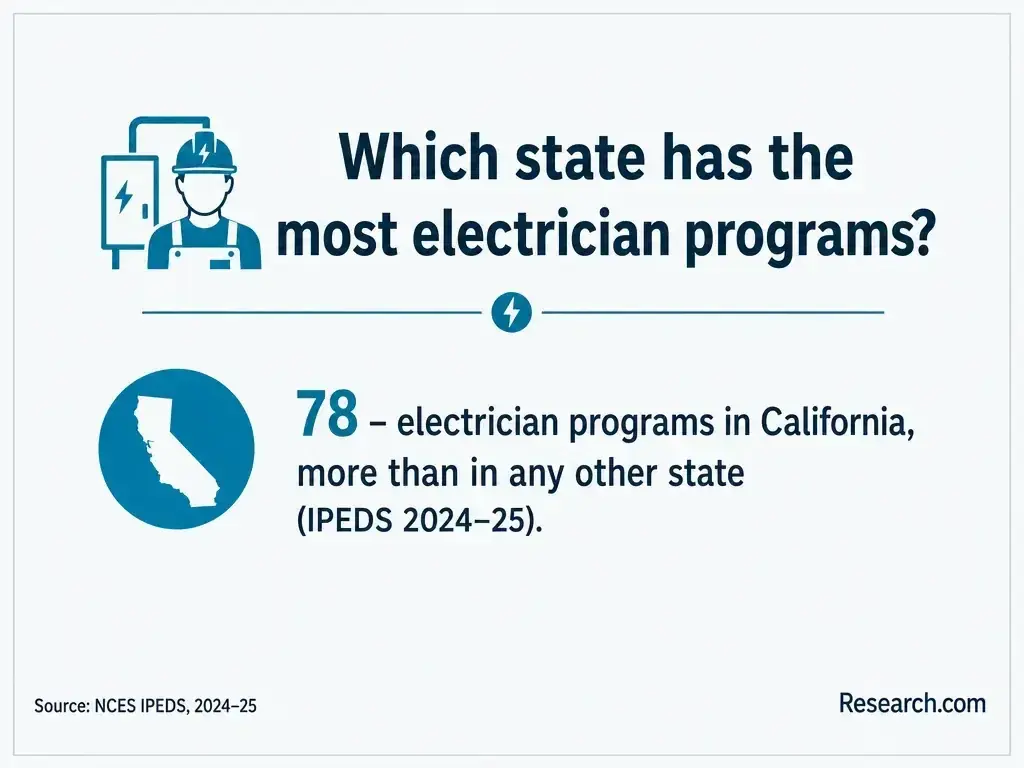
California distinguishes electrician certification, electrical-trainee registration, apprenticeship status, and contractor licensing. The Department of Industrial Relations administers electrician certification and sets requirements by classification. For general-electrician certification, it identifies 8,000 hours of qualifying work experience and an examination. A person still gaining experience may need to work through the state's registered electrical-trainee route or a qualifying apprenticeship, subject to the rules for that role. Finishing trade school does not itself make someone a certified electrician.
Running an electrical contracting business is another matter: California's Contractors State License Board regulates the C-10 electrical contractor license. Do not buy a program on the assumption that its certificate is a contractor license or that it waives experience and examination requirements. Confirm your intended classification and current eligibility rules directly with the relevant state agency before enrolling.
Start with your goal: getting a first supervised job, completing an apprenticeship, preparing for state certification, or adding a specialty. Then compare the least-cost routes that actually serve that goal. An affordability ranking can identify schools to investigate, but it cannot tell you whether a particular employer will hire you or whether the program fits your certification pathway.
Use these checks to avoid the most expensive enrollment mistakes:
- Confirm the exact credential, total program hours, lab access, and any documented connection to supervised employment.
- Verify the school's authorization and institutional accreditation separately from California electrical-trainee program approval or apprenticeship registration, whichever applies to your route.
- Request an itemized cost and aid estimate that includes tools, fees, travel, and income you may forgo; compare it with a paid apprenticeship offer if available.
- Ask how many students complete the program and what evidence supports placement claims; request written details rather than relying on advertising.
- Compare your likely starting earnings with your current income and expected debt over a realistic time horizon, accounting for completion risk and when you expect to begin paid work.
Return on investment depends on more than a high eventual wage: duration, aid, debt, completion probability, earnings before and after training, and the timing of those earnings all matter. Broad searches such as masters degrees with the highest roi use a different education and career comparison; for this decision, calculate the value of the electrician pathway you can actually enter.
An entry program can lead to supervised electrical-trainee work or strengthen an apprenticeship application. With qualifying experience and the applicable examination, a worker may pursue California certification in the appropriate classification, then build expertise in residential, commercial, industrial, maintenance, or specialized systems. Some experienced electricians move into crew leadership, estimating, or inspection-related work; operating an electrical contracting business raises separate Contractors State License Board requirements.
Choose training for the work you want to do next. Someone aiming for industrial troubleshooting should inspect the program's motor-controls and testing labs, while someone seeking residential work should ask about installation practice and relevant employer connections. Specialty instruction can improve a skill set, but it does not replace the experience or state credential required for the underlying electrical work.
The U.S. Bureau of Labor Statistics projects 9.2% growth in electrician employment nationally from 2025 to 2035. That signals continuing demand across the occupation, not a guaranteed opening in a particular California city or an assured placement for every graduate. Building activity, maintenance needs, and electrical upgrades can create different opportunities by employer and location.
For a local decision, check current California Employment Development Department projections and job postings for the area where you can work, then ask apprenticeship sponsors and schools about actual hiring relationships. A program's value improves when you can reach its labs and likely jobsites consistently; moving or commuting farther may erase an apparent tuition saving. National growth is a reason to investigate the trade, not a substitute for a local employment plan.
Most Affordable Electrical Technician Schools & Training in California for 2027
Investing in electrician training is an important decision, especially when the lowest advertised tuition may not represent the lowest cost of becoming job-ready. The Research.com team built this ranking to help readers compare affordable programs against other electrician programs in California, rather than against unrelated trades or schools elsewhere. The team reviewed established education and training data sources and applied a consistent scoring method.
Only programs with completions reported to the Integrated Postsecondary Education Data System (IPEDS) are eligible. The most affordable ranking scores tuition, cost of attendance, median student debt, and federal loan default rate; an entropy-based method assigns more weight to indicators that vary more across programs. Accreditation and other quality indicators are not part of this affordability score. Separately, Research.com's best-program rankings consider student outcomes, earnings and return on investment, costs and debt, and quality and recognition. That distinction matters: an affordability rank is a starting point, not proof that a program provides the practical training or state eligibility you need.
The following sources inform Research.com's trade-program ranking framework. Some cover other occupations and do not establish electrician-program approval or certification eligibility.
- IPEDS database - program completions and institutional education data used to identify and compare eligible programs.
- National Center for Education Statistics - federal education data and definitions used to interpret institutional reporting.
- College Scorecard database - available institutional cost, debt, and outcome measures.
- Peterson's database - supplementary institution and program information.
- Commission on Accreditation of Allied Health Education Programs (CAAHEP) - occupation-specific recognition information for applicable health programs, not electrician certification.
- Accrediting Bureau of Health Education Schools (ABHES) - accreditation information for applicable health schools, not electrician certification.
- Commission on Dental Accreditation (CODA) - approval information for applicable dental programs, not electrician certification.
- Dental Assisting National Board (DANB) - dental-assisting credential information, not electrician certification.
- National Center for Construction Education and Research (NCCER) - construction-training and industry-credential information where relevant.
- Apprenticeship.gov Partner Finder - registered-apprenticeship pathway information used to understand alternatives to school-based training.
IPEDS and college-oriented datasets do not capture every apprenticeship, union training center, or employer-sponsored route. Use the ranking to narrow school options, then compare their full costs, hands-on instruction, and alignment with California's electrician rules. More detail about Research.com's approach is available on its methodology page.
# 2 position
College of the Sequoias - Electrician.
certificate or diploma# 3 position
Merced College - Electrician.
associate
# 4 position
Merced College - Electrician.
certificate or diploma # 5 position
# 6 position
Santiago Canyon College - Electrician.
associate # 7 position
Santiago Canyon College - Electrical and Power Transmission Installation/Installer, General.
certificate or diploma # 8 position
Santiago Canyon College - Electrician.
certificate or diploma # 9 position
Modesto Junior College - Electrician.
certificate or diploma
# 10 position
Orange Coast College - Electrician.
certificate or diploma
# 11 position
Palomar College - Electrician.
associate# 12 position
Palomar College - Electrician.
certificate or diploma# 13 position
# 14 position
Antelope Valley Community College District - Electrician.
certificate or diploma# 15 position
College of San Mateo - Electrician.
associate# 16 position
College of San Mateo - Electrician.
certificate or diploma# 17 position
San Joaquin Delta College - Electrician.
associate
# 18 position
San Joaquin Delta College - Electrician.
certificate or diploma # 19 position
Foothill College - Electrician.
associate
# 20 position
Foothill College - Electrician.
certificate or diploma Frequently asked questions about electrician programs in California
Is trade school required to become an electrician in California?
No single trade-school credential is the universal entry route. Registered apprenticeships and the state's electrical-trainee pathway are alternatives, but each has its own training, registration, and supervised-work requirements. Verify the route for your intended electrician classification with California's Department of Industrial Relations.
Will a short electrician certificate make me eligible for California certification?
Not by itself. California requires qualifying experience and an examination for general-electrician certification; the Department of Industrial Relations identifies 8,000 qualifying work hours for that classification. Ask how the certificate helps you obtain the required experience.
Are electrician apprenticeships cheaper than trade school?
They can be less costly to finance because apprentices generally earn wages while training, but compare any required supplies, travel, entry conditions, and time to completion. A school program may still be worthwhile if it helps you gain skills or find supervised work you could not otherwise access.
Can I complete electrician training entirely online?
Online courses can cover theory and exam preparation, but wiring, testing, and supervised jobsite skills require in-person practice. Do not assume a fully online certificate satisfies California electrical-trainee or certification requirements.
What should I ask a school before enrolling?
Ask for its itemized total cost, lab hours, exact credential, documented trainee-program approval if relevant, completion information, and a clear explanation of how students obtain qualifying supervised work. Get answers in writing before paying a deposit.
- U.S. Bureau of Labor Statistics - Electricians
Used to verify salary, employment outlook, and typical education requirements.
https://www.bls.gov/ooh/construction-and-extraction/electricians.htm - NCCER - Accredited Training
Used to verify programmatic accreditation or industry recognition of programs.
https://www.nccer.org/ - O*NET OnLine - Electricians
Used to verify common responsibilities, skills, work settings, and education expectations.
https://www.onetonline.org/link/summary/47-2111.00 - College of the Sequoias - official website
Official school website (programs, tuition, admissions).
https://www.cos.edu/ - Merced College - official website
Official school website (programs, tuition, admissions).
https://www.mccd.edu/ - Santiago Canyon College - official website
Official school website (programs, tuition, admissions).
https://www.sccollege.edu/SitePages/Home.aspx - Modesto Junior College - official website
Official school website (programs, tuition, admissions).
https://www.mjc.edu/ - Orange Coast College - official website
Official school website (programs, tuition, admissions).
https://orangecoastcollege.edu/