# 1 position

Audited and Verified:
Our Editorial and Data Verification Process
Research.com uses government datasets, official education statistics and primary institutional information to support its career and degree guides. Our review process checks factual accuracy, occupational definitions, source dates and the requirements associated with the credentials discussed.
How This Article Was Fact-Checked
Our editorial team verifies salary estimates, employment projections, education requirements and program information against original data providers and official organizations. Salary figures are checked against the relevant occupational definitions and reporting periods. Information about licensure, accreditation and required in-person training is reviewed separately.
Fact-checked and verified on:

Co-Founder and Chief Data Scientist

Reviewed by Karolina Broda
Fact-Checker and Data Verification
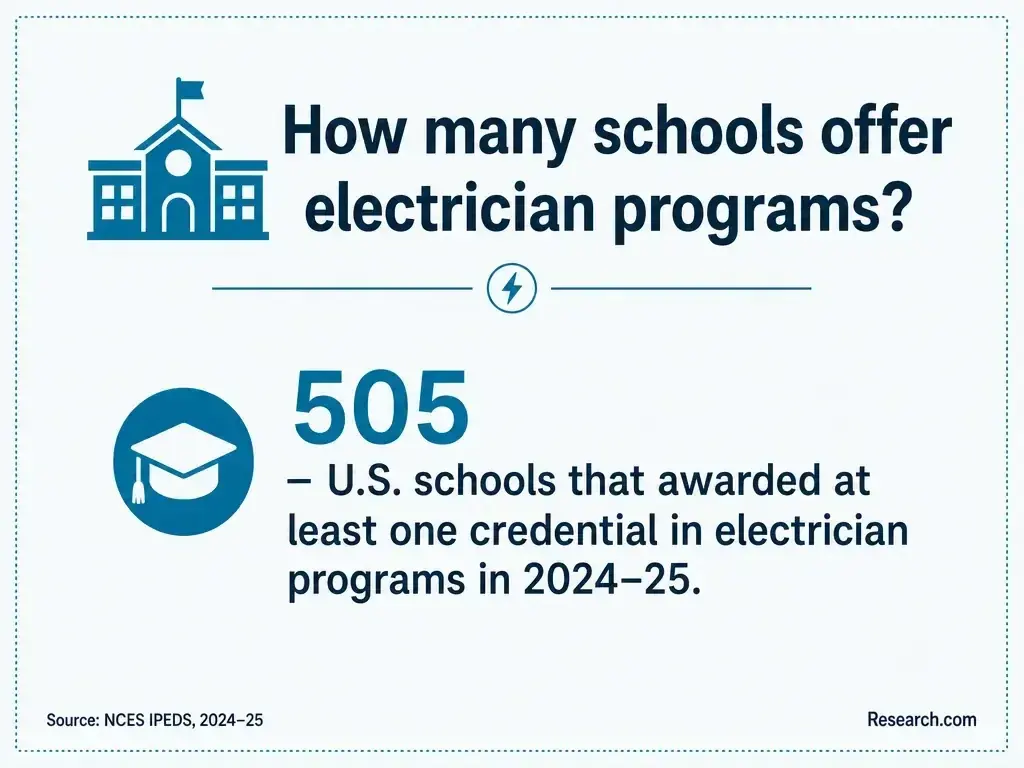
Choosing electrician training in Shelby means deciding whether to pay for classroom instruction first or earn wages while learning on the job. The distinction matters: U.S. Bureau of Labor Statistics projections show electrician employment growing 9.2% from 2025 to 2035, but training alone does not qualify someone to operate an electrical contracting business in North Carolina. This guide compares credentials, apprenticeships, costs, and licensing. It also accompanies the Best Electrician Trade Schools in Shelby for 2027 ranking, created by the Research.com team of data scientists to help students identify programs worth considering.
Expect instruction in electrical theory, circuits, wiring methods, code use, testing, and safe tool handling, paired with labs where students build and troubleshoot installations. Ask how often you will work with panels, conduit, meters, and drawings rather than only watching demonstrations. A school program can prepare you to seek an entry-level role, but sustained supervised field experience generally comes through employment or an apprenticeship.
The pathways differ in what you receive immediately and what remains to be done:
| Pathway | What it provides | Best fit |
| Certificate or diploma | Focused instruction and labs; the awarded credential and length depend on the program | Someone seeking foundational skills before applying for electrical work |
| Associate degree | Electrical coursework plus a broader academic curriculum | Someone who wants that additional coursework and can justify its time and cost |
| Registered apprenticeship | Paid, supervised work with related technical instruction over several years | Someone ready to apply to a sponsor and learn primarily on the job |
| Employer-sponsored entry | Training while employed; structure and recognition vary | Someone with an employer willing to document instruction and supervised experience |
In Shelby, Cleveland Community College is a local school-based option to investigate; compare its current electrical offerings with apprenticeship openings and employer training rather than assuming similarly named credentials provide equivalent field experience.
Electrical contractors working on homes and commercial buildings are an entry point. Industrial facilities and building-maintenance employers may also need workers who can maintain motors, controls, and electrical systems. These jobs require different emphases: residential work centers more on building wiring and service calls, while industrial work can demand stronger troubleshooting and controls skills (U.S. Bureau of Labor Statistics; O*NET).
Ask prospective employers whether they hire trainees, provide supervised electrical work, and support related instruction. A commute beyond Shelby may widen the range of jobs and apprenticeship sponsors, but travel costs and schedules should be part of the training decision.
The U.S. median annual wage for electricians was $63,190 in May 2025 (U.S. Bureau of Labor Statistics). That is a national occupational median across experience levels, not a Shelby wage or an offer to a new trainee. Apprentices and entry-level helpers may earn less; overtime, specialty, employer, and experience can change pay.
Before borrowing for a program, compare actual local trainee offers and apprenticeship wage schedules with your likely earnings while studying. Unlike lists of what bachelor's degrees make the most money, an occupational wage figure does not describe the return on any particular education purchase.
A certificate or diploma may be shorter than an associate degree, but the reliable measure is the provider's published contact hours, lab schedule, and required courses - not the credential's name. Ask whether evening attendance extends the calendar and whether previous coursework or documented experience earns credit. Do not assume school hours will reduce an apprenticeship's requirements; the sponsor must confirm any advanced standing.
Electrician apprenticeships typically last four or five years and combine paid on-the-job training with technical instruction (U.S. Bureau of Labor Statistics). A short course can help you explore the trade, but a list of the best 6 month course with high salary should not be read as a shortcut to independent electrical work.
Online or hybrid delivery can make electrical theory, calculations, and code-reading lessons easier to schedule around work. It cannot replace supervised practice with wiring, testing instruments, equipment, and jobsite safety. Ask a hybrid provider where labs occur, how often attendance is mandatory, and who assesses practical skills before paying.
General guides to the best accredited non profit online universities answer a different question: institutional accreditation does not establish that remote electrician coursework supplies hands-on training or meets an apprenticeship sponsor's expectations. For someone already employed in the trade, online theory paired with documented worksite practice may be useful; a beginner without access to labs or a supervisor should be wary of an online-only claim.
There is no defensible single Shelby-wide average covering college programs, private training, and paid apprenticeships. Request a current, itemized quote for each option. The figure that matters is the cost of becoming employable, not tuition alone.
Compare these costs and offsets on the same time horizon so a cheaper-looking program does not hide expenses elsewhere:
North Carolina residency can affect public-college tuition eligibility; ask the college to assess your status rather than assuming an advertised rate applies. Check federal aid eligibility with the school and ask NCWorks about workforce-training assistance. Lists of low cost online schools for working adults are not substitutes for an electrical-program quote that includes required in-person work. For return on investment, weigh completion likelihood, debt, earnings during training, likely post-training pay, and the years over which you expect the investment to repay.
The award may be a certificate, diploma, or associate degree; ask the provider for the exact credential title and transcript or completion document. A registered apprenticeship instead documents completion of a structured work-and-instruction program through its sponsor (U.S. Department of Labor, Apprenticeship.gov). Industry credentials, if offered, are separate again: confirm who issues them and whether local employers value them.
None of these documents is automatically a North Carolina electrical contractor license. Institutional accreditation concerns the school, while apprenticeship registration concerns the training arrangement. Check each separately against your intended job.
Requirements differ by provider and pathway. Ask a school for its current prerequisites, placement expectations, start dates, and any requirements to participate safely in labs. An apprenticeship sponsor may also screen for readiness to work on jobsites and follow its own application and selection process; school admission does not reserve an apprenticeship place.
Before applying, request the written requirements and ask whether you must secure an employer, supply tools, or travel to worksites. This matters particularly if you need evening training or cannot commute regularly outside Shelby.
A useful curriculum connects electrical theory to tasks employers can observe: interpreting plans, selecting wiring methods, measuring voltage and continuity, installing devices, tracing faults, and applying safety and code principles (U.S. Bureau of Labor Statistics; O*NET). For industrial work, ask about motors and controls; for residential work, ask how much practice involves service equipment and building wiring.
Request a lab outline and visit if possible. A red flag is a program that advertises job readiness but cannot explain how students practice and receive feedback on installations or how they transition to supervised work.
North Carolina regulates electrical contracting through the North Carolina State Board of Examiners of Electrical Contractors. Its contractor license is distinct from a school credential, industry certification, or registered apprenticeship. Someone entering the trade can seek supervised employment with a licensed contractor; someone planning to contract for electrical work must check the board's applicable license classification, experience, examination, and application rules (North Carolina State Board of Examiners of Electrical Contractors).
Ask the board and a prospective employer how your intended role is supervised. Do not pay for a program because it claims to make graduates "licensed" without specifying the license, the experience still required, and who issues it.
Start with the job you want, then test whether each option delivers the instruction, practical access, and next step into paid work that the job requires. Use the ranking as one input, not a replacement for checking current terms with providers and apprenticeship sponsors.
These questions expose the differences most likely to change your decision:
Institutional accreditation is worth checking, but even a guide to the best accredited non profit online universities cannot establish electrical licensing eligibility. Correction: that resource is not a measure of electrician-program quality; verify the provider's status and practical training directly. If your priority is earning immediately, apply to apprenticeships as well as schools. If you need foundational lab practice before approaching employers, a school program may justify its cost.
Training can lead to supervised electrical installation work, followed by greater responsibility as skills and experience develop. Workers may concentrate on residential construction, commercial systems, industrial maintenance, or troubleshooting. Supervisory work and electrical contracting require additional experience; operating as a contractor also brings North Carolina board requirements (U.S. Bureau of Labor Statistics; North Carolina State Board of Examiners of Electrical Contractors).
Choose training with the next role in mind, not the most ambitious job title in an advertisement. Advice about what's the easiest doctorate to get concerns a separate education decision and has no bearing on electrical jobsite competence or contractor eligibility.
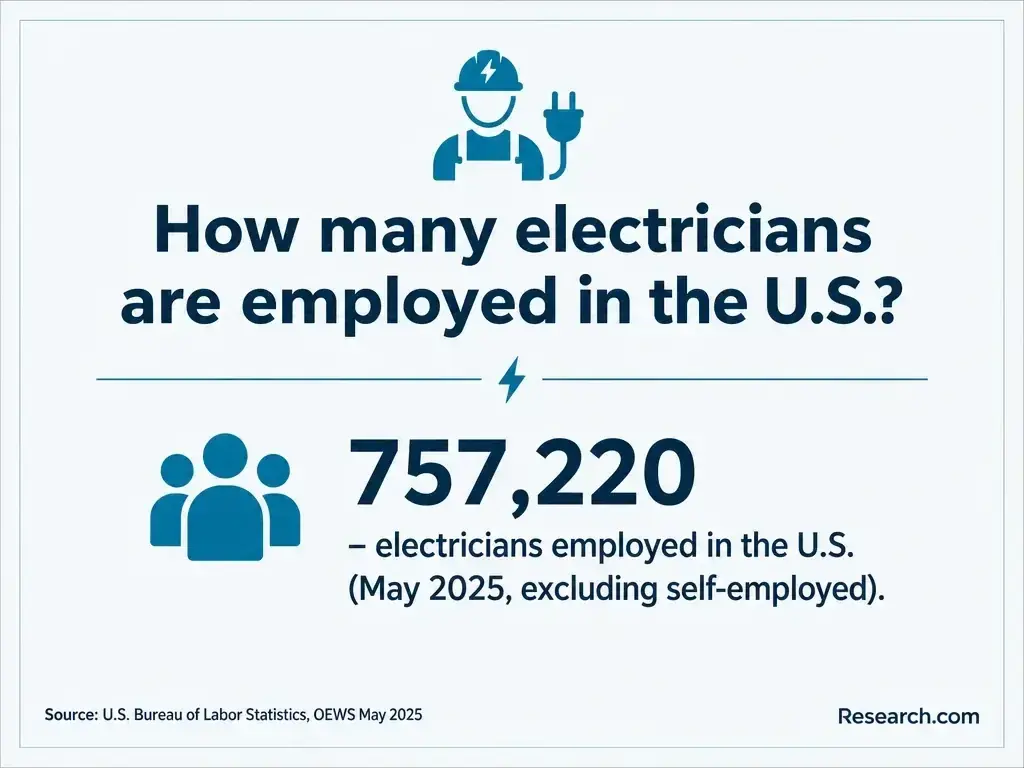
U.S. electrician employment is projected to grow 9.2% from 2025 to 2035 (U.S. Bureau of Labor Statistics, Employment Projections). That national projection supports investigating the trade, but it does not measure Shelby vacancies or guarantee an apprenticeship opening. Local opportunities depend on contractors' projects, maintenance hiring, and how far you can travel.
Check current employer postings and registered apprenticeship openings before choosing a start date. Look for the skills they request, then compare them with the program's actual labs and work-based training - not just its course title.
Investing in training is an important decision, so the Research.com team compares programs with other electrician programs in the same location rather than with unrelated trades. The best-program ranking evaluates student outcomes; earnings and return on investment; costs and debt; and quality and recognition. Programmatic accreditation or relevant industry recognition accounts for 20% of the score, institutional accreditation for 10%, and student support for 10%. The remaining 60% covers outcomes, earnings, and costs, with entropy-based weights that give more weight to indicators that vary more across programs.
The team draws on the following sources to check program and institutional information. Some occupation-specific sources in its broader research framework concern healthcare and do not establish approval for electrician training.
Only programs reporting completions to IPEDS can appear in this ranking. A registered apprenticeship or employer program missing from it is not necessarily inferior - or unavailable. Use the ranking to narrow college-based options, then compare those options with paid training. The Research.com methodology explains the ranking approach further.
# 1 position
# 2 position
No single school credential is the only route. Paid apprenticeship and employer training are alternatives; compare their instruction and supervised work with what a school offers (U.S. Bureau of Labor Statistics).
Online theory can supplement training, but electrical installation and troubleshooting require in-person practice and supervision. Confirm lab and worksite requirements before enrolling.
No. North Carolina electrical contracting has separate licensing requirements administered by the North Carolina State Board of Examiners of Electrical Contractors.
Choose based on access to paid work, the hands-on training you need, and total cost. A certificate can build initial skills; an apprenticeship combines instruction with paid, supervised experience.
Request the total required cost, lab schedule, exact credential, and written explanation of how graduates reach supervised work. Verify any accreditation, industry-credential, or licensing claim with its issuing organization.