# 1 position


Audited and Verified:
Our Editorial and Data Verification Process
Research.com uses government datasets, official education statistics and primary institutional information to support its career and degree guides. Our review process checks factual accuracy, occupational definitions, source dates and the requirements associated with the credentials discussed.
How This Article Was Fact-Checked
Our editorial team verifies salary estimates, employment projections, education requirements and program information against original data providers and official organizations. Salary figures are checked against the relevant occupational definitions and reporting periods. Information about licensure, accreditation and required in-person training is reviewed separately.
Fact-checked and verified on:

Co-Founder and Chief Data Scientist

Reviewed by Karolina Broda
Fact-Checker and Data Verification
Choosing electrician training in Charlotte means deciding whether to pay for a school program, pursue a paid apprenticeship, or combine the two. The choice matters: the U.S. Bureau of Labor Statistics projects 9.2% national growth in electrician employment from 2025 to 2035. This guide explains costs, practical training, credentials, and North Carolina's licensing rules. It also features a Best Electrician Trade Schools in Charlotte for 2027 ranking, created by the Research.com team of data scientists to help students make an informed choice about programs worth considering.
Expect to learn electrical theory, read plans, interpret code requirements, and practice installation and troubleshooting in person. At Central Piedmont Community College, prospective students can investigate electrical-systems training and ask which current credentials, lab courses, and employer connections match their goals. A college program and an apprenticeship can complement each other, but students should not assume college courses automatically count toward an apprenticeship (Central Piedmont Community College; ApprenticeshipNC).
The central choice is how soon you need paid work and how much supervised practice the pathway supplies. The comparison below describes pathways, not promises about a particular provider.
| Pathway | Typical credential or result | Best fit and main trade-off |
| Short certificate or pre-apprenticeship | School credential or preparation for applying to an apprenticeship | Useful for exploring the trade and building fundamentals; verify lab time and whether an employer recognizes it. |
| Diploma or associate degree in electrical systems | School credential; an associate program awards an academic degree | Offers broader coursework and potentially more lab time, but usually costs more time away from work. |
| Registered apprenticeship | Completion credential after related instruction and supervised employment | Fits someone seeking wages while learning; entry depends on a sponsor and a work placement. |
| Employer-sponsored entry | Job-specific training, sometimes leading to a registered apprenticeship | Can provide immediate experience; ask whether instruction and work hours lead to a portable credential. |
For an aspiring electrician, a short credential is worth paying for when its labs, employer access, and total cost offer a clear advantage over applying directly for paid training. Even top paying 6 month online certifications should not be read as evidence that six months of remote study makes someone qualified to perform unsupervised electrical work.
Electricians may work for electrical contractors on homes, commercial buildings, and construction projects, or in facilities maintenance and industrial settings. Charlotte-area students should ask whether a program's labs and placements emphasize the setting they want: residential wiring, commercial conduit and plans, or industrial controls involve different daily tasks (U.S. Bureau of Labor Statistics; O*NET).
Job geography also affects training costs. Worksites can change during construction projects, so ask a prospective employer or apprenticeship sponsor about travel across the Charlotte metro area, transportation expectations, and whether travel time is paid. Utility linework is a distinct occupation; do not assume a building-wiring program prepares you for it (U.S. Bureau of Labor Statistics).
A verified Charlotte-specific wage is preferable for a local pay estimate, but the national benchmark is useful context: the median annual wage for U.S. electricians was $63,190 in May 2025 (U.S. Bureau of Labor Statistics). It is the midpoint for employed electricians at all experience levels, not a forecast of what a new graduate or apprentice will earn in Charlotte.
Compare actual local apprentice wage schedules and entry-level offers before committing to a program. Hours worked, overtime, specialization, and experience can change annual earnings; compare benefits and commuting costs as well as the posted hourly rate. If a school advertises graduate pay, ask which graduates were counted, when earnings were measured, and whether the figure reflects local jobs.
Length depends on the credential and schedule. A focused certificate may take less time than a diploma or associate program, while a registered electrician apprenticeship commonly takes four to five years of related instruction and paid, supervised work (U.S. Bureau of Labor Statistics). School completion and apprenticeship completion are different milestones: finishing classes alone does not establish the same work experience.
Before enrolling, request the current course sequence and ask for the total classroom, lab, and work-based hours - not just the number of terms. Part-time attendance may preserve income but extend completion; an accelerated schedule may reduce elapsed time while leaving less room for paid work. Ask an apprenticeship sponsor whether previous coursework earns advanced standing rather than assuming it will.
Online instruction can cover theory, calculations, code concepts, and plan reading. Wiring, equipment handling, testing, and supervised jobsite practice require access to physical equipment and qualified supervision. An entirely online course should therefore be judged as classroom preparation, not a replacement for hands-on electrician training (U.S. Bureau of Labor Statistics).
When reviewing top online trade schools, check where each required lab happens, how often you must attend, and who arranges supervised work near Charlotte. A hybrid format may suit someone already employed in the trade; campus labs may be more useful for a beginner who cannot otherwise access tools and instruction. Neither format automatically satisfies an employer's experience expectations or North Carolina contracting-license requirements.
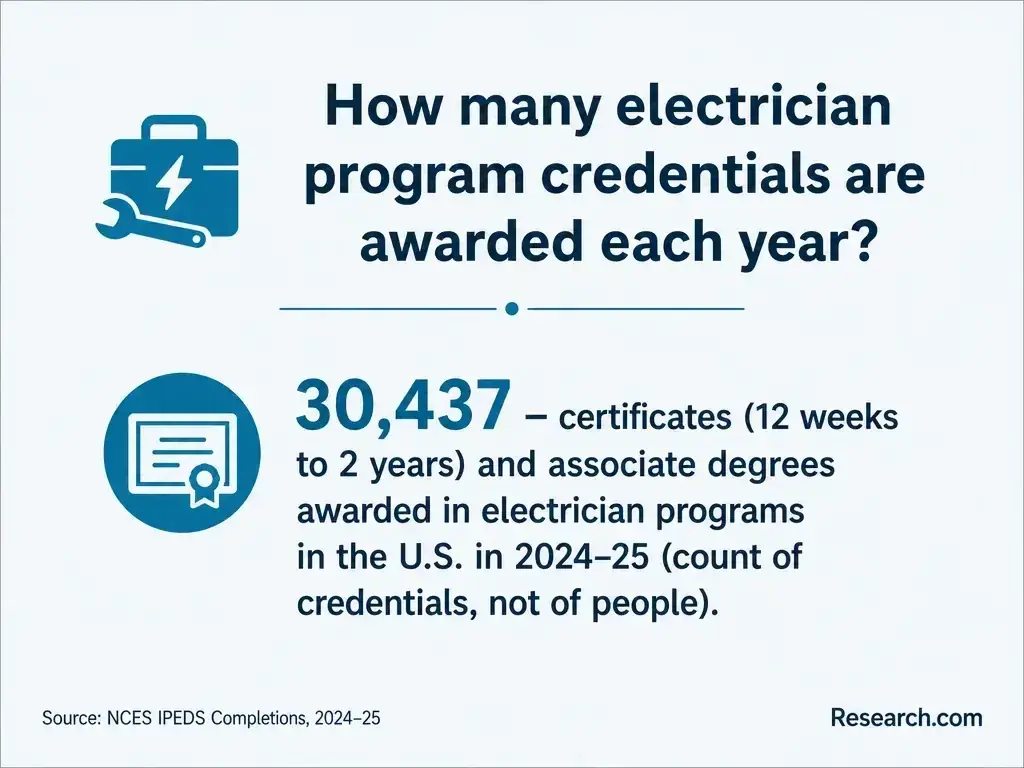
There is no single reliable Charlotte-wide average covering college programs, private training, and paid apprenticeships: they use different pricing and reporting systems. Request a current, program-specific total instead of comparing tuition alone. A paid apprenticeship can offset training costs with wages, although tools, travel, and any required instruction costs still matter (Apprenticeship.gov).
Build a job-ready budget from these items, then subtract aid or employer support you have actually been offered:
For a college option, check eligibility for federal aid with Federal Student Aid and ask the institution about North Carolina aid and workforce funding; eligibility depends on the student and program. Compare net cost and likely debt with the wages you could earn through an apprenticeship. A low cost online master's degree comparison is not a useful price benchmark for electrician training: the relevant measure is what it costs to gain the practical skills and supervised experience your intended job requires.
The answer depends on what you enroll in: a school may award a certificate, diploma, or associate degree; a registered apprenticeship awards its own completion credential. Ask for the credential's exact name and whether an employer or apprenticeship sponsor accepts it for hiring or advanced standing. Similarly named school credentials can include substantially different amounts of lab and field training (Central Piedmont Community College; Apprenticeship.gov).
An optional industry training credential, such as one aligned with NCCER, is distinct from school accreditation and from a North Carolina electrical contracting license. Neither a school credential nor an industry certificate grants permission to operate an electrical contracting business (NCCER; North Carolina State Board of Examiners of Electrical Contractors). Comparisons about an easy bachelors degree do not answer the occupational question: confirm which electrical credential and documented experience your next employer or apprenticeship sponsor will recognize.
Requirements vary by provider and pathway. Ask a college or training provider about its current application process, course prerequisites, placement rules, age requirements, and required safety equipment. An apprenticeship sponsor may also assess whether applicants can meet jobsite requirements and have reliable transportation; admission to a school does not secure an apprenticeship position (Central Piedmont Community College; ApprenticeshipNC).
If you already work in construction, ask whether documented experience or prior coursework can shorten instruction or support advanced standing. Get any credit decision in writing before paying a deposit. A promise of "apprenticeship placement" is not the same as an offer from a sponsoring employer.
Core instruction typically addresses electrical safety, circuits, measurements, blueprint reading, wiring methods, applicable electrical code, and troubleshooting. Strong practical training lets students install and test components, identify faults, use tools safely, and explain why an installation meets code - not merely recognize answers on a screen (U.S. Bureau of Labor Statistics; O*NET).
Ask to see the current lab sequence and its equipment before enrolling. Someone targeting commercial construction should look for relevant conduit, plans, and distribution-system practice; someone interested in industrial maintenance should ask about motors and controls. An apprenticeship adds supervised work under real schedules and site conditions, which a classroom simulation cannot fully reproduce.
North Carolina licenses electrical contractors through the North Carolina State Board of Examiners of Electrical Contractors; it does not make a trade-school certificate an electrical contracting license. Someone entering the occupation as an employee or apprentice should distinguish that role from independently offering electrical contracting services. The board's contractor classifications have examination, experience, and other application requirements, so check the current classification that matches your intended work before planning to start a business (North Carolina State Board of Examiners of Electrical Contractors).
Ask a prospective school or sponsor how it documents supervised work and whether its instruction helps prepare for later examinations. Institutional accreditation, state school authorization, apprenticeship registration, optional industry certification, and occupational licensure answer different questions; none substitutes automatically for another. Employers may impose additional hiring or safety requirements.
Start with the job you want, then work backward to the instruction and supervised experience it requires. Rankings help narrow college options, but they cannot by themselves measure an unlisted apprenticeship or confirm that a particular lab schedule fits your life. Resources about top online colleges can help frame questions about online coursework, but electrician training still needs a credible plan for in-person practice.
Use the following checks when speaking with admissions staff and apprenticeship coordinators:
A costly short program with little hands-on practice is a red flag even if its advertised completion time looks attractive. For return on investment, consider financial aid, debt, the chance of completing, your current earnings, potential pay after training, the time needed to reach it, and the value of money over that time - not just a headline wage or tuition figure.
An entry-level trainee may move into an apprenticeship or supervised electrician role, then gain experience in residential, commercial, or industrial work. Later possibilities include specialization in controls or maintenance, leading crews, and - with the required North Carolina contractor license - operating an electrical contracting business. These are progression options, not automatic outcomes of a certificate (U.S. Bureau of Labor Statistics; North Carolina State Board of Examiners of Electrical Contractors).
Choose early training for the next realistic step rather than paying now for every possible future role. A beginner seeking immediate paid field experience may prefer an apprenticeship; an employed worker seeking broader technical instruction may value a school program that fits around work. Ask whether the credential supports that specific transition.
The U.S. Bureau of Labor Statistics projects 9.2% growth in electrician employment nationally from 2025 to 2035. That points to continued demand for the occupation, but it does not forecast a Charlotte applicant's chance of getting a job or guarantee an apprenticeship opening. Local opportunities will depend on employers' projects, hiring standards, and the kind of electrical work you can perform.
Before enrolling, check current Charlotte-area openings and apprenticeship recruitment notices for repeated skill requirements. Compare them with the program's actual labs and work placements. This is especially useful when choosing between building-construction training and facility or industrial work: national growth alone cannot tell you which local route is the better fit.
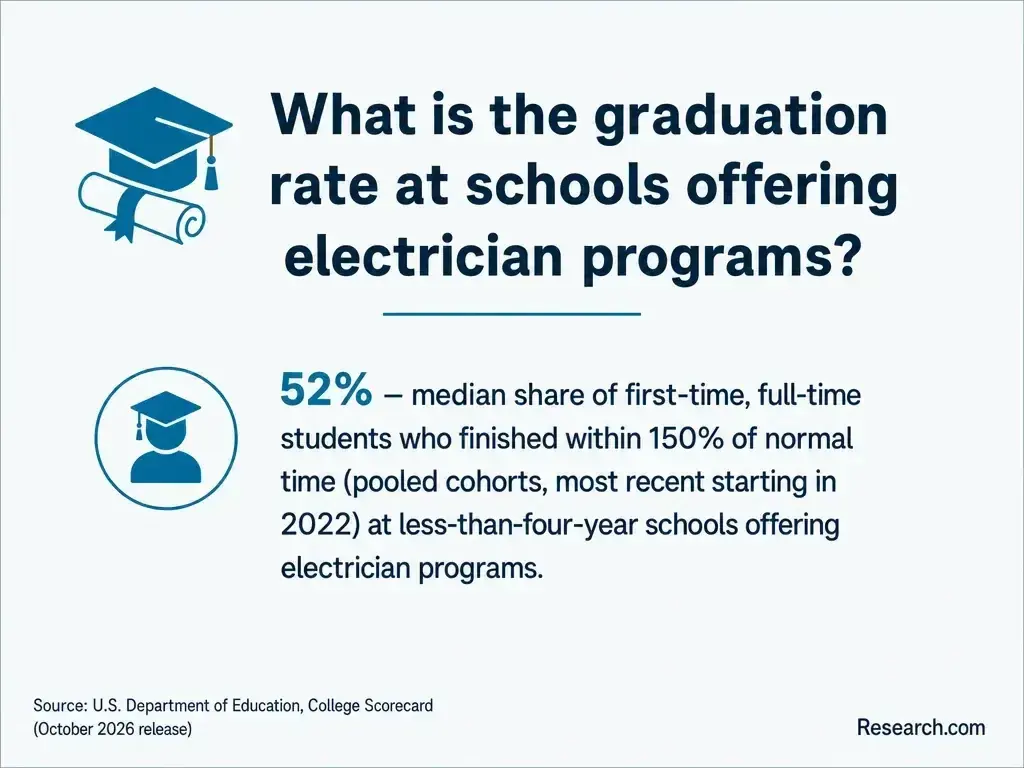
Investing in training is an important decision, so Research.com evaluates electrician programs against other programs serving the same occupation and location - not against unrelated schools nationwide. Its best-program rankings assess student outcomes; earnings and return on investment; costs and debt; and quality and recognition. Only programs with completions reported to the Integrated Postsecondary Education Data System (IPEDS) are eligible. That makes the ranking useful for comparing included schools, but it does not mean an unlisted apprenticeship or employer program is low quality.
Current best-program scoring assigns 20% to occupation-relevant programmatic accreditation or industry recognition, 10% to institutional accreditation, and 10% to student support. The remaining 60% covers completion and full-time and part-time retention; earnings one year after completion and relative to annual attendance cost; tuition, attendance cost, debt - including debt held by students who withdrew - and federal loan default rates. An entropy-based method gives more weight to indicators that vary more across programs. Most-affordable rankings instead score only tuition, attendance cost, median debt, and loan default rates using entropy-based weights; accreditation and other quality indicators are not part of that affordability score.
The Research.com team uses the following sources to check program, institutional, outcome, and occupation-relevant information. Some cover other trades or health fields and should not be mistaken for electrician-specific approval:
The ranking is a starting point, not a substitute for checking lab access, apprenticeship connections, and the full price of becoming job-ready. Readers can learn more about the scoring approach on the Research.com methodology page.
# 1 position
# 2 position
No single trade-school credential is the universal entry route. Paid apprenticeship and employer-sponsored training are alternatives; compare their supervised work and instruction with a school program (ApprenticeshipNC; U.S. Bureau of Labor Statistics).
You can study some theory online, but installation, testing, and supervised jobsite skills require in-person practice. Verify where a hybrid program provides its labs and work experience.
Not by itself. North Carolina electrical contracting is regulated by the state's electrical contractors board, with requirements separate from school completion (North Carolina State Board of Examiners of Electrical Contractors).
It depends on your goal. An apprenticeship offers wages and supervised experience; a college program may provide accessible foundational instruction. Ask whether college coursework receives apprenticeship credit before paying for both.
Request the full cost, credential name, lab and work-based hours, current completion outcomes, and written details of any claimed employer placement or apprenticeship credit.