# 1 position
Nash Community College - Electrician.
associate

Audited and Verified:
Our Editorial and Data Verification Process
Research.com uses government datasets, official education statistics and primary institutional information to support its career and degree guides. Our review process checks factual accuracy, occupational definitions, source dates and the requirements associated with the credentials discussed.
How This Article Was Fact-Checked
Our editorial team verifies salary estimates, employment projections, education requirements and program information against original data providers and official organizations. Salary figures are checked against the relevant occupational definitions and reporting periods. Information about licensure, accreditation and required in-person training is reviewed separately.
Fact-checked and verified on:

Co-Founder and Chief Data Scientist

Reviewed by Karolina Broda
Fact-Checker and Data Verification
Choosing electrician training in Rocky Mount means deciding whether to pay for classroom instruction, seek a paid apprenticeship, or combine both. The U.S. Bureau of Labor Statistics projects electrician employment to grow 9.2% nationally from 2025 to 2035, making that choice timely - but growth does not guarantee a local job. The Research.com team of data scientists created the Best Electrician Trade Schools in Rocky Mount for 2027 ranking to help students identify programs worth considering. This guide explains credentials, practical training, costs, licensing, and career prospects so you can choose a route that fits your goal.
Expect to learn electrical theory and safe installation in a classroom or lab, then develop jobsite competence under supervision. Electricians read drawings, install and test circuits, troubleshoot equipment, and follow electrical codes. A classroom credential can help you seek an entry-level position; it does not replace the sustained field experience needed to work independently (U.S. Bureau of Labor Statistics).
The main choice is how to combine instruction with paid work. This comparison separates a school credential from an apprenticeship rather than treating similarly named programs as equivalent.
| Pathway | Training and credential | Best fit and limitation |
| Community-college certificate, diploma, or associate program | Classroom and lab study; the credential depends on the specific program offered | Useful for structured fundamentals or a later technical specialty; confirm how graduates obtain supervised work |
| Registered apprenticeship | Paid, supervised work paired with related instruction; completion yields an apprenticeship credential | Useful if earning while learning is essential; entry depends on sponsor selection and available positions |
| Employer-sponsored entry | Jobsite training that may or may not connect to a registered apprenticeship | Useful when an employer will train beginners; confirm the instruction, supervision, and record of experience provided |
For someone based in Rocky Mount, Nash Community College is a school option to investigate. Ask which electrical credentials are currently enrolling and how much time students spend installing, measuring, and troubleshooting in supervised labs. Also compare apprenticeship sponsors serving the area: their worksites and classroom locations may require travel beyond the city (Nash Community College; U.S. Department of Labor).
Electrical training can support applications to contractors working on homes and commercial buildings, industrial facilities that maintain electrical equipment, and organizations that maintain buildings. These settings call for different preparation: a construction employer may emphasize conduit, panels, and code-based installation, while an industrial maintenance role may place more weight on motors, controls, and troubleshooting (U.S. Bureau of Labor Statistics).
Ask a provider where its recent students completed work-based training and what types of employers recruited them. If your preferred work is industrial, inspect the lab curriculum for controls and motor work; if it is construction, ask about installation practice and current code instruction. A willingness to travel to regional jobsites may expand options, but it also adds transportation cost.
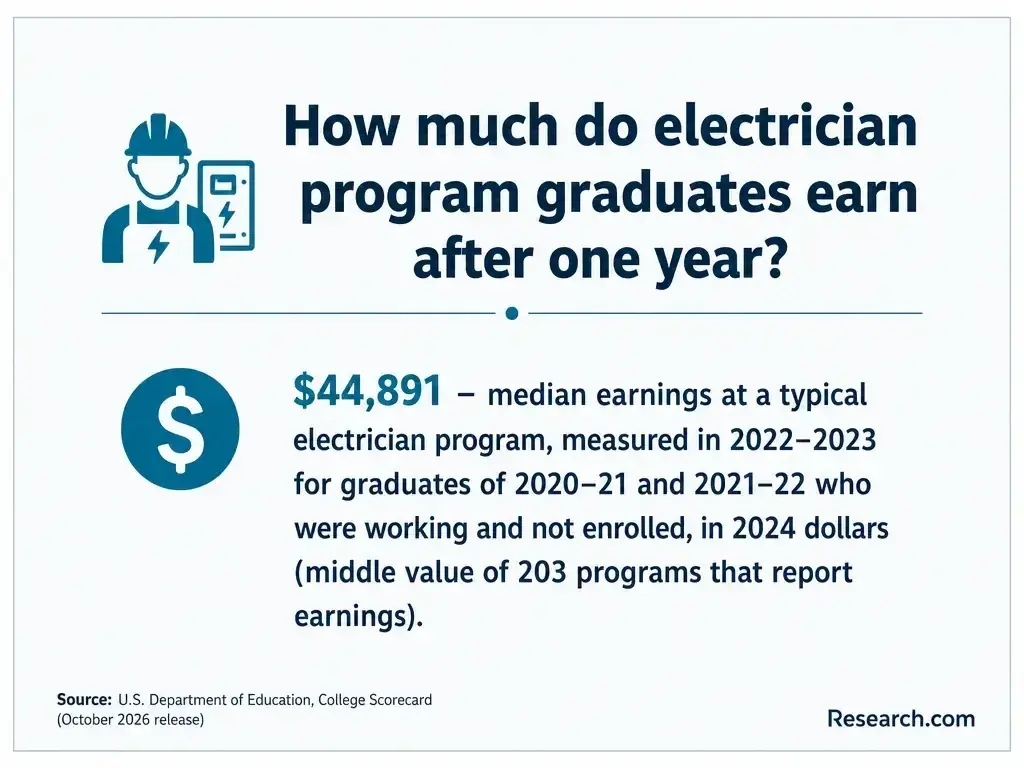
A verified Rocky Mount-specific electrician wage is not available here, so the national figure is a benchmark, not a local estimate: the U.S. median annual wage for electricians was $63,190 in May 2025 (U.S. Bureau of Labor Statistics). It includes experienced workers and should not be used as an expected wage immediately after a short training program.
Before comparing offers, ask employers or apprenticeship sponsors for the actual starting rate, scheduled increases, benefits, travel expectations, and whether classroom time is paid. Compare those terms with your training costs and current earnings. An apprenticeship can reduce the need to give up wages during training, although an apprentice's initial rate and schedule will depend on the sponsor.
The timeline depends on whether you mean finishing a school credential or developing the experience required for independent work. A focused certificate is generally shorter than a diploma or associate program, but published schedules and required contact hours vary. Ask Nash Community College for the current course sequence, lab hours, and part-time availability rather than assuming an advertised completion date includes jobsite training (Nash Community College).
Registered electrical apprenticeships commonly extend over several years because they combine related instruction with substantial supervised work. The sponsor's approved standards, not the title "apprenticeship," determine its exact hours and progression (U.S. Department of Labor). A short school program may get you ready to apply for an apprentice or helper role sooner; it does not compress all subsequent field experience into a semester.
Online coursework can be useful for electrical theory, calculations, code study, and scheduling flexibility. It cannot, on its own, demonstrate that you can safely install a circuit, use test instruments, bend conduit, or troubleshoot energized equipment under appropriate supervision. An on-campus or genuinely hybrid program should provide access to those practical exercises, while an apprenticeship supplies supervised work at jobsites (U.S. Bureau of Labor Statistics; U.S. Department of Labor).
Before paying for a hybrid program, get its lab dates, locations, required attendance, and equipment list in writing. If it advertises an entirely remote route to becoming an electrician, ask exactly which employer or sponsor accepts its practical training. Cost comparisons on a cheapest degree online page cannot answer that hands-on-training question for this trade.
There is no verified Rocky Mount-wide average that fairly combines college programs, other school-based training, and paid apprenticeships. Request a current, program-specific cost sheet instead. A low tuition figure can be misleading if it excludes tools, protective equipment, travel, or income forgone while attending daytime classes.
These cost categories show what to include in a job-ready budget; amounts depend on the provider and training route.
| Cost or offset | What to check |
| Tuition and required fees | Resident status, total courses, lab fees, and payment schedule |
| Tools, safety gear, and materials | Required purchases, included equipment, and replacement supplies |
| Books, software, and assessments | Code materials and any separate exam charges |
| Transportation and lost earnings | Travel to campus and worksites; hours unavailable for paid work |
| Possible offsets | Eligible aid, grants, scholarships, employer support, and apprenticeship wages |
Federal aid depends on both student and program eligibility; do not assume every short course or apprenticeship qualifies (Federal Student Aid). Ask about eligible North Carolina workforce assistance and whether an employer supplies tools. The relevant comparison is what each route costs you through completion and entry into supervised work - not its sticker price. General lists of most lucrative majors do not account for that trade-specific calculation.
A school may award a certificate, diploma, or associate degree, depending on the program completed. A registered apprenticeship instead awards a completion credential under its approved standards. Ask for the exact credential name before enrolling: an individual short course, an industry training certificate, and completion of a full occupational program are not interchangeable (Nash Community College; U.S. Department of Labor).
Institutional accreditation concerns a school; an industry credential can document particular skills; apprenticeship registration concerns a sponsor's training program; and North Carolina electrical contractor licensure is a separate legal matter. None automatically substitutes for another. If you may continue training later, ask whether prior coursework, documented work experience, or apprenticeship instruction can receive credit or advanced standing - and require the receiving provider to confirm it.
Requirements differ by route. A college sets its application, placement, and course-prerequisite rules; an apprenticeship sponsor selects applicants under its own published standards; an employer decides whom it will hire and train. Ask each provider about math readiness, minimum age, documents, scheduling, physical job duties, and any screening before assuming you qualify (Nash Community College; U.S. Department of Labor).
For an apprenticeship, also ask when applications open, where instruction takes place, whether you must secure an employer first, and how applicants are selected. If you need income immediately, compare that selection timeline with applying for a supervised helper position. Neither admission to a course nor a job offer establishes future contractor-license eligibility.
Relevant instruction covers electrical fundamentals, calculations, wiring methods, drawings, testing, troubleshooting, and safe work practices. Programs may also cover motors and controls or other topics aligned with particular worksites. Ask to see the current syllabus and lab assignments: the useful question is not merely whether "hands-on training" appears in an advertisement, but which tasks students perform, with what equipment, and under whose supervision (U.S. Bureau of Labor Statistics; Nash Community College).
Workplace skills matter alongside technical knowledge. Entry-level workers must follow instructions, document problems accurately, communicate hazards, and know when a task exceeds their training. If an employer expects construction experience, a classroom-only electronics course may be a poor substitute for installation labs and supervised fieldwork.
North Carolina's State Board of Examiners of Electrical Contractors licenses electrical contractors; completing trade school alone does not confer a contractor license. Its classifications and eligibility rules concern the contracting work an applicant intends to perform, and the application process involves documented qualifications and examination requirements. Check the board's current rules before choosing a program on the assumption that its credential will satisfy a licensing requirement (North Carolina State Board of Examiners of Electrical Contractors).
Working as a supervised employee or apprentice is different from independently offering electrical contracting services. A registered apprenticeship, an optional industry certificate, school accreditation, and a contractor license each serve different purposes. Ask prospective employers what they require for your intended entry-level role, and ask the state board about the experience and examination documentation you would need if your long-term goal is contracting.
Start with the job you want and work backward. A school-based program can be worthwhile if its labs build skills employers seek and its schedule helps you reach supervised work. A paid apprenticeship may fit better if you can obtain a position and need earnings throughout training. Neither is automatically the better investment: weigh completion likelihood, wages while training, aid, debt, time away from work, and the experience you still need afterward.
Use the following checks before paying a deposit or accepting a training offer; each addresses a common source of costly surprises.
A ranking is a starting point, not a substitute for those checks. Likewise, searches for what's the easiest bachelor degree to get do not resolve whether an electrician program provides the practical experience your intended job requires.
A realistic starting point is a supervised electrical helper or apprentice role, followed by greater responsibility as skills and documented experience grow. Construction electricians may develop residential or commercial expertise; maintenance-focused workers may build skills in motors, controls, and fault-finding. Later goals can include supervising crews or qualifying to pursue electrical contracting under North Carolina's rules (U.S. Bureau of Labor Statistics; North Carolina State Board of Examiners of Electrical Contractors).
Choose electives and worksites for the path you want, not for a salary headline. A list of high paying trade jobs can suggest possibilities, but earnings in any one path depend on experience, employer, duties, and location. Additional training can support advancement; it does not make an entry-level applicant an experienced contractor.
The U.S. Bureau of Labor Statistics projects 9.2% growth in electrician employment from 2025 to 2035. That signals national demand over the projection period, not a measured forecast for Rocky Mount or a guarantee of placement after training. Local hiring will depend on employers' projects, turnover, and the match between your skills and available work.
For a grounded local assessment, ask training providers which employers recruit beginners, check current postings for required skills and travel, and ask apprenticeship sponsors whether they are accepting applicants. Compare those answers with the program's completion and placement information, including how the provider defines "placed." If nearby opportunities require a commute, include its cost in your decision before enrolling.
Investing in electrician training is an important decision, and a useful ranking must compare programs with the options students can realistically reach. Research.com evaluates trade-school programs against others in the same occupation and location. Only programs with completions reported to the Integrated Postsecondary Education Data System (IPEDS) can appear in the ranking; the absence of an apprenticeship or employer program does not mean it is unavailable or unsuitable.
For its best-program rankings, the Research.com team examines student outcomes; earnings and return on investment; costs and debt; and quality and recognition. Occupation-relevant programmatic accreditation or industry recognition accounts for 20% of the score, institutional accreditation for 10%, and student support for 10%. The remaining 60% covers completion and retention, earnings, tuition and attendance costs, debt - including debt held by students who withdrew - and federal loan default rates. An entropy-based method assigns more weight to indicators that vary more across programs. Most-affordable-program rankings instead score only costs and debt, with entropy-based weights; they do not score accreditation or other quality measures.
The ranking methodology draws on the following data sources. Some are relevant to other trades rather than electrician training; listing them does not imply that a health-care accreditor approves an electrical program.
This approach helps readers compare reported outcomes and costs, but a ranking cannot establish that a particular course provides sufficient supervised work or qualifies someone to contract independently in North Carolina. Verify those points with the provider and the state licensing board. More detail is available on the Research.com methodology page.
# 1 position
# 2 position
Not necessarily. Supervised employer training and registered apprenticeships are alternative routes. School can provide structured fundamentals, but ask how it connects students with hands-on jobsite experience (U.S. Department of Labor).
No. It is a school option to compare with registered apprenticeships and employer-sponsored training accessible from Rocky Mount. Check each route's current availability, location, schedule, and entry requirements.
Online lessons may cover theory, but installation, testing, and safe jobsite practice require in-person work. Ask where and how a program assesses those skills before enrolling.
No. A school certificate is not a North Carolina electrical contractor license. Confirm the applicable classification, experience, and examination requirements with the North Carolina State Board of Examiners of Electrical Contractors.
There is no reliable universal answer. Compare all required school purchases and lost earnings with an apprenticeship's wages, required expenses, and time commitment. Request current figures from each provider.