# 1 position
James Rumsey Technical Institute - Electrician.
certificate or diploma

Audited and Verified:
Our Editorial and Data Verification Process
Research.com uses government datasets, official education statistics and primary institutional information to support its career and degree guides. Our review process checks factual accuracy, occupational definitions, source dates and the requirements associated with the credentials discussed.
How This Article Was Fact-Checked
Our editorial team verifies salary estimates, employment projections, education requirements and program information against original data providers and official organizations. Salary figures are checked against the relevant occupational definitions and reporting periods. Information about licensure, accreditation and required in-person training is reviewed separately.
Fact-checked and verified on:

Co-Founder and Chief Data Scientist

Reviewed by Karolina Broda
Fact-Checker and Data Verification
Choosing electrician training in Martinsburg means deciding how to get both classroom instruction and the supervised experience needed for the work. The Research.com team of data scientists created the Best Electrician Trade Schools in Martinsburg for 2027 ranking to help students identify programs worth considering. The decision matters: the U.S. Bureau of Labor Statistics projects electrician employment to grow 9.2% nationally from 2025 to 2035. This guide helps prospective students and career changers compare training routes, costs, licensing, and career prospects before enrolling.
Expect a mix of electrical theory and supervised practice, not a credential that automatically permits independent electrical work. A school-based program may teach safe tool use, circuits, wiring methods, and code interpretation in a lab. A registered apprenticeship combines related classroom instruction with paid, supervised work under a sponsor's training plan. According to the U.S. Department of Labor, registered apprenticeships include structured on-the-job learning and instruction.
For local comparisons, ask James Rumsey Technical Institute and Blue Ridge Community and Technical College which electrical training is open to your age group, what credential it awards, and how much instruction happens in a lab. Ask apprenticeship sponsors whether they accept prior school training for advanced standing; credit is not automatic. School is a useful starting point if you need fundamentals before seeking an employer. If you can secure a suitable paid apprenticeship now, paying separately for introductory coursework may offer less value.
Electrical trainees may seek supervised work with building contractors, industrial maintenance teams, facilities departments, or companies installing and servicing electrical systems. The U.S. Bureau of Labor Statistics identifies electrical contractors as a major employer of electricians nationally. Around Martinsburg, the practical question is whether a prospective employer offers qualified supervision and work that counts toward the license you intend to pursue.
The Eastern Panhandle also puts jobs across state lines within commuting reach. That broadens a search, but West Virginia training does not by itself authorize work under another state's rules. Before accepting a placement in Maryland, Virginia, or Pennsylvania, ask the employer which jurisdiction's licensing and supervision requirements apply.
A dependable Martinsburg-specific electrician wage should not be inferred from the national figure. The U.S. Bureau of Labor Statistics reports a $63,190 national median annual wage for electricians in May 2025. It reflects workers at different experience levels and does not predict an apprentice's starting pay or a local job offer.
For a useful comparison, request current apprentice wage steps and expected hours from local sponsors, then compare them with actual job postings for supervised entry-level work. Include travel time if a higher-paying placement is across the state line. If you are considering a longer route into management, resources such as what master degrees make the most money answer a different question; they are not a substitute for comparing electrician training costs with apprentice wages.
There is no single duration for "electrician trade school." An introductory school credential may take less time than a multi-year apprenticeship, but completing it does not erase any supervised-experience requirement for a license. Registered apprenticeships combine classroom learning with work over a sponsor-defined training period, according to the U.S. Department of Labor.
Get each provider's current calendar, total instructional hours, lab hours, attendance schedule, and completion requirements in writing. If speed matters, compare the date you could start earning in supervised work - not merely the school graduation date. Part-time classes may fit an existing job but can delay completion; a full-time option may carry greater lost-income costs.
Online coursework can cover concepts such as electrical calculations, prints, and code study. It cannot replace direct practice installing, testing, and troubleshooting equipment under appropriate supervision. The format comparison below helps separate flexible coursework from the practical training needed for electrician work.
| Format | Useful for | Limit to check |
| On-campus | Scheduled shop practice, tools, and instructor feedback | Commute and lab timetable |
| Hybrid | Remote theory paired with required in-person labs | Where, when, and how often labs meet |
| Fully online theory | Foundational study or review | Does not itself establish hands-on competence or licensing eligibility |
If you are comparing a best online trades school option, ask exactly which practical components are delivered in person and who supervises them. Do not assume a fully online certificate satisfies the West Virginia State Fire Marshal's electrician requirements.
A defensible Martinsburg-wide average is not available across school programs and apprenticeships, which charge and pay students differently. Request a written, current cost sheet from each school and sponsor rather than treating advertised tuition as the price of becoming job-ready.
Your comparison should include mandatory fees, books, tools, testing equipment, safety gear, consumables, transportation, and any exam or license-application charges. Add earnings you would forgo while attending class, then subtract confirmed grants, aid, employer contributions, or apprentice wages. Federal Student Aid notes that eligibility for federal aid depends on the institution and program; do not assume every short course qualifies. A lower-tuition option can cost more overall if it requires a longer unpaid commute or does not connect you with supervised work.
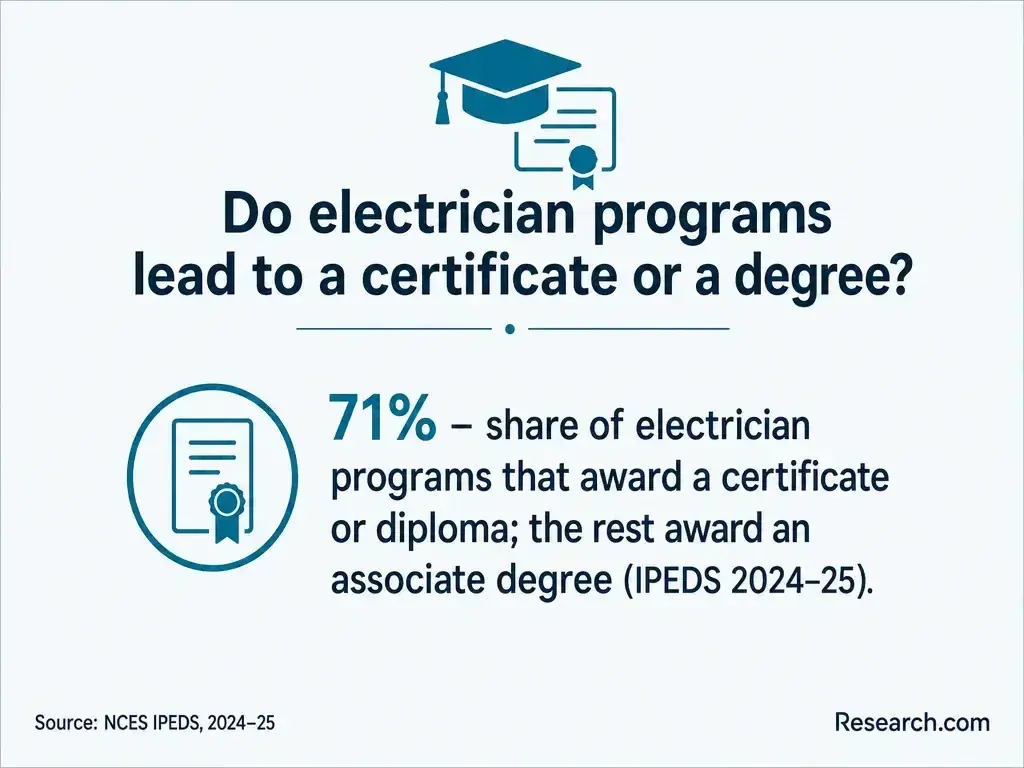
The credential depends on the route: a school may award a certificate or diploma, a college may offer an associate degree, and a registered apprenticeship leads to a completion credential through its sponsor. None is the same thing as a West Virginia occupational license. The U.S. Department of Labor identifies apprenticeship completion as a recognized credential, while the West Virginia State Fire Marshal administers the state's electrician licensing process.
Ask whether a provider's credential documents specific lab skills and whether a sponsor or licensing authority will recognize any instruction or experience. If you are weighing college majors for the future, keep the immediate electrician decision separate: the most valuable credential here is the one that supports supervised entry and your intended licensing path.
School admission and apprenticeship selection are separate processes. A school may ask for an application, education records, and placement information; an apprenticeship sponsor may also assess applicants' math preparation, work readiness, and ability to travel to job sites. Requirements vary by provider and intake, so check the current notices from James Rumsey Technical Institute, Blue Ridge Community and Technical College, and any sponsor you are considering.
Before applying, confirm the minimum age, required prior education, application deadline, math assessment, driver or transportation expectations, and whether a physical or background screening applies to particular worksites. Do not pay for a course on the assumption that admission reserves an apprenticeship position.
Useful electrician training joins calculations and code knowledge to safe, repeatable installation and troubleshooting. The U.S. Bureau of Labor Statistics describes electricians as reading technical diagrams, installing wiring and equipment, testing systems, and identifying electrical problems. For a new trainee, that makes supervised practice with circuits, conduit or other wiring methods, meters, and lockout procedures more important than a course title alone.
Ask to see a skills checklist and the equipment used in labs. Compare how much work you perform yourself with how much you only watch. Training that introduces controls or industrial systems can fit a maintenance goal, while residential wiring practice may be more relevant to a building contractor; neither specialization replaces the broader experience required for the license you seek.
For electrical work in Martinsburg, distinguish supervised training from licensed practice. The West Virginia State Fire Marshal oversees state electrician licensing, including license classifications and examination requirements. A school certificate, institutional accreditation, industry training credential, or registered-apprenticeship record does not independently grant a state electrician license.
Before enrolling, ask the State Fire Marshal which current license category fits your intended work, what documented experience and examination it requires, and whether particular classroom or apprenticeship hours count. Ask an employer who will supervise and document your work. If you plan to cross into another state, check that state's rules separately rather than assuming West Virginia credentials transfer automatically. Optional industry credentials may demonstrate skills, but confirm that an employer wants them before paying for an exam.
Choose backward from your goal: the right option is the one that gets you into appropriately supervised electrical work at a manageable total cost. A ranking can identify programs to investigate, but it cannot replace a licensing check or confirm that a sponsor has an opening. Use this sequence when comparing local options.
A common mistake is choosing the fastest advertised certificate without checking practical hours or the next step into paid work. Another is treating institution type or a national salary median as proof of return on investment. Compare completion likelihood, debt, time out of work, and plausible earnings over several years. Questions such as what's the easiest degree do not answer whether electrician training supplies the hands-on experience your goal requires.
A common progression is supervised trainee or apprentice, followed by work at the applicable licensed level after meeting West Virginia's requirements. With experience, electricians may focus on construction, industrial maintenance, troubleshooting, or supervisory work. Business ownership can introduce separate contractor requirements; an individual electrician license should not be assumed to cover every business obligation, according to the West Virginia State Fire Marshal and West Virginia contractor-licensing authorities.
Choose training that matches the first role you can realistically enter. If you want industrial maintenance, ask about motors and controls alongside wiring fundamentals. If you aim to run jobs later, prioritize a path that documents varied supervised experience rather than a narrow certificate promising quick advancement. For career changers exploring shortest online doctoral programs, that is a different investment decision; electrician advancement depends principally on relevant work experience, skills, and applicable licenses.
The U.S. Bureau of Labor Statistics projects 9.2% national electrician employment growth from 2025 to 2035. That supports investigating the trade, but it is not a forecast of openings in Martinsburg or a guarantee of placement after school. Construction cycles, employer needs, and the number of available supervised positions will affect a local trainee's opportunities.
Before committing to training, check current postings and ask schools and apprenticeship sponsors how many employers take their trainees and where those worksites are. In the Eastern Panhandle, a wider commuting radius may expand opportunities, but crossing a state line adds a licensing check. Treat the national projection as context and an actual route into supervised work as the stronger enrollment test.
Investing in training is a consequential decision, so Research.com evaluates programs against others in the same occupation and location rather than treating every trade school as interchangeable. Only programs with completions reported to IPEDS qualify for this ranking. That boundary matters: an apprenticeship or employer training program can be a strong local option even if it does not appear in a college-oriented dataset.
The best-program rankings assess student outcomes; earnings and return on investment; costs and debt; and quality and recognition. Programmatic accreditation or relevant industry recognition accounts for 20% of the score, institutional accreditation for 10%, and student support for 10%. The remaining 60% covers completion and retention, earnings, attendance costs, tuition, debt, and loan default measures, with entropy-based weights that give more weight to indicators that vary more across programs. Separate most-affordable rankings score only cost and debt indicators; they do not include accreditation or other quality indicators. Readers can find further details on Research.com's ranking methodology.
Research.com uses the following sources across its trade-program research and ranking work. Several are relevant to other occupations, not electrician licensure; their inclusion should not be read as an electrician-program endorsement.
The ranking can narrow a student's search, but it cannot establish whether a particular course satisfies West Virginia licensing requirements or whether a sponsor has an apprenticeship opening. Verify those points directly before paying a deposit.
# 1 position
Not necessarily. An apprenticeship or qualifying supervised employer training may be another route. Confirm the current experience, instruction, and examination rules for your intended license with the West Virginia State Fire Marshal.
Start by checking current electrical offerings at James Rumsey Technical Institute and Blue Ridge Community and Technical College, then compare them with available registered apprenticeships. Offerings and admission windows can change.
Online theory can help, but electrical installation and troubleshooting require practical training. Verify how any program provides supervised, in-person experience and whether that experience counts toward your intended license.
No. A certificate documents completion of training; licensing has separate requirements. Ask the West Virginia State Fire Marshal how, if at all, the program's instruction applies to the license you want.
It may be if you can obtain a suitable placement and want to earn while learning. School can make sense if you need foundational skills first. Compare entry timing, instruction, supervised hours, wages, and out-of-pocket costs.
Request the full cost, credential, lab schedule, required tools, completion conditions, and documented route into supervised work. Confirm licensing relevance with the state rather than relying solely on a provider's marketing.