# 1 position


Audited and Verified:
Our Editorial and Data Verification Process
Research.com uses government datasets, official education statistics and primary institutional information to support its career and degree guides. Our review process checks factual accuracy, occupational definitions, source dates and the requirements associated with the credentials discussed.
How This Article Was Fact-Checked
Our editorial team verifies salary estimates, employment projections, education requirements and program information against original data providers and official organizations. Salary figures are checked against the relevant occupational definitions and reporting periods. Information about licensure, accreditation and required in-person training is reviewed separately.
Fact-checked and verified on:

Co-Founder and Chief Data Scientist

Reviewed by Karolina Broda
Fact-Checker and Data Verification
Choosing an electrician program in Bethlehem means deciding whether to pay for classroom training, pursue a paid apprenticeship, or combine both. The U.S. Bureau of Labor Statistics projects 9.2% national electrician employment growth from 2025 to 2035, making that choice timely. The Research.com team of data scientists created a Best Electrician Trade Schools in Bethlehem for 2027 ranking to help students identify programs worth considering. This guide explains the credentials, practical training, costs, and local rules behind a better-informed decision.
Expect instruction in electrical theory, circuits, drawings, code use, safety, and installation practice - not independent electrician status on graduation. A useful program lets students measure circuits, identify faults, and install components under supervision. Ask how much scheduled time takes place in an equipped lab rather than watching demonstrations.
The pathways differ most in when paid field experience begins. A pre-apprenticeship introduces tools and jobsite expectations; a certificate or diploma provides more structured school training; a registered apprenticeship combines instruction with supervised, paid work. An associate degree can add broader technical study, but its value depends on the specific work you want and whether an apprenticeship sponsor grants credit for it. The U.S. Bureau of Labor Statistics identifies apprenticeship as the usual electrician training route.
Do not confuse a short occupational certificate with search results for short certificate programs that pay well: electrician preparation must be judged by its electrical labs, employer connections, and path to supervised work, not speed alone.
Possible worksites include residential and commercial construction, building maintenance, manufacturing facilities, and electrical contractors serving the Lehigh Valley. The setting changes the skills employers seek: construction emphasizes installation and code-compliant work, while industrial maintenance may emphasize motors, controls, and troubleshooting. The U.S. Bureau of Labor Statistics identifies electrical contractors and manufacturing among electrician employers.
Bethlehem students should ask where a program places trainees and how far worksites extend beyond the city. A classroom close to home may still require travel to a jobsite elsewhere in the valley; transportation can determine whether a paid apprenticeship is practical.
The national median annual wage for electricians was $63,190 in May 2025, according to the U.S. Bureau of Labor Statistics. Half of employed electricians earned more and half earned less. That figure combines experienced workers with newer ones and should not be used as an apprentice wage or a Bethlehem-specific salary promise.
For a local comparison, use the latest Bureau of Labor Statistics wage estimate for the Allentown-Bethlehem-Easton metropolitan area and ask prospective apprenticeship sponsors for their current starting wage schedule and progression rules. The metro area extends beyond Bethlehem and into New Jersey, so its estimate describes a wider labor market. Compare offers on paid hours, benefits, travel, and the point at which wages increase - not annual salary alone.
A short pre-apprenticeship may prepare someone to apply for a job, while a certificate, diploma, or associate degree requires a different amount of coursework and lab time. Published program length is not necessarily time to independent work. The U.S. Bureau of Labor Statistics describes electrician apprenticeships as typically lasting four or five years and combining classroom instruction with paid, supervised work.
Request each program's actual calendar, clock or credit hours, lab hours, and attendance rules. Then ask an apprenticeship sponsor whether prior schoolwork could shorten its instruction or training requirements; never assume credit transfers automatically. Advertisements for an associate degree in 6 months online do not establish a realistic timeline for electrician field training.
Online or hybrid study can suit electrical theory, calculations, drawings, and some code instruction. In-person labs and supervised worksites are needed to demonstrate safe tool use, installation, testing, and fault-finding. An online-only course should therefore be treated as supplemental learning unless an employer or apprenticeship sponsor confirms how practical competencies will be completed and recognized.
For a working adult in Bethlehem, hybrid study may reduce classroom trips but not travel to labs or changing jobsites. Confirm the location and frequency of practical sessions before paying. Institutional accreditation - or appearing among regionally accredited online colleges with no application fee - does not by itself show that electrical field training is included.
There is no defensible single average that captures Bethlehem-area school programs and paid apprenticeships together: their prices, wages, and included equipment differ. Ask each provider for a written, itemized estimate rather than treating advertised tuition as the amount needed to become job-ready.
A useful estimate includes mandatory fees, books or software, tools, consumable materials, safety gear, travel to labs and jobsites, and any applicable exam or local application charges. Subtract confirmed grants or employer-paid costs, then account for earnings you would give up while attending. Federal Student Aid eligibility depends on the school and program; paid apprenticeship wages may make a longer training route more affordable than an apparently faster course. That is a more relevant comparison than pricing unrelated options such as dual degree programs online.
The award depends on the route: a pre-apprenticeship may provide a completion document, a school may award a certificate, diploma, or associate degree, and a registered apprenticeship leads to a nationally recognized completion credential when its requirements are met. A school award and an apprenticeship credential document different training; neither should be described as a Pennsylvania statewide electrician license. The U.S. Department of Labor oversees the registered-apprenticeship framework.
Ask for the exact credential name and who issues it. Also ask whether any industry certificate is included or merely prepared for, and whether a sponsor grants advanced standing. Searches for a quickest masters degree online address a different educational goal and offer no shortcut to electrician occupational entry.
Requirements vary by provider. School applicants may need proof of prior schooling and placement information; apprenticeship applicants may also face an aptitude assessment, interview, age requirement, and requirements tied to worksite safety or transportation. Check the current written criteria with each provider rather than assuming that school admission also secures an apprenticeship.
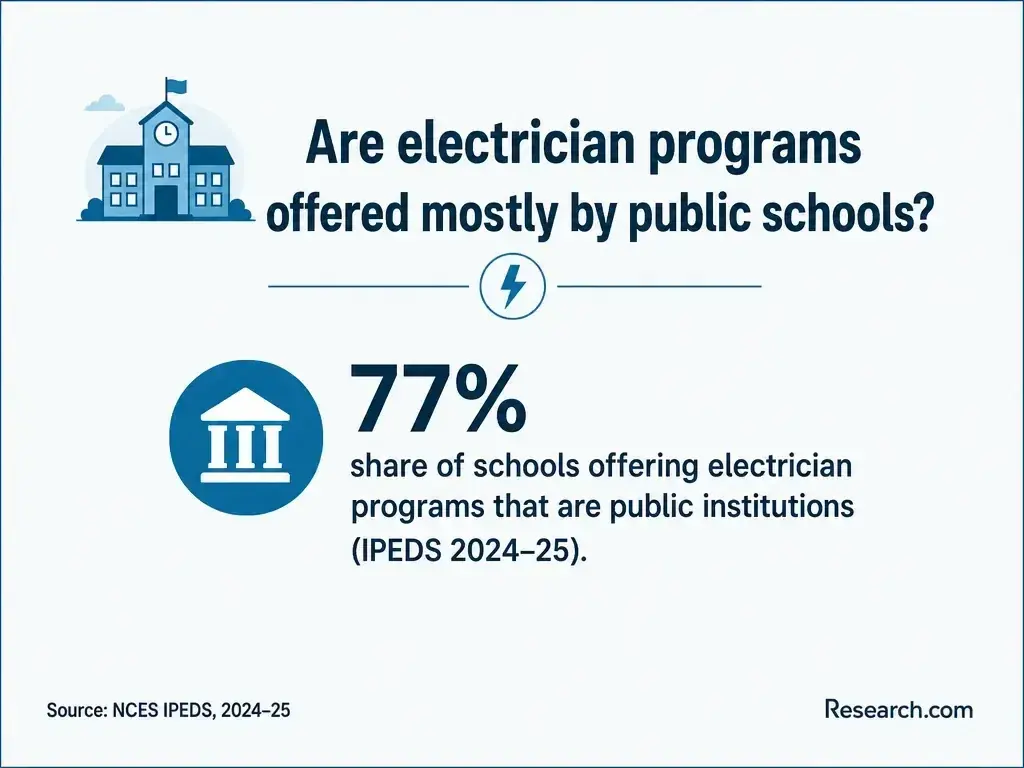
Before applying, ask whether basic algebra is expected, when the next cohort starts, whether evening labs are available, and what documentation is needed for any prior training. Northampton County Area Community College is one public-college option to investigate in the area, but confirm its current electrician-related offerings and admission terms directly before planning around a specific credential.
Core instruction generally covers electrical safety, circuit theory, measurement, blueprint reading, wiring methods, and applying the electrical code used by the relevant jurisdiction. Stronger hands-on preparation requires learners to install, test, and troubleshoot equipment - not simply recognize components. The U.S. Bureau of Labor Statistics describes reading technical diagrams, installing wiring and equipment, and inspecting electrical components as electrician duties.
Match electives or work placements to your target. Someone seeking industrial maintenance should ask about motors and controls; someone targeting building construction should ask about branch circuits, service equipment, and supervised installation practice. Code instruction matters, but knowing a rule is different from performing safe work under real site conditions.
Pennsylvania does not have a general statewide electrician license, but local rules can govern electrical contracting, permits, inspections, and who may perform or supervise particular work. Requirements may change when a job is outside Bethlehem. Check the City of Bethlehem's current building or licensing requirements and those of each municipality where you expect to work before assuming a school credential permits independent contracting.
Keep the categories separate: institutional accreditation concerns the school; school authorization concerns permission to operate; registered-apprenticeship status concerns the training arrangement; an industry certificate documents specified skills; and a local license or registration, where required, governs particular work. None automatically substitutes for another. Ask a program to identify the exact rule and authority behind any claim that graduation makes you "licensed."
Start with the job you want, then compare the training routes that can get you there. A school program may suit someone who needs structured preparation before applying for field work; a paid registered apprenticeship may suit someone ready for competitive entry and work-based learning. Neither is automatically the better investment.
Use the same questions with every school and apprenticeship sponsor so the answers are comparable:
Verify school accreditation and authorization with the relevant accreditor and Pennsylvania regulator, and verify apprenticeship registration with the sponsor or U.S. Department of Labor. Treat missing itemized costs, vague placement promises, and "fully online electrician qualification" claims as reasons to pause. For return on investment, weigh completion probability, debt, lost earnings, expected wage progression, and how long you expect to work - not the ranking or tuition alone.
An entry path commonly begins with helper or apprentice work under supervision, followed by more complex installation or maintenance responsibilities as experience grows. Depending on the employer and local rules, experienced electricians may move toward crew leadership, industrial controls, estimating, or contracting. These are progression possibilities, not automatic outcomes of a certificate.
Choose initial training with that progression in mind. Construction-focused labs and worksites fit installation goals; industrial equipment exposure better supports a maintenance direction. Before paying for an additional credential, ask employers whether they value it for the specific role and whether they provide the training on the job.
The U.S. Bureau of Labor Statistics projects 9.2% growth in U.S. electrician employment from 2025 to 2035. This national projection supports considering the trade, but it does not measure vacancies in Bethlehem or guarantee a local apprenticeship opening.
For a local decision, compare current openings and apprenticeship recruitment across the Lehigh Valley with your willingness to commute. Look at whether postings seek construction installation, facility maintenance, or industrial troubleshooting, then favor programs with matching practical experience. A national growth figure is most useful when paired with evidence that your intended route actually connects to nearby employers.
Investing in training is an important decision, so the Research.com team evaluates programs against other electrician programs in the same location rather than against unrelated schools nationwide. Only programs with completions reported to the Integrated Postsecondary Education Data System (IPEDS) are eligible. That makes the ranking a comparison of reported programs, not a complete inventory of Bethlehem-area apprenticeships or employer training.
The best-programs ranking considers student outcomes; earnings and return on investment; costs and debt; and quality and recognition. Occupation-relevant programmatic accreditation or industry recognition accounts for 20% of the score, institutional accreditation for 10%, and student support services for 10%. The remaining 60% covers completion, full-time and part-time retention, earnings one year after completion, earnings relative to annual attendance cost, tuition, attendance cost, median debt - including debt held by students who withdrew - and federal loan default rates. An entropy-based method assigns more weight to indicators that vary more across programs. A separate most-affordable ranking uses only tuition, attendance cost, median debt, and default rates, with entropy-based weights; accreditation and other quality indicators do not enter that score.
The team uses the following sources to check reported education, cost, outcome, and recognition information. Some recognition databases concern other trades and health occupations; their inclusion as research sources does not imply that they accredit electrician programs.
These checks help readers compare programs on more than advertised tuition. Rankings cannot establish that a particular course meets a municipality's electrical-work rules or that a student will secure an apprenticeship. Readers can review the full approach on Research.com's methodology page.
# 1 position
# 2 position
No single school credential is the universal entry route. Many electricians train through paid apprenticeships that combine instruction and supervised work. A school program can help you prepare, but ask whether it connects to an employer or apprenticeship.
Online coursework can cover theory, but it cannot replace hands-on installation and supervised field practice. Confirm where and how a hybrid program provides those components.
No. Pennsylvania has no general statewide electrician license, and applicable local rules depend on where and how you work. Check the municipality before planning independent work.
It may reduce out-of-pocket education costs while providing wages, but compare tools, travel, fees, admission timing, and earnings during training. Request written terms from each sponsor and school.
Choose the fastest route that still gives you relevant practical training and a credible next step into supervised work. A short completion date has limited value if employers or apprenticeship sponsors do not recognize the preparation.