
# 1 position
Most Affordable Electrical Technician Schools & Training in San Mateo for 2027
Audited and Verified:
Our Editorial and Data Verification Process
Research.com uses government datasets, official education statistics and primary institutional information to support its career and degree guides. Our review process checks factual accuracy, occupational definitions, source dates and the requirements associated with the credentials discussed.
How This Article Was Fact-Checked
Our editorial team verifies salary estimates, employment projections, education requirements and program information against original data providers and official organizations. Salary figures are checked against the relevant occupational definitions and reporting periods. Information about licensure, accreditation and required in-person training is reviewed separately.
Fact-checked and verified on:

Co-Founder and Chief Data Scientist

Reviewed by Karolina Broda
Fact-Checker and Data Verification
The cheapest electrician course may not be the cheapest route to becoming job-ready in San Mateo. California requires supervised experience and state certification for many electrical jobs, so tuition is only one part of the decision. The Research.com team of data scientists created its Most Affordable Electrician Trade Schools in San Mateo for 2027 ranking to help students identify programs worth considering. With U.S. electrician employment projected to grow 9.2% from 2025 to 2035, this guide helps you compare costs, training routes, credentials, and certification requirements (U.S. Bureau of Labor Statistics).
Key findings about electrician degrees in San Mateo
- For California general electrician certification, applicants generally need 8,000 hours of qualifying on-the-job experience; a short school certificate alone does not replace that experience (California Division of Labor Standards Enforcement).
- California community colleges publish a $46-per-unit resident enrollment fee, but fees, supplies, tools, and travel can raise the cost of a classroom-based route; confirm the rate and program charges for your enrollment term (California Community Colleges Chancellor's Office).
- The U.S. median annual wage for electricians was $63,190 in May 2025, not a forecast of apprentice or new-graduate pay in San Mateo (U.S. Bureau of Labor Statistics).
Table of Contents
- Most Affordable Electrical Technician Schools & Training in San Mateo for 2027
- What can I expect from an electrician trade school program in San Mateo?
- Where can I work with an electrician trade school training in San Mateo?
What can I expect from an electrician trade school program in San Mateo?
Expect electrical theory, code study, safety instruction, and hands-on practice - not immediate qualification to work independently. In California, the decisive distinction is whether a course is an approved route for an electrical trainee and connects you to supervised employment, or is simply introductory instruction (California Division of Labor Standards Enforcement).
These pathways serve different starting points. An introductory course can help someone test the trade; an approved trainee program supports the school-and-work route; a registered apprenticeship combines instruction with paid, supervised work. A certificate documents completed coursework, while an apprenticeship completion credential documents a different training experience. Neither should be mistaken for California electrician certification.
If you are weighing electrical work against college majors in demand, compare the actual entry route rather than credential names. Electrician training makes most sense when you want physical, code-governed work and can secure the supervised experience needed beyond the classroom.
Where can I work with an electrician trade school training in San Mateo?
Electrical workers may work for contractors serving homes and commercial buildings, facilities-maintenance employers, or businesses installing and maintaining electrical equipment. Around San Mateo, the practical question is not just where work exists, but whether an employer will hire and supervise you in a role that counts toward your intended California certification classification. Installation, troubleshooting, and maintenance are distinct jobs; ask which tasks an entry-level position actually includes (U.S. Bureau of Labor Statistics; California Division of Labor Standards Enforcement).
Bay Area job sites and training locations can require travel beyond San Mateo. Compare commute time and transport costs before accepting a course or apprenticeship, particularly if instruction and paid work occur at different sites. If you are also considering most rewarding majors, weigh the work itself: a wage comparison cannot tell you whether you will enjoy field installation, service calls, or facilities work.
The U.S. median annual wage for electricians was $63,190 in May 2025 (U.S. Bureau of Labor Statistics). That national figure describes employed electricians across experience levels; it is neither a San Mateo wage estimate nor an entry-level offer. Apprentice pay, hours worked, overtime, employer, and specialization can change actual earnings substantially.
For a local decision, compare written apprentice or trainee wage schedules and current San Mateo-area job offers with your present earnings and commuting costs. Ask whether advertised pay is an hourly base rate, includes overtime, or requires certification you have not yet earned. Do not use a national occupational median to calculate a guaranteed return on tuition.
A classroom course may end well before a person qualifies for independent electrical work. Registered electrician apprenticeships commonly take several years because they combine related instruction with extensive paid job experience; California's general electrician certification route generally calls for 8,000 hours of qualifying work experience (California Division of Labor Standards Enforcement; U.S. Department of Labor). Program length and certification eligibility are therefore different timelines.
Ask a provider for its exact classroom or clock hours, lab hours, calendar schedule, and expected time to obtain supervised work. If you already have electrical experience, ask the program and California certification authority whether it can be documented for placement or eligibility; do not assume prior work automatically receives credit.
Online delivery can suit code reading, calculations, and some electrical theory. Wiring, testing, tool use, and safe work procedures require supervised practice with real equipment; qualifying work experience takes place on job sites. A hybrid program can be convenient for a working trainee, but an entirely online course should not be assumed to meet California electrical-trainee enrollment or certification requirements (California Division of Labor Standards Enforcement).
Compare formats by asking where labs occur, who supervises them, whether attendance fits your work schedule, and whether the course appears on California's approved training-provider list when trainee enrollment is your goal. A listing among fafsa approved online colleges addresses a different question from whether a specific electrical course provides required practical training or qualifies for aid. Verify both with the provider and Federal Student Aid.
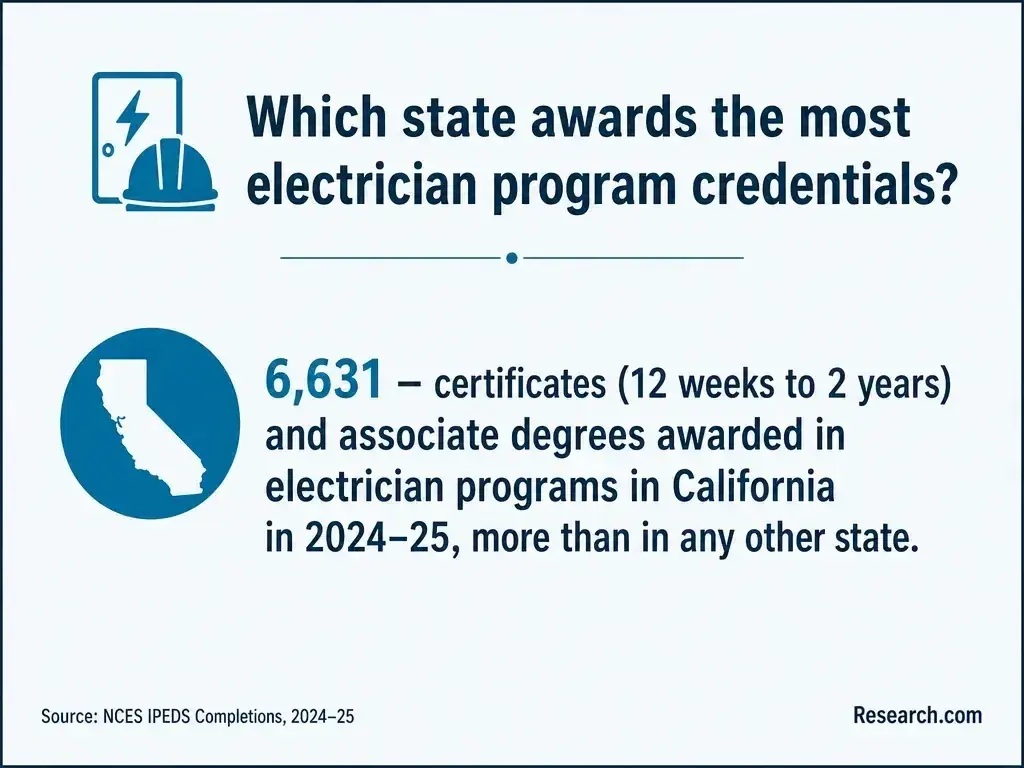
There is no single defensible San Mateo average that covers short courses, college-based instruction, private career training, and paid apprenticeships. California community colleges list a $46-per-unit resident enrollment fee, but that is a starting rate, not a complete electrician-program price; confirm the rate for your term and whether the course carries units (California Community Colleges Chancellor's Office).
Compare written, all-in estimates rather than tuition advertisements. The same charge can have a different impact if one route lets you earn apprentice wages while another requires you to reduce paid work.
- School charges: tuition or enrollment, mandatory fees, books, materials, and any lab or equipment charges.
- Job-readiness charges: tools, personal protective equipment, transportation, and applicable registration, examination, or certification fees.
- Offsets and opportunity cost: grants or eligible aid, employer-paid instruction, apprentice wages, debt payments, and earnings forgone while attending class.
Ask the provider for a current itemized estimate and its aid eligibility; ask an apprenticeship sponsor what it pays for and what you must buy. Research into the easiest way to get a master's degree concerns a separate education decision and offers no shortcut through California electrician experience requirements.
The answer depends on the provider: a course may award a completion certificate, a college program may award a certificate or associate degree, and a registered apprenticeship may award an apprenticeship completion credential. Ask for the exact credential name in writing. A school credential records education; it is not the same as California electrician certification or permission to operate an electrical contracting business (California Division of Labor Standards Enforcement; California Contractors State License Board).
A longer credential is worthwhile when its added instruction, lab access, scheduling, or documented credit serves your goal. It is poor value if you pay for additional coursework believing the credential alone replaces supervised experience. Ask whether completed classes articulate into an apprenticeship or another approved program, and get any credit agreement in writing.
Entry rules vary. A short introductory class may have fewer prerequisites than an apprenticeship, which can use an application process, math assessment, interview, and employer or sponsor requirements. Some programs expect a high school diploma or equivalent. Check the current requirements with the provider rather than assuming that admission to a course also secures an apprenticeship job.
For California's electrical-trainee route, enrollment in a state-approved school and registration with the state are separate from a school's admission decision. Electrical trainees work under required supervision and must keep their registration and education status current (California Division of Labor Standards Enforcement). Before paying, ask the school to identify its approval status and explain the registration steps that apply to your planned work.
Relevant instruction includes electrical fundamentals and calculations, circuit interpretation, wiring methods, equipment testing, troubleshooting, workplace safety, and use of the electrical code. Labs should let students handle tools and test circuits under supervision, while field experience builds the ability to perform those tasks in occupied or active work environments (U.S. Bureau of Labor Statistics; California Division of Labor Standards Enforcement).
Compare the amount and setting of practice, not just course titles. Ask to see a syllabus and lab schedule: Can students repeatedly install, measure, diagnose, and correct faults, or do they mostly watch demonstrations? Ask how the provider teaches current code use and verifies safe practices. Those answers matter more to an entry-level employer than a broad promise of "hands-on training."
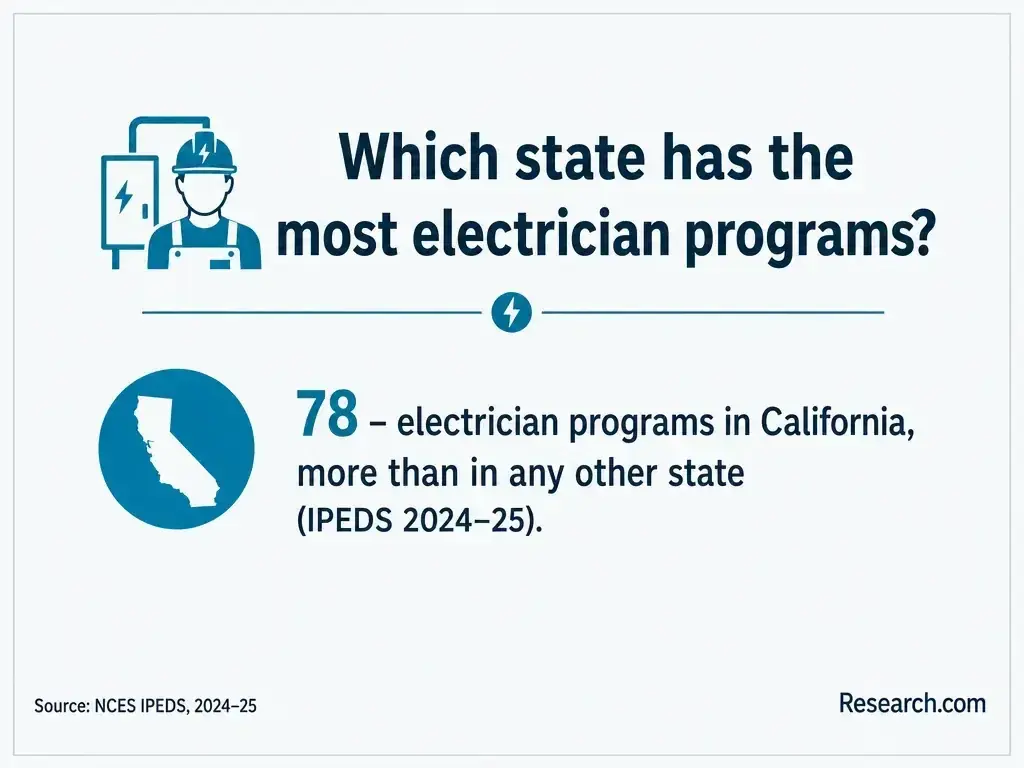
California distinguishes electrical trainees, registered apprentices, and certified electricians. A trainee's school enrollment and state registration do not make the trainee a certified electrician; qualifying supervised work and the applicable certification examination are separate steps. For general electrician certification, California generally requires 8,000 hours of qualifying on-the-job experience. Requirements differ by certification classification, so verify the one matching your intended work with the California Division of Labor Standards Enforcement.
Institutional accreditation concerns a school, state school authorization concerns permission to operate, apprenticeship registration concerns a training arrangement, and electrician certification concerns the worker. None automatically substitutes for another. If your eventual goal is to contract for electrical jobs independently, California's C-10 contractor licensing rules are a further, separate matter administered by the Contractors State License Board. Ask a prospective program which step it supports - and which steps remain after completion.
Start with the job you want, then work backward from California's applicable certification classification. An affordable course is a good investment only if you can complete it, use its training, and access qualifying work without taking on disproportionate cost. To compare finalists, obtain written answers to these questions:
- Is this specific course on California's approved list if I plan to register as an electrical trainee, and what credential does it award?
- How many hours are classroom instruction and supervised lab practice, and where do they take place?
- Does the provider arrange supervised employment or apprenticeship entry, or must I find an employer myself?
- What is my complete cost after fees, tools, transport, available aid, and expected earnings while training?
- What completion, job-placement, and credit-transfer claims can the provider document for this specific program?
Do not mistake a ranking position, institutional accreditation, or a low advertised tuition figure for proof of California certification eligibility. For return on investment, consider completion likelihood, debt, wages earned or forgone during training, your current earnings, plausible earnings afterward, and how long it may take to recover the cost. A paid apprenticeship may be the better fit if you can enter one; a flexible approved course may better suit someone who already has supervised work lined up.
Training can support progression from supervised trainee or apprentice work to California certification in the applicable electrical classification. With experience, electricians may move toward service and troubleshooting, commercial installation, facilities maintenance, estimating, or crew supervision. Independent contracting is a different step with separate state licensing requirements; it is not an automatic result of school completion (California Division of Labor Standards Enforcement; California Contractors State License Board).
Use job descriptions to identify the work you want before selecting classes. A program emphasizing basic residential wiring may not provide the same preparation as one with substantial commercial equipment or troubleshooting practice. A highest-paying trade school careers list can broaden your comparison, but it cannot tell you which local entry route, certification, or starting wage you personally qualify for.
U.S. electrician employment is projected to grow 9.2% from 2025 to 2035 (U.S. Bureau of Labor Statistics, Employment Projections). That supports considering the trade, but it is a national projection - not a forecast of San Mateo openings or a promise of apprenticeship placement. Local hiring depends on projects, maintenance needs, employers, and whether applicants meet supervision and certification requirements.
For a more useful local test, compare current trainee and apprentice openings with each program's schedule and placement support. If the only affordable class conflicts with available work hours or leaves you without a path to supervised experience, its low price may not translate into a workable career-entry plan.
Most Affordable Electrical Technician Schools & Training in San Mateo for 2027
Investing in training is a consequential decision, and an affordability ranking should make its limits clear. Research.com compares electrician programs with other programs in the same occupation and location. Only programs with completions reported to the Integrated Postsecondary Education Data System (IPEDS) are eligible. Registered apprenticeships and other providers absent from IPEDS may still be valuable options; their absence is not a quality judgment.
The most-affordable ranking scores costs and debt only: tuition, cost of attendance, median student debt, and federal loan default rate. It assigns weights through an entropy-based method, which gives more weight to measures that vary more across programs. Accreditation, practical training, and licensing eligibility are not part of this affordability score. Research.com's separate best-program rankings consider student outcomes; earnings and return on investment; costs and debt; and quality and recognition. In those rankings, occupation-relevant programmatic accreditation or industry recognition accounts for 20%, institutional accreditation for 10%, student support for 10%, and outcomes, earnings, and costs for the remaining 60%, weighted by the entropy-based method.
The team uses the following data sources in its ranking work. Some cover fields other than electrical training; their inclusion as sources does not mean an allied-health or dental accreditor approves electrician programs.
- IPEDS database
- National Center for Education Statistics
- College Scorecard database
- Peterson's database
- Commission on Accreditation of Allied Health Education Programs (CAAHEP)
- Accrediting Bureau of Health Education Schools (ABHES)
- Commission on Dental Accreditation (CODA)
- Dental Assisting National Board (DANB)
- National Center for Construction Education and Research (NCCER)
- Apprenticeship.gov Partner Finder
This approach helps readers narrow a price-based shortlist, not select a licensing pathway on price alone. Before enrolling, confirm current charges, California training eligibility, and access to supervised work. Research.com explains its ranking process further on its methodology page.
# 2 position
College of San Mateo - Electrician.
certificate or diplomaFrequently asked questions about electrician programs in San Mateo
What is the cheapest way to start electrician training?
Compare an approved community-college course with registered apprenticeships and employer-supported training. An apprenticeship may provide wages during training, but entry is not guaranteed. Compare tools, fees, transport, and forgone earnings as well as tuition.
Can I become a California electrician after one short course?
No. A course can provide instruction, but California certification also depends on qualifying experience and the applicable examination. General electrician certification generally requires 8,000 hours of qualifying work (California Division of Labor Standards Enforcement).
Can I complete electrician training entirely online?
You may be able to study some theory online. Practical electrical work and qualifying supervised job experience cannot be replaced by online lessons; verify any course's California trainee approval before enrolling.
Does College of San Mateo offer a qualifying electrician pathway?
Check College of San Mateo's current catalog and ask which specific course, if any, is approved for California electrical-trainee enrollment. Do not infer approval from a college's name or a course title.
Is trade school better than an apprenticeship?
Neither is always better. A registered apprenticeship combines paid work and instruction; a school course may offer a more accessible or flexible starting point. Choose based on admission, schedule, total cost, supervised-work access, and the credential you need.
- U.S. Bureau of Labor Statistics - Electricians
Used to verify salary, employment outlook, and typical education requirements.
https://www.bls.gov/ooh/construction-and-extraction/electricians.htm - NCCER - Accredited Training
Used to verify programmatic accreditation or industry recognition of programs.
https://www.nccer.org/ - O*NET OnLine - Electricians
Used to verify common responsibilities, skills, work settings, and education expectations.
https://www.onetonline.org/link/summary/47-2111.00 - College of San Mateo - official website
Official school website (programs, tuition, admissions).
https://www.collegeofsanmateo.edu/