# 1 position

Audited and Verified:
Our Editorial and Data Verification Process
Research.com uses government datasets, official education statistics and primary institutional information to support its career and degree guides. Our review process checks factual accuracy, occupational definitions, source dates and the requirements associated with the credentials discussed.
How This Article Was Fact-Checked
Our editorial team verifies salary estimates, employment projections, education requirements and program information against original data providers and official organizations. Salary figures are checked against the relevant occupational definitions and reporting periods. Information about licensure, accreditation and required in-person training is reviewed separately.
Fact-checked and verified on:

Co-Founder and Chief Data Scientist

Reviewed by Karolina Broda
Fact-Checker and Data Verification
Choosing electrician training in Nanticoke means deciding whether to pay for classroom preparation, pursue a paid apprenticeship, or combine both. The U.S. Bureau of Labor Statistics projects electrician employment to grow 9.2% nationally from 2025 to 2035, but that does not make every program a good investment. This guide explains costs, credentials, practical training, and Pennsylvania's rules. It also accompanies the Most Affordable Electrician Trade Schools in Nanticoke for 2027 ranking, created by the Research.com team of data scientists to help students identify programs worth considering.
An electrician trade-school program teaches the theory and practical skills needed to begin electrical work, but a school credential is not the same as completing an apprenticeship. Students should expect instruction in electrical circuits, wiring methods, the National Electrical Code, blueprint reading, testing equipment, and jobsite safety, followed by supervised practice on training equipment or installations.
The main choice is between school-first training and earn-while-you-learn training. A certificate or diploma can prepare someone to apply for entry-level work or an apprenticeship; an associate degree may add broader technical coursework. A registered apprenticeship pairs technical instruction with substantial paid, supervised work and is generally the more direct route to building documented trade experience. Ask whether a school's practical exercises and credits count toward a particular apprenticeship: acceptance is not automatic.
For someone comparing fast degrees that pay well with a trade credential, the decisive difference is time to qualified electrical work, not time to receive a school certificate. A short program may speed entry into the field without shortening the supervised experience an employer or local authority expects.
Electricians work for electrical contractors, building owners, manufacturers, utilities, and maintenance departments. In and around Nanticoke, that means considering both local jobs and commutes to other Luzerne County worksites; a training schedule that conflicts with a potential employer's hours can be a real cost.
Work settings change the skills worth prioritizing. Residential construction emphasizes branch circuits and installation; commercial projects add larger systems and coordinated jobsite work; industrial maintenance calls for troubleshooting motors and controls. The U.S. Bureau of Labor Statistics describes electricians as installing, maintaining, and repairing electrical power, communications, lighting, and control systems. Choose labs or work placements aligned with the setting you want rather than assuming every electrical credential prepares you equally for each one.
The national median annual pay for electricians was $63,190 in May 2025, according to the U.S. Bureau of Labor Statistics. This is the midpoint for working electricians nationwide - not the expected pay of a new Nanticoke trainee. Apprentices generally earn less than experienced electricians, with wages increasing as they gain skills under their sponsor's terms.
Before using wages to justify tuition, compare actual apprentice or entry-level offers for jobs within your commuting range. Ask whether pay includes benefits, how raises are scheduled, and whether travel between jobsites is compensated. A program's advertised graduate earnings may reflect experienced workers, a broader geographic area, or a different occupation; request the occupation, measurement period, and number of graduates behind any claim.
Completion time depends on which milestone you mean. School certificates and diplomas vary in length by provider and attendance schedule; an associate degree generally takes longer because it includes additional coursework. The only reliable estimate for a specific Nanticoke option is its current program plan, including required labs and course availability.
For the work-based route, the U.S. Bureau of Labor Statistics says most electrician apprenticeships last four or five years and typically include about 2,000 hours of paid on-the-job training each year plus technical instruction. Those are typical apprenticeship figures, not a promise that any school credential fulfills a local experience requirement. A part-time school schedule may preserve current earnings but delay completion; a paid apprenticeship may take longer to finish while providing income and documented practice throughout.
Online coursework can be useful for electrical theory, calculations, code study, and scheduling around a job. It cannot by itself demonstrate safe use of tools, circuit installation, testing, or supervised work on a jobsite. A hybrid program is credible when it specifies where those in-person competencies are practiced and assessed.
For a working adult comparing cheap online schools for job holders, the electrician-specific question is whether required labs or work placements are reachable from Nanticoke at workable times. Get the campus, lab, and field schedule in writing. Do not assume an online certificate satisfies an employer, apprenticeship sponsor, or municipality simply because the theory courses can be completed remotely.
There is no defensible single average price for an electrician trade-school program in Nanticoke: published college prices, private-school charges, and paid apprenticeship costs are not equivalent measures. For Luzerne County Community College, request the current program-specific tuition and mandatory-fee schedule and confirm which residency rate applies. For any provider, compare the total cost to become job-ready, not a headline tuition figure.
These cost categories matter because two similarly priced programs can leave students with very different bills and earning opportunities.
| Cost or offset | What to confirm |
| School charges | Tuition, required fees, books, software, and lab materials for the full credential. |
| Jobsite readiness | Tools, protective equipment, transportation, and any required screening. |
| After-school costs | Applicable exam or local licensing fees, if the intended job or jurisdiction requires them. |
| Offsets | Grants, eligible federal or state aid, employer support, and wages earned during a paid apprenticeship. |
| Time cost | Work hours or income given up to attend classes and labs. |
Federal student aid depends on both student and program eligibility, according to Federal Student Aid; do not assume every short course qualifies. Ask the provider for an itemized estimate and a written aid offer, then compare what you would pay and borrow through completion. Students comparing trades with money making majors should likewise compare debt and time out of work - not salary figures alone.
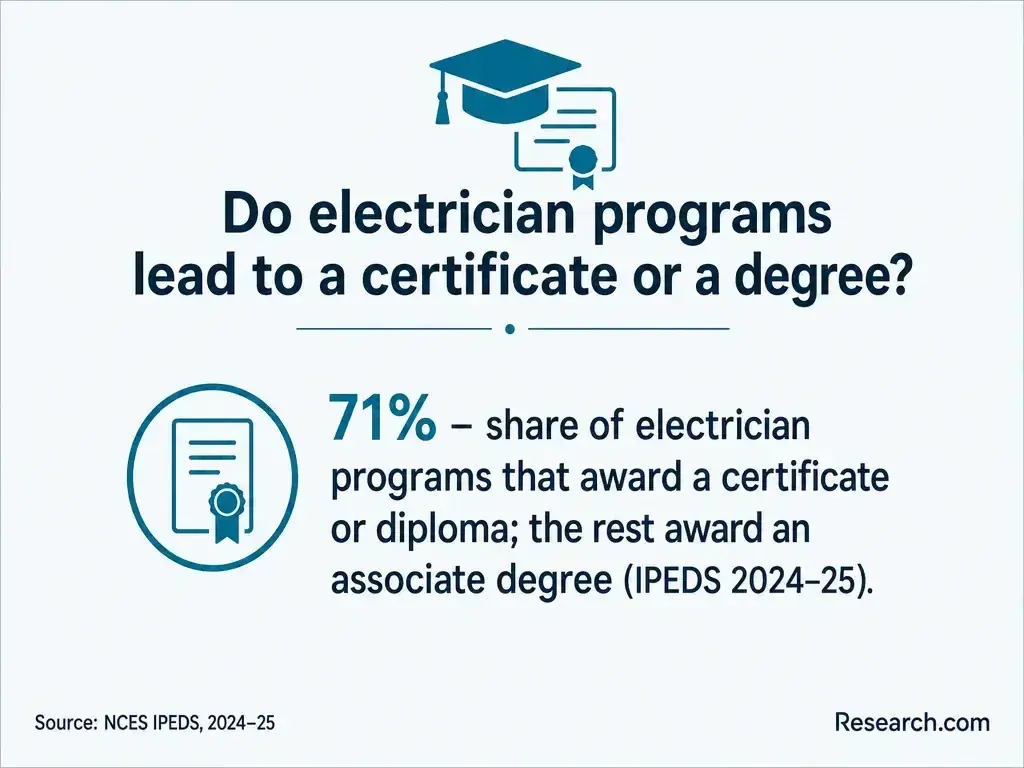
A school may award a certificate, diploma, or associate degree, depending on its program. A pre-apprenticeship may instead provide completion documentation intended to help applicants enter an apprenticeship; completing it does not itself make someone a registered apprentice. A registered apprenticeship leads to a recognized completion credential after its required instruction and supervised work, according to the U.S. Department of Labor.
Before enrolling, ask for the exact credential name and a course-and-lab outline. Check whether an apprenticeship sponsor accepts any coursework for advanced standing and whether that decision affects placement, required hours, or wages. Institutional accreditation, industry credentials such as NCCER-related training, apprenticeship registration, and permission to perform locally regulated work are distinct; none should be inferred from the name of a certificate.
Entry requirements vary by provider. A college program may require an application, placement or prerequisite coursework, and registration for lab sections. Apprenticeship sponsors commonly assess applicants' readiness for math, safety-sensitive physical work, and reliable travel to jobsites; individual sponsors set their own application procedures. Ask the provider for its current requirements rather than assuming acceptance into school also secures an apprenticeship position.
If you already have electrical coursework or related work experience, request a written review of transfer credit or advanced standing before paying a deposit. Even if you are comparing an easiest doctoral program with a career change, electrician entry turns on practical preparation and the requirements of the employer or apprenticeship sponsor, not the prestige of a prior credential.
Useful electrician training connects theory to decisions workers make under supervision: calculating electrical loads, identifying conductors and protection devices, reading plans, following applicable code, and diagnosing faults without creating a hazard. The U.S. Bureau of Labor Statistics identifies troubleshooting, critical thinking, physical stamina, and safety awareness as important to the occupation.
Ask to see what students actually build and test in the lab. Practice with meters, wiring assemblies, and safe isolation procedures is more relevant to entry-level electrical work than a syllabus consisting only of videos and quizzes. If your goal is industrial maintenance rather than residential installation, look for meaningful exposure to motors and controls and ask whether a relevant work placement is available.
Pennsylvania does not issue a single statewide general electrician license. Municipal rules may govern who can perform or contract for electrical work, and requirements can change when a worker crosses a local boundary. The Pennsylvania Department of Labor & Industry's apprenticeship registration is a separate matter: registration establishes a structured training program, not a universal license to work independently.
Before choosing training, contact the municipality where you expect to work and ask what rules apply to an apprentice, employee, journeyperson, or contractor. Confirm any required examination, experience documentation, registration, or permit arrangements directly with that authority. Also ask prospective employers whether they expect apprenticeship completion or a particular credential. A school's accreditation or certificate alone does not answer either question.
The best-value option is the one that gets you the practical preparation and accepted experience needed for your intended job at a manageable total cost. A lower-ranked or unranked apprenticeship may make more sense than a low-tuition school program if it offers paid, supervised work. Conversely, school-first training can suit someone who needs structured fundamentals before competing for apprenticeship openings.
Use the following checks when speaking with Luzerne County Community College, another eligible provider, or an apprenticeship sponsor. They expose common mistakes before they become expensive.
If you are also considering an online masters 1 year, keep the investment comparison grounded in your actual career goal: electrician training requires in-person competence and usually years of supervised trade experience, regardless of how quickly classroom study ends. Weigh completion probability, lost earnings, aid, debt, and likely earnings over a realistic time horizon rather than using tuition alone as a return-on-investment measure.
A common starting point is an electrical helper or apprentice role under supervision. With documented experience, a worker may move toward more independent installation or maintenance responsibilities, then specialize in areas such as commercial systems, industrial controls, or troubleshooting. Supervisory and contracting roles require additional experience and may be subject to local rules; they are not automatic outcomes of a school credential.
Choose training for the first job you can realistically obtain. Someone already offered a registered apprenticeship may gain more from its paid instruction than from buying a separate introductory certificate. Someone unable to enter an apprenticeship immediately may use a hands-on school program to strengthen an application, provided its cost is reasonable and its training matches local employers' work.
The U.S. Bureau of Labor Statistics projects 9.2% national employment growth for electricians from 2025 to 2035. That supports considering the trade, but it is not a forecast of openings in Nanticoke or a guarantee of placement after training. Construction schedules, contractor hiring, and the distance to available jobs will shape a local applicant's opportunities.
For a more useful personal outlook, review current electrical helper and apprentice postings within your feasible commute and compare their requirements with each program's labs and work-based training. Ask apprenticeship sponsors when they accept applicants and whether entry is competitive. This gives you a clearer test of whether a particular credential is worth its cost than national growth alone.
Education is a substantial investment, so Research.com designed this ranking to help readers compare electrician programs against other programs serving the same location and occupation. The team checks multiple education and industry sources to improve the ranking's credibility and accuracy. Only programs with completions reported to the Integrated Postsecondary Education Data System (IPEDS) are eligible; a missing apprenticeship or training provider should not be interpreted as low quality.
The most affordable ranking scores eligible programs on tuition, cost of attendance, median student debt, and federal loan default rate. An entropy-based method gives more weight to measures that distinguish programs more clearly. Accreditation, support services, and other quality indicators are not part of this affordability score. Readers should assess those separately before enrolling. Research.com also publishes broader best-program rankings that consider outcomes, earnings, costs, recognition, and support; those are a different evaluation.
The following sources inform Research.com's trade-program ranking work. Some cover other trades and do not establish electrician-specific approval or licensing eligibility.
The ranking can narrow a cost-focused shortlist, but it cannot replace a current written price quote or confirmation of hands-on training and local work requirements. See Research.com's methodology for more information about how rankings are created.
# 1 position
# 2 position
Not necessarily. A paid apprenticeship is another route. Check employer expectations and the rules of the municipality where you plan to work before paying for a school program.
No. It is a local college option; registered apprenticeships and employer training may also be available. Compare their practical training, entry requirements, costs, and wages while training.
Online study can cover theory, but electrical installation, testing, and supervised jobsite work require in-person practice. Verify where and how any advertised online program provides it.
Do not assume so. A school certificate documents coursework, while employers and municipalities may expect supervised experience or impose separate requirements.
Compare full school charges and job-ready expenses against grants, employer support, and potential apprenticeship wages. Exclude options that do not provide the hands-on preparation your target job requires.