# 1 position
Pennco Tech-Blackwood - Electrician.
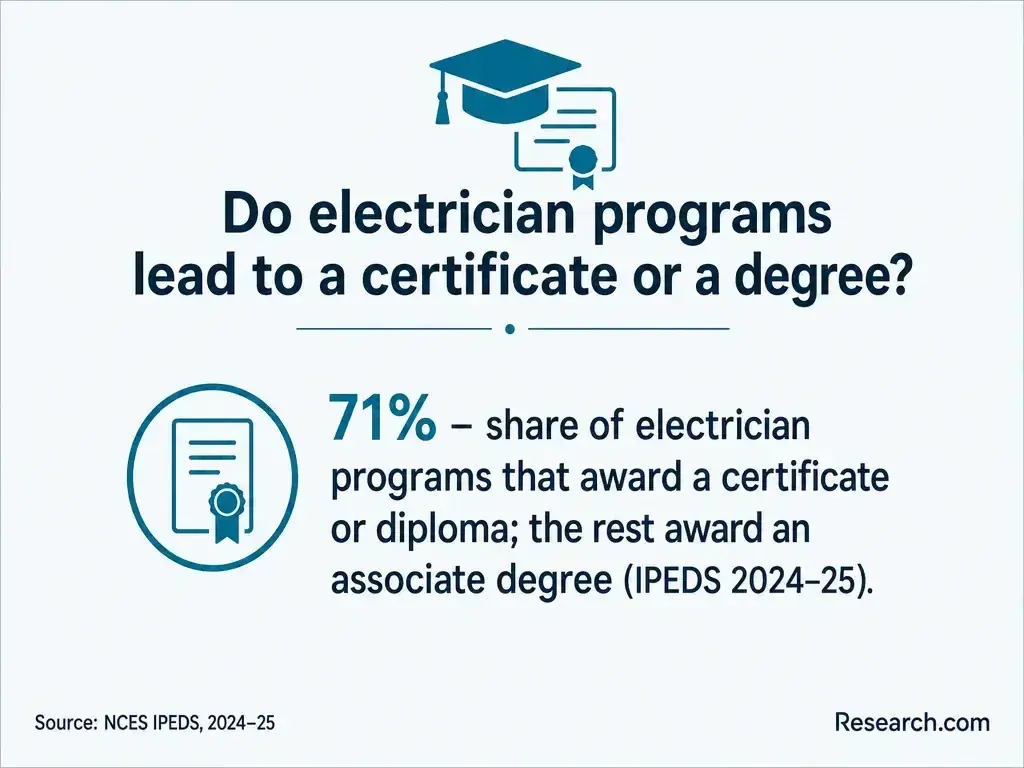
certificate or diploma

Audited and Verified:
Our Editorial and Data Verification Process
Research.com uses government datasets, official education statistics and primary institutional information to support its career and degree guides. Our review process checks factual accuracy, occupational definitions, source dates and the requirements associated with the credentials discussed.
How This Article Was Fact-Checked
Our editorial team verifies salary estimates, employment projections, education requirements and program information against original data providers and official organizations. Salary figures are checked against the relevant occupational definitions and reporting periods. Information about licensure, accreditation and required in-person training is reviewed separately.
Fact-checked and verified on:

Co-Founder and Chief Data Scientist

Reviewed by Karolina Broda
Fact-Checker and Data Verification
Choosing electrician training in New Jersey means deciding more than where to take classes: you need a route to supervised work and, eventually, the credentials your job requires. The U.S. Bureau of Labor Statistics projects 9.2% national growth in electrician employment from 2025 to 2035. This guide explains costs, apprenticeships, practical training, and state rules. It accompanies the Best Electrician Trade Schools in New Jersey for 2027 ranking, created by the Research.com team of data scientists to help you identify programs worth considering.
Expect instruction in electrical theory, the National Electrical Code, blueprint reading, circuits, wiring methods, testing, and jobsite safety, alongside supervised practice with tools and equipment. A school certificate or diploma documents training; a registered apprenticeship pairs related instruction with paid, supervised work. Neither credential should be mistaken for an electrical contractor license.
The routes below solve different problems. Compare them by the experience you still need after finishing, not by the credential name alone.
| Pathway | What it typically provides | Best fit and main limitation |
| Trade-school certificate or diploma | Structured classroom and lab training; credential and hours depend on the provider | Useful for building fundamentals before seeking work; ask whether employers or apprenticeship sponsors credit the training |
| Public vocational or community-college training | Electrical coursework and practical instruction; some options lead to a certificate, while others award an associate degree | Worth comparing for schedule and resident pricing; classroom completion alone is not a substitute for supervised work |
| Registered apprenticeship | Paid on-the-job learning and related instruction under an approved sponsor | Strong fit if you can secure a position and need earnings while training; entry may depend on openings and selection requirements |
| Employer-sponsored entry route | Workplace training that varies by employer | Can offer earlier paid experience; verify supervision, instruction, and whether hours meet your eventual credential goal |
New Jersey readers should ask a provider exactly how much time is spent in a wiring lab, who supervises practice, and whether it has a documented route into an apprenticeship or qualifying job. Two programs with similar certificates can offer very different preparation.
Electricians work for electrical contractors, construction firms, industrial facilities, utilities, and organizations maintaining buildings and equipment (U.S. Bureau of Labor Statistics). In New Jersey, a residential contractor and an industrial maintenance employer may value different experience: one may emphasize service wiring and code compliance, while the other may prioritize motors, controls, and troubleshooting.
Ask where a program's apprentices or entry-level hires actually work and whether its employer contacts are within a practical commute. A classroom near home is less useful if required jobsite training is difficult to reach. School training may help you compete for an entry-level position, but independent contracting is a separate, regulated step.
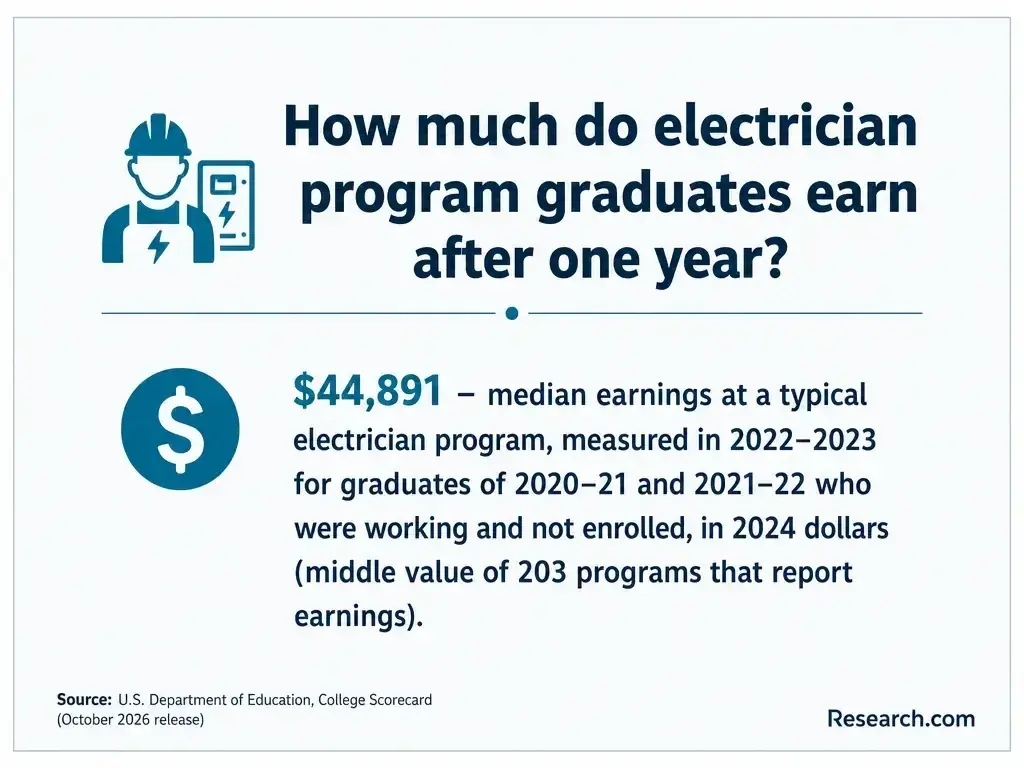
Pay varies by experience, employer, specialty, work hours, and location. The U.S. Bureau of Labor Statistics reports a $63,190 national median annual wage for electricians in May 2025. That is an occupation-wide midpoint, not a New Jersey starting wage or an expected salary immediately after school.
For a local decision, compare current apprentice wage schedules and entry-level offers in the part of New Jersey where you intend to work. Ask whether quoted compensation includes overtime or benefits. When estimating a program's return, compare likely earnings while training as well as afterward: a paid apprenticeship can change the calculation even if a school program is shorter.
School programs vary from short introductory training to longer certificate, diploma, or associate-degree pathways; there is no single New Jersey trade-school duration that makes someone an electrician. Ask for the program's published clock hours, lab hours, weekly timetable, and completion date rather than relying on an "accelerated" label.
A registered apprenticeship is a longer work-and-instruction route. The U.S. Department of Labor says such programs commonly provide approximately 2,000 hours of paid on-the-job learning annually, with related classroom instruction; the sponsor sets its approved schedule. Before paying for school first, ask whether an apprenticeship sponsor will recognize those classes or grant advanced standing. A shorter course is only a time-saver if it advances the supervised-training route you need. Searches for online masters 1 year do not answer that electrician-specific question.
Online coursework can be useful for theory, calculations, code study, and scheduling flexibility. It cannot by itself demonstrate safe wiring, equipment testing, fault finding, or performance under jobsite supervision. On-campus and hybrid programs can provide those practical components if their labs are properly equipped and scheduled often enough.
Request a written breakdown of remote instruction, in-person lab hours, and supervised fieldwork. For a hybrid option, factor travel to labs and worksites into the apparent convenience. Do not treat an entirely online course as proof of apprenticeship credit or New Jersey licensing eligibility; confirm any claimed credit with the relevant sponsor and the New Jersey State Board of Examiners of Electrical Contractors. A page about online phd programs no dissertation likewise offers no evidence about required electrical practice.
There is no reliable single price that represents every New Jersey electrician route: school tuition, program length, residency pricing, and paid apprenticeships are not directly interchangeable. Obtain a current, itemized quote from each provider rather than using an advertised tuition figure as your budget.
Calculate the cost of becoming job-ready, including mandatory fees, books, tools, testing equipment, safety gear, consumable materials, transportation, and any relevant examination or application fees. Add earnings you may forgo during full-time study; subtract grants or other aid you are eligible to receive. A paid apprenticeship may reduce the need to borrow, though available positions and wages vary. For college-based training, cheapest per credit hour online college comparisons are not a substitute for checking electrician-specific lab fees and required in-person work.
Ask the school about eligible federal aid and ask New Jersey's workforce system about possible training assistance; eligibility depends on the student and program (Federal Student Aid; New Jersey Department of Labor and Workforce Development). Compare the resulting net cost with the training and employment access each route provides.
A school may award a certificate, diploma, or, where offered, an associate degree. A registered apprenticeship leads to a completion credential through its sponsor. These documents describe different combinations of instruction and work experience; none is automatically a New Jersey electrical contractor license (New Jersey State Board of Examiners of Electrical Contractors; U.S. Department of Labor).
Check the precise credential name and whether the institution is authorized to operate. Institutional accreditation concerns the school, while industry recognition concerns particular training or credentials; neither alone establishes licensing eligibility. A nationally accredited online colleges list may help frame an accreditation question, but it cannot verify that an electrician program supplies practical training or qualifies for credit toward a state requirement.
Schools set their own entry criteria, which may include proof of prior schooling, an application, an assessment, and the ability to participate safely in labs. Registered apprenticeship sponsors set separate selection requirements and may assess math readiness, availability for jobsite work, and other sponsor-specific conditions (U.S. Department of Labor). Admission to a school is not admission to its partner apprenticeship.
Before applying, ask whether you need to buy tools or safety gear, arrange transportation to worksites, or meet employer screening requirements. If an admissions representative promises apprenticeship placement, request the terms in writing: which sponsor participates, how applicants are selected, and whether a place is guaranteed.
A useful foundation connects electrical theory to safe installation and troubleshooting. Look for supervised practice reading plans, making connections, testing circuits, selecting wiring methods, and using the National Electrical Code - not just lectures or simulated exercises. The U.S. Bureau of Labor Statistics identifies installing, maintaining, and repairing electrical systems as core electrician work.
Curriculum should also match your intended setting. Residential work calls for different repeated tasks than industrial controls or building maintenance. Ask to see the lab equipment and an outline showing which skills students perform themselves. If a program advertises solar, electric-vehicle charging, or automation content, check whether it teaches the underlying electrical work rather than only describing the technology.
It depends on the role. New Jersey regulates electrical contracting through the State Board of Examiners of Electrical Contractors, which administers electrical contractor licensing and qualified journeyman electrician registration. Working as a supervised trainee is different from independently offering electrical contracting services. School graduation alone does not confer either state credential (New Jersey State Board of Examiners of Electrical Contractors).
Before enrolling, tell the board or your prospective apprenticeship sponsor your intended role and ask which supervised experience, instruction, documentation, and examinations apply to your route. Keep records of classroom hours and work experience from the start. An industry training certificate can demonstrate a skill, but it does not replace state registration or licensure when those are required.
The best investment is the route that gets you usable electrical skills and a credible next step toward paid, supervised work at a cost you can sustain. A school program can make sense if you need structured practice before applying to employers; a registered apprenticeship may make more sense if you can obtain a place and need wages while learning. Neither choice is best for everyone.
Use the following checks with every shortlisted school or sponsor. They expose gaps that a ranking or advertised tuition cannot show.
Beware of a program that promises licensure upon graduation, treats online theory as a replacement for supervised work, or will not itemize fees. Pages about easy degrees do not resolve the harder question here: whether you will leave with the practical preparation and documented experience your intended electrical role requires.
An initial route may lead to supervised installation or maintenance work, followed by broader responsibility as experience and applicable credentials accumulate. Electricians may focus on residential service, commercial construction, industrial equipment, or electrical maintenance (U.S. Bureau of Labor Statistics). Later options can include supervising work or pursuing electrical contracting, subject to New Jersey's separate requirements.
Choose early training for the work you want to enter, not for a distant job title. For example, someone drawn to industrial troubleshooting should look for meaningful motors, controls, and diagnostic practice, then seek relevant supervised work. Optional specialty training can build on that foundation; it is not a substitute for the experience required for regulated work.
The U.S. Bureau of Labor Statistics projects 9.2% national employment growth for electricians from 2025 to 2035. That supports considering the trade, but it does not predict the number of openings near a particular New Jersey school or guarantee an apprenticeship position.
For a local decision, compare current openings and apprenticeship recruitment in the area where you can realistically commute, using New Jersey Department of Labor and Workforce Development information and sponsor postings. Demand matters most when you can connect your training to an available entry route; ask providers where recent completers obtained supervised work.
Education is a significant investment, so the Research.com team designed this ranking to help readers compare electrician programs with other programs serving the same occupation and location. The team evaluates reported outcomes, costs, and quality indicators rather than treating a school's name or advertised tuition as sufficient evidence of value.
Only programs with completions reported to the Integrated Postsecondary Education Data System (IPEDS) are eligible. The best-programs ranking considers student outcomes, earnings and return on investment, costs and debt, and quality and recognition. Programmatic accreditation or relevant industry recognition accounts for 20% of the score, institutional accreditation for 10%, and student support services for 10%. The remaining 60% covers outcomes, earnings, and costs, with weights distributed through an entropy-based method that gives more weight to indicators that differ more across programs. A separate most-affordable-programs methodology scores only tuition, cost of attendance, median debt, and federal loan default rates; it does not score accreditation or other quality indicators.
The team draws on the following sources. Some accreditation and credentialing sources support Research.com's broader trade-program research; their presence does not imply that a healthcare accreditor approves electrician training.
IPEDS and College Scorecard do not capture every union, employer-sponsored, or registered apprenticeship option. Use the ranking to shortlist schools, then verify each program's current price, hands-on instruction, apprenticeship connections, and relevance to New Jersey requirements. More detail on the ranking process is available in Research.com's methodology.
# 1 position
# 2 position
# 3 position

# 4 position

# 5 position
# 6 position
# 7 position
# 8 position

# 9 position
# 10 position

# 11 position

# 12 position

# 13 position

No. Registered apprenticeships combine paid work and related instruction. Prior school training may help you prepare, but ask the sponsor whether it grants credit or advanced standing (U.S. Department of Labor).
No. A certificate documents school training, not authorization to offer electrical contracting services. Check the New Jersey State Board of Examiners of Electrical Contractors for the requirements of the role you intend to pursue.
Online study can cover theory and code topics, but practical wiring, testing, and supervised jobsite work require in-person participation. Verify how any online coursework fits your apprenticeship or credential plan.
Compare the school's full net cost and practical training with the apprenticeship's wages, available openings, instruction, and schedule. The better option is the one you can enter, complete, and use toward your intended New Jersey electrical role.