# 1 position


Audited and Verified:
Our Editorial and Data Verification Process
Research.com uses government datasets, official education statistics and primary institutional information to support its career and degree guides. Our review process checks factual accuracy, occupational definitions, source dates and the requirements associated with the credentials discussed.
How This Article Was Fact-Checked
Our editorial team verifies salary estimates, employment projections, education requirements and program information against original data providers and official organizations. Salary figures are checked against the relevant occupational definitions and reporting periods. Information about licensure, accreditation and required in-person training is reviewed separately.
Fact-checked and verified on:

Co-Founder and Chief Data Scientist

Reviewed by Karolina Broda
Fact-Checker and Data Verification
Choosing the cheapest electrician program can be expensive if it leaves you without the field experience employers expect. The Research.com team of data scientists created the Most Affordable Electrician Trade Schools in Las Vegas for 2027 ranking to help students make an informed choice about programs worth considering. The U.S. Bureau of Labor Statistics projects 9.2% national growth in electrician employment from 2025 to 2035. This guide helps prospective students and career changers compare costs, credentials, apprenticeships, and Nevada work requirements before enrolling.
Expect instruction in electrical theory, code use, safety, and installation techniques, with supervised practice where the program provides a lab or shop. A school credential can help you qualify for entry-level opportunities, but it does not replace the extensive jobsite experience involved in becoming an independent electrician. Compare these pathways by what you will actually do after enrollment, not just by the credential's name.
The table distinguishes common routes. Durations and credit for prior training depend on the provider and should be confirmed before you commit.
| Pathway | Training and credential | Best fit and main trade-off |
| School certificate or diploma | Classroom and, where offered, lab training; school-awarded credential | Useful for building fundamentals before applying for work; ask how much supervised field experience it includes. |
| Community college program | Technical coursework and labs; certificate or, where offered, associate degree | Fits students who want structured instruction; compare course schedules and total required credits. |
| Registered apprenticeship | Paid supervised work plus related instruction; apprenticeship completion credential | Fits applicants ready to learn on jobsites; entry may be selective and work schedules less flexible. |
| Employer-sponsored entry route | Training varies by employer; a formal credential is not assured | May offer an earlier paycheck; verify supervision, instruction, and how experience is documented. |
In the Las Vegas area, ask providers how their training connects to local contractors and apprenticeship sponsors. That connection matters more than a short completion time if your goal is sustained electrical work.
Potential settings include residential and commercial electrical contractors, construction and renovation sites, and maintenance teams serving large properties. Las Vegas's hospitality venues create maintenance opportunities, but those jobs may combine electrical tasks with other building-systems work. Ask whether a prospective role is an electrical apprenticeship, an electrical helper position, or broader facilities maintenance: the supervision, recorded experience, and route to advancement may differ.
School training alone may make you more competitive for an entry-level opening; it should not be read as authorization to perform regulated work independently. The U.S. Bureau of Labor Statistics describes apprenticeship as a common route into the electrician occupation.
The U.S. Bureau of Labor Statistics reports a $63,190 national median annual wage for electricians in May 2025. That is the midpoint across workers at different experience levels nationwide - not a Las Vegas wage quote or an expected wage immediately after school. Apprentices, helpers, and experienced electricians can have substantially different earnings.
For a useful local comparison, ask apprenticeship sponsors for their current wage progression and check current Las Vegas-area occupational wage estimates from the Nevada Department of Employment, Training and Rehabilitation or the U.S. Bureau of Labor Statistics. Compare offers alongside paid hours, benefits, commuting costs, and the time needed to progress.
A school certificate may take less time than an apprenticeship, but the end points differ: finishing coursework is not the same as completing supervised electrical training. Registered apprenticeships combine related instruction with substantial paid on-the-job learning over multiple years; the exact schedule and hour requirements belong to the sponsor's registered standards (U.S. Department of Labor, Apprenticeship.gov).
Ask each school for its published clock or credit hours, lab hours, and full-time and part-time schedules. Then ask an apprenticeship sponsor whether any coursework earns advanced standing. An accelerated schedule can shorten time in class without shortening the experience needed for the job. Search results for best accelerated adult degree programs online address a different kind of study; they are not a shortcut through hands-on electrical training.
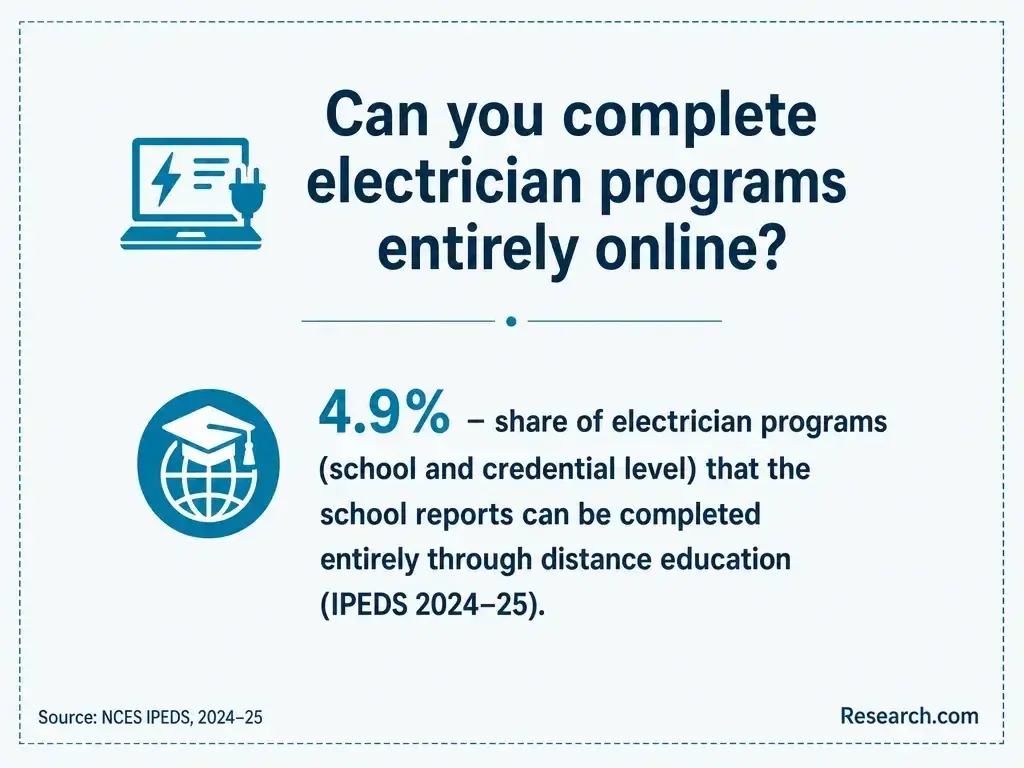
Online coursework can be practical for electrical theory, code reading, and calculations. Wiring, testing, tool use, and safe work habits require supervised practice with physical equipment; apprenticeship experience requires work at actual sites. A hybrid program can combine those elements, but an entirely online course should not be assumed equivalent to a lab-based program or registered apprenticeship.
Before paying for remote instruction, request the location and schedule of every required lab and ask who supervises it. This matters in Las Vegas if travel across the metro area adds time or cost to an apparently convenient program. Even an online credential advertised among phd no dissertation online options would have no bearing on electrician field-training requirements; judge electrical programs by their practical component instead.
There is no single defensible Las Vegas average that covers school programs, paid apprenticeships, and employer training on the same basis. Published tuition may omit substantial job-entry expenses, while an apprenticeship may pay wages during training. Request a current, itemized quote before treating any program as the cheapest.
The table shows which costs to include in an apples-to-apples comparison. It is a budgeting checklist, not a claim that every provider charges every item.
| Cost or offset | What to verify | Why it changes the decision |
| Tuition and mandatory fees | Full-program price, residency rules, and payment schedule | A low per-term price can conceal a longer program cost. |
| Equipment and materials | Tools, PPE, books, software, and consumables | Included kits and required purchases vary. |
| Career-entry expenses | Exams, applications, transportation, and any required screening | These can arise after tuition is paid. |
| Funding and earnings | Eligible aid, grants, employer support, and apprenticeship wages | Net cost depends on assistance and income during training. |
For a return-on-investment estimate, also consider debt, lost earnings during unpaid study, the likelihood of completing, your current earnings, plausible earnings after training, and how long it may take for the investment to pay off. Federal aid eligibility depends on the institution and program (Federal Student Aid); ask about workforce funding separately. A guide to best accredited non profit colleges does not establish the price or aid eligibility of a particular electrical program.
Depending on the program, you may earn a school certificate, diploma, or associate degree. Completing a registered apprenticeship yields an apprenticeship credential rather than the same school award. An optional industry training credential, where offered, is separate again. Ask what appears on your completion record and whether a prospective employer or apprenticeship sponsor recognizes it.
The credential's title does not tell you how many hours you spent in a lab or on a jobsite. If you are comparing associate-degree searches such as what is an easy associate's degree to get, keep the decision focused on electrical coursework, supervised practice, cost, and your intended employment route - not perceived ease.
Schools set their own admissions rules; apprenticeship sponsors set separate entry standards. Depending on the route, applicants may need evidence of prior education, math readiness, identification, and the ability to meet jobsite safety expectations. An employer or sponsor may also have screening or transportation requirements. Do not assume admission to school reserves an apprenticeship position.
Before applying, request the current admissions checklist and ask whether instruction starts with the math needed for electrical calculations. For an apprenticeship, confirm the application window, selection process, required documents, and whether previous coursework can count toward advanced standing. Provider-specific answers are more useful than a general promise of "career readiness."
Relevant instruction can include circuits, electrical measurements, blueprint reading, conduit and wiring methods, troubleshooting, code navigation, and safe tool use. The U.S. Bureau of Labor Statistics identifies installing, maintaining, and repairing electrical power, communications, lighting, and control systems as central electrician work. A strong program lets students practice and receive feedback, rather than only memorize terminology.
Ask to see a course outline and lab inventory. Check whether students actually assemble and test circuits, use meters under supervision, and work through faults safely. If your goal is commercial construction or large-property maintenance, ask which projects resemble that work; similarly named credentials need not teach the same practical competencies.
Distinguish permission to operate an electrical contracting business from the qualifications an individual worker needs for a particular job. Nevada regulates contractors through the Nevada State Contractors Board; a school completion certificate is not a Nevada contractor license. Apprenticeship registration, industry certification, and any job-specific or local credential checks serve different purposes (Nevada State Contractors Board; U.S. Department of Labor).
Before enrolling, describe your intended role to the provider and verify applicable requirements with the Nevada State Contractors Board, the relevant local building authority, and prospective employers or apprenticeship sponsors. Ask specifically how supervised experience is recorded and which examinations, if any, apply to your goal. Lists of nationally recognized online colleges cannot establish Nevada occupational eligibility; institutional accreditation and work authorization are separate questions.
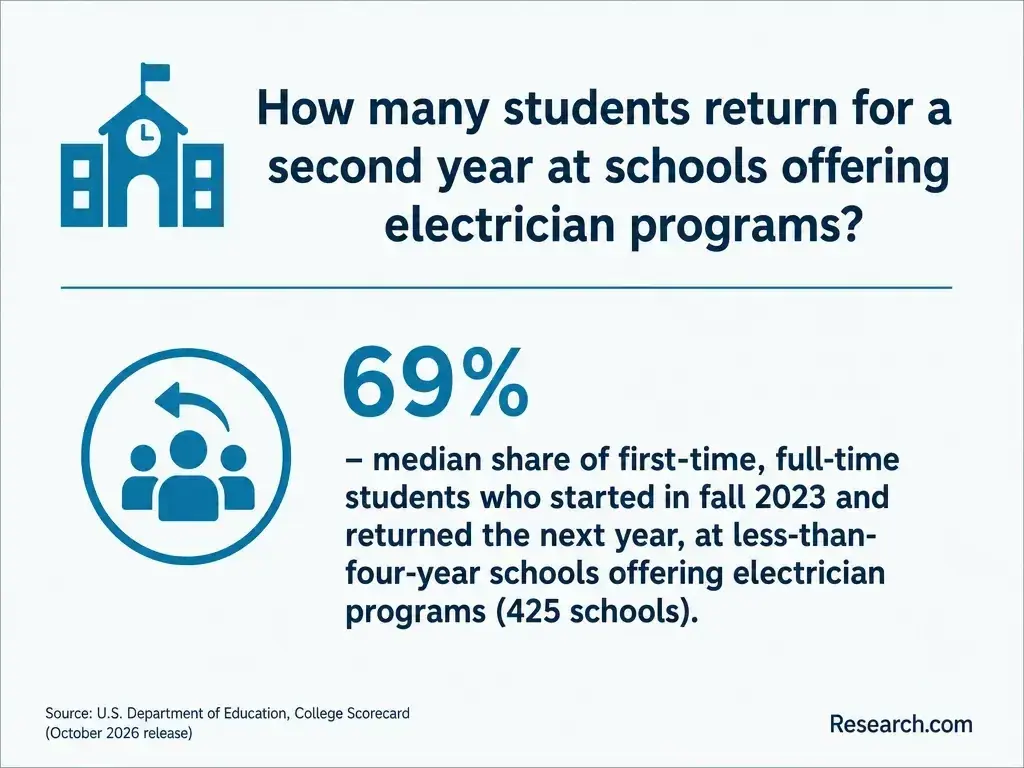
Start with the job you want, then compare training routes that can realistically get you there. College of Southern Nevada, Advanced Training Institute, and United Education Institute-Las Vegas are names you may encounter when investigating local education; verify each provider's current electrical program offering, credential, and published terms rather than assuming every campus offers the same training. Compare school options with registered apprenticeships and employer-sponsored entry before committing to tuition.
Use the following questions with admissions staff and apprenticeship coordinators. Written answers make it easier to spot gaps that a ranking or advertised tuition cannot show:
Check accreditation and authorization with the relevant accreditor or regulator; neither guarantees a job or license. A low price paired with little hands-on training may be poor value, while a longer paid apprenticeship may suit someone who can secure a place and wants to earn while learning. Likewise, an institution's appearance on a best accredited non profit colleges list would not, by itself, answer whether its electrical training meets your goal.
An initial school program can support applications for electrical helper, apprentice, or related maintenance roles, depending on employer requirements. With documented supervised experience and further training, a worker may pursue more independent installation, service, troubleshooting, or supervisory responsibilities. Contractor business ownership is a separate step subject to Nevada's contractor rules (Nevada State Contractors Board).
Choose instruction that matches the first role you can realistically enter. Someone seeking an apprenticeship may value sponsor-recognized coursework and jobsite preparation; someone targeting facilities work should examine troubleshooting and maintenance practice. Neither route makes a new graduate automatically qualified for every electrician position.
The U.S. Bureau of Labor Statistics projects 9.2% growth in U.S. electrician employment from 2025 to 2035. That supports investigating the occupation, but it does not measure Las Vegas openings, apprenticeship capacity, or your probability of being hired. Local construction activity and employers' maintenance needs can affect the timing and type of openings.
For a practical read on the market, compare current local postings with sponsor intake schedules: note whether employers seek helpers, registered apprentices, or experienced workers. If openings predominantly require experience, favor a route that documents paid supervised work rather than assuming a short certificate alone will meet the requirement.
Investing in electrician training is a consequential decision. Research.com evaluates programs against others in the same occupation and location so readers can compare relevant local options. Its most-affordable ranking includes only programs with completions reported to the Integrated Postsecondary Education Data System (IPEDS); it evaluates tuition, cost of attendance, median student debt, and federal loan default rates. Indicator weights are assigned using an entropy-based method. Accreditation, student support, and other quality measures are not part of the affordability score, so readers should check them separately.
The Research.com team uses the following data sources in its ranking research. Some cover occupations other than electrical work and should not be mistaken for electrician-specific approvals:
IPEDS and college-oriented databases do not cover every apprenticeship or employer-sponsored route. Use the ranking to narrow down reported school programs, then compare them with paid training options and verify current costs directly. More detail on the ranking approach is available on Research.com's methodology page.
# 1 position
# 2 position
# 3 position
# 4 position

Not necessarily. Registered apprenticeships and some employer-sponsored entry routes combine instruction with supervised work. Compare their entry requirements and credentials with school programs before paying tuition.
Only if it also delivers the practical training and credible pathway you need. Add fees, tools, travel, debt, and lost earnings to tuition; account for wages during a paid apprenticeship.
You may study some theory online, but safe electrical installation and troubleshooting require in-person practice and supervision. Confirm where a program's labs and fieldwork take place.
Do not assume so. A school certificate documents completion of that program; independent work or contracting may involve additional experience and regulatory requirements. Check your intended role with Nevada and local authorities.
School may help you build fundamentals before seeking work. An apprenticeship combines paid work with related instruction but may have a separate selection process. Choose based on access, total net cost, and the experience your target job requires.