# 1 position
Saint Paul College - Electrician.
associate

Audited and Verified:
Our Editorial and Data Verification Process
Research.com uses government datasets, official education statistics and primary institutional information to support its career and degree guides. Our review process checks factual accuracy, occupational definitions, source dates and the requirements associated with the credentials discussed.
How This Article Was Fact-Checked
Our editorial team verifies salary estimates, employment projections, education requirements and program information against original data providers and official organizations. Salary figures are checked against the relevant occupational definitions and reporting periods. Information about licensure, accreditation and required in-person training is reviewed separately.
Fact-checked and verified on:

Co-Founder and Chief Data Scientist

Reviewed by Karolina Broda
Fact-Checker and Data Verification
Choosing electrician training in Saint Paul means looking beyond the credential: you need a route to supervised work, documented experience, and Minnesota licensure. The U.S. Bureau of Labor Statistics projects 9.2% national growth in electrician employment from 2025 to 2035, making this a timely career decision. The Research.com team of data scientists created the Best Electrician Trade Schools in Saint Paul for 2027 ranking to help students make an informed choice about programs worth considering. This guide explains how to compare training, costs, apprenticeships, and career-entry requirements.
Expect a mix of electrical theory and physical practice: reading plans, calculating circuits, selecting materials, wiring equipment, testing installations, and working safely around energized systems. The most important distinction is whether the program primarily teaches these skills in a school lab or also places you in supervised, documentable electrical work.
These pathways serve different starting points. Credential names and schedules vary, so compare the actual curriculum and work arrangement rather than assuming similarly named programs are equivalent.
| Pathway | What it provides | Best fit |
| Certificate or diploma | Focused classroom and lab training; any work placement must be confirmed separately | Someone preparing to seek an apprentice or entry-level supervised role |
| Associate degree | Electrical training plus a broader course sequence | Someone who wants the additional coursework and can justify its time and cost |
| Registered apprenticeship | Paid, supervised work paired with related instruction under a registered training plan | Someone ready to apply for work-based training and earn while learning |
| Employer-sponsored training | Job-specific instruction and supervised work, subject to the employer's arrangements | Someone with an offer who can verify how experience will be documented |
For a Saint Paul applicant, the decisive question is whether an option leads to qualifying experience under Minnesota rules. Ask for a breakdown of lab time, field time, placement support, and who records supervised hours; a school credential alone is not a substitute for those hours (Minnesota Department of Labor and Industry).
Electrical contractors are a common route into residential, commercial, and industrial installation work. Other possibilities in the Saint Paul-Minneapolis labor market include facility maintenance, manufacturing, and construction projects involving controls or building systems. The work available to a trainee depends on the employer and the supervision required for that task; completing school does not authorize independent electrical contracting (U.S. Bureau of Labor Statistics; Minnesota Department of Labor and Industry).
Ask prospective employers whether they offer supervised electrical work that can be documented for Minnesota licensing. This matters more than a job title alone: a general maintenance position may develop useful skills without providing the particular experience needed for a journeyworker application.
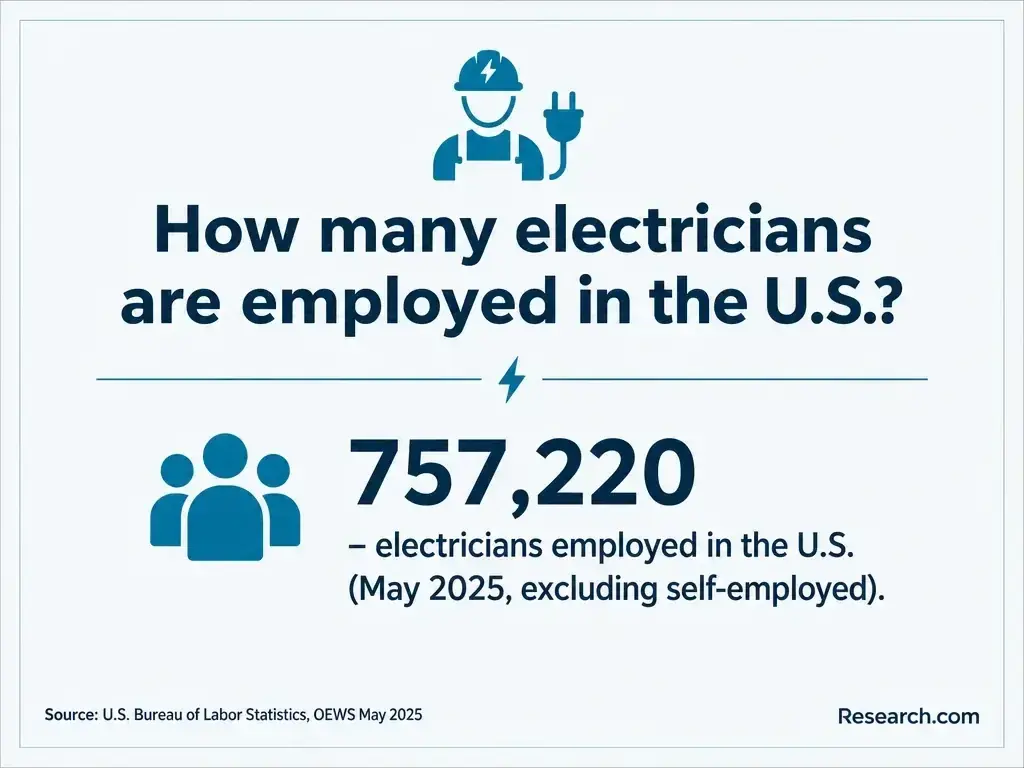
The U.S. Bureau of Labor Statistics reports a $63,190 national median annual wage for electricians in May 2025. This figure covers workers at different career stages across the United States; it is not a Saint Paul wage estimate or a realistic promise of first-year apprentice pay.
For a local decision, compare actual Saint Paul-Minneapolis apprentice wage schedules and job postings with your likely training costs and current earnings. Check whether quoted pay is an apprentice rate, a licensed journeyworker rate, or a rate tied to a particular contract. Paid training can improve the financial case for an apprenticeship even when its starting wage is below an experienced electrician's wage.
A school certificate, diploma, or associate degree may be completed before a person has enough qualifying work experience to seek a Minnesota journeyworker license. Length varies by credential and enrollment intensity; request the current program map from Saint Paul College rather than relying on a generic completion estimate.
Minnesota's journeyworker electrician route generally requires four years of qualifying electrical experience and passage of the licensing examination, subject to the Minnesota Department of Labor and Industry's experience rules. A registered apprenticeship combines work and related instruction over that longer progression. Before choosing an accelerated school program, ask whether any instruction qualifies for credit under current state rules and get the answer confirmed by the department; faster graduation is not necessarily faster licensure.
Online delivery can work for electrical theory, calculations, code study, and some assignments. It cannot by itself show that a student can install conduit, make terminations, use test instruments safely, or perform supervised electrical work. On-campus or hybrid programs should provide access to appropriate labs; apprenticeships add practice at employer worksites.
If flexibility is the priority, ask exactly which days require lab attendance, where the lab is located, and how field experience is arranged. Do not choose a fully remote option because it appears to be the easiest degree course: electrician licensing depends on qualifying experience and an exam, not the convenience of coursework (Minnesota Department of Labor and Industry).
There is no reliable single average that fairly combines Saint Paul school programs with paid apprenticeships: they charge and compensate trainees differently, and costs vary by credential and enrollment status. Get a current, itemized estimate from Saint Paul College or any provider you are considering. An advertised tuition figure is not the cost of becoming job-ready.
Build a comparable budget using these categories, then subtract assistance or wages you can reasonably expect to receive:
Federal aid eligibility depends on the program and student, while Minnesota aid and workforce assistance have separate rules (Federal Student Aid; Minnesota Office of Higher Education). When comparing a campus-based electrical credential with a remote associate option, how much does an associate's degree cost online is only part of the question: an online price does not include the local practical training this occupation requires.
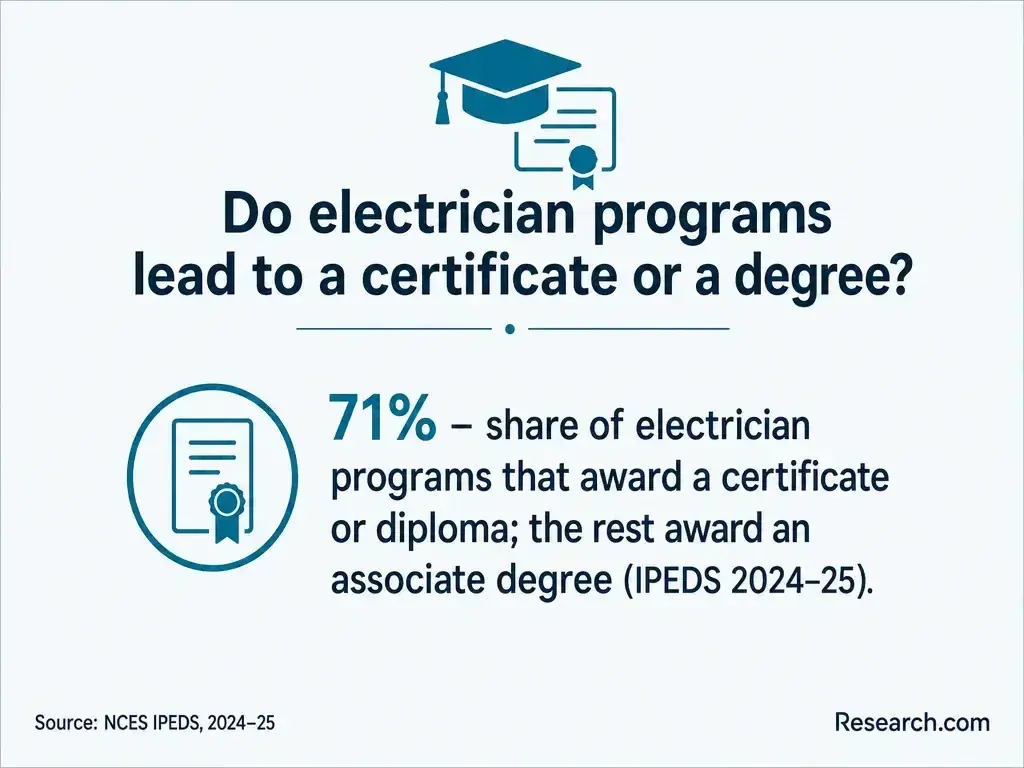
The award depends on the pathway: a school may award a certificate, diploma, or associate degree; a registered apprenticeship documents completion of its work-based training plan. Ask Saint Paul College for the exact award on the current program page and transcript. If you might move between school and apprenticeship, also ask whether relevant coursework can receive transfer credit or advanced standing; neither is automatic.
A school award, apprenticeship completion, and a Minnesota electrician license are different credentials. Institutional accreditation concerns the school; industry credentials may demonstrate particular skills; state occupational licensure governs licensed electrical work. Verify each separately rather than treating one as proof of the others (Minnesota Department of Labor and Industry; U.S. Department of Labor).
School admission and apprenticeship selection are separate processes. Check Saint Paul College's current program requirements for placement, prerequisite coursework, and any lab-related expectations. Apprenticeship sponsors may assess math preparation, interviews, and ability to meet worksite requirements; applicants should use the sponsor's current notice rather than assume that school admission secures an apprenticeship.
If application expense is a barrier, top-ranked accredited online schools no fee to apply may sound appealing, but fee policy and accreditation do not establish access to electrical labs or Minnesota-qualifying work. Ask when training begins, how placement works, and whether you must obtain an employer before starting. Someone who already has a suitable supervised job may be better served by its training route than by paying for a separate introductory program.
Core instruction typically includes electrical safety, circuit theory, code use, blueprint reading, wiring methods, motors or controls, and measurement and troubleshooting. Lab quality matters: ask to see how students practice conduit work, equipment connections, and testing rather than judging a program by its course titles alone (U.S. Bureau of Labor Statistics).
For the local market, check whether instruction covers the building systems or industrial equipment relevant to the work you want. A residential-focused course and an industrial-controls course can both be valuable, but neither automatically supplies the supervised experience required for a Minnesota journeyworker license (Minnesota Department of Labor and Industry).
Minnesota regulates electrical work through the Minnesota Department of Labor and Industry. A person learning the trade can work under applicable registration and supervision rules, but school completion alone does not grant a journeyworker electrician license. The journeyworker route requires qualifying experience and an examination; independent contracting involves additional business licensing requirements. Check the department's current rules for the exact work you intend to do before accepting a position or paying for training.
Do not confuse apprenticeship registration, school accreditation, an optional industry certification, and occupational licensure. They answer different questions. Ask a program to explain which state requirements its instruction addresses, how supervised work is obtained and recorded, and which requirements remain after graduation.
Start with your intended job and work backward. A school program can be worth the investment if its labs and employer connections help you secure qualifying work at a manageable total cost. A paid apprenticeship may make more sense if you can enter one directly; a broader associate degree may fit if you value its additional coursework. The ranking is a shortlist, not a replacement for checking Minnesota eligibility and your own finances.
Use these questions when speaking with Saint Paul College, an apprenticeship sponsor, or an employer:
Beware of claims that graduation guarantees licensure or a particular wage. If you are also exploring the best college degrees to get, keep that separate from this decision: the electrician pathway should be judged by practical preparation, entry into supervised work, and the full time and cost to your goal.
A common progression is supervised trainee or apprentice, then licensed journeyworker after meeting Minnesota's experience and examination requirements. With further experience, an electrician may pursue advanced licensing, supervision, a specialty such as controls or maintenance, or the requirements for operating an electrical contracting business. These are later steps, not outcomes automatically conferred by an entry-level school award (Minnesota Department of Labor and Industry; U.S. Bureau of Labor Statistics).
Optional industry credentials can support a specific skill area, but compare them against the work you want before paying for one. Lists of best paying certifications cannot tell you whether a credential replaces Minnesota licensing requirements; it does not. For an entry-level applicant, documented supervised experience is often the more immediate priority.
The U.S. Bureau of Labor Statistics projects 9.2% growth in electrician employment nationally from 2025 to 2035. That points to continued demand for the occupation, but it does not predict how many openings a newly trained applicant will find in Saint Paul or guarantee an apprenticeship place.
Use the national outlook as context, then investigate current Twin Cities contractor openings and registered-apprenticeship intake schedules. Construction activity, maintenance needs, and employer hiring cycles can affect the timing of a local entry opportunity. A program's value rests partly on whether it helps you reach those opportunities with usable skills and a realistic plan for supervised work.
Investing in electrician training is an important decision, so the ranking is designed to compare programs with other options in the same occupation and location. Research.com evaluates programs with completions reported to the Integrated Postsecondary Education Data System (IPEDS); this means a registered apprenticeship or employer training program may be a worthwhile option even if it does not appear in the ranking.
Best-program rankings assess student outcomes, earnings and return on investment, costs and debt, and quality and recognition. Programmatic accreditation or relevant industry recognition accounts for 20% of the score, institutional accreditation for 10%, and student support services for 10%. The remaining 60% covers completion, retention, earnings, cost, debt, and loan-default indicators, with weights distributed using an entropy-based method. Most-affordable-program rankings use only cost and debt indicators, also entropy-weighted; accreditation and other quality measures are not part of that score. A ranking position therefore helps narrow a search but does not establish Minnesota licensing eligibility.
The team draws on the following sources to check institutional, program, cost, outcome, and occupation-relevant information. Some sources cover other trades and are not electrician-specific approvals:
These sources help readers compare reported outcomes and costs on a consistent basis, while recognizing gaps in college-oriented datasets. For more detail on how Research.com develops rankings, see its methodology.
# 1 position
# 2 position
No single school credential substitutes for Minnesota's qualifying experience and examination requirements. A registered apprenticeship or other qualifying supervised-work route may be an alternative; confirm the rules for your intended license with the Minnesota Department of Labor and Industry.
Online coursework may help with theory or code study, but it does not replace hands-on skills, qualifying supervised experience, or the Minnesota licensing examination (Minnesota Department of Labor and Industry).
It depends on your access to an apprenticeship and your preparation. Compare wages, instruction, lab practice, entry requirements, total costs, and how each option leads to documented electrical work.
Do not assume it does. Ask the Minnesota Department of Labor and Industry whether the specific training qualifies for any allowable credit, and separately verify the work experience you still need.
Request the full cost, credential name, lab schedule, completion information, and a written explanation of how students connect with supervised work. Treat promises of guaranteed licensure or wages as red flags.