# 1 position
Lee College - Electrician.
associate

Audited and Verified:
Our Editorial and Data Verification Process
Research.com uses government datasets, official education statistics and primary institutional information to support its career and degree guides. Our review process checks factual accuracy, occupational definitions, source dates and the requirements associated with the credentials discussed.
How This Article Was Fact-Checked
Our editorial team verifies salary estimates, employment projections, education requirements and program information against original data providers and official organizations. Salary figures are checked against the relevant occupational definitions and reporting periods. Information about licensure, accreditation and required in-person training is reviewed separately.
Fact-checked and verified on:

Co-Founder and Chief Data Scientist

Reviewed by Karolina Broda
Fact-Checker and Data Verification
Choosing electrician training in Baytown means comparing more than tuition: you need supervised work experience and a route to a Texas license. The U.S. Bureau of Labor Statistics projects 9.2% national electrician employment growth from 2025 to 2035. This guide explains training options, costs, licensing, and local career prospects. It also accompanies the Best Electrician Trade Schools in Baytown for 2027 ranking, created by the Research.com team of data scientists to help students make an informed choice about programs worth considering.
Expect instruction in electrical theory, circuits, code use, blueprint reading, testing, and safety, followed by practical work with wiring, conduit, and equipment. A classroom program helps you build foundational skills; supervised jobsite experience is a separate, essential part of the Texas licensing path. Ask how many hours occur in an equipped lab and whether the provider helps students connect with employers.
Baytown applicants should compare these routes by what each actually provides - not by credential name alone:
| Training route | What you receive | Best fit and key limitation |
| Certificate or diploma | Focused classroom and lab training | Useful for learning fundamentals before employment; confirm how it connects to supervised work. |
| Associate degree | Broader technical coursework and an academic degree | May suit someone seeking additional technical breadth; it takes more time and does not itself confer a license. |
| Registered apprenticeship | Paid on-the-job training plus related instruction | Strong fit for applicants ready to work while learning; entry depends on sponsor openings and selection requirements. |
| Employer-sponsored entry | Supervised work, with training determined by the employer | May reduce upfront school costs; verify instruction quality and documentation of qualifying hours. |
Lee College is a local institution to check for current electrical offerings and schedules. Confirm the exact credential and curriculum before applying; a similarly named program elsewhere may devote a different amount of time to hands-on work.
Baytown's location near industrial facilities, construction activity, and the wider Houston labor market gives trainees more than one type of worksite to consider. Industrial maintenance and construction can require different equipment familiarity, schedules, and site-safety practices; residential and commercial contractors offer other starting points. Training alone does not authorize independent electrical work. Ask employers whether an opening offers the supervision and documented experience needed for your intended Texas license.
If you want industrial work, look for instruction involving motors, controls, troubleshooting, and lockout/tagout practices. If your goal is residential service, prioritize building wiring, code navigation, and customer-facing diagnosis. In either case, a commute to a training site or jobsite outside Baytown may affect the route's real cost.
The U.S. Bureau of Labor Statistics reports a $63,190 national median annual wage for electricians in May 2025. That figure covers employed electricians across experience levels and locations; it is not a Baytown-specific estimate or a likely apprentice starting wage. Pay can differ substantially between an entry-level position, experienced licensed work, and jobs with overtime or specialized industrial duties.
For a decision you can act on, compare actual Baytown-area apprentice or trainee offers: base hourly pay, scheduled hours, overtime rules, benefits, tool allowances, and wage progression. Use those offers - not the national median - to estimate whether paid training will offset its longer path to independent work.
The school portion depends on the credential and whether you attend full time or around a job. Request the published program length, total contact hours, lab hours, and course schedule from each provider rather than assuming every electrical certificate takes the same time. An associate degree generally includes more coursework than a short certificate.
School completion and licensing are different milestones. TDLR requires 8,000 hours of on-the-job training under the supervision of a Texas-licensed master electrician and a passing examination for a journeyman electrician license. A registered apprenticeship organizes work and related instruction over multiple years; a short school program should be judged by how well it prepares you to obtain and succeed in that supervised work, not by how quickly it ends.
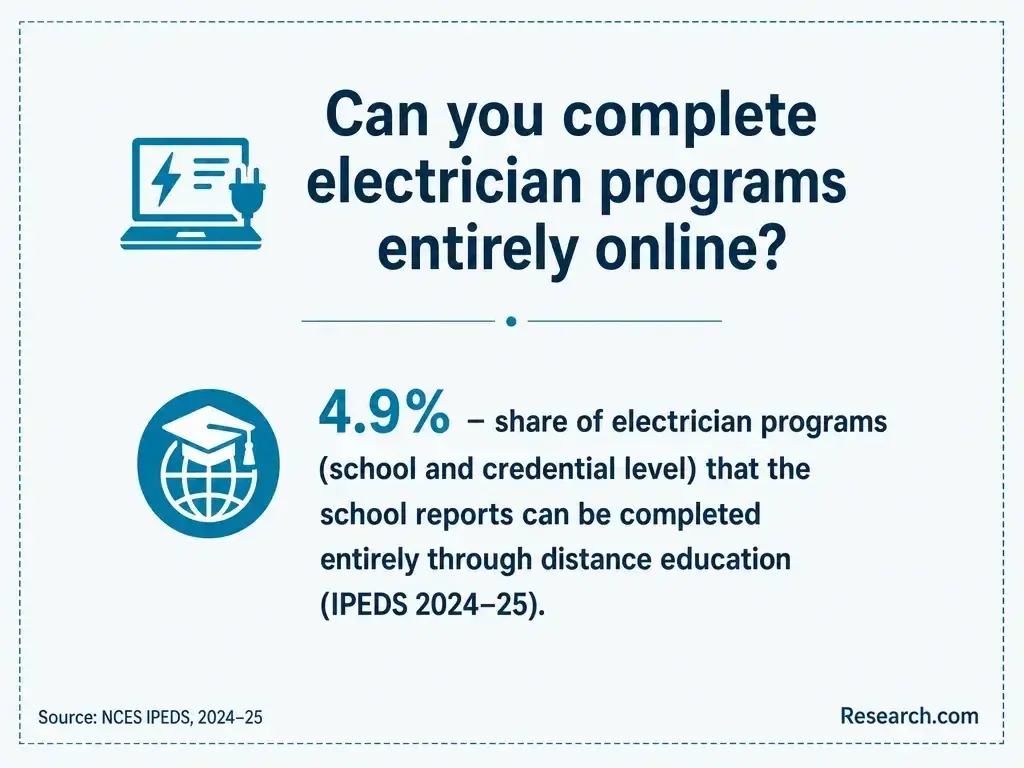
Online lessons can work for theory, calculations, and some code study. Wiring, testing, conduit work, and jobsite safety require in-person practice and supervision. A hybrid program can be convenient for a working student if it identifies where labs take place, how often attendance is required, and whether its schedule works alongside employment.
Use a best online trade schools comparison as a starting point, not proof that remote coursework meets Texas licensing requirements. Before paying, ask which competencies are assessed hands-on and whether the provider arranges local practical instruction. Avoid a program that markets itself as an entirely online route to becoming a licensed electrician without explaining the required supervised work and examination.
There is no single defensible Baytown average that captures certificates, associate degrees, and paid apprenticeships on the same basis. Ask each provider for a current, itemized cost of attendance and check whether your residency changes public-college tuition. Tuition alone can understate what it takes to become job-ready.
Build a comparison that includes mandatory fees, books or software, tools, safety gear, consumable materials, transportation to labs and jobsites, and later TDLR application and examination costs. Then subtract confirmed grants, scholarships, or employer-paid expenses. A paid apprenticeship may have lower upfront school charges and provide wages, but its work schedule and travel still have costs. Federal aid eligibility depends on the institution and specific program, according to Federal Student Aid; ask the provider to verify both before relying on an aid estimate.
For return on investment, compare each route's total cost, debt, likelihood of completion, time away from other paid work, and realistic trainee pay against the experience and credential it helps you obtain. The cheapest classroom option is not necessarily cheapest if it leaves you without a workable path to supervised employment.
Depending on the program, you may earn a certificate, diploma, or associate degree. A registered apprenticeship has its own completion credential. None is the same as a Texas occupational license: TDLR sets the experience and examination requirements for licensed electrician work. Industry training credentials can document skills, but employer recognition and licensing eligibility must be checked separately.
Ask whether completed coursework can receive credit toward another program or an apprenticeship's related instruction, and get any advanced-standing decision in writing from the receiving provider. A best college degree to get comparison addresses a different choice; for this trade, the decisive question is whether your credential helps you gain practical skills and qualifying supervised experience.
Entry rules vary by provider. A school may require an application, proof of prior schooling, placement information, or readiness for technical math; an apprenticeship sponsor or employer may also assess work availability, transportation, and ability to meet jobsite requirements. Ask for the current written criteria and application timeline rather than assuming admission to a school also secures an apprenticeship position.
Texas has a separate regulatory step for electrical work: TDLR says people performing electrical work as apprentices must hold an apprentice electrician license and work under appropriate supervision. Confirm the registration process with TDLR and the employer before starting fieldwork. Institutional accreditation, school authorization, apprenticeship registration, and your individual license are distinct checks.
Strong entry training links electrical theory to safe installation and troubleshooting. Look for instruction in reading plans, measuring circuits, choosing materials, interpreting the National Electrical Code, using test instruments, and applying jobsite safety procedures. Lab practice should let students perform and explain tasks - not merely watch demonstrations.
Curriculum fit matters locally. Someone aiming for Baytown-area industrial maintenance should ask about motors, control circuits, and systematic fault-finding; a prospective construction electrician should examine the time spent on conduit, installation, and plan reading. Ask instructors how competencies are assessed and which tools students must supply. Software-based simulations can reinforce diagnosis, but they cannot replace work on physical equipment.
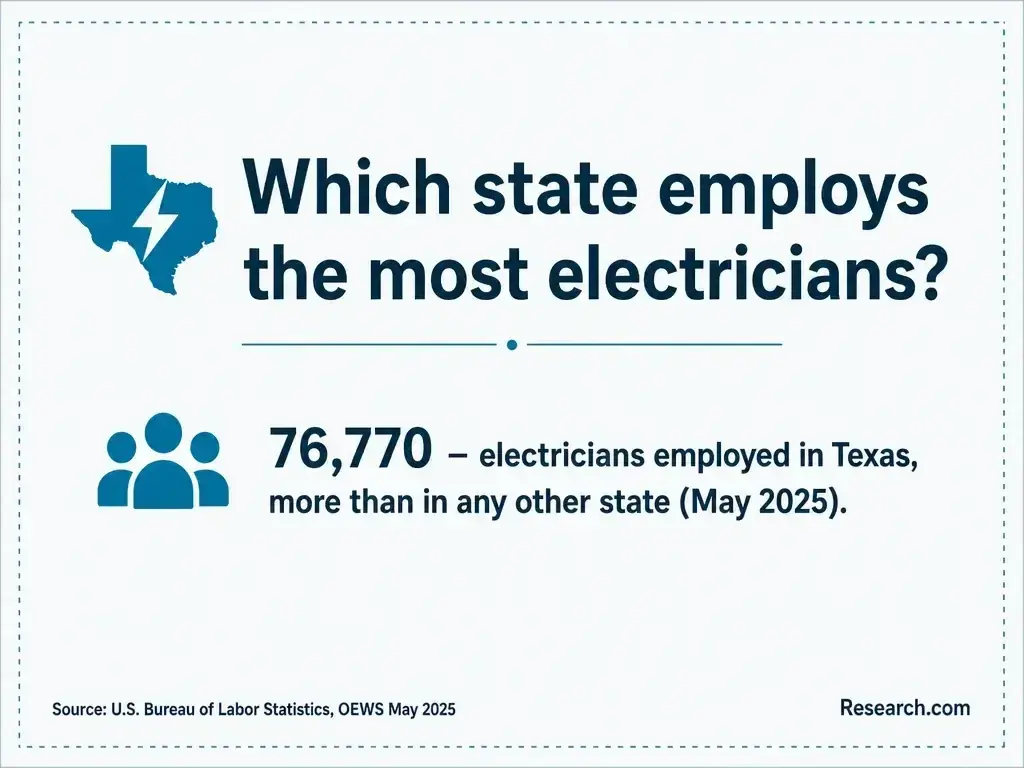
Yes, Texas regulates electrical work. TDLR identifies an apprentice electrician license for supervised entry-level work and sets separate requirements for higher license classes. For journeyman licensure, its requirements include 8,000 hours of supervised on-the-job training and a passing examination. An electrician school credential, institutional accreditation, an industry certificate, and a registered apprenticeship are not interchangeable with a TDLR license.
Choose training only after identifying the license class that matches your intended work. Ask how an employer will document supervised hours and verify current application, examination, and supervision rules directly with TDLR before enrolling or changing jobs. Do not assume that hours spent in a school lab count as on-the-job experience.
Start with the job you want, then test each program against the steps required to reach it. A ranking can narrow the field, but it cannot tell you whether a lab schedule, employer connection, and total cost fit your circumstances. Use these questions when speaking with Lee College or another training provider, apprenticeship sponsor, or prospective employer:
Verify institutional accreditation separately from any industry recognition, and check Texas licensing requirements yourself. A list of top-ranked accredited online schools no fee to apply may help with application-cost comparisons, but neither an application-fee waiver nor accreditation establishes that an electrical program provides the practical training you need.
A practical progression is supervised apprentice work, followed by the experience and examination needed for journeyman licensure, then greater responsibility in construction, service, or industrial settings. With additional qualifying experience, some electricians pursue higher Texas license classes, supervision, or contracting; requirements differ by role and should be checked with TDLR. Specialized work may also demand employer training beyond an entry-level school curriculum.
Match your first role to your longer-term goal. Industrial maintenance offers exposure to plant equipment, while construction and service work develop different installation and diagnostic skills. If you are weighing this occupation against a much broader set of careers, a college majors list and careers is context rather than a substitute for comparing actual electrician training routes. Likewise, an easiest masters list does not address Texas electrical work-hour or licensing requirements.
The U.S. Bureau of Labor Statistics projects 9.2% growth in U.S. electrician employment from 2025 to 2035. That supports investigating the trade, but it is a national projection - not a forecast of Baytown vacancies or a promise of employment after training.
For a local decision, check current contractor and industrial-maintenance openings across Baytown and the wider Houston area. Note which employers accept new apprentices, which require experience, and how far you would commute. Demand for experienced electricians does not automatically translate into available supervised entry positions, so an employer connection can be as important as the classroom credential.
Investing in electrician training is an important decision. Research.com designed this ranking to help readers compare programs against other programs in the same occupation and location, using documented outcomes, costs, and quality measures rather than a school's reputation alone. Only programs with completions reported to IPEDS are eligible; a registered apprenticeship or employer program absent from the ranking may still be a strong option.
Best-program scores cover student completion and full- and part-time retention; earnings one year after completion and earnings relative to annual attendance cost; tuition, attendance cost, debt - including debt held by students who withdrew - and federal loan default rates; and accreditation, relevant industry recognition, and student support. Programmatic accreditation or relevant industry recognition accounts for 20% of the score, institutional accreditation for 10%, and support services for 10%. The remaining 60% covers outcomes, earnings, and costs, with entropy-based weighting that gives more weight to indicators that differ more across programs. Most-affordable-program rankings score only costs and debt, using entropy-based weights; they do not include quality indicators.
The team used the following sources to check the quality, credibility, and accuracy of the ranking. Some sources cover other trades and are not evidence that a particular electrician program holds a trade-specific approval.
Use the ranking to build a shortlist, then confirm current program offerings, total charges, hands-on instruction, and a viable route to supervised employment. More detail on the scoring approach appears in Research.com's methodology.
# 1 position
# 2 position
# 3 position
Yes. Supervised employer training or a registered apprenticeship can provide a route into the trade. Texas still requires the appropriate apprentice license for supervised electrical work and sets experience and examination requirements for journeyman licensure, according to TDLR.
No. A certificate documents program completion; TDLR separately requires qualifying supervised on-the-job hours and a passing examination for journeyman licensure.
It may be better if you can secure a suitable position and want wages while gaining supervised experience. A school program may be useful first if you need structured fundamentals or lab practice. Compare admission availability, instruction, pay, and total costs.
You may study some theory online, but practical electrical work and the supervised job experience required for Texas journeyman licensure cannot be completed entirely online.
Ask for the exact credential, lab hours, full cost, current schedule, employer connections, and written evidence of how the program supports - but does not replace - the Texas licensing path.