# 1 position


Audited and Verified:
Our Editorial and Data Verification Process
Research.com uses government datasets, official education statistics and primary institutional information to support its career and degree guides. Our review process checks factual accuracy, occupational definitions, source dates and the requirements associated with the credentials discussed.
How This Article Was Fact-Checked
Our editorial team verifies salary estimates, employment projections, education requirements and program information against original data providers and official organizations. Salary figures are checked against the relevant occupational definitions and reporting periods. Information about licensure, accreditation and required in-person training is reviewed separately.
Fact-checked and verified on:

Co-Founder and Chief Data Scientist

Reviewed by Karolina Broda
Fact-Checker and Data Verification
Choosing electrician training in Vernon means looking beyond the school's name: you need a route to supervised work, a credential employers recognize, and a plan for Texas licensing. The U.S. Bureau of Labor Statistics projects electrician employment to grow 9.2% nationally from 2025 to 2035, making the training decision timely. This guide explains costs, apprenticeships, wages, and licensing so you can compare your options. It also accompanies the Best Electrician Trade Schools in Vernon for 2027 ranking, created by the Research.com team of data scientists to help students identify programs worth considering.
Expect electrical theory paired with practical work - not a classroom credential that by itself authorizes independent electrical contracting. A relevant program may cover circuits, wiring methods, blueprint reading, testing instruments, and safe installation practices. Before enrolling at Vernon College, confirm whether it currently offers an electrical program, its exact credential and schedule, and how much supervised shop or worksite training it includes.
The central choice is whether to take school-based instruction before seeking an electrical employer or enter a paid apprenticeship or employer-sponsored training route directly. In Texas, the work arrangement matters because qualifying supervised experience - not simply time spent in a lab - counts toward journeyman licensure under Texas Department of Licensing and Regulation (TDLR) rules. Ask a prospective employer or sponsor who will supervise you and how hours will be documented.
Electrical training can lead to supervised work with residential and commercial electrical contractors, industrial maintenance employers, or construction teams. Vernon's smaller local market makes the location of the worksite as important as the location of the classroom: ask whether employers recruiting from a program have projects within a commute you can sustain. Do not assume a training provider can place every student locally.
Residential wiring, commercial installations, and industrial troubleshooting can demand different equipment and work schedules. If your goal is industrial maintenance rather than construction, check whether the curriculum includes motors, controls, and diagnostic practice, and whether an employer will provide the supervision needed for the Texas license you intend to pursue.
Vernon-specific electrician wages are not established by the national figure: the U.S. Bureau of Labor Statistics reports a $63,190 median annual wage for U.S. electricians in May 2025. That median includes experienced workers and should not be used as a new apprentice's pay estimate. Request the actual starting wage, scheduled increases, and typical hours from local apprenticeship sponsors and prospective employers before comparing offers.
Questions such as what college majors make the most money use a different education and earnings comparison; they cannot tell you whether Vernon electrician training will repay its cost. For this decision, compare likely apprentice wages with your current earnings and the full time and expense required to reach licensed work.
A school certificate may take substantially less time than the supervised work needed to become a journeyman electrician. Texas requires 8,000 hours of qualifying on-the-job training under a master electrician for journeyman licensure, according to TDLR. Ask how a particular school's contact hours fit into your plan; do not count them as replacement work hours without confirmation from TDLR.
An apprenticeship combines related instruction with supervised employment, while a short school program may help you compete for an entry-level position sooner without completing the licensing pathway. Searches for quickest online degrees for working adults should not be mistaken for a shortcut around Texas electrical work-hour requirements. If speed matters, compare how soon each route gets you into documented, paid supervised work.
Online study can make theory, calculations, and some code instruction easier to schedule around a job. It cannot, on its own, demonstrate safe tool use, wiring, testing, or jobsite performance. For a hybrid option, establish where labs take place, who supervises practical work, and whether the provider helps you secure qualifying employment.
Lists of affordable online schools for job holders can help identify flexible coursework, but advertised online tuition does not establish an electrician pathway's practical-training value. An on-campus or worksite-based route may be the better investment if it gives you equipment access and employer contacts that remote theory does not.
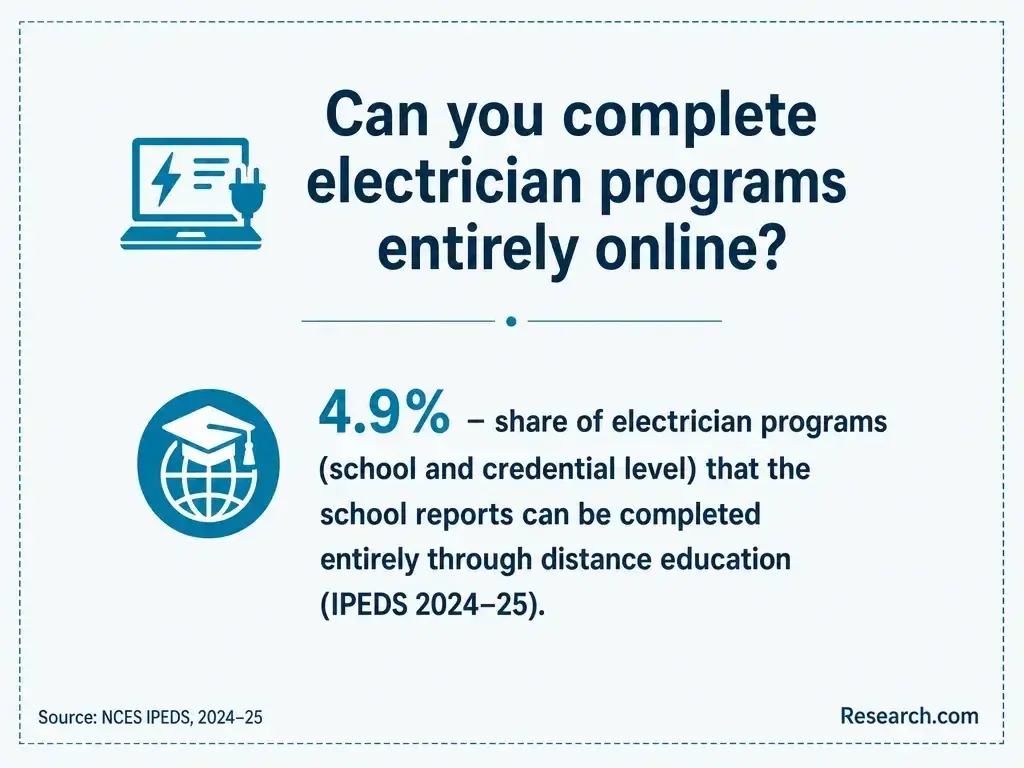
A defensible Vernon-wide average is not available from the information reported here: program offerings and apprenticeship charges are not necessarily captured in the same college datasets. Obtain a written, current cost of attendance from Vernon College for any relevant offering, and a separate schedule of charges and wages from apprenticeship sponsors. Tuition alone will understate what it costs to become job-ready.
The following comparison shows which expenses to request in writing. It also shows why a paid apprenticeship and a shorter school program cannot be compared by sticker price alone.
| Cost or offset | What to check |
| School charges | Tuition, mandatory fees, books, materials, and any lab charges |
| Job-ready equipment | Tools, testing equipment, work clothes, and personal protective equipment |
| Entry and travel | Applicable registration or examination fees and travel to classes and worksites |
| Financial offsets | Apprentice wages, employer-paid instruction, grants, and aid for eligible programs |
| Time cost | Hours of work or earnings given up while attending training |
Federal student aid depends on both student and program eligibility; it is not automatic for every trade course. Listings of online schools accept fafsa cannot establish whether a particular electrical offering qualifies. Check directly with the provider and Federal Student Aid, and ask the Texas Workforce Commission about potentially applicable workforce-training assistance. Compare net cost with the likelihood of completing training and obtaining supervised work - not with an occupation-wide median wage alone.
The credential depends on the route: school instruction might award a certificate or other stated program credential; a registered apprenticeship documents completion under its sponsor's requirements. Neither should be described as a Texas journeyman license. Verify the exact award and whether instruction can receive credit within an apprenticeship before assuming two similarly named programs provide equivalent value.
Institutional accreditation concerns the school, while state school authorization concerns its permission to operate. Industry credentials or relevant program recognition address different questions; apprenticeship registration and TDLR occupational licensure are different again. If you are comparing quickest certifications to get that pay well, check what each certificate actually verifies: a short course completion is not a substitute for supervised electrical experience or a Texas license.
School admission, apprenticeship selection, employer hiring, and state apprentice registration are separate steps. A provider may assess reading and math readiness; an employer or sponsor may require an interview, reliable travel to worksites, and compliance with jobsite safety rules. Requirements vary, so obtain the current admissions checklist rather than assuming acceptance into a class secures an apprenticeship job.
Texas offers an apprentice electrician registration through TDLR for people learning electrical work under appropriate supervision. Confirm the registration and supervision requirements before beginning work you expect to count toward licensure. If you have prior electrical experience, ask TDLR how it must be verified and ask the training provider separately whether it offers advanced standing; credit from one does not automatically confer credit from the other.
Useful instruction connects circuit theory and electrical calculations to wiring, equipment installation, testing, and troubleshooting. Students should also practice reading plans and applying electrical-code and safety procedures. These skills matter differently on a construction site and in a maintenance role, so inspect the course outline against the jobs you intend to seek.
Ask to see the lab equipment and examples of assessed tasks: Can students make connections, use meters, identify faults, and explain safe procedures under supervision? A program emphasizing videos and quizzes without a clear practical component may be useful for theory, but it is not equivalent to supervised shop and worksite practice.
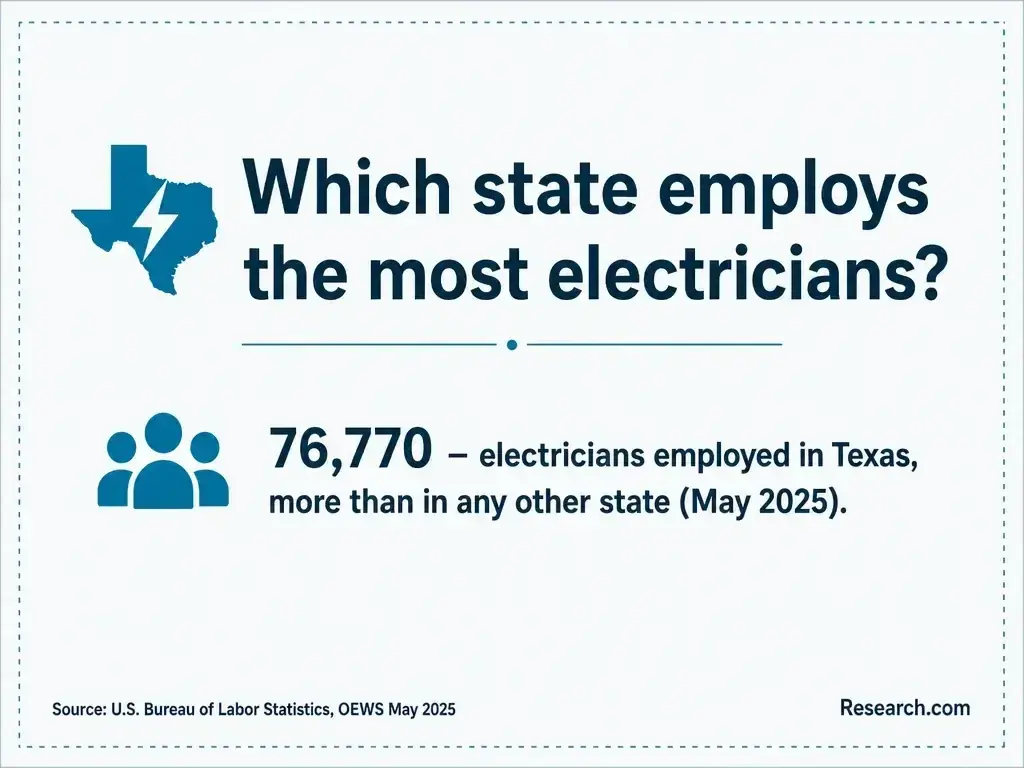
Texas regulates electrical work through TDLR. An entrant can pursue apprentice electrician registration and work under required supervision; independent practice is not an immediate outcome of completing a trade-school course. For journeyman licensure, TDLR requires qualifying supervised experience and passage of the licensing examination. Texas also has other license classifications, with requirements that may differ by scope of work; check the classification that matches your intended job.
Before paying for training, ask TDLR what experience counts, ask the provider whether its instruction prepares students for the applicable exam, and ask a prospective employer who will document your hours. Accreditation, an optional industry certificate, or registration in an apprenticeship does not itself grant occupational licensure. Requirements should be rechecked when you apply, particularly if you plan to work outside Texas.
The best option is the one that gets you from your current skills to documented supervised work at a cost you can sustain. Use a ranking to identify programs to investigate, then test each route against the same practical questions. A lower-priced class may be poor value if it leaves you without a lab or an employer connection; a paid apprenticeship may be attractive if its schedule and entry process fit your circumstances.
Before you commit, ask each provider or sponsor for answers you can compare:
Verify institutional accreditation separately from TDLR requirements and any apprenticeship registration. Be cautious of promises that a brief online course makes you a licensed electrician, or that the national median wage is your likely first paycheck. If the answers are unclear, compare direct employer entry or a registered apprenticeship before taking on school costs.
A common progression begins with supervised apprentice work, moves toward a Texas license after qualifying experience and examination, and can develop into residential, commercial, or industrial specialization. Later choices may include supervising crews or pursuing another Texas electrical license classification when eligible. These are progression options, not credentials automatically awarded by an entry-level program.
If you want hands-on installation, prioritize employers and training with substantial jobsite practice. If you prefer troubleshooting equipment, look for exposure to controls, motors, and maintenance tasks. For either path, ask where graduates actually work: a route tied to employers beyond Vernon may require a commute or relocation, even if classroom instruction is nearby.
The U.S. Bureau of Labor Statistics projects 9.2% growth in electrician employment nationwide from 2025 to 2035. That is a national occupational projection, not a forecast of openings in Vernon or a guarantee of placement. It supports investigating the trade, but a local training decision still depends on employers willing to hire and supervise entrants.
Check current postings for apprentice or helper roles, ask sponsors where their worksites are, and compare their hiring schedules with your availability. Electrical work spans construction and maintenance, so a program that prepares you for more than one setting may give you flexibility when local projects change.
Investing in training is a consequential decision, so Research.com evaluates trade programs against others in the same occupation and location rather than treating every trade-school option as interchangeable. The ranking includes only programs with completions reported to the Integrated Postsecondary Education Data System (IPEDS). That boundary improves comparability but excludes some apprenticeships, employer training, and other providers that do not report completions to IPEDS; exclusion does not indicate poor quality or lack of approval.
For best-program rankings, Research.com evaluates student outcomes, earnings and return on investment, costs and debt, and quality and recognition. Occupation-relevant programmatic accreditation or industry recognition carries 20% of the score, institutional accreditation 10%, and student support services 10%. The remaining 60% covers completion and full- and part-time retention, earnings one year after completion relative to annual attendance cost, tuition, attendance cost, debt - including debt held by students who withdrew - and federal loan default rates. An entropy-based method gives more weight to indicators that vary more across programs. Most-affordable rankings instead score only tuition, attendance cost, median debt, and loan default rate using entropy-based weights; accreditation and other quality indicators are not part of that score.
The ranking methodology draws on the following sources across the trades it evaluates. Some health-care accreditors and credentialing bodies listed here are not relevant to electrician training; their inclusion does not imply that they approve electrical programs.
The result is a structured starting point for comparing reported outcomes and costs - not a substitute for checking current electrical-program availability, Texas licensing rules, or apprenticeship openings. More detail about the approach is available on Research.com's methodology page.
# 1 position
# 2 position
Not necessarily. Supervised work through an employer or apprenticeship is a viable route. Compare the school's practical instruction and employer connections with what you could obtain through direct entry.
No. Texas journeyman licensure requires qualifying supervised experience and an examination under TDLR rules; a school certificate alone does not meet those requirements.
Online courses can cover theory, but safe electrical installation and troubleshooting require in-person practice. Ask where labs and supervised work occur before enrolling in a remote or hybrid option.
An apprenticeship can combine paid work and instruction, while a school program may help you build foundational skills before applying for a job. Compare entry availability, wages, costs, practical hours, and the route to documented Texas experience.
Confirm that an electrical offering is currently available, the credential awarded, total charges, lab requirements, schedule, and any documented apprenticeship or employer connections. Do not infer those details from the college's name or a ranking.