# 1 position


Audited and Verified:
Our Editorial and Data Verification Process
Research.com uses government datasets, official education statistics and primary institutional information to support its career and degree guides. Our review process checks factual accuracy, occupational definitions, source dates and the requirements associated with the credentials discussed.
How This Article Was Fact-Checked
Our editorial team verifies salary estimates, employment projections, education requirements and program information against original data providers and official organizations. Salary figures are checked against the relevant occupational definitions and reporting periods. Information about licensure, accreditation and required in-person training is reviewed separately.
Fact-checked and verified on:

Co-Founder and Chief Data Scientist

Reviewed by Karolina Broda
Fact-Checker and Data Verification
Choosing electrician training in Levelland means deciding not just where to study, but how to get supervised work experience and meet Texas licensing rules. The U.S. Bureau of Labor Statistics projects 9.2% national growth in electrician employment from 2025 to 2035, making the pathway worth examining. This guide compares trade-school training with apprenticeships, costs, credentials, and career prospects. It also accompanies the Best Electrician Trade Schools in Levelland for 2027 ranking, created by the Research.com team of data scientists to help students make an informed choice about programs worth considering.
Expect instruction in electrical safety, circuits, wiring methods, code use, and troubleshooting, paired with practice using tools and test equipment. The essential distinction is between learning the trade in a lab and accumulating qualifying supervised work experience. In Texas, graduating from school does not by itself make someone a licensed journeyman electrician; TDLR sets separate work-experience and examination requirements.
These pathways meet different needs. Ask each provider exactly what credential it awards, how much instruction happens in person, and whether it helps place students with an electrical contractor.
| Pathway | What it typically provides | Best fit - and main limitation |
| Trade-school certificate or diploma | Focused classroom and lab preparation; the provider awards the credential | Useful for building fundamentals before seeking work; does not itself supply all Texas journeyman experience |
| Community-college associate program | A longer academic credential with technical coursework and labs, if an electrical option is currently offered | Useful if its broader curriculum supports your goals; confirm that added time and cost improve your employment options |
| Registered apprenticeship | Paid supervised work plus structured instruction; completion may lead to an apprenticeship credential | Useful if you can secure a position and want to earn while learning; admission and worksite travel may be constraints |
| Employer-sponsored entry route | Supervised work and employer-provided instruction, which vary by employer | Useful for entering work promptly; verify training quality, supervision, and how experience is documented |
South Plains College is the local public-college option to check first, but confirm its current electrical offerings, credential, schedule, and lab access rather than assuming a particular program is available. An accelerated associate's degree online may shorten study in other fields, but an electrician pathway still needs in-person practical training and qualifying supervised work.
Potential work settings include electrical contractors serving homes and businesses, construction and renovation sites, facilities maintenance teams, and employers maintaining agricultural or industrial equipment. The setting matters: residential wiring, commercial systems, and industrial maintenance expose trainees to different equipment and troubleshooting tasks. Training can help you seek an entry-level role, but employers and Texas licensing rules determine what work you may perform and under whose supervision.
Levelland's smaller labor market makes the practical job search wider than the city limits. Check whether an apprenticeship sponsor or employer has worksites in the broader South Plains area, what travel it expects, and whether its work will develop the skills you want. For a broader view of occupations linked to hands-on credentials, see this trade school jobs list; it is not a list of Levelland vacancies.
A reliable Levelland-specific electrician wage estimate is not established here, so do not treat a national figure as a local offer. The U.S. Bureau of Labor Statistics reports a $63,190 national median annual wage for electricians in May 2025. That occupational median includes workers at different experience levels; an apprentice's pay and a licensed, experienced electrician's pay can differ substantially.
For a usable local estimate, compare current South Plains job postings and apprenticeship wage schedules for the same experience level. Ask whether quoted pay assumes a license, overtime, travel, or particular industrial skills. When weighing school against paid training, compare earnings while training as well as pay after completion.
There is no single Levelland-wide program length: a certificate, associate program, and registered apprenticeship have different schedules and outcomes. Request the provider's current calendar and its breakdown of classroom, lab, and worksite hours. A shorter course may get you ready to apply for supervised work sooner, but it does not shorten Texas's licensing experience requirement simply because classes are accelerated.
For a Texas journeyman electrician license, TDLR generally requires 8,000 hours of on-the-job training under a master electrician and a licensing examination. A registered apprenticeship organizes instruction alongside paid work; its actual completion timeline depends on the sponsor and documented progress. When comparing advertised "fast" programs - even search results for the shortest masters degree program - keep the decision focused on the supervised hours and practical competence your intended electrical role requires.
Online coursework can be useful for electrical theory, calculations, and code study. It cannot substitute for safely installing wiring, using test instruments, troubleshooting live-work scenarios under appropriate controls, or completing supervised work at a jobsite. A hybrid option is credible only if it clearly identifies where and when those in-person requirements occur.
For someone traveling from Levelland, fewer classroom trips can reduce commuting costs - but only if labs and required worksites remain accessible. Ask for the lab schedule before enrolling, especially if classes are advertised as online. Pages about top degrees for seniors online address a different credential decision; an older adult entering electrical work still needs the same applicable hands-on practice and Texas licensing pathway.
There is no defensible single average cost without comparable, current prices for the available Levelland pathways. Request an itemized quote from South Plains College if it offers a suitable current program, and compare that with any apprenticeship or employer-sponsored option open to you. Tuition alone understates the amount needed to become job-ready.
Build a budget that includes mandatory fees, books or code materials, tools, test equipment, safety gear, licensing and examination charges, and travel to labs and jobsites. Then subtract aid for which you actually qualify and account for wages earned during paid training. Federal aid eligibility depends on the institution, program, and student; do not assume every short course qualifies. A guide to the cheapest online colleges that accept financial aid can help frame aid questions, but verify eligibility for the specific electrician program with its financial-aid office and Federal Student Aid.
The lowest quoted tuition is not necessarily the lowest-cost route. Compare likely debt, completion prospects, commuting, time away from paid work, and the value of structured placement in supervised electrical work.
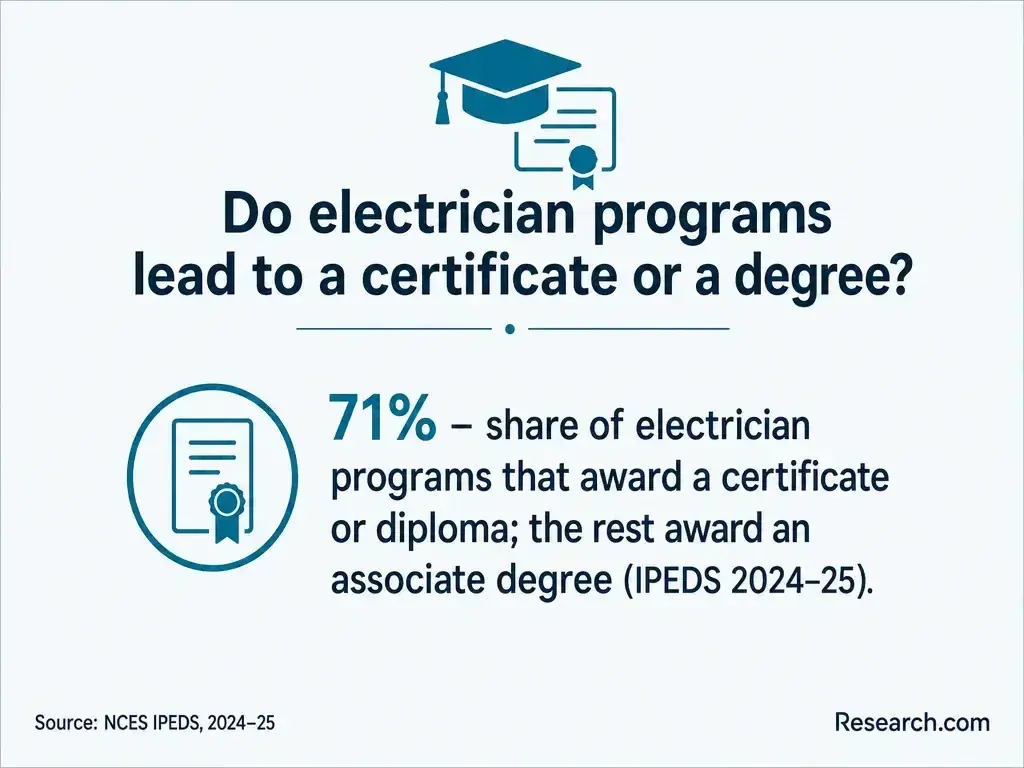
The credential depends on the pathway: a school may award a certificate, diploma, or associate degree; a registered apprenticeship has its own completion credential. An NCCER-related training credential, if offered, documents particular training or assessments. None of these is interchangeable with a Texas occupational license. Verify the exact credential name in the current catalog or apprenticeship agreement before enrolling. Sources: National Center for Construction Education and Research; U.S. Department of Labor; Texas Department of Licensing and Regulation.
If you might continue training later, ask whether prior coursework receives transfer credit or whether documented work and prior learning can earn advanced standing. Get any credit or apprenticeship-articulation decision in writing: a provider's acceptance of earlier learning is separate from TDLR's assessment of licensing experience.
School admission and eligibility to perform electrical work are different questions. Check South Plains College's current catalog for the admission rules of any electrical program it offers, including placement, prerequisites, and tool requirements. Apprenticeship sponsors and employers set their own selection standards and may require an application, interview, or ability to reach changing worksites; ask directly rather than assuming college admission secures an apprenticeship.
Texas also requires an appropriate TDLR credential to work in a regulated electrical role. Someone starting supervised electrical work should check the apprentice electrician application requirements before beginning, even if already enrolled in classes. Source: Texas Department of Licensing and Regulation.
A useful entry-level curriculum connects electrical theory to safe installation and diagnosis: reading diagrams, calculating loads, identifying conductors and protection devices, following applicable code, bending or installing raceway where taught, and checking circuits with test equipment. Labs should require students to demonstrate procedures - not just watch them. The U.S. Bureau of Labor Statistics identifies installation, testing, and troubleshooting as central electrician tasks.
Ask to see the current lab syllabus and equipment list. If your goal is industrial maintenance rather than residential construction, check whether the instruction and available worksites include relevant controls and troubleshooting. That match matters more than two programs awarding similarly named certificates.
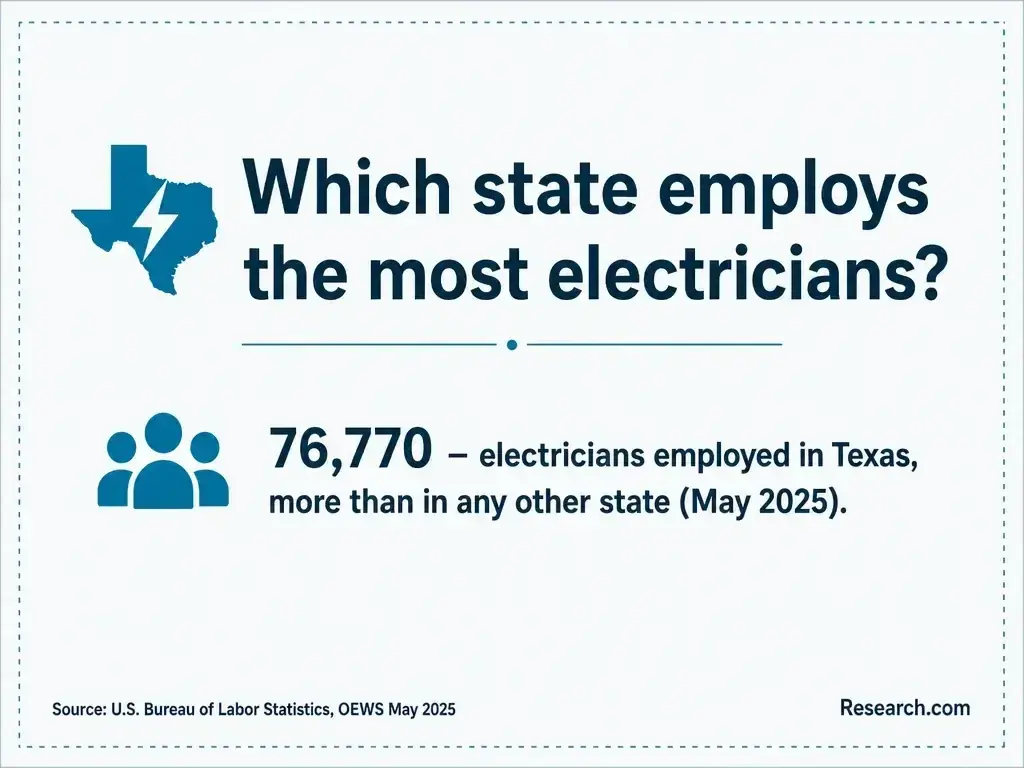
Yes, Texas regulates electrical work through TDLR. An entry-level worker should verify the appropriate apprentice electrician license and supervision rules before starting regulated work. Progression depends on the license sought: TDLR generally requires 4,000 hours of supervised on-the-job training for residential wireman and 8,000 hours for journeyman electrician, along with the applicable examination. Master electrician has additional experience and licensing requirements. Check TDLR's current rules before relying on any school's description of eligibility. Source: Texas Department of Licensing and Regulation.
Keep the distinctions clear: institutional accreditation concerns the school; state school authorization concerns permission to operate; apprenticeship registration concerns a structured training program; industry certification may document skills; and an occupational license authorizes work under Texas law. None automatically substitutes for another. If a program promises that graduation alone makes you a journeyman, ask it to show how your supervised hours and examination eligibility will actually be met.
Start with your target role and a realistic way to obtain supervised work. A school program can be worthwhile if its labs fill a skills gap and its schedule helps you reach an employer; paid apprenticeship or direct employer training may make more sense if you can enter quality supervised work now. A ranking can narrow the search, but it cannot confirm an opening, a current lab schedule, or your individual licensing eligibility.
Use these checks when speaking with South Plains College, an apprenticeship sponsor, or a prospective employer:
Be wary of guaranteed wages, vague "fully online" licensing claims, or a price that omits tools and travel. For return on investment, consider your current earnings, aid, likely debt, chance of completing, earnings while training, and a realistic period over which later earnings might repay the cost - not just the fastest advertised finish date.
A common progression is supervised apprentice work, greater responsibility as experience is documented, and application for an appropriate Texas license once requirements are met. From there, electricians may focus on residential service, commercial construction, or industrial systems. More advanced work, supervision, and contracting can involve further experience and separate licensing or business requirements; a school credential alone does not authorize those roles. Source: Texas Department of Licensing and Regulation.
Choose early training with the next role in mind. If you want service work, seek opportunities to diagnose faults and communicate with customers; if you want industrial work, ask whether employers can expose you to the equipment you hope to maintain. A first placement affects the experience you build, even when the initial credential looks similar.
The U.S. Bureau of Labor Statistics projects 9.2% growth in electrician employment nationwide from 2025 to 2035. That supports considering the trade, but it is not a forecast of openings in Levelland. Local opportunities depend on construction, maintenance demand, contractors' staffing, and the availability of supervised positions.
Before paying for training, check current openings across the South Plains, ask sponsors where apprentices actually work, and compare travel demands with expected pay. A smaller-city applicant who can reach a wider set of jobs may have more ways to complete supervised hours; someone who cannot commute should establish that a workable local placement exists first.
Education is a consequential investment, so the Research.com team evaluates electrician programs against other programs in the same occupation and location - not against unrelated schools nationwide. The ranking includes only programs with completions reported to the Integrated Postsecondary Education Data System (IPEDS). That makes its comparisons more consistent, but it also means a registered apprenticeship or employer training program can be a good option without appearing in the ranking.
Best-program rankings assess student outcomes; earnings and return on investment; costs and debt; and quality and recognition. Relevant programmatic accreditation or industry recognition accounts for 20% of the score, institutional accreditation for 10%, and student support services for 10%. The remaining 60% covers completion and retention, earnings one year after completion relative to annual attendance cost, tuition, attendance cost, debt - including debt held by students who withdrew - and federal loan default rates. An entropy-based method gives more weight to indicators that differ more across programs. Most-affordable rankings instead score only tuition, attendance cost, median debt, and federal loan default rate using entropy-based weights; accreditation and other quality measures are not part of that affordability score.
The team uses the following sources to check institutional, outcome, cost, and occupation-relevant information. Some sources cover other trades and are not evidence that an electrician program has a particular health-profession accreditation.
Use the ranking to narrow your choices, then verify current program availability, practical training, total costs, and Texas licensing implications directly with the provider and the Texas Department of Licensing and Regulation (TDLR). Read more about how Research.com creates its rankings.
# 1 position
# 2 position
# 3 position
# 4 position
No. School can build useful skills, but supervised work is central to Texas licensing. A registered apprenticeship or employer-sponsored route may combine work and training. Verify the requirements for your intended license with TDLR.
No. A school certificate documents completion of its program; TDLR separately assesses journeyman experience and examination requirements.
Some theory may be taught online, but tool use, installation, troubleshooting, and qualifying supervised work require in-person participation. Check exactly where a hybrid program holds labs.
Choose based on access to a quality placement, instruction, total cost, and your need to earn while training. Ask the school about lab time and employer connections; ask the sponsor about pay, instruction, travel, and how work hours are documented.
Confirm that the electrical program is currently offered, what credential it awards, its full cost and lab schedule, and how you would obtain supervised work toward your intended Texas license.