Choosing a counseling master's program means comparing more than popularity: the degree must fit your budget, schedule, clinical training needs, and Illinois licensure plans. This guide accompanies the 2027 Most Popular Marriage, Couple, And Family Counseling Degree Programs Ranking in Illinois, created by the Research.com team of data scientists to help students make an informed choice about programs worth considering. Whether you are entering counseling or changing careers, you will learn how to compare programs, estimate the investment, and check the requirements that matter before applying.
Key findings about Marriage, Couple, and Family Counseling degrees in Illinois
Marriage and family therapist roles have a U.S. median annual wage of $66,940 for May 2025 and projected employment growth of 14% for 2025-2035; neither figure predicts an individual graduate's earnings or job prospects (U.S. Bureau of Labor Statistics).
Plan on roughly two to three years for a full-time counseling master's, plus any supervised experience Illinois requires after graduation; compare each school's published course sequence and field-placement schedule (Illinois Department of Financial and Professional Regulation; institution program pages).
Popularity alone cannot establish licensure fit or value. In Illinois, compare a couple-and-family-specific degree with counseling degrees offering a concentration, then confirm coursework, clinical training, total cost, and the licensing board's current rules before enrolling (institution program pages; Illinois Department of Financial and Professional Regulation).
What can I expect from a Marriage, Couple, and Family Counseling degree in Illinois?
Marriage, couple, and family counseling prepares students to assess concerns in the context of relationships and family systems, rather than treating each person's experiences in isolation. Graduate study typically combines counseling theory, ethics, assessment, culturally responsive practice, and supervised work with clients. A dedicated couple-and-family degree may provide a more concentrated curriculum; a broader counseling degree with a marriage, couple, and family concentration may suit someone who also wants substantial general counseling training (Northeastern Illinois University; University of Illinois Springfield).
This path makes sense if you want sustained client-facing work and can commit to graduate training and post-degree supervision. If you want to provide support without pursuing clinical licensure, compare less clinically focused human-services roles before taking on master's-level costs. A degree title, even one explicitly naming family counseling, is not itself an Illinois license (Illinois Department of Financial and Professional Regulation).
Where can I work with a Marriage, Couple, and Family Counseling degree in Illinois?
Potential settings include community mental health agencies, family-service organizations, group practices, and, with the appropriate license and business arrangements, private practice. Employers' duties and credential requirements differ: a supervised graduate role is not the same as independent clinical practice (U.S. Bureau of Labor Statistics; Illinois Department of Financial and Professional Regulation).
Location affects the training decision. A Chicago-area student may be able to compare several types of agencies for fieldwork, while a student farther from a campus should ask how the program approves local placements and supervisors. Do not assume an online course format removes the need to complete clinical work at an approved site.
The national median annual wage for marriage and family therapists was $66,940 in May 2025, according to the U.S. Bureau of Labor Statistics. That is a median for people employed in the occupation - not a starting salary for Illinois graduates, a private-practice revenue estimate, or a return on the price of a degree.
When comparing offers or projected earnings, distinguish salaried pay from fee-for-service income and ask whether benefits, supervision, administrative time, and client cancellations are covered. For an investment calculation, compare plausible earnings after the credential with what you could earn without it, rather than treating the national median as an automatic raise.
These Illinois program options differ most clearly in how they organize couple-and-family study within the degree. Use the distinctions below to narrow your list, then verify each school's current curriculum and clinical-placement requirements; for a broader quality comparison, see the best marriage, couple, and family counseling programs.
Northeastern Illinois University: Its M.A. is named Couple and Family Counseling, making the specialty the degree's central focus rather than a concentration within a differently named master's. It is a useful first comparison for applicants who already know they want relationship- and family-focused training; confirm its current course and placement requirements against your intended Illinois license (Northeastern Illinois University).
University of Illinois Springfield: Marriage, Couple, and Family Counseling is a concentration within the M.A. in Human Development Counseling. That structure may appeal to applicants who want to compare specialty courses with a broader counseling curriculum, particularly if Springfield-area study or placements fit their plans (University of Illinois Springfield).
Governors State University: Its M.A. in Counseling provides a broader degree framework rather than using couple-and-family counseling as the degree title. Applicants considering it should identify the current specialization and course sequence that match their intended credential; that check is especially important when comparing it with a dedicated couple-and-family M.A. (Governors State University).
None of these structural differences establishes superior licensure results or a lower total price. Ask each program for current completion, placement, and examination information where available, and compare figures only when they describe the same student group and reporting period.
A full-time counseling master's commonly takes about two to three years; part-time study can extend beyond three years. The meaningful comparison is each program's published sequence, because a required practicum or internship may run on a schedule that cannot be compressed simply by taking more classroom courses (institution program pages).
Ask when clinical training begins, whether courses are offered every term, and how many days per week placements may require. Working students should compare the income they would forgo in a faster program with the extra tuition or fees - and later entry into supervised practice - associated with taking longer. Graduation and completion of Illinois post-degree licensure requirements are separate milestones (Illinois Department of Financial and Professional Regulation).
Online delivery can reduce trips to class, but it does not make clinical skills practice, approved field placements, or supervision optional. Campus study may make scheduled face-to-face practice easier; online study may be more workable for someone whose job or home is far from the teaching campus. Either way, Illinois licensure eligibility depends on the education and training completed, not the marketing label attached to the format (Illinois Department of Financial and Professional Regulation).
Before choosing an online or hybrid option, get written answers about required campus visits, live meeting times, placement approval near your home, and whether the program's coursework is designed for the Illinois credential you seek. This is particularly important if you might move: another state's licensing board can apply different requirements.
There is no single reliable statewide average that captures the full cost of these specific master's programs. Published tuition may be quoted per credit, term, or year, and an institution-wide figure may not describe graduate counseling charges. Compare current school-published graduate tuition and fees for your residency status with the program's required credits and expected time to completion; NCES IPEDS is useful for checking institution-reported costs but should not replace a program-specific estimate.
Add books, travel or technology, clinical-placement expenses, and any reduction in paid working hours. A lower tuition rate can lose its advantage if the program takes longer or makes fieldwork difficult to arrange. The most affordable marriage, couple, and family counseling programs can help create a shortlist, but request an individualized total-cost estimate before deciding.
Eligible graduate students can submit the FAFSA to be considered for federal aid, including Direct Unsubsidized Loans, subject to current federal rules and individual eligibility. Schools may also offer graduate assistantships, scholarships, or payment plans; an employer may provide tuition assistance. Availability varies by institution and student, so compare net cost after grants or employer support rather than comparing advertised tuition alone (Federal Student Aid; institution financial aid offices).
Ask each Illinois school whether aid continues during internship terms and what enrollment level it requires. If you intend to borrow, request the full program budget and review current federal loan terms before accepting an award; a shortfall during clinical training is easier to plan for before you start than after you reduce your work hours.
View the chart data as a table
Median wage by U.S. state - Marriage & Family Therapists (BLS OEWS, May 2025) (Source: BLS)
State
Value
AK
60,010
AL
49,990
AR
64,340
AZ
65,290
CA
67,300
CO
60,700
CT
86,250
DE
76,580
FL
56,400
GA
91,550
HI
141,960
IA
67,180
ID
62,700
IL
60,970
IN
56,810
KS
68,710
KY
52,420
MA
67,370
MD
69,900
ME
71,680
MI
52,270
MN
72,470
MO
60,440
MS
51,440
MT
46,960
NC
48,100
NE
62,610
NH
60,030
NJ
92,150
NM
70,630
NY
64,430
OH
70,240
OK
57,670
OR
91,520
PA
66,040
SC
55,430
SD
44,870
TN
46,700
TX
46,300
UT
84,980
VA
79,900
VT
62,780
WA
60,000
WI
37,870
WV
55,700
Expect to need a bachelor's degree and an application documenting academic preparation and interest in counseling. Programs may request transcripts, recommendations, a statement, an interview, or prerequisite coursework, but their current admissions pages - not a statewide rule - determine what is required. Applicants changing careers should ask whether missing psychology or human-development courses can be completed before or during enrollment (institution admissions and program pages).
Admissions eligibility and professional eligibility are different. Before paying an application deposit, send the program your intended Illinois credential and ask it to identify how its curriculum and supervised training address the Illinois Department of Financial and Professional Regulation's current educational requirements. Check institutional accreditation, any relevant programmatic accreditation, and the board's rules separately; CACREP recognition and COAMFTE accreditation describe different programmatic accreditation systems and should not be treated as interchangeable (CACREP; Commission on Accreditation for Marriage and Family Therapy Education; Illinois Department of Financial and Professional Regulation).
Look for coursework in family systems, couple and family assessment, counseling methods, ethics, development, multicultural practice, and research or evaluation, followed by supervised clinical training. Course titles alone are a poor comparison: one program may integrate relationship work throughout its curriculum, while another places it chiefly in concentration electives (institution program pages).
Request a degree audit or course map and mark which classes address your intended license's educational areas. Ask what happens if an elective is unavailable in the term you need it; the answer can affect both graduation timing and your ability to document required preparation (Illinois Department of Financial and Professional Regulation).
The most consequential distinction is often degree focus rather than a menu of electives: a dedicated couple-and-family degree versus a general counseling master's with a marriage, couple, and family concentration. Depending on the school, students may also pursue relevant coursework on trauma, children and adolescents, or substance use. Verify whether such study is a formal concentration, an elective, or supervised experience; those are not equivalent credentials (Northeastern Illinois University; University of Illinois Springfield; Governors State University).
Choose the emphasis that fits the clients and credential you actually intend to pursue. An appealing elective is not a substitute for checking the full curriculum against Illinois licensure rules.
Begin with the intended job and license, not a ranking position. Once programs pass that test, compare their total cost, feasible clinical placement, completion schedule, and evidence of student outcomes. The most valuable marriage, couple, and family counseling programs offer another comparison lens, but value for you also depends on aid, debt, completion probability, time away from work, baseline and potential future earnings, and how far into the future you expect to practice.
Use the following checks before accepting an offer; each addresses a mistake that a tuition figure or popularity rank can hide.
Confirm the precise Illinois license you want and ask the program how its required courses and fieldwork map to the licensing board's current rules.
Check institutional and relevant programmatic accreditation independently; do not assume that accreditation alone confers a license.
Request a term-by-term plan, including placement hours and scheduling, to test whether the advertised duration works with your job.
Compare written total-cost estimates after aid, including clinical expenses and earnings you may give up.
Ask for clearly dated completion and licensure-exam results, if published, and what support is available when students need help securing a placement.
View the chart data as a table
Wage range - Marriage & Family Therapists in Illinois (BLS OEWS, May 2025) (Source: BLS)
Category
Value
10th percentile
51,420
25th percentile
55,420
Median
60,970
75th percentile
78,070
90th percentile
104,900
The clearest clinical path is toward marriage and family therapy, subject to Illinois education, examination, supervised-experience, and licensure requirements. Graduates may also seek appropriately supervised counseling positions in agencies or family-service settings. Independent practice comes later, if and when the individual satisfies the applicable licensing requirements (Illinois Department of Financial and Professional Regulation; U.S. Bureau of Labor Statistics).
A broader counseling position can have a different credential pathway. If your preferred job posting names a particular license, work backward from that requirement before choosing a degree; related-sounding program titles do not necessarily prepare students for the same professional role.
View the chart data as a table
Graduates (2024-25) by program (Source: Research.com)
Category
Value
University of Illinois S
6
Northeastern Illinois Un
8
Governors State Universi
11
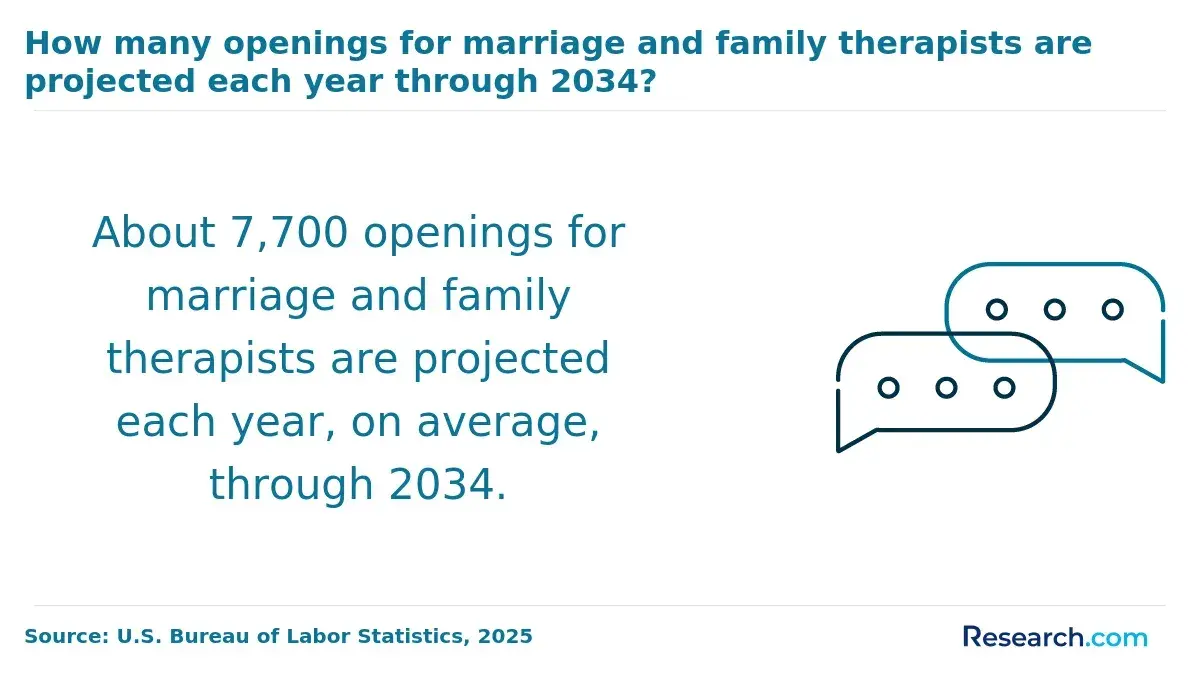
The U.S. Bureau of Labor Statistics projects 14% growth in employment for marriage and family therapists from 2025 to 2035. That national projection supports investigating the field, but it is not an Illinois hiring forecast or a promise of an opening where you live.
Test local demand against your intended setting. Review Illinois-area postings for required licenses, supervision arrangements, client populations, and schedules; then ask programs where recent students completed fieldwork. This gives you a more useful picture of entry routes in the area where you plan to practice than a national growth figure alone.
2027 Most Popular Marriage, Couple, And Family Counseling Degree Programs Ranking in Illinois
Investing in a graduate degree is a consequential decision. Research.com developed its counseling rankings to help readers compare programs using education and outcomes data rather than promotional claims, and its team checks the quality, credibility, and accuracy of the information used. The following sources contribute to the ranking:
IPEDS database, for institutional reporting on enrollment, completions, and costs.
Research.com evaluates counseling programs on graduate outcomes, applicable licensure-exam results, accreditation and federal Title IV eligibility, and cost; each ranking orders programs by the dimension named in its title. For the separate Best ranking, the initial outcomes-and-accreditation score weights completion at 40%, employment or doctoral admission at 20%, applicable licensure-exam pass rates at 20%, CACREP recognition at 16%, and Title IV eligibility at 4%. Inapplicable criteria are renormalized, and cost contributes about 7% of the final Best score. The approach applies to online and campus programs. Readers can examine Research.com's full methodology and use this popularity ranking as a starting point - not a substitute for checking program fit and licensure eligibility.
# 1 position
Northeastern Illinois University
Master
Couple and Family Counseling, M.A.
Delivery mode: campus
30.60
/ 100
Final score
Program length
3 years
Specialization
Marriage, Couple, and Family Counseling
Required credits
60 semester credits
GPA range
2.75 - 4.00
Licensure exam pass rate
67% (2024-25)
Application deadline
February 1 for Fall
Application process
direct
Additional requirements
Application form, official transcripts from all colleges attended, current resume, Statement of Goals and Objectives essay addressing fit for the specialization, and attendance at a Pre-Admission Workshop (PAW).
Accreditation
Accredited by the Council for Accreditation of Counseling and Related Educational Programs (CACREP), with institutional accreditation from the Higher Learning Commission (HLC).
Northeastern Illinois University earned a Research.com Student Interest Score of 30.6/100, supported by 8 graduates (2024-25) and 67% licensure exam pass rate. The program is CACREP-accredited, valid through 2033-03-31.
# 2 position
University of Illinois Springfield
Master
Human Development Counseling, MA with Marriage, Couple, and Family Counseling Concentration
Delivery mode: campus
27.10
/ 100
Final score
Program length
3 years
Specialization
Marriage, Couple, and Family Counseling
Required credits
61 semester credits
GPA range
2.75 - 4.00
Program completion rate
64% (2024-25)
Application deadline
rolling
Application process
direct
GRE
no
Prerequisites
No prerequisite courses. Phase 1: three recommendation forms; Phase 2: group interview; full admission needs a 3.00 GPA in last 60 credits or 2.75 cumulative. Fall admission only; Phase 1 due January 31 (late by June 15).
Additional requirements
Complete online application, submit official transcripts, submit a required statement/writing sample (250-650 words), and pay the non-refundable application fee ($60 domestic / $75 graduate per apply page)
Accreditation
Accredited by the Council for Accreditation of Counseling and Related Educational Programs (CACREP), with institutional accreditation from the Higher Learning Commission (HLC).
University of Illinois Springfield earned a Research.com Student Interest Score of 27.1/100, supported by 6 graduates (2024-25) and 64% program completion rate. The program is CACREP-accredited, valid through 2034-04-30.
# 3 position
Governors State University
Master
Counseling, M.A.
Delivery mode: campus
34.60
/ 100
Final score
Specialization
Marriage, Couple, and Family Counseling
Required credits
60 semester credits
GPA range
2.50 - 4.00
Application deadline
Fall: February 15; Spring: August 15; Fall 2027 priority deadline: February 15, 2027
Application process
direct
GRE
Conditional: GRE Verbal 155+ required if cumulative GPA is 2.5-2.74 and last-60-hour GPA is below 3.0, unless COUN 6600, COUN 6630 and ENGL 1010 are completed with B- or better
Prerequisites
Bachelor's degree; GPA of 2.75+ cumulative or 3.0 over last 60 credit hours. Applicants with 2.50–2.74 meeting neither must score 155+ on GRE Verbal or complete COUN 6600, COUN 6630, and ENGL 1010 or equivalent with B- or better.
Additional requirements
Official transcripts from all previous college work, Statement of Character, three personal references, and GRE scores if applicable. Qualified applicants may be invited to an interview; academic references are preferred.
Accreditation
Accredited by the Council for Accreditation of Counseling and Related Educational Programs (CACREP), with institutional accreditation from the Higher Learning Commission (HLC).
Governors State University earned a Research.com Student Interest Score of 34.6/100. The program is CACREP-accredited, valid through 2031-03-31.
Frequently asked questions about Marriage, Couple, and Family Counseling degree in Illinois
Do I need a master's degree to become a marriage and family therapist in Illinois?
Illinois has specific educational and other requirements for marriage and family therapist licensure. Check the Illinois Department of Financial and Professional Regulation's current rules against a program's required curriculum before enrolling; graduation alone does not grant a license.
Is a couple-and-family concentration the same as a dedicated degree?
No. A concentration sits within a broader degree, while a dedicated program makes the specialty central to its degree structure. Compare actual required courses and clinical training rather than relying on either label.
Can I complete the degree online and practice in Illinois?
Possibly, if the education and supervised training meet Illinois requirements. Confirm the program's Illinois licensure preparation, in-person training obligations, and local placement arrangements with the school and licensing board.
How long should I budget for school and licensure?
Full-time master's study commonly takes about two to three years. Budget additional time for any Illinois-required post-degree supervised experience, examination, and licensing process; ask the board and program for their current requirements.
Is a popular program necessarily the best investment?
No. Popularity can help identify options to investigate, but your decision should depend on licensure fit, affordable net cost, achievable placement and completion, and the kind of work you want to do.
See What Experts Have To Say About Studying Counseling