Choosing a counseling master's program in Montana means looking beyond its name: the degree must fit your budget, clinical training needs, and plans for licensure. This guide is for prospective students and working professionals weighing those trade-offs. It accompanies the 2027 Most Popular Clinical Mental Health Counseling Degree Programs Ranking in Montana, created by the Research.com team of data scientists to help students make an informed choice about which programs are worth considering. You'll learn how to compare programs, estimate the investment, and plan for practice after graduation.
Key findings about Clinical Mental Health Counseling degrees in Montana
A clinical mental health counseling master's is the relevant degree path for many prospective Montana licensed clinical professional counselors; graduation alone does not confer a license. Confirm educational eligibility with the Montana Board of Behavioral Health before enrolling.
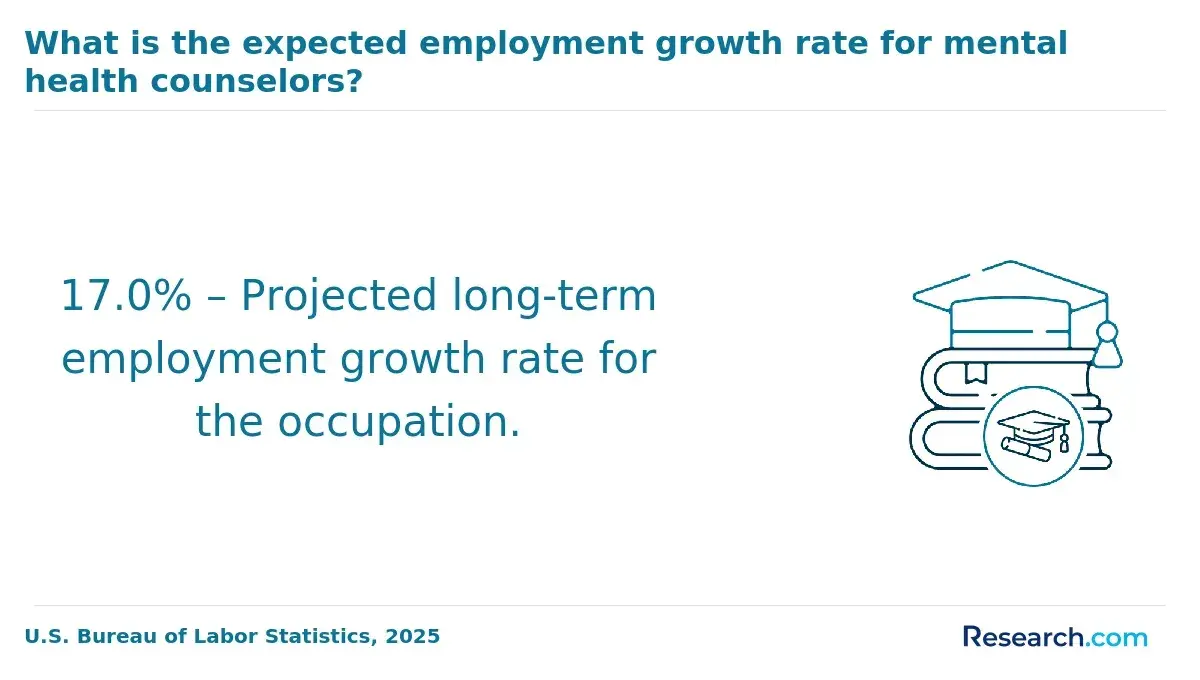
The U.S. median annual wage for substance abuse, behavioral disorder, and mental health counselors was $59,350 in May 2025, with employment projected to grow 18% from 2025 to 2035 (U.S. Bureau of Labor Statistics). These national figures are not a Montana salary promise.
Compare Montana programs on total cost, supervised-placement access, delivery format, and licensure alignment - not popularity alone. A lower tuition quote may lose its advantage if travel, unpaid fieldwork, or a longer study schedule adds substantial cost.
What can I expect from a Clinical Mental Health Counseling degree in Montana?
A clinical mental health counseling degree prepares students to assess clients, develop treatment plans, provide counseling, document care, and respond to ethical and safety concerns. For someone seeking to practice independently in Montana, the relevant option is generally a licensure-oriented graduate program, not an undergraduate counseling-related major or a short certificate. The Montana Board of Behavioral Health sets the requirements for the state's licensed clinical professional counselor (LCPC) credential.
Expect coursework alongside supervised practicum and internship experiences. Those placements make location consequential: a student living far from a campus may be able to study remotely yet still need an approved local site, suitable supervision, and time away from paid work. Ask each program which placement responsibilities belong to the school and which belong to the student.
This path makes sense if you want to provide clinical counseling and can accommodate supervised training after graduation. If your goal is school counseling, social work, or a role that does not require clinical licensure, compare those credentials first; similar job titles do not establish equivalent licensing eligibility.
Where can I work with a Clinical Mental Health Counseling degree in Montana?
Depending on the position and your licensure status, potential settings include community mental health organizations, hospitals and health systems, substance-use treatment providers, group practices, and private practice. A degree may qualify a graduate for some supervised roles, while independent clinical practice depends on meeting Montana's licensing requirements (Montana Board of Behavioral Health).
Montana's geography changes the placement and job search. A position serving a smaller community may offer a different mix of travel, referral resources, and clinical support than one in Missoula or Great Falls. When evaluating a program, ask where recent students completed placements and whether its contacts extend to the part of the state where you intend to work. Do not assume a remote job or telehealth practice removes state licensing obligations.
The U.S. Bureau of Labor Statistics reports a May 2025 national median annual wage of $59,350 for substance abuse, behavioral disorder, and mental health counselors. That occupation is a useful benchmark for clinical mental health counseling careers, but it combines roles and experience levels; it is not a starting salary, an LCPC-only figure, or a Montana wage estimate.
For a realistic return-on-investment estimate, compare actual Montana job postings for your intended setting and location with your expected earnings during and after supervised practice. Account for tuition and fees, aid, borrowing costs, time away from work, the likelihood of completing the program, and how long you expect to work in the field. A higher salary later does not automatically offset a much larger debt balance.
The University of Montana and University of Providence give prospective students two institutionally different starting points for a Montana program search. Their published program descriptions are useful, but neither a school's location nor its appearance in a ranking establishes your eligibility for licensure. Compare the current catalog, fieldwork arrangements, and board requirements before choosing.
The University of Montana: Its mental health counseling program sits within the university's counseling and education offerings in Missoula (University of Montana). Its public-university setting makes resident tuition eligibility and access to a workable Missoula-area or approved alternative placement especially important comparisons for applicants weighing the total cost of attendance.
University of Providence: Its clinical mental health counseling program is offered through a private university based in Great Falls (University of Providence). For applicants considering this option, the distinguishing decision is whether its current delivery schedule and clinical-placement process work better with their job and home location than the Missoula-based alternative; obtain both answers and a written program-cost estimate before committing.
Neither highlight substitutes for current, program-level evidence. Ask both schools for their present credit requirements, supervised-hour requirements, completion and employment outcomes if published, accreditation status, and an itemized cost for your enrollment plan. For a broader quality-focused comparison, see Research.com's best clinical mental health counseling programs.
Plan on roughly two to three years of full-time graduate study for a licensure-oriented counseling master's; part-time enrollment can take longer. Your actual timeline depends on the school's course sequence, whether required classes run every term, and when you can secure a supervised clinical placement. Ask for a term-by-term plan rather than relying on an advertised minimum.
Degree completion and permission to practice independently are separate milestones. Montana's LCPC process includes requirements beyond earning the degree, including supervised experience and examination requirements established by the Montana Board of Behavioral Health. If you need to maintain full-time employment, compare programs by the timing of required clinical hours - not just the number of semesters of coursework.
Online delivery can reduce routine travel for a Montana student who lives far from a campus, but it does not make practicum and internship work virtual by default. An on-campus schedule can simplify access to campus activities while imposing relocation or commuting costs. The decisive question is whether the full program - including any required in-person sessions and approved field placements - works where you live.
This comparison separates course delivery from clinical training so you can ask schools about both.
Consideration
Online or hybrid study
On-campus study
Course access
May reduce regular campus trips; scheduled live classes may still apply.
Requires attendance in the campus area on the published schedule.
Clinical placement
Still requires an approved site and supervision; local-site approval matters.
Still requires an approved site; proximity to campus does not guarantee placement.
Cost to check
Technology, travel for residencies, and local fieldwork expenses.
Commuting, housing, and potential relocation expenses.
Before choosing an online program - particularly one based outside Montana - ask the school to document how its curriculum and placements address Montana's educational requirements. Delivery format alone neither establishes nor prevents licensure eligibility (Montana Board of Behavioral Health).
There is no single verified statewide average that accurately prices every Montana clinical mental health counseling master's program. Published graduate tuition figures may use different credit loads and may exclude required fees or fieldwork expenses. For this decision, an individualized total-program estimate is more useful than an unrelated national tuition average.
Request the cost per credit and the current required credit total, then add mandatory fees, books, travel, possible relocation, and income you may give up during clinical training. At a public university, confirm whether you qualify for resident tuition; at any institution, ask how tuition and aid could change if you study part time or need an extra term. NCES IPEDS institutional tuition data can provide context, but it should not be mistaken for a bill for this specific degree.
Eligible graduate students can explore institutional scholarships or assistantships, employer tuition assistance, and federal aid through the FAFSA. Federal Direct Unsubsidized Loans may be available to eligible graduate students; borrowing limits and eligibility are governed by Federal Student Aid, and loans must be repaid. Ask each Montana program whether counseling students actually receive assistantships, whether awards cover tuition or provide a stipend, and whether fieldwork affects eligibility.
Do not build a budget around an aid source merely because it appears in a general graduate-school guide. Federal graduate borrowing rules have changed, including restrictions affecting new Graduate PLUS borrowers beginning July 2026; limited transitional eligibility may apply to qualifying existing borrowers (Federal Student Aid). Confirm your own eligibility and current loan options with the school's financial aid office before accepting an offer.
View the chart data as a table
Wage range - Mental Health Counselors in Montana (BLS OEWS, May 2025) (Source: BLS)
Category
Value
10th percentile
36,840
25th percentile
46,170
Median
59,000
75th percentile
74,010
90th percentile
83,640
Applicants generally need a bachelor's degree, but programs set their own rules for prerequisite coursework, minimum academic performance, recommendations, statements, interviews, and application deadlines. A psychology major should not be assumed necessary - or sufficient - without checking the program's current admissions page (University of Montana; University of Providence).
For a career changer, admissions eligibility is only the first test. Ask whether prior graduate credits will transfer, whether transferred courses count toward required clinical content, and whether the completed curriculum will satisfy the Montana Board of Behavioral Health's education rules. An offer of admission is not a board determination of eventual licensure eligibility.
Licensure-oriented clinical mental health counseling curricula typically cover counseling theory, helping relationships, assessment, diagnosis, ethics, human development, research, group work, and supervised clinical practice. Course titles differ, so compare each school's catalog against the Montana Board of Behavioral Health's educational requirements rather than matching titles alone.
Pay particular attention to how diagnosis and treatment-planning coursework connects to practicum and internship. If you expect to counsel clients experiencing substance-use concerns or to work in a rural setting with limited referral options, ask what relevant training and supervision the program makes available. Electives can deepen an interest, but they do not replace required clinical coursework.
Programs may offer electives, placement opportunities, or focused training involving substance use, trauma, children and adolescents, or other client needs. Availability varies by school and clinical site. A concentration name is not itself a separate professional license; verify the courses and supervised experience behind it before paying for additional credits.
If you already know your intended population, compare access to suitable placements and supervisors before comparing elective labels. If you are undecided, a broad clinical curriculum with varied supervised experience may serve you better than a narrow focus. Students aiming specifically for school counseling or marriage and family therapy should check those distinct credential pathways instead of assuming a clinical mental health counseling specialization is interchangeable (Montana Board of Behavioral Health).
Start with your intended credential and where you plan to practice. Then seek comparable, written answers from each program; this prevents a low advertised tuition rate or convenient course format from obscuring a placement or licensing problem.
Verify the license pathway. Compare the current curriculum and fieldwork requirements with Montana Board of Behavioral Health rules, and ask the program to explain any gaps. Confirm institutional and any claimed programmatic accreditation with the accreditor itself.
Test placement feasibility. Ask who finds sites, where placements are permitted, when clinical hours occur, and what happens if an approved site is unavailable near your home.
Price your actual schedule. Obtain a written estimate for all required terms, fees, travel, and likely aid; include lost earnings if fieldwork reduces paid hours.
Check evidence of student progress. Request recent program-level completion, placement, and licensure-exam information where available, including the reporting period and the number of students represented.
A common mistake is treating a ranking position as a substitute for these checks. If you are comparing cost with likely career benefit, the most valuable clinical mental health counseling programs provide another perspective - but your debt, completion prospects, current earnings, and time horizon determine whether the investment works for you.
View the chart data as a table
Graduates (2024-25) by program (Source: Research.com)
Category
Value
University of Providence
5
The University of Montan
29
A graduate may pursue a supervised counseling position while working toward licensure, then seek roles with greater clinical autonomy after meeting Montana's LCPC requirements. Possible paths include community mental health counseling, behavioral health work in medical settings, substance-use treatment, and - when appropriately licensed - independent or group practice (Montana Board of Behavioral Health).
Choose the program with your intended setting in mind. Someone who wants community-based work may benefit from placements involving multidisciplinary teams and referral coordination; someone considering independent practice also needs to understand the business and ethical responsibilities that arise after licensure. A master's degree opens an education pathway, not every job title or scope of practice automatically.
National employment for substance abuse, behavioral disorder, and mental health counselors is projected to grow 18% from 2025 to 2035 (U.S. Bureau of Labor Statistics, Employment Projections). That signals substantial U.S. demand, but it does not predict openings in a particular Montana town or guarantee employment to a new graduate.
Evaluate the local market where you intend to live: compare current postings by required license, supervision offered, setting, schedule, and pay. In a geographically large state, willingness to serve a different community may widen your options, while staying in one location makes nearby placement partnerships and employers more important. Treat telehealth opportunities as an additional option to investigate, not a workaround for applicable licensing rules.
2027 Most Popular Clinical Mental Health Counseling Degree Programs Ranking in Montana
Investing in a counseling degree is a consequential decision. Research.com developed its rankings to help readers compare programs using consistent measures rather than relying on promotional descriptions. Its team draws on multiple education databases and considers graduate outcomes, licensure exam results where applicable, accreditation, and cost; readers should still confirm current program details directly with each school.
The data sources used to create the ranking are:
IPEDS database - institutional enrollment, completion, and cost information.
Research.com's Best counseling ranking first combines program completion (40%), employment or doctoral admission (20%), licensure exam pass rates where applicable (20%), CACREP programmatic accreditation (16%), and institutional federal Title IV eligibility (4%). Shares are adjusted when a criterion does not apply. Program cost contributes a smaller component - about 7% of the final score. The same approach applies to online and on-campus programs; other rankings order programs by the dimension named in the ranking.
A popularity ranking answers a different question from a Best or affordability ranking: it should not be read as proof of superior clinical preparation or lower cost. Use it to identify options, then check the factors that affect your own decision. Research.com explains its approach further on its methodology page.
# 1 position
The University of Montana
Master
Clinical Mental Health Counseling MA
Delivery mode: campus
47.30
/ 100
Final score
Specialization
Clinical Mental Health Counseling
Required credits
60 semester credits
GPA range
3.00 - 4.00
Program completion rate
100% (2024-25)
Employment or doctoral admission
100% (2024-25)
Licensure exam pass rate
100% (2024-25)
Application deadline
January 15, 2027
Application process
direct
GRE
optional
Prerequisites
No specific undergraduate degree required; recommended (not required) background includes developmental psychology, abnormal psychology or child/adolescent psychological disorders, and basic statistics/education measurement.
Additional requirements
Current resume (CV); 3 letters of recommendation; official transcripts from all higher-education institutions; personal statement; official GRE scores optional.
Accreditation
Accredited by the Council for Accreditation of Counseling and Related Educational Programs (CACREP), with institutional accreditation from the Northwest Commission on Colleges and Universities (NWCCU).
The University of Montana earned a Research.com Student Interest Score of 47.3/100, supported by 29 graduates (2024-25) and 100% program completion rate. The program is CACREP-accredited, valid through 2031-03-31.
# 2 position
University of Providence
Master
Master of Science in Clinical Mental Health Counseling
Delivery mode: hybrid
24.90
/ 100
Final score
Program length
three years; six 15-week semesters and two summer courses
Specialization
Clinical Mental Health Counseling
GPA range
3.00 - 4.00
Program completion rate
100% (2023-24)
Licensure exam pass rate
100% (2023)
Application deadline
August (Fall enrollment)
Application process
GradCAS
GRE
no
Prerequisites
Baccalaureate degree from an accredited institution; minimum 3.0 undergraduate GPA (lower GPA may require GRE at coordinator's discretion).
Additional requirements
Graduate application, official transcripts, one-page personal essay, CV/resume, $38 application fee (GradCAS). GRE is not required for applicants with an undergraduate GPA of 3.0 or higher; below 3.0, GRE may be required at the coordinator's discretion.
Accreditation
Accredited by the Council for Accreditation of Counseling and Related Educational Programs (CACREP), with institutional accreditation from the Northwest Commission on Colleges and Universities (NWCCU).
University of Providence earned a Research.com Student Interest Score of 24.9/100, supported by 5 graduates (2024-25) and 100% program completion rate. The program is CACREP-accredited, valid through 2034-04-30.
Frequently asked questions about Clinical Mental Health Counseling degree in Montana
Do I need a master's degree to become an LCPC in Montana?
Montana's LCPC pathway has graduate education requirements, along with additional requirements such as supervised experience and examinations. Check your proposed program against the Montana Board of Behavioral Health's current rules before enrolling.
Does graduating from a counseling program make me licensed?
No. Degree completion and state licensure are separate steps. The Montana Board of Behavioral Health determines whether an applicant meets its requirements.
Can I study online and complete clinical training near home?
Potentially, but only if the program permits and approves a suitable local site and supervisor. Get its placement policy in writing before assuming an online course schedule eliminates travel.
Is a public program always cheaper than a private program?
No. Resident tuition can matter, but aid, fees, travel, program length, and lost work time can change the total. Compare written estimates for the same study schedule.
Is clinical mental health counseling the right degree for school counseling?
Not necessarily. School counseling follows a distinct credential pathway. Ask about the specific school-counselor requirements rather than assuming the two degrees are interchangeable.