An affordable counseling master's degree is only a good deal if its coursework, clinical training, and delivery format fit the state where you plan to practice. This guide accompanies the 2027 Most Affordable Online Clinical Mental Health Counseling Degree Programs Ranking in the Midwest, created by the Research.com team of data scientists to help students make an informed choice about programs worth considering. You'll learn how to compare total cost, licensure fit, time to completion, and career prospects before committing.
Key findings about online Clinical Mental Health Counseling degrees in Midwest
The relevant national occupation has a May 2025 median annual wage of $59,350 and projected employment growth of 18% for 2025-2035; neither figure predicts an individual graduate's earnings or job prospects (U.S. Bureau of Labor Statistics).
Clinical mental health counseling master's programs commonly require at least 60 semester credits under CACREP standards, plus supervised practicum and internship experience; online coursework does not eliminate in-person clinical training (CACREP).
There is no single Midwest counseling license or regional tuition rate. Compare each program's full price and clinical-placement support against the rules of the state where you intend to practice (state licensing boards).
What can I expect from an online Clinical Mental Health Counseling degree in Midwest?
An online clinical mental health counseling degree is generally a graduate program preparing students for supervised assessment, diagnosis where permitted, treatment planning, and counseling in mental health settings. "Online" usually describes academic instruction, not the entire degree: skills practice, any required campus sessions, practicum, and internship may require scheduled participation or approved local sites.
For a working Midwestern student, the practical question is whether the school can support clinical training near home. Ask who identifies sites, whether evening or weekend placements are acceptable, and how the program handles supervisors in another state. A school across a state line may be accessible online but still require a placement arrangement that is difficult to fit around a full-time job.
Where can I work with an online Clinical Mental Health Counseling degree in Midwest?
Depending on licensure status and employer requirements, graduates may seek positions in community mental health agencies, hospitals, integrated health clinics, substance-use treatment programs, and private practices. Rural placements can expose students to broad community needs, while larger markets such as Omaha, Wichita, and Indianapolis may offer a wider range of specialized settings. Neither setting is automatically easier for obtaining a placement or a job.
A master's degree alone does not confer independent practice authority. State boards distinguish an initial or associate credential from independent licensure and set rules for supervised experience, examinations, and permitted practice. If private practice is your goal, compare programs against the board's full pathway rather than treating graduation as the finish line.
The national median annual wage for substance abuse, behavioral disorder, and mental health counselors was $59,350 in May 2025 (U.S. Bureau of Labor Statistics, Occupational Outlook Handbook). This occupation includes workers with different specialties, credentials, and experience levels; it is not a starting-salary estimate for a newly licensed clinical counselor or a Midwest-specific wage.
For a more useful personal estimate, compare the Bureau of Labor Statistics' state or metropolitan wage data for the same occupation with current postings for the credential you could hold immediately after graduation. Consider whether those roles offer paid supervision and benefits. A higher advertised salary elsewhere may matter less if moving or delaying independent licensure increases your costs.
The programs below differ in degree framing and location - details that can affect curricular fit and access to clinical sites. Program pages should be checked for current credits, tuition, online participation rules, outcomes, and state-licensure disclosures before treating any option as the cheapest workable path. An older catalog description, in particular, is not a current offer.
Fort Hays State University: Its named clinical mental health counseling program offers a Kansas-based option outside the state's largest metropolitan areas (Fort Hays State University). It is worth examining if you need to arrange clinical training nearer a smaller community; confirm current online requirements and site approval before relying on that fit.
Wayne State College: This Nebraska college identifies a dedicated clinical mental health counseling master's degree rather than leaving students to infer the specialty from a general counseling title (Wayne State College). Ask how its clinical-site process works if you will remain outside Wayne during training.
Indiana University South Bend: Its mental health counseling curriculum appears in an Indiana University South Bend graduate bulletin, making the published degree requirements a useful starting point for checking curricular fit (Indiana University South Bend). The linked bulletin is for 2022-2023, so obtain the current catalog and delivery schedule before comparing its cost or licensure preparation.
Chadron State College: Its clinical mental health counseling program sits within a Master of Arts in Education framework (Chadron State College). Students comparing degree titles should check the actual clinical curriculum and intended license - not assume an education-designated degree is a school-counseling credential.
University of Nebraska at Kearney: Kearney provides a central Nebraska location from which to investigate placements beyond the state's largest cities (University of Nebraska at Kearney). For students planning to stay in that area, the decisive distinction is whether approved supervisors and sites are available where they live.
Central Methodist University: Its graduate offering is titled Master of Science in Clinical Counseling (Central Methodist University). Because that title differs from "clinical mental health counseling," Missouri applicants should compare the current coursework and clinical requirements directly with the license they intend to pursue.
South Dakota State University: Clinical mental health counseling is identified within its Counseling and Human Resource Development master's program (South Dakota State University). That structure makes the specific track requirements - not the broader program name - the relevant basis for comparing credits, placements, and licensure fit.
Northern State University: Its counseling master's program gives South Dakota applicants another institution to compare for delivery and placement support (Northern State University). Request the current clinical mental health pathway requirements rather than assuming that every counseling option within a program leads to the same credential.
Wichita State University: Clinical mental health is identified as a track within its Master of Education in Counseling (Wichita State University). Wichita-area students may find the location relevant when seeking clinical sites, but should compare the track's specific requirements and placement assistance - not just the parent degree title.
University of Nebraska at Omaha: Its clinical mental health offering is housed in the university's counseling graduate program (University of Nebraska at Omaha). For students seeking Omaha-area training, the metro location is a useful point of comparison with Nebraska programs based in smaller communities; confirm which sites are available to online students.
These distinctions help narrow a shortlist, but none establishes a price or outcome advantage by itself. Readers who want to weigh quality measures separately from cost can also compare the best clinical mental health counseling programs.
Plan on roughly two to three years for a full-time master's program and longer if you study part time, subject to the school's course sequence and clinical-site availability. CACREP-accredited entry-level clinical mental health counseling programs require at least 60 semester credits; their supervised fieldwork requirements include a practicum and internship (CACREP). A placement that starts only after prerequisites are finished can extend the calendar even if online classes are available year-round.
Ask for a term-by-term plan showing when clinical work begins, how many hours a student can realistically complete while employed, and what happens if a site falls through. If speed matters more than schedule flexibility, compare that plan with the fastest clinical mental health counseling programs; an accelerated course sequence is useful only if you can also complete the fieldwork on time.
The academic credential may serve the same career goal, but the weekly logistics differ. The comparison below focuses on obligations that can change a working student's costs and completion timeline.
Consideration
Online program
On-campus program
Course participation
May combine self-paced work with scheduled live sessions
Typically requires regular travel to campus
Skills training
May involve live video practice or required in-person sessions
Often built into campus meeting times
Clinical experience
Requires an approved placement; local-site arrangements matter
Also requires an approved placement, which may not be on campus
Budget pressure
May reduce relocation costs but add travel or placement-related expenses
May simplify access to campus activities but add commuting or relocation costs
Online study is usually the stronger fit when you need to keep a job or remain in a community with no nearby campus. On-campus study may be preferable if you want face-to-face skills practice and can use the school's local placement network. Neither format overrides the licensing requirements of the state where you will practice.
There is no defensible single average price for the programs discussed here without comparable, current program-level charges. Institutions may publish tuition by credit, term, or residency category; a quoted rate may exclude mandatory fees and clinical costs. National graduate-tuition averages from NCES/IPEDS can provide broad context, but they do not represent the total cost of a Midwest counseling degree.
Build a comparable estimate using the same categories for every school. This prevents a low per-credit rate from masking expenses that appear later in training:
Academic charges: Required credits, tuition rate, mandatory fees, and any tuition changes between years.
Clinical costs: Site travel, background checks, liability coverage if required, and time away from paid work.
Format costs: Required campus visits, technology, and relocation or commuting where applicable.
Financing costs: Expected borrowing and interest, less grants, scholarships, or employer support.
Request a written estimate for your residency status and expected pace. Compare it with the price of finishing - not merely the first term - and consider the most valuable clinical mental health counseling programs if you want a separate lens on cost and outcomes.
Eligible students at participating institutions can seek federal graduate aid by filing the FAFSA. Direct Unsubsidized Loans, institutional scholarships, assistantships, and employer tuition assistance are possibilities; eligibility and amounts depend on the student and program (Federal Student Aid). State grants often have residency, institution, or degree-level restrictions, so a grant offered to undergraduates or residents attending an in-state school should not be assumed to cover an online master's degree elsewhere.
Graduate PLUS rules are particularly important for a 2027 applicant: under the federal changes effective July 1, 2026, new graduate borrowers generally cannot use new Graduate PLUS loans. Limited transition protections may apply to qualifying students who were already enrolled and had borrowed for that program before the change (Federal Student Aid). Ask the financial aid office which rules apply to your enrollment and borrowing history, and whether a funding gap remains after other aid.
Applicants generally need a bachelor's degree and must meet the individual program's academic and application requirements. Schools may request transcripts, recommendations, a statement of purpose, an interview, or prerequisite coursework; a psychology major is not necessarily required (institutional admissions offices). Admission is distinct from eligibility for field placement, which may involve background checks or site-specific conditions.
Before paying an application fee, send admissions your transcript and ask which prerequisites remain, whether previous graduate credits could transfer, and how accepted credits would alter both cost and the clinical course sequence. If entry requirements are your immediate concern, the easiest clinical mental health counseling programs provide another comparison point; easier admission does not mean easier clinical training or licensure.
Expect training in counseling theories and techniques, assessment, diagnosis and treatment planning, ethics, multicultural counseling, research, and group work, followed by supervised practicum and internship (CACREP). Course names vary, so compare syllabi and credit allocations rather than looking only for a familiar title.
Pay particular attention to coursework your intended state board specifies. A program can cover a topic broadly yet not document it in the way a board requests. Ask the school for a current curriculum-to-licensure map for your state, especially if you plan to study in one Midwest state and seek your first license in another.
Programs may offer electives or focused placements in areas such as addiction, trauma, child and adolescent counseling, or integrated behavioral health. Availability differs by school and by the clinical sites a student can reach. An elective or concentration is not a separate professional license or proof that a graduate meets an employer's specialty requirements.
If your goal is school counseling, marriage and family therapy, or another distinctly regulated profession, compare that profession's degree and licensing rules before choosing a clinical mental health counseling track. For students still exploring interests, a broadly applicable clinical curriculum with access to varied placements may be more useful than a narrow specialization that delays graduation.
Start with your intended licensing state and your likely place of clinical training, then compare affordable programs that can serve both. "Accredited" needs clarification: institutional accreditation concerns the college, while CACREP programmatic accreditation concerns a particular counseling program. A school's institutional status does not establish CACREP recognition for every track (CACREP; U.S. Department of Education).
Use this sequence before accepting an offer:
Check the intended state board's current education, examination, and supervised-experience rules; ask the program to identify any gaps.
Verify institutional accreditation, the specific program's CACREP status if relevant, and the school's written licensure disclosure for your state.
Obtain a complete tuition-and-fee estimate and a term-by-term plan that includes clinical training and any campus visits.
Ask who secures placements, what happens if a site declines you, and whether required hours are feasible alongside your job.
Compare published completion, exam-pass, and employment information only when reporting periods and definitions are clear; speak with current students if possible.
The common costly mistake is choosing the lowest listed tuition before checking licensure fit and fieldwork access. The better investment is the program you can finance, complete, and use toward your intended credential - not necessarily the one with the lowest initial quote.
View the chart data as a table
Median wage by U.S. state - Mental Health Counselors (BLS OEWS, May 2025) (Source: BLS)
State
Value
AK
80,770
AL
47,310
AR
51,580
AZ
65,300
CA
59,250
CO
62,390
CT
63,590
DC
60,450
DE
56,020
FL
56,790
GA
58,960
HI
60,090
IA
60,880
ID
63,360
IL
60,730
IN
53,760
KS
59,470
KY
54,190
LA
37,910
MA
59,890
MD
59,530
ME
59,970
MI
61,690
MN
58,780
MO
56,910
MS
46,990
MT
59,000
NC
55,490
ND
68,630
NE
63,770
NH
54,840
NJ
62,820
NM
74,100
NV
57,210
NY
59,450
OH
58,360
OK
59,350
OR
74,590
PA
52,010
PR
46,790
RI
65,120
SC
52,370
SD
53,650
TN
49,580
TX
62,630
UT
63,890
VA
59,880
VT
61,810
WA
68,910
WI
62,220
WV
49,430
WY
62,980
A graduate may begin in a supervised counseling role and, after meeting a state's additional requirements, pursue independent clinical practice. Community agencies, hospitals, and treatment providers offer different mixes of clients, schedules, supervision, and compensation. A later move into private practice also brings business responsibilities that a first agency role may not.
This degree makes the most sense if you want to provide mental health counseling and are prepared for supervised clinical work after graduation. If you chiefly want a nonclinical helping role, compare that role's actual hiring requirements before taking on the cost of a licensure-oriented master's program. If you want to teach or conduct advanced research, investigate doctoral requirements separately.
View the chart data as a table
Reported total program cost distribution across ranked programs (Source: Research.com)
Category
Value
$20,000–$29,999
8
$30,000–$39,999
10
$40,000–$49,999
14
$50,000–$59,999
5
$60,000–$69,999
2
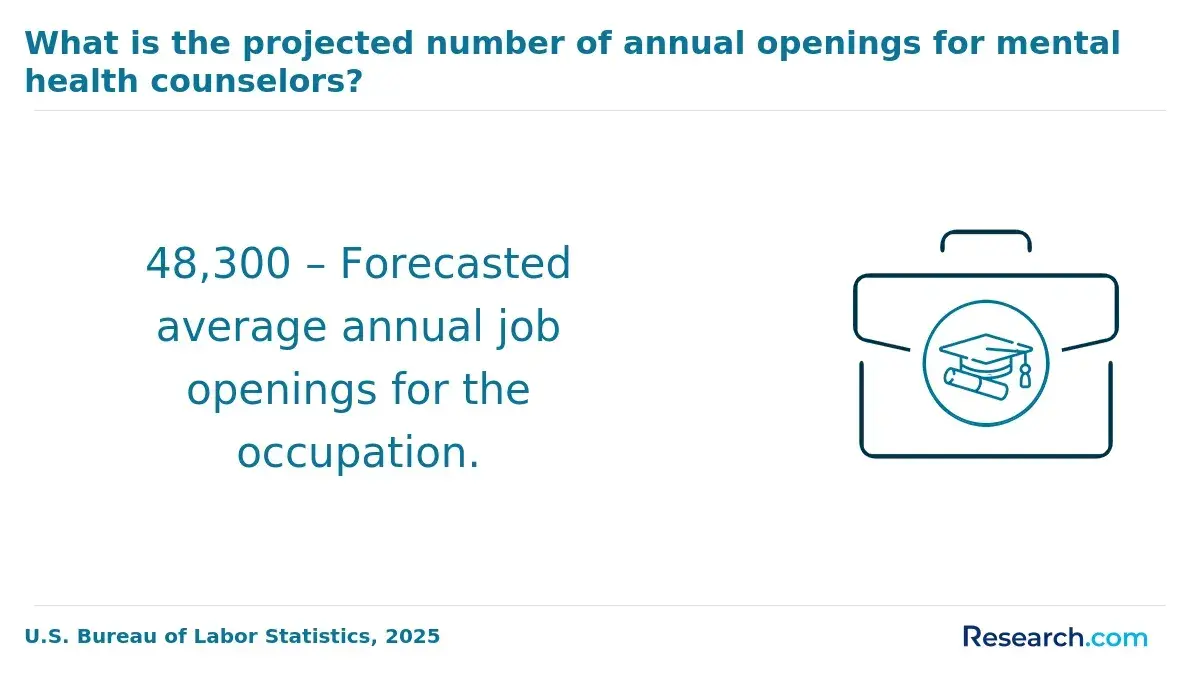
National employment for substance abuse, behavioral disorder, and mental health counselors is projected to grow 18% from 2025 to 2035 (U.S. Bureau of Labor Statistics, Employment Projections). That projection indicates demand across the occupation, not an 18% forecast for every Midwest state, specialty, or newly licensed applicant.
Test the market where you expect to live: review openings for both supervised and independently licensed counselors, the credentials employers request, and whether organizations provide supervision. Compare a major metro with nearby smaller communities if you can travel or relocate. That exercise connects a program's placement network and cost to realistic first-job options rather than assuming national growth will produce a suitable local opening.
2027 Most Affordable Online Clinical Mental Health Counseling Degree Programs Ranking in the Midwest
Investing in a counseling degree is a consequential decision, especially when the least expensive advertised tuition may not represent the least expensive route to licensure. Research.com's team evaluates program cost alongside evidence about graduate outcomes, accreditation, and licensure exam results where applicable, and checks multiple sources to improve the ranking's credibility and accuracy. The Most Affordable ranking orders programs by cost; a low-cost position should not be read as a finding that a program has the strongest outcomes or meets every state's licensing rules.
The team used these data sources to build and check the rankings:
IPEDS database - institutional reporting on enrollment, completions, and prices.
Research.com's broader counseling methodology scores completion, employment or doctoral admission, licensure exam pass rates where applicable, CACREP accreditation, Title IV eligibility, and cost. Its Best ranking gives the greatest weight to graduate outcomes and accreditation; cost has a smaller role. The other rankings emphasize the dimension in their names. Read the Research.com methodology for more detail, and use the affordability ranking as a shortlist - not a substitute for confirming a current tuition quote and licensing-board requirements.
# 1 position
Fort Hays State University
Master
Master of Science in Counseling (Clinical Mental Health Counseling)
Delivery mode: online
95.40
/ 100
Final score
Specialization
Clinical Mental Health Counseling
Required credits
60 semester credits
GPA range
3.00 - 4.00
Application deadline
Summer: Jan 15 priority / Feb 15 final; Fall: Mar 15 priority / Apr 15 final; Spring: Sep 15 priority / Oct 15 final
Application process
direct
GRE
no
Prerequisites
No specific prerequisite coursework listed. Requires a bachelor's degree with minimum 3.00 GPA in the last 60 credit hours, a 1-2 page personal statement, two letters of recommendation, and a completed background check.
Additional requirements
Official transcripts, proof of 3.00 GPA in last 60 undergrad credit hours, 1-2 page personal/professional goals statement, two letters of recommendation, background check (Validity Screening Solutions)
Accreditation
Accredited by the Council for Accreditation of Counseling and Related Educational Programs (CACREP), with institutional accreditation from the Higher Learning Commission (HLC).
Fort Hays State University earned a Research.com Affordability Score of 95.4/100, supported by $22,482 total cost (tuition and fees) and 60 semester credits. The program is CACREP-accredited, valid through 2029-03-31.
# 2 position
Wayne State College
Master
Clinical Mental Health Counseling Master's Degree (MSE)
Delivery mode: hybrid
94.60
/ 100
Final score
Program length
2.5-3 years if attending at a full-time pace
Specialization
Clinical Mental Health Counseling
Required credits
60 semester credits
Employment or doctoral admission
90.8% (2021-22)
Application deadline
Fall: March 1; Spring: Oct 1; Summer: Oct 1
Application process
direct
Additional requirements
Program application, learning agreement, affirmation of conduct, statement of purpose, contact information for a minimum of three recommendations, transcript submission
Accreditation
Accredited by the Council for Accreditation of Counseling and Related Educational Programs (CACREP), with institutional accreditation from the Higher Learning Commission (HLC).
Wayne State College earned a Research.com Affordability Score of 94.6/100, supported by $23,554 total cost (tuition and fees) and 60 semester credits. The program is CACREP-accredited, valid through 2033-03-31.
# 3 position
Indiana University-South Bend
Master
Master of Science in Education/Clinical Mental Health Counseling
Delivery mode: hybrid
94.40
/ 100
Final score
Program length
Minimum of 3 years of full-time study (includes summer classes)
Specialization
Clinical Mental Health Counseling
Required credits
60 semester credits
GPA range
3.00 - 4.00
Application deadline
April 1
Application process
direct
GRE
no
Accreditation
Accredited by the Council for Accreditation of Counseling and Related Educational Programs (CACREP), with institutional accreditation from the Higher Learning Commission (HLC).
Indiana University-South Bend earned a Research.com Affordability Score of 94.4/100, supported by $23,895 total cost (tuition and fees, estimated) and 60 semester credits. The program is CACREP-accredited, valid through 2030-10-31.
# 4 position
Chadron State College
Master
Master of Arts in Education – Clinical Mental Health Counseling
Delivery mode: online
93.80
/ 100
Final score
Specialization
Clinical Mental Health Counseling
Required credits
60 semester credits
GPA range
3.00 - 4.00
Program completion rate
50%
Licensure exam pass rate
100% (2024-25)
Application deadline
Fall Cohort: Feb 1 (final deadline); Spring Cohort: Sept 15 (final deadline)
Application process
direct
GRE
no
Prerequisites
Earned baccalaureate degree from a regionally accredited institution
Additional requirements
Official transcripts from the college/university that issued the bachelor's degree; official transcripts from any institutions attended after receiving a bachelor's degree (if applicable); admission essay; viewing of New Student Orientation video
Accreditation
Accredited by the Council for Accreditation of Counseling and Related Educational Programs (CACREP), with institutional accreditation from the Higher Learning Commission (HLC).
Chadron State College earned a Research.com Affordability Score of 93.8/100, supported by $24,720 total tuition and 60 semester credits. The program is CACREP-accredited, valid through 2032-03-31.
# 5 position
University of Nebraska at Kearney
Master
Clinical Mental Health Counseling, Master of Science in Education
Delivery mode: hybrid
93.10
/ 100
Final score
Program length
Fall First Semester ... Spring Third Semester (8 semesters incl. 2 summers)
Official transcripts (Low GPA Statement if below 2.75), resume, personal essay (300-500 words) on motivation to become a clinical mental health counselor, three professional references, admission interview.
Accreditation
Accredited by the Council for Accreditation of Counseling and Related Educational Programs (CACREP), with institutional accreditation from the Higher Learning Commission (HLC).
University of Nebraska at Kearney earned a Research.com Affordability Score of 93.1/100, supported by $25,667 total cost (tuition and fees, estimated) and 60 semester credits. The program is CACREP-accredited, valid through 2032-10-31.
# 6 position
Central Methodist University-College of Graduate and Extended Studies
Master
Master of Science in Clinical Counseling
Delivery mode: online
92.80
/ 100
Final score
Program length
less than three calendar years
Specialization
Clinical Mental Health Counseling
Required credits
60 semester credits
GPA range
3.00 - 4.00
Application deadline
Priority: February 1; Final: May 1
Application process
direct
GRE
no
Prerequisites
Baccalaureate degree from an accredited college or university; 18 or more hours of coursework in psychology, counseling, social work or a closely related field.
Additional requirements
Official transcripts showing a baccalaureate degree; criminal background check; three one-page written statements; two reference letters from clinical or academic professionals.
Accreditation
Accredited by the Council for Accreditation of Counseling and Related Educational Programs (CACREP), with institutional accreditation from the Higher Learning Commission (HLC).
Central Methodist University-College of Graduate and Extended Studies earned a Research.com Affordability Score of 92.8/100, supported by $26,060 total cost (tuition and fees) and 60 semester credits. The program is CACREP-accredited, valid through 2034-04-30.
# 7 position
South Dakota State University
Master
Counseling and Human Resource Development (M.S.)
Delivery mode: online
92.50
/ 100
Final score
Program length
2.5 years
Specialization
Clinical Mental Health Counseling
Required credits
60 semester credits
GPA range
2.75 - 4.00
Program completion rate
96% (2024-25)
Employment or doctoral admission
100% (2024-25)
Licensure exam pass rate
100% (2024-25)
Application deadline
Fall: April 15 (Priority: Dec 1); Spring: Oct 15
Application process
direct
GRE
no
Accreditation
Accredited by the Council for Accreditation of Counseling and Related Educational Programs (CACREP), with institutional accreditation from the Higher Learning Commission (HLC).
South Dakota State University earned a Research.com Affordability Score of 92.5/100, supported by $26,501 total cost (tuition and fees, estimated) and 60 semester credits. The program is CACREP-accredited, valid through 2033-10-31.
# 8 position
Northern State University
Master
M.Ed. in Counseling – Clinical Mental Health Pathway
Delivery mode: hybrid
91.80
/ 100
Final score
Program length
Estimated Time to Complete: Two Years
Specialization
Clinical Mental Health Counseling
Required credits
60 semester credits
Program completion rate
100% (2022-23)
Employment or doctoral admission
100% (2022-23)
Application process
direct
Prerequisites
Undergraduate degree in psychology, sociology, or education (typical incoming background noted for the program)
Additional requirements
Graduate application; participation in an individual and group interview process with program faculty (in-person or via Zoom)
Accreditation
Accredited by the Council for Accreditation of Counseling and Related Educational Programs (CACREP), with institutional accreditation from the Higher Learning Commission (HLC).
Northern State University earned a Research.com Affordability Score of 91.8/100, supported by $27,437 total cost (tuition and fees, estimated) and 60 semester credits. The program is CACREP-accredited, valid through 2034-04-30.
# 9 position
Wichita State University
Master
M.Ed. in Counseling
Delivery mode: hybrid
89.90
/ 100
Final score
Specialization
Clinical Mental Health Counseling
Required credits
60 semester credits
GPA range
3.00 - 4.00
Application deadline
Fall: July 15; Spring: Dec 1
Application process
direct
GRE
no
Prerequisites
Bachelor's degree with a minimum 3.00 GPA for the last 60 credit hours; statement of professional goals, résumé, and three professional references; criminal background check required before the first semester.
Additional requirements
Completed graduate school application; official transcripts showing 3.00 GPA for the last 60 hours; a statement of professional goals; a resume; names, addresses and phone numbers of three professional references.
Accreditation
Accredited by the Council for Accreditation of Counseling and Related Educational Programs (CACREP), with institutional accreditation from the Higher Learning Commission (HLC).
Wichita State University earned a Research.com Affordability Score of 89.9/100, supported by $30,111 total cost (tuition and fees, estimated) and 60 semester credits. The program is CACREP-accredited, valid through 2029-10-31.
# 10 position
University of Nebraska at Omaha
Master
M.S. in Counseling with a concentration in Clinical Mental Health Counseling (CMHC)
Delivery mode: hybrid
89.60
/ 100
Final score
Program length
Average completion: 3-4 years (full-time)
Specialization
Clinical Mental Health Counseling
Required credits
60 semester credits
Acceptance rate
52.5%
GPA range
3.00 - 4.00
Program completion rate
90.4% (2022-23)
Licensure exam pass rate
91% (2023-24)
Application deadline
Summer 2027: Feb 15, 2027; Fall 2027: Feb 15, 2027
Application process
direct
GRE
no
Prerequisites
Bachelor's degree; 3.0 GPA for unconditional admission (2.7-2.99 considered for provisional admission); no specific undergraduate major required.
Additional requirements
Official transcripts of all attended universities; two letters of recommendation; current resume or CV; Statement of Purpose (max 2 pages, double-spaced); group admission interview (by invitation).
Accreditation
Accredited by the Council for Accreditation of Counseling and Related Educational Programs (CACREP), with institutional accreditation from the Higher Learning Commission (HLC).
University of Nebraska at Omaha earned a Research.com Affordability Score of 89.6/100, supported by $30,540 total tuition and 60 semester credits. The program is CACREP-accredited, valid through 2033-03-31.
# 11 position
Evangel University
Master
Master of Science in Clinical Mental Health Counseling
Delivery mode: hybrid
87.90
/ 100
Final score
Program length
27 months (7-semester accelerated plan, summer start); standard 9 semesters
Specialization
Clinical Mental Health Counseling
Required credits
60 semester credits
GPA range
3.00 - 4.00
Program completion rate
70% (2024-25)
Employment or doctoral admission
100% (2024-25)
Application deadline
Spring (January): November 1; Summer (May): April 1
Application process
direct
GRE
Conditional: GRE (combined 290+) required if undergraduate GPA is below 3.0
Prerequisites
Bachelor's degree from an accredited institution; six hours of psychology or counseling coursework; undergraduate GPA of 3.0 or combined GRE score of at least 290. Conditional admission possible below thresholds.
Additional requirements
Bachelor's degree from an accredited college or university; GPA of 3.0 or higher in the last 60 undergraduate hours (or last two years of full-time study), or GRE scores of at least 290 combined with a 3.0 writing score;
Accreditation
Accredited by the Council for Accreditation of Counseling and Related Educational Programs (CACREP), with institutional accreditation from the Higher Learning Commission (HLC).
Evangel University earned a Research.com Affordability Score of 87.9/100, supported by $32,925 total cost (tuition and fees, estimated) and 60 semester credits. The program is CACREP-accredited, valid through 2027-10-31.
# 12 position
Huntington University
Master
Master of Arts in Clinical Mental Health Counseling
Delivery mode: hybrid
86.60
/ 100
Final score
Specialization
Clinical Mental Health Counseling
Required credits
60 semester credits
Acceptance rate
96%
GPA range
3.00 - 4.00
Program completion rate
79% (2024-25)
Employment or doctoral admission
100% (2024-25)
Licensure exam pass rate
100% (2024-25)
Application deadline
Fall: July 15 (May 1 for scholarship consideration); Spring: December 1
Application process
direct
Prerequisites
Biblical studies: 3 credit hours; Psychology: 3 credit hours from Intro/General, Abnormal, or Clinical Psychology, or Personality Theories/Theories of Counseling (minimum C); conditional admission possible pending completion in first year.
Additional requirements
Two recommendation letters (preferably one academic), professional résumé, official transcripts from the highest degree-granting institution (3.0 undergraduate GPA desired), and completion (or conditional completion) of prerequisite coursework.
Accreditation
Accredited by the Council for Accreditation of Counseling and Related Educational Programs (CACREP), with institutional accreditation from the Higher Learning Commission (HLC).
Huntington University earned a Research.com Affordability Score of 86.6/100, supported by $34,620 total cost (tuition and fees) and 60 semester credits. The program is CACREP-accredited, valid through 2033-10-31.
# 13 position
Bethany Lutheran College
Master
Master of Arts in Clinical Mental Health Counseling
Delivery mode: hybrid
85.60
/ 100
Final score
Program length
two years (three-year option available)
Specialization
Clinical Mental Health Counseling
Required credits
60 semester credits
Program completion rate
93%
Employment or doctoral admission
79% (2025)
Application deadline
Priority Fall Cohort or Summer Jumpstart: February 28/29; Standard Fall Cohort: May 15; Rolling if Available: June 30
Application process
direct
Prerequisites
An undergraduate degree in any field is accepted; a psychology degree is not required.
Accreditation
Accredited by the Council for Accreditation of Counseling and Related Educational Programs (CACREP), with institutional accreditation from the Higher Learning Commission (HLC).
Bethany Lutheran College earned a Research.com Affordability Score of 85.6/100, supported by $36,040 total cost (tuition and fees) and 60 semester credits. The program is CACREP-accredited, valid through 2034-04-30.
# 14 position
Northwestern College
Master
Master of Arts in Clinical Mental Health Counseling
Delivery mode: online
85.10
/ 100
Final score
Program length
two years (6 semesters)
Specialization
Clinical Mental Health Counseling
Required credits
60 semester credits
GPA range
3.00 - 4.00
Program completion rate
91% (2025)
Employment or doctoral admission
100% (2025)
Licensure exam pass rate
100% (2025)
Application deadline
rolling
Application process
direct
GRE
no
Prerequisites
Baccalaureate degree from an accredited institution
Additional requirements
Official transcripts, minimum 3.0 GPA (conditional admission possible below), updated résumé, virtual interview with faculty member; no GRE required, no application fee.
Accreditation
Accredited by the Council for Accreditation of Counseling and Related Educational Programs (CACREP), with institutional accreditation from the Higher Learning Commission (HLC).
Northwestern College earned a Research.com Affordability Score of 85.1/100, supported by $36,735 total cost (tuition and fees) and 60 semester credits. The program is CACREP-accredited, valid through 2031-10-31.
# 15 position
Grand View University
Master
Master of Science in Clinical Mental Health Counseling
Delivery mode: hybrid
84.80
/ 100
Final score
Program length
two-year intensive program
Specialization
Clinical Mental Health Counseling
Required credits
60 semester credits
GPA range
2.75 - 4.00
Licensure exam pass rate
69% (2022-23)
Application deadline
rolling
Application process
direct
GRE
no
Prerequisites
A baccalaureate degree or a completion plan meeting the program's requirements; cumulative undergraduate GPA of 2.75 or greater, or a GPA of 2.75 or higher in the last 60 hours of undergraduate coursework.
Additional requirements
Completion of the application for admission; video submission responding to prompt questions (e.g., approach to personal biases); no GRE required.
Accreditation
Accredited by the Council for Accreditation of Counseling and Related Educational Programs (CACREP), with institutional accreditation from the Higher Learning Commission (HLC).
Grand View University earned a Research.com Affordability Score of 84.8/100, supported by $37,145 total cost (tuition and fees) and 60 semester credits. The program is CACREP-accredited, valid through 2032-03-31.
# 16 position
Grace College and Theological Seminary
Master
Master of Arts in Clinical Mental Health Counseling
A degree from an accredited institution; Undergraduate 3.0 GPA minimum
Additional requirements
Completed application, official/unofficial transcripts, professional reference (non-relative, recent employer/instructor/supervisor), interview with faculty member, background check
Accreditation
Accredited by the Council for Accreditation of Counseling and Related Educational Programs (CACREP), with institutional accreditation from the Higher Learning Commission (HLC).
Grace College and Theological Seminary earned a Research.com Affordability Score of 84.5/100, supported by $37,500 total tuition and 60 semester credits. The program is CACREP-accredited, valid through 2029-03-31.
# 17 position
Truman State University
Master
Master of Arts in Counseling: Mental Health Counseling
Delivery mode: online
84.40
/ 100
Final score
Program length
Semester 1 ... Semester 7 (no term labels)
Specialization
Clinical Mental Health Counseling
Required credits
60 semester credits
GPA range
2.75 - 4.00
Licensure exam pass rate
100% (2023-24)
Application deadline
rolling
Application process
direct
GRE
Conditional: GRE required if undergraduate GPA is below 3.000
Prerequisites
Earned baccalaureate degree from a regionally accredited institution (or extra-national equivalent); GRE General Test scores required only for applicants with an undergraduate GPA below 3.000.
Additional requirements
Official undergraduate and graduate transcripts; GRE if undergraduate GPA is below 3.000; personal statement; three professional references; criminal background check via Family Care Safety Registry; required online interview.
Accreditation
Accredited by the Council for Accreditation of Counseling and Related Educational Programs (CACREP), with institutional accreditation from the Higher Learning Commission (HLC).
Truman State University earned a Research.com Affordability Score of 84.4/100, supported by $37,680 total tuition and 60 semester credits. The program is CACREP-accredited, valid through 2033-03-31.
# 18 position
MidAmerica Nazarene University
Master
M.A. in Counseling – Clinical Mental Health Counseling
Delivery mode: hybrid
83.00
/ 100
Final score
Program length
Complete in 33 months
Specialization
Clinical Mental Health Counseling
Required credits
60 semester credits
GPA range
3.00 - 4.00
Program completion rate
95.8% (2024-25)
Employment or doctoral admission
100% (2024-25)
Licensure exam pass rate
100% (2024-25)
Application deadline
Applications and interviews occur every February and April
Application process
direct
Prerequisites
Bachelor's degree from a regionally accredited college or university; minimum cumulative GPA of 3.0 (or 3.2 in last 30 hours), with lower GPAs eligible under probation
Additional requirements
Official transcripts, three professional and/or academic references, a writing assessment, and one half-day of comprehensive interviews with graduate faculty
Accreditation
Accredited by the Council for Accreditation of Counseling and Related Educational Programs (CACREP), with institutional accreditation from the Higher Learning Commission (HLC).
MidAmerica Nazarene University earned a Research.com Affordability Score of 83.0/100, supported by $39,665 total cost (tuition and fees) and 60 semester credits. The program is CACREP-accredited, valid through 2033-10-31.
# 19 position
Crown College
Master
Master of Arts in Counseling
Delivery mode: hybrid
81.90
/ 100
Final score
Program length
full time ... can complete the program in three years
Specialization
Clinical Mental Health Counseling
Required credits
60 semester credits
GPA range
3.00 - 4.00
Application process
direct
Prerequisites
Bachelor's degree from a regionally or nationally accredited college or university with transcripts on file; minimum GPA of 3.0 for previous post-secondary coursework (case-by-case review below 3.0).
Additional requirements
3-4 page paper answering program prompts; 1.5-2 hour Virtual Group Interview with Faculty; 2 references (one pastoral, one from another category).
Accreditation
Accredited by the Council for Accreditation of Counseling and Related Educational Programs (CACREP), with institutional accreditation from the Higher Learning Commission (HLC).
Crown College earned a Research.com Affordability Score of 81.9/100, supported by $41,200 total cost (tuition and fees) and 60 semester credits. The program is CACREP-accredited, valid through 2034-10-31.
# 20 position
Minnesota State University Moorhead
Master
Master of Science in Counseling – Clinical Mental Health Counseling
Delivery mode: online
81.80
/ 100
Final score
Program length
two years for full-time students
Specialization
Clinical Mental Health Counseling
Required credits
60 semester credits
GPA range
3.00 - 4.00
Program completion rate
86% (2024-25)
Employment or doctoral admission
100% (2024-25)
Application deadline
Summer: February 1
Application process
GradCAS
Prerequisites
Baccalaureate degree from a regionally accredited institution; no specific major required.
Additional requirements
GradCAS application, resume, unofficial transcripts, three letters of recommendation, ~350-word career goals essay, criminal background check, $50 application fee.
Accreditation
Accredited by the Council for Accreditation of Counseling and Related Educational Programs (CACREP), with institutional accreditation from the Higher Learning Commission (HLC).
Minnesota State University Moorhead earned a Research.com Affordability Score of 81.8/100, supported by $41,239 total cost (tuition and fees, estimated) and 60 semester credits. The program is CACREP-accredited, valid through 2032-10-31.
Frequently asked questions about online Clinical Mental Health Counseling degree in Midwest
Can I become licensed after an online counseling master's degree?
Potentially, but online delivery alone determines neither eligibility nor approval. Check the specific curriculum, accreditation status, clinical experience, and post-degree requirements with the licensing board in the state where you intend to practice.
Do I have to complete an internship in person?
Expect supervised work with clients at an approved clinical site even when classes are online. Ask each program which activities must be in person and who approves an out-of-state site.
Is the cheapest program the best value?
Not necessarily. Compare total cost, time away from work, completion likelihood, placement support, borrowing, and the credential you can pursue afterward - not tuition alone.
Can I keep working full time while enrolled?
Some students do, particularly during coursework. Practicum and internship schedules can be harder to combine with full-time employment, so request the school's clinical timetable before enrolling.
Will a license earned in one Midwest state transfer to another?
Do not assume it will. States set their own licensure and endorsement rules; consult the destination state's board before choosing a program or planning a move.