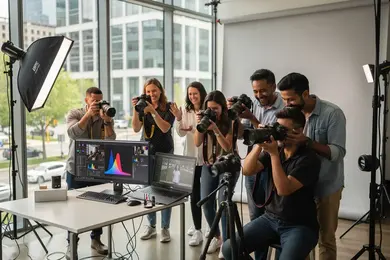
2027 Online Digital Photography Degrees for Students Who Want Stable Creative Careers

Co-Founder and Chief Data Scientist
Choosing a photography degree is really a career-planning decision: you need creative training, but you also need employable digital skills. The U.S. Bureau of Labor Statistics reported a May 2024 median annual wage of $42,520 for photographers, which shows why many students pair photography with editing, marketing, content production, or visual media strategy.
This guide explains online degree types, costs, accreditation, admissions, coursework, career options, and red flags so you can decide whether an online digital photography degree is a smart investment for your goals.
Key Things You Should Know
- Online digital photography degrees are best for students who want structured portfolio development, digital editing skills, and career flexibility, not just camera technique.
- College Board's 2024-25 pricing data lists average published tuition and fees at $4,050 for public two-year in-district colleges and $11,610 for public four-year in-state colleges, making school type and transfer credits major cost drivers.
- BLS data published in 2024 projected photographer employment to grow 4% from 2023 to 2033, so students should choose programs that connect photography with stable adjacent skills such as content production, e-commerce, design, and digital asset management.
What is an online digital photography degree and who is it best suited for?
An online digital photography degree is a college program that teaches image-making, lighting, composition, editing, visual storytelling, portfolio development, and professional workflow through a distance-learning format. Unlike a short hobby course, a degree usually includes general education, critique-based studio work, history or theory, business practices, and a final portfolio or capstone.
The word digital matters because most professional photography work now extends beyond pressing the shutter. Students learn to manage image files, edit RAW photos, use software such as Lightroom or Photoshop, prepare images for web and print, organize metadata, and adapt visuals for social media, advertising, journalism, e-commerce, or brand campaigns.
This degree is usually a good fit for learners who want both creative structure and career direction. It can work especially well for students who need schedule flexibility, already own some camera equipment, or want to build a portfolio while working part time.
It may be a strong fit if you want to prepare for roles that combine photography with broader visual media work. These are the kinds of students who often benefit most:
- Career changers who need a guided portfolio and formal credential to move into creative work.
- Working adults who can photograph locally while completing lectures, critiques, and editing assignments online.
- Students interested in product, portrait, event, editorial, social media, or commercial photography.
- Creative professionals who want stronger technical editing, lighting, and business skills.
- Students who want to combine photography with marketing, communications, journalism, design, or content production.
It may not be the best first choice if you only want to learn basic camera controls, if you dislike feedback-heavy creative work, or if your goal is a highly technical career unrelated to visual media. In those cases, a certificate, workshop series, apprenticeship, or different degree may be more efficient.
How do online digital photography degrees work compared with on-campus programs?
Online photography programs usually combine asynchronous lessons, live or recorded critiques, project submissions, digital portfolios, and instructor feedback. Students complete shooting assignments wherever they live, upload contact sheets or edited files, and receive critique through a learning management system or video meeting.
The main difference is not whether you take pictures; both formats require practice. The difference is how you access studios, equipment, peer critique, and professional networks. The table below summarizes the decision points that matter most when comparing online and on-campus options.
| Factor | Online digital photography degree | On-campus photography degree | Best fit |
| Schedule | Often more flexible, with many assignments completed on your own time | Usually tied to studio, lab, and class schedules | Online fits working adults and caregivers; campus fits students who want fixed structure |
| Equipment access | Students may need to own or rent more equipment | Students may access school studios, lighting kits, printers, and labs | Campus can be better if you need expensive shared facilities |
| Critique | Conducted through uploaded files, video calls, discussion boards, or recorded feedback | Often face-to-face in studios or critique rooms | Online works if you are self-directed; campus helps students who need live interaction |
| Networking | Can be national and remote, but requires initiative | Often local and easier through campus events | Campus may help students targeting local arts or media markets |
| Portfolio building | Usually possible if assignments are well designed and faculty feedback is strong | Often supported by studio access and in-person critique | Either can work if the program requires a professional final portfolio |
Online learning can be a practical choice if you are disciplined and have access to places, people, products, or events to photograph. The common mistake is assuming "online" means easier. A good online program still expects repeated shooting, revision, critique participation, file management, and professional-level presentation.
Students should also look closely at hands-on requirements. Some online programs require short residencies, local internships, proctored exams, or specific software and hardware. Those requirements can be worthwhile, but they should be visible before you enroll.
What types of digital photography degrees can you earn online?
Online photography education is available at several academic levels, and the right choice depends on how quickly you want to enter the field, how much general education you need, and whether you want advancement into creative direction, teaching, or business ownership. A degree is not the only path, but it can provide structure and a portfolio-building sequence that self-study often lacks.
The table below compares common online options and the situations where each one makes the most sense.
| Credential | Typical focus | Common length | Who it fits best | Main trade-off |
| Certificate in digital photography | Camera operation, editing, lighting basics, and portfolio samples | A few months to about one year | Beginners, hobbyists, or professionals adding one skill set | Usually less comprehensive than a degree |
| Associate degree | Foundational photography, editing, general education, and introductory business skills | About two years full time | Students seeking a lower-cost entry point or transfer pathway | May not be enough for some competitive creative leadership roles |
| Bachelor's degree | Advanced visual storytelling, studio practice, critique, digital workflow, history, marketing, and capstone portfolio | About four years full time | Students who want broader career flexibility in media, marketing, design, or communications | Higher total cost and longer time commitment |
| Master's degree or MFA-related path | Advanced studio practice, conceptual development, research, teaching preparation, or professional body of work | Often two to three years | Experienced photographers pursuing teaching, exhibition, or advanced creative direction | Best when the career goal clearly requires graduate-level work |
Some students choose photography as part of a broader visual arts, media arts, or communication degree. That can be a smart move if you want more stable employment options than freelance photography alone. If your interests lean toward branding, layout, typography, and visual communication, comparing photography programs with graphic design programs can help you decide which creative skill set better matches your career goals.
A practical way to choose is to start with your target job, not the credential name. For example, a future wedding photographer may need strong business and client-management training, while a future e-commerce photographer may need product lighting, color correction, workflow speed, and digital asset organization.
How can you tell if an online digital photography program is properly accredited?
Accreditation is one of the most important checks before enrolling because it affects credit transfer, eligibility for federal financial aid, employer recognition, and graduate school options. For most students, the first priority is institutional accreditation from an accreditor recognized by the U.S. Department of Education or the Council for Higher Education Accreditation.
Photography programs may also mention art, design, or discipline-specific accreditation, but specialized accreditation is not always required for photography careers. What matters most is that the school itself is legitimate, transparent, and authorized to offer online education to students in your state.
Use this process before you apply or pay a deposit:
- Search the school in the U.S. Department of Education's Database of Accredited Postsecondary Institutions and Programs.
- Confirm that the institution name, campus, and accreditor match what the school advertises.
- Check whether the online program is offered by the accredited institution itself, not only by a third-party marketing partner.
- Ask whether the program is authorized to enroll students from your state.
- Review transfer policies in writing, especially if you may move from an associate program to a bachelor's program.
- Confirm federal financial aid eligibility if you plan to use grants or loans.
Red flags include vague claims such as "fully recognized worldwide," pressure to enroll immediately, no public accreditation information, unclear tuition pages, or promises of guaranteed employment. A legitimate program should be able to explain accreditation, costs, portfolio expectations, faculty qualifications, and student support without evasive language.
What courses and skills are typically taught in an online digital photography curriculum?
A strong online digital photography curriculum should move from camera fundamentals to professional image production. The best programs do not only teach attractive composition; they teach repeatable processes that help students produce usable images for clients, publications, campaigns, archives, and digital platforms.
Typical coursework includes both creative and technical subjects. These areas are worth checking because they show whether a program is preparing students for modern photography work rather than only traditional studio assignments:
- Camera operation, exposure, lenses, color, composition, and visual problem-solving.
- Lighting for portraits, products, interiors, events, and controlled studio situations.
- Digital editing, RAW processing, retouching, color correction, and file export standards.
- Photojournalism, documentary practice, commercial photography, or editorial storytelling.
- History of photography, visual culture, ethics, copyright, and representation.
- Portfolio development, critique, artist statements, and professional presentation.
- Business practices, pricing, contracts, client communication, licensing, and self-promotion.
- Digital asset management, metadata, archiving, workflow automation, and web delivery.
AI is also changing the field. Employers and clients increasingly expect photographers to understand generative image tools, AI-assisted editing, authenticity concerns, usage rights, and when an image must remain documentary rather than synthetic. Students who become deeply interested in the technical side of AI-enabled media may eventually explore more advanced computing paths, including a PhD in artificial intelligence USA program, but most photography students mainly need practical fluency in ethical tool use.
The strongest programs make students revise work repeatedly. That matters because professional photography is rarely a one-shot process. Clients care about consistency, file quality, deadlines, licensing clarity, and the ability to adjust visuals to a specific audience or platform.
What are the usual admission requirements for online digital photography programs?
Admission requirements vary by degree level and school selectivity, but most online digital photography programs are accessible to students who can show academic readiness and creative interest. Highly selective art schools may require a portfolio, while community colleges and open-admission institutions may not require previous photography experience.
Most applicants should expect some combination of the following requirements. Check each school's admissions page carefully because missing portfolio or transcript instructions can delay admission:
- High school diploma, GED, or equivalent for undergraduate admission.
- Official transcripts from high school and any prior colleges attended.
- Application form and, in some cases, an application fee.
- Portfolio of images for selective bachelor's, transfer, or graduate programs.
- Personal statement describing creative interests and career goals.
- Minimum GPA for some programs, especially transfer or graduate pathways.
- English placement, writing sample, or general education placement for some colleges.
- Proof of equipment or software access if the program requires specific tools.
Portfolio requirements deserve special attention. Admissions reviewers usually want to see observation, composition, experimentation, and willingness to develop-not necessarily expensive equipment or a fully professional style. If you are applying to a beginner-friendly program, ask whether smartphone work, school projects, or personal photo essays are acceptable.
Students interested in international, bilingual, or travel-oriented creative work may also benefit from language study alongside photography. For example, a bachelors in Spanish online can complement visual media careers in tourism, education, journalism, nonprofit communications, and multicultural marketing.
How long do online digital photography degrees take and what do they cost?
Program length depends on credential level, transfer credits, enrollment intensity, and whether courses run in traditional semesters or accelerated terms. A certificate may take less than a year, an associate degree often takes about two years full time, and a bachelor's degree usually takes about four years full time. Part-time students should expect a longer timeline but may be able to work while studying.
Tuition varies widely, so students should compare total cost rather than advertised per-credit rates alone. College Board's 2024-25 data shows average published tuition and fees of:
- $4,050 for public two-year in-district colleges.
- $11,610 for public four-year in-state colleges.
- $30,780 for public four-year out-of-state colleges.
- $43,350 for private nonprofit four-year colleges.
Those figures are broad averages, not photography-specific prices, but they give students a useful benchmark. Online programs may reduce commuting or housing costs, yet they can add technology fees, software subscriptions, printing costs, storage needs, and equipment expenses.
The table below summarizes cost factors that are especially important for photography students because the cheapest tuition is not always the lowest total price.
| Cost factor | Why it matters | What to ask before enrolling |
| Tuition and fees | Per-credit pricing can make two similar programs very different in total cost | What is the full program cost after required fees? |
| Camera and lenses | Some programs expect DSLR or mirrorless equipment beyond a phone camera | Is there a required equipment list, and can students rent or borrow gear? |
| Lighting and accessories | Portrait, product, or studio work may require lights, modifiers, tripods, and backdrops | Which assignments require lighting equipment at home or locally? |
| Software | Editing courses often require professional photo-editing tools | Are licenses included, discounted, or billed separately? |
| Printing and portfolio production | Final portfolios may require professional prints, books, or presentation materials | Are physical prints required for critiques or capstones? |
| Transfer credits | Accepted credits can reduce both time and cost | Will the school evaluate previous credits before admission? |
To reduce cost, start with accredited public options, ask for a transfer-credit review, compare equipment requirements, and complete the FAFSA if the school participates in federal aid. Avoid borrowing up to the maximum loan amount just because it is offered; photography income can vary, especially for freelancers and early-career professionals.
What stable, long-term careers can an online digital photography degree lead to?
A photography degree can lead to creative work, but stability often comes from combining photography with business, marketing, design, editing, production, or communications skills. The most resilient graduates are not limited to one type of shoot; they can plan visual content, edit efficiently, communicate with clients, manage files, and understand how images support a larger business goal.
The table below shows career directions where digital photography training can be useful. Some roles may require additional experience, internships, software skills, or a broader degree in media, communications, marketing, or design.
| Career path | Typical responsibilities | Why it may offer more stability |
| Commercial or product photographer | Photograph products, interiors, food, apparel, or branded assets for businesses | E-commerce and marketing teams need consistent visual content |
| Portrait, school, or event photographer | Create images for individuals, families, schools, weddings, conferences, and organizations | Local relationship-building can create repeat and referral business |
| Photo editor or retoucher | Select, edit, color-correct, retouch, and prepare images for publication or campaigns | Editing skills are needed across media, retail, and marketing workflows |
| Content producer | Create still images, short-form visuals, and campaign assets for digital channels | Employers often prefer multi-skill creators who can support ongoing content needs |
| Digital asset coordinator | Organize, tag, archive, license, and distribute image libraries for organizations | Large organizations need searchable, rights-managed visual archives |
| Visual communications specialist | Support brand, nonprofit, education, healthcare, or corporate communications with images | Photography becomes part of a broader communications function |
Students who want maximum income stability should think beyond the job title "photographer." For example, a hospital, university, retailer, real estate company, nonprofit, or municipal agency may need someone who can shoot, edit, manage releases, maintain an image library, and support web or social media content.
Some students discover during their search that they want a more technical, structured, or engineering-oriented career path. Military learners and veterans comparing creative and technical options may also want to review an online electrical engineering degree for military veterans if their long-term priority is a less portfolio-dependent field.
What salaries and job outlook can digital photography graduates realistically expect?
Salary expectations should be realistic because photography income varies by region, specialization, employer type, portfolio strength, business skills, and whether the work is salaried or freelance. The BLS reported a May 2024 median annual wage of $42,520 for photographers. That number is useful as a national benchmark, but it does not capture all adjacent roles in marketing, design, content production, or media management.
Job outlook also requires careful interpretation. BLS data published in 2024 projected 4% employment growth for photographers from 2023 to 2033, which is about steady rather than explosive. For students, the takeaway is clear: a degree can help, but a flexible skill set and strong portfolio matter heavily.
The following table places common photography-related paths into a practical salary-and-stability context without implying guaranteed outcomes.
| Path | Salary context | Outlook and stability considerations |
| Photographer | BLS May 2024 median annual wage: $42,520 | Income may be steadier in salaried institutional roles and more variable in freelance work |
| Commercial imaging specialist | Often influenced by employer, product category, location, and production volume | E-commerce, real estate, hospitality, and retail can create recurring image needs |
| Photo editor or retoucher | Pay depends on software skill, speed, publication standards, and employer type | Can be more stable when combined with content operations or design responsibilities |
| Content producer | Compensation varies because duties may include photography, short video, social media, and editing | Multi-platform content skills may improve employability compared with photography alone |
| Digital asset or media coordinator | Often tied to communications, marketing, museum, retail, or institutional operations | Stability can come from ongoing organizational need for searchable, compliant media libraries |
AI editing, smartphone cameras, stock-image marketplaces, and low-cost freelance platforms have increased competition for basic image work. However, they have not removed the need for professionals who can direct shoots, solve lighting problems, work with people, manage rights, meet brand standards, and deliver consistent files under deadline.
The strongest ROI usually comes from treating the degree as one part of a career plan. Students should build a portfolio in a marketable niche, complete internships or client projects, learn basic contracts and licensing, and graduate with evidence of reliable workflow-not only attractive images.
How can prospective students compare and choose the best online digital photography program?
The best online digital photography program is the one that matches your career goal, budget, learning style, and portfolio needs. Rankings can be a starting point, but they should never replace direct questions about accreditation, faculty feedback, equipment, software, internships, and graduate outcomes.
Use the following steps to compare programs in a practical order:
- Define your target outcome, such as freelance portrait work, commercial product photography, content production, photo editing, or transfer to a bachelor's program.
- Verify institutional accreditation and state authorization before reviewing any other feature.
- Compare total cost, including tuition, fees, equipment, software, printing, and portfolio production.
- Ask for the required equipment list and identify what you already own, what you can rent, and what you must buy.
- Review the curriculum for lighting, editing, business practices, portfolio development, and critique, not just introductory camera courses.
- Look at student work or portfolio examples to judge whether the program's output matches your goals.
- Ask how often students receive individual faculty feedback and whether critiques are live, recorded, written, or peer-based.
- Check internship, capstone, career services, alumni network, and transfer options.
- Request written information on transfer credits, withdrawal policies, refund rules, and financial aid.
- Compare at least three programs before committing.
The table below highlights common selection mistakes and better alternatives so you can avoid choices that look convenient at first but create problems later.
| Common mistake | Why it can hurt you | Better approach |
| Choosing the cheapest tuition without checking equipment costs | Required gear and software can raise the real price | Compare total program cost before applying |
| Ignoring accreditation | Credits may not transfer and aid eligibility may be limited | Verify accreditation through official databases |
| Assuming online means no hands-on work | Photography requires repeated shooting, editing, and critique | Review sample assignments and weekly time expectations |
| Picking a program with weak critique | Portfolio growth depends on detailed feedback | Ask how faculty review images and how often feedback is given |
| Focusing only on artistic style | Career stability often depends on business and workflow skills | Choose a curriculum with contracts, licensing, marketing, and digital asset management |
| Assuming a degree guarantees clients or employment | Creative careers depend on portfolio, network, market, and persistence | Build client projects, internships, and a niche while enrolled |
Before enrolling, ask admissions advisors direct questions and save their answers. A trustworthy school should be transparent about cost, outcomes, student support, and limitations. If a program promises fast success, avoids accreditation questions, or cannot explain portfolio expectations, keep looking.
Other Things You Should Know About Digital Photography
Not always. Some beginner courses may allow a smartphone or entry-level camera at first, but degree programs often require a DSLR or mirrorless camera with manual controls. Ask for the equipment list before enrolling so you can budget accurately.
Students should learn Adobe Lightroom and Adobe Photoshop first, because most online digital photography degrees require basic editing, color correction, and file management. Many programs also introduce Capture One, batch processing, and non-destructive workflows within the first 30 to 60 credit hours.
They can be effective when instructors provide detailed feedback on composition, lighting, editing, concept, and technical execution. Look for programs that include regular instructor critique, not just automated quizzes or peer comments.
In 2027, students should prioritize mastering digital editing tools, understanding the principles of composition and lighting, and building a solid portfolio. Incorporating multimedia skills, like video editing, can also provide a competitive edge because of the growing demand for versatile content creators.
References
- Diploma in Digital Photography and Photoshop | Free Course | Alison https://alison.com/course/diploma-in-digital-photography
- Photography Jobs Outlook 2026: Is Studying Photography Still a Good Career Investment? https://www.baph.co.uk/blog/photography-jobs-outlook-2026--is-studying-photography-still-a-good-career-investment-
- Online Photography Degrees | Photography Programs & Courses https://www.onlinecolleges.net/degrees/photography/
- Digital Photography https://www.learndirect.com/course/digital-photography
- Best Online Photography Degrees https://www.onlineu.com/degrees/photography
- What's the Outlook for Photographer Jobs? | All Art Schools https://www.allartschools.com/photography/outlook-photography-jobs/
- College Certificate vs Online Photography School | Cameraderie https://cameraderie.org/threads/college-certificate-vs-online-photography-school.56322/
- How to Choose the Right Photography Program https://nossi.edu/how-to-choose-the-right-photography-program/
- Top Online Photography Classes 2025 for Photographer Career — about photography https://aboutphotography.blog/blog/top-online-photography-classes-2025-for-photographer-career
- What Can You Do With a Photography Degree? https://pnca.willamette.edu/academics/bfa/photography/career-options