2027 UT Austin MSDS vs. Grand Canyon Online MS in Data Science: Cost, Curriculum, Admissions, and Format

Co-Founder and Chief Data Scientist
UT Austin's online Master of Science in Data Science (MSDS) and Grand Canyon University's online MS in Data Science require different kinds of scrutiny. UT Austin publishes a notably low program tuition figure and a defined technical curriculum; prospective GCU students should obtain a current, individualized cost and course plan before making an equivalent comparison.
This guide helps working adults compare the academic preparation, scheduling, and total expense each program would demand - and decide which questions to resolve before applying.
Key Things You Should Know
- UT Austin advertises approximately $10,000 in tuition for its 30-credit online MSDS; compare that figure with a written, all-in GCU estimate rather than a per-credit rate alone.
- UT Austin's published curriculum emphasizes statistics, computing, and machine learning. For GCU, inspect the current required-course list and project expectations to judge technical depth on the same basis.
- Both universities hold institutional accreditation, but neither accreditation nor the degree title establishes which program best fits your preparation, schedule, or target role.
How do UT Austin and Grand Canyon's online data science master's programs compare?
The useful comparison is not simply public versus private university. It is the amount of technical preparation each program expects, what students must study, and what they will pay and schedule to complete it. The table separates established UT Austin features from GCU details worth confirming in its current catalog and enrollment documents.
| Decision factor | UT Austin online MSDS | GCU online MS in Data Science |
| Academic requirements | 30 credit hours across 10 courses | Confirm the current total credits and required courses before comparing workload |
| Published emphasis | Statistics, computing, and machine learning | Evaluate the current course descriptions for statistical depth, programming, and applied projects |
| Tuition comparison | Approximately $10,000 in advertised program tuition | Request a current program-wide estimate covering tuition and required fees |
| Online planning | Courses are delivered online; term deadlines still matter | Confirm course length, meeting requirements, and course availability |
UT Austin has the clearer documented advantage for a student prioritizing a predictable, comparatively low tuition figure. That does not settle academic or scheduling fit. A prospective GCU student should ask for its current degree plan and a sample course calendar, then compare those documents with UT Austin's offerings rather than assuming that two similarly named degrees teach the same material.
How much do UT Austin and Grand Canyon's data science master's degrees cost?
Start with program-wide tuition, then add required fees and expenses that depend on how you study. The figures below should not be read as equivalent quotes: UT Austin's is an advertised program tuition amount, while a current GCU total needs to be confirmed directly.
- UT Austin: Approximately $10,000 in advertised tuition for the full 30-credit MSDS. Check the current term's billing information for any applicable additional charges.
- GCU: Obtain a written estimate using the current tuition rate, the credits in your degree plan, and every required program or technology fee; do not treat a per-credit quote as the total price.
For either school, budget separately for a suitable computer, internet access, any required materials, financing charges, and courses you might need before admission. Ask how transfer credit, employer assistance, or a change in enrollment pace would affect your actual bill. If price is your main constraint but your interests lean toward machine learning, lower-cost artificial intelligence master's options provide a separate comparison - not a substitute for checking each program's fees and curriculum.
A common mistake is to divide a projected future salary by tuition and call the result a return on investment. Your potential benefit depends on your existing pay, experience, target job, and whether studying changes your work hours; no degree alone establishes a salary increase.
What curriculum and courses does each data science master's program offer?
UT Austin's 10-course MSDS combines statistical reasoning and computation with machine-learning study. Its published offerings include probability and inference, regression and predictive modeling, data structures and algorithms, and machine-learning subjects. Those areas make it a stronger apparent fit for applicants who want substantial quantitative work, provided they have - or can build - the preparation to handle it.
For GCU, use the current catalog rather than the degree name to assess depth. Compare required, not merely elective, study in programming, probability and statistics, data management, model evaluation, and communication of results. Ask which courses require students to build and assess models using data, and whether a culminating project is required. Course titles alone cannot establish how much coding or mathematical work students actually complete.
Neither program should be assumed to provide extensive production data-engineering practice solely because it teaches data science. If building pipelines and deploying AI systems is your priority, use choosing an AI master's with data engineering preparation to sharpen the course-level questions you ask both schools.
Are UT Austin and Grand Canyon's data science degrees accredited?
Yes, both universities hold institutional accreditation: UT Austin is accredited by the Southern Association of Colleges and Schools Commission on Colleges, and Grand Canyon University is accredited by the Higher Learning Commission. Institutional accreditation applies to the university; it is not a claim that either individual data science degree has separate programmatic accreditation.
If accreditation matters for an employer's tuition benefit, a later degree, or another specific purpose, confirm the employer's or receiving institution's rules before enrolling. Also check whether your state of residence affects online enrollment or access to any required activity. Accreditation by itself does not establish curriculum quality, transferability, or eligibility for every form of aid.
What are the admission requirements for each data science master's program?
Both programs require applicants to meet graduate admission rules, but eligibility and readiness are different questions. For UT Austin, review the current MSDS application instructions alongside its stated expectations for quantitative, statistical, and programming preparation. Do not assume that meeting a university-wide minimum makes an applicant competitive or ready for its technical courses.
For GCU, request the current program-specific admission criteria, including acceptable bachelor's backgrounds, GPA rules, required documents, and any prerequisites or conditional-admission provisions. Do not assume that professional experience replaces a formal prerequisite unless admissions confirms it in writing. If your preparation is uneven, preparatory courses for AI master's programs can help you identify foundation topics to ask about; taking a course does not automatically satisfy either university's requirement.
Before paying an application fee, send each program a brief account of your calculus, statistics, and coding experience and ask which gaps must be resolved for admission versus which are recommendations for success.
How long does each data science master's program take to complete?
UT Austin's 30-credit requirement gives applicants a basis for planning, but a calendar completion date depends on courses taken per term, course availability, and any enrollment rules. Ask for a feasible sequence at the pace you can sustain while working, not just the fastest possible schedule.
Use the same test for GCU: request the current degree plan showing credits, course length, start dates, prerequisites, and the sequence offered to online students. A shorter individual course does not necessarily mean a shorter degree if required courses cannot be taken together or are offered less frequently. Compare two personalized schedules at the same weekly study capacity before choosing on speed.
How do the online formats differ between UT Austin and Grand Canyon?
UT Austin delivers the MSDS online, but online access does not mean students can ignore term schedules, assignment deadlines, or assessments. For GCU, confirm whether each required course is asynchronous, includes scheduled live activities, or imposes group-work meeting times. These details matter more to a shift worker or caregiver than the word "online" in either program's name.
Ask both schools for a recent syllabus from an introductory and an advanced course. Check weekly deadlines, examination arrangements, group-project expectations, software access, and instructor support. The red flag is not a particular format; it is committing to a program before learning whether its recurring obligations fit your working hours and time zone.
What careers can graduates pursue with a data science master's degree?
Depending on previous experience and the skills demonstrated in coursework, graduates may pursue data scientist, machine-learning, advanced analytics, or related quantitative roles. An analyst seeking more statistical and modeling responsibility may assess these degrees differently from a software developer moving toward machine learning; neither degree title alone determines which jobs an employer will consider them qualified for.
When reviewing projects, look for evidence you could discuss in an interview: a well-defined problem, defensible data preparation, appropriate model evaluation, and a clear account of limitations. If introductions to employers are especially important to your transition, AI master's degree options with alumni career networks offer another dimension to investigate. Ask UT Austin and GCU what career services their online data science students can actually access rather than assuming campus-wide services work identically for them.
What salaries and job outlook can data science graduates expect?
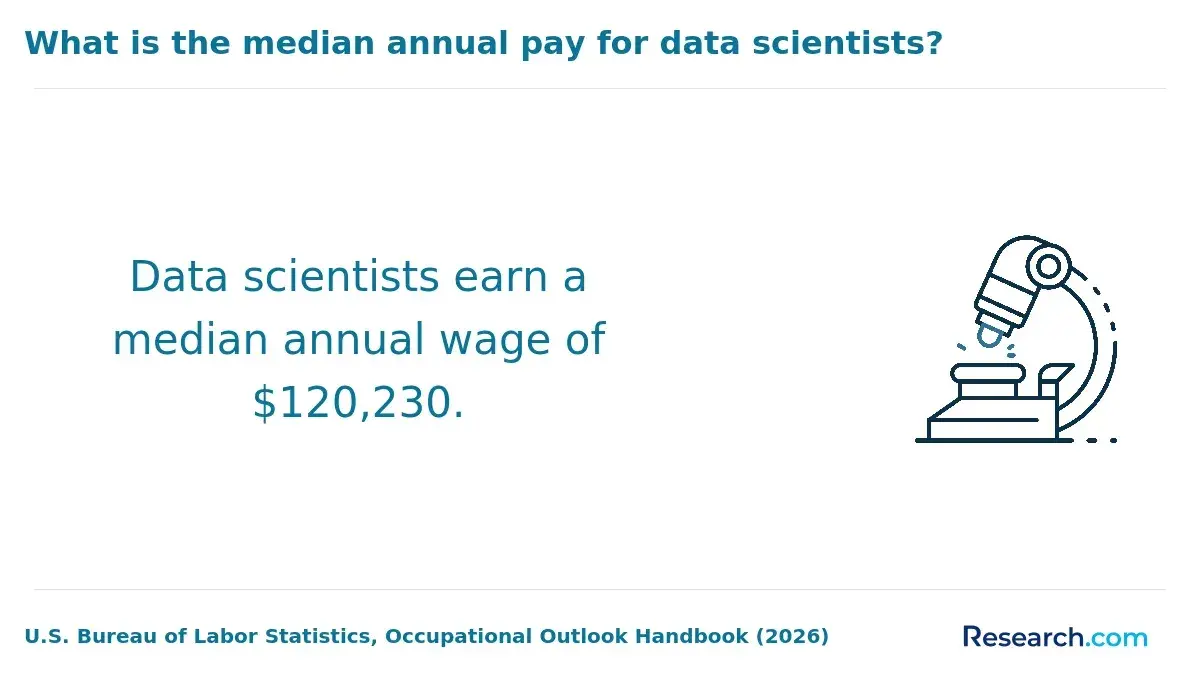
The U.S. Bureau of Labor Statistics reports a $120,230 median annual wage for data scientists in May 2025 and projects 35% employment growth from 2025 to 2035. The outlook indicates demand for the occupation, not an expected salary or job offer for a graduate of either university.
Those national figures cover people with varied experience, employers, locations, and educational backgrounds. For your own financial decision, compare realistic postings for your target role with your current earnings and skills. Neither a national median nor projected job growth demonstrates that one of these two programs produces better employment outcomes.
Which data science master's program is the better choice for you?
Choose UT Austin for closer consideration if its roughly $10,000 advertised tuition and established 30-credit, quantitative curriculum match your budget and preparation. Give GCU closer consideration if its current course sequence, teaching arrangements, or admission pathway better fit your circumstances - but decide only after obtaining its full cost estimate and verifying that the required technical work meets your goals. There is no evidence-based universal winner.
A practical next step is to request a current degree plan, sample advanced-course syllabus, realistic part-time schedule, and itemized cost estimate from each school. Compare the documents for the same target role and study pace. If your aim is primarily business reporting and decision support rather than deeper modeling, review data analytics master's degree options before committing to either data science program.
Other Things You Should Know About Data Science
Not without permission. Ask your employer about data-use restrictions and the school about project rules; public, synthetic, or properly approved data may be safer alternatives.
Requirements vary by course and by the software or cloud resources a program provides. Request each school's current technology specifications before buying hardware.
With appropriate permission, describe the problem, methods, evaluation, and your contribution without disclosing restricted data. A separate public-data project can demonstrate the underlying skills.
Look first for durable skills such as statistical reasoning, careful evaluation, and reproducible code. Tools change; ask how each program updates assignments and teaches students to assess new methods critically.
References
- Semester Course Load and Student Performance - PMC - NIH https://pmc.ncbi.nlm.nih.gov/articles/PMC7568764/
- Accreditation in the U.S. | ed.gov http://www.ed.gov/laws-and-policy/higher-education-laws-and-policy/college-accreditation/accreditation-in-the-us
- Academic Years, Academic Calendars, Payment Periods, and Disbursements | 2025-2026 Federal Student Aid Handbook https://fsapartners.ed.gov/knowledge-center/fsa-handbook/2025-2026/vol3/ch1-academic-years-academic-calendars-payment-periods-and-disbursements
- What's the Difference Between Asynchronous and Synchronous Learning? | Ohio State Online https://online.osu.edu/content-hub/blogs/whats-the-difference-between-asynchronous-and-synchronous-learning/
- Cost of Attendance | Tuition & Finance | GCU Blog https://www.gcu.edu/tuition/cost-attendance
- New Online Master's Degree in Data Science is a First for The University of Texas at Austin - UT News https://news.utexas.edu/2020/06/02/new-online-masters-degree-in-data-science-is-a-first-for-the-university-of-texas-at-austin/
- What Is Data Science? Definition, Skills, Applications & More | Harvard SEAS https://seas.harvard.edu/news/what-data-science-definition-skills-applications-more
- Mode of Instruction - Queens College - CUNY https://www.qc.cuny.edu/cetll/mode-of-instruction/
- Computer Science vs Data Science: What is Right for You? | South Dakota Mines https://www.sdsmt.edu/academics/academic-departments/electrical-engineering-and-computer-science/computer-science-vs-data-science.html