
2027 Choosing an Online Data Science Master's for a Career in Public Health

Co-Founder and Chief Data Scientist
Choosing an online data science master's for public health means looking beyond the degree title. A program may teach sophisticated modeling yet offer little preparation for disease surveillance, health data privacy, or communicating findings to public agencies.
This guide is for prospective students deciding whether a data science degree - and which kind of program - fits their target role. It shows how to compare curriculum, projects, credentials, format, and cost without assuming that every health-related elective provides meaningful public health training.
Key Things You Should Know
- Prioritize programs that combine statistics and programming with epidemiology, population-level data, privacy, and an applied health project; a general data science curriculum may require you to build that specialization yourself.
- Verify institutional accreditation and the credential awarded. CEPH accreditation is relevant when considering a public health program, but it is not a substitute for checking an online data science degree's institution and curriculum.
- The U.S. Bureau of Labor Statistics (BLS) reports a $120,230 median annual wage for data scientists in May 2025; that figure covers data scientists across industries, not public health graduates or entry-level offers.
What Is a Public Health Data Science Master's Degree?
A public health-focused data science master's applies statistical and computational methods to population health questions: where disease is spreading, which groups face unequal outcomes, or whether an intervention is reaching its intended population. Depending on the school, the credential may be a data science degree with health electives, a public health degree with an analytics concentration, or a closely related biostatistics or health informatics degree. The title alone does not establish what students can do.
These degree paths emphasize different parts of the work. The comparison helps narrow a shortlist before examining individual course descriptions.
| Degree path | Typical emphasis to verify | Potential fit |
| Data science master's with health options | Programming, modeling, data engineering, and the availability of health-focused electives or projects | Building technical methods for health and non-health roles |
| Public health master's with analytics training | Epidemiology, population health, policy, and the depth of coding and statistical instruction | Work centered on public health practice and interpretation |
| Biostatistics or health informatics master's | Study design and inference, or health information systems and implementation, respectively | Research-focused analysis or health-system data work |
If your goal is to develop AI tools in a healthcare setting, AI study options for health data careers may be worth comparing. Healthcare AI and public health analytics can overlap, but predicting an individual patient's outcome is not the same task as evaluating a population-level intervention.
How Do You Choose an Accredited Online Data Science Master's?
First, confirm the institution's recognized accreditation, the exact degree awarded, and whether the school can enroll students in your state. If you are comparing an MPH or another public health degree, check whether that specific program or school holds Council on Education for Public Health (CEPH) accreditation and whether it matters to your target employers. Do not assume CEPH accreditation applies to a separate data science degree at the same university.
Then test whether the program supports your intended public health work. These questions expose gaps that broad labels such as "health analytics" can hide:
- Can students take epidemiology, biostatistics, and courses addressing health disparities or population health - not merely one introductory health elective?
- Do required courses cover study design, missing or biased data, model validation, and interpretation as well as predictive accuracy?
- Can online students complete a supervised project using appropriately governed health or public health data, and who helps arrange it?
- Are the health electives offered often enough to fit the published graduation timeline?
- What career support and project supervision are available remotely, and are any reported outcomes specific to this degree?
A warning sign is a program advertising health applications without showing relevant courses, accessible projects, or qualified supervision. If AI is your principal interest, compare affordable online AI programs against the same public health criteria rather than choosing by degree label or price alone.
What Careers Can You Pursue With a Public Health Data Science Master's?
Possible roles include public health data scientist, epidemiology data analyst, health outcomes analyst, population health analyst, and research data scientist. Employers may include health departments, research institutions, healthcare organizations, and organizations evaluating health programs. Job titles overlap; responsibilities and required qualifications vary substantially.
A data scientist may build and assess prediction models, while an epidemiology analyst may focus more on surveillance, study design, and interpreting rates across populations. A population health analyst may translate findings into operational decisions. Choose target job postings before choosing electives: if they emphasize causal inference and study design, a machine-learning-heavy degree without those subjects may be a poor match. Some epidemiologist positions have distinct education expectations, so a data science degree should not be assumed to satisfy every posting.
How Do Online and Campus-Based Data Science Master's Programs Compare?
Online study can let working professionals keep their jobs and attend a program outside commuting distance. Campus study may make it easier to participate in in-person research groups and locally arranged projects. Neither format inherently offers stronger public health preparation; access to courses, faculty, data, and applied work matters more.
For an online option, confirm live-session requirements, time zones, group-project schedules, exam arrangements, and whether a practicum or campus visit is required. For either format, ask who secures project placements and whether working students can use approved employer data. If speed is a priority, consult a data science master's time-to-completion guide, then verify the specific program's course rotation and your realistic weekly availability. An advertised completion time may assume a heavier course load than you can sustain.
What Courses Are Included in Public Health Data Science Programs?
A strong course plan usually connects programming and data management with statistical inference, machine learning, and public health interpretation. Look for epidemiology and study design; regression and uncertainty; database work; and methods for evaluating models across population groups. Privacy, research ethics, and responsible communication should be taught as part of the analytical workflow, not treated solely as a final disclaimer.
Read syllabi or detailed course descriptions when available. A course that mentions health data once offers different preparation from a dedicated epidemiology course or a supervised project. Useful project evidence might include a reproducible analysis of a public surveillance dataset that documents missingness, compares an appropriate baseline with a more complex method, and explains limitations for a health department audience. A flashy prediction score without population context is a weaker signal of public health readiness.
What Are the Admission Requirements for Online Data Science Master's Programs?
Requirements vary by program, but applicants should check expectations for a bachelor's degree, prior mathematics and statistics, programming experience, transcripts, recommendations, and a statement of purpose. Some programs require specified prerequisite courses; others assess equivalent preparation. Professional health experience can demonstrate domain knowledge without necessarily fulfilling a formal calculus or coding prerequisite.
Before applying, match your transcript and work samples against each school's published requirements. If you lack a required course, ask admissions whether an approved course can satisfy it and when it must be completed. If a skill is recommended rather than required, a small, well-documented analysis may help demonstrate readiness. Neither self-study nor work experience should be assumed to replace a formal prerequisite without written confirmation.
How Long Do Online Data Science Master's Programs Take and Cost?
Completion time depends on required credits, course availability, prerequisites, and whether you enroll full- or part-time. Tuition also varies by institution and sometimes residency; a per-credit quote is not a total price. Request the current official tuition and fee schedule for the exact online program rather than relying on an older comparison or a schoolwide average.
Build a cost estimate from required credits, mandatory program and technology fees, materials, and any travel or project expenses. Include the cost of prerequisite courses and the effect of reducing work hours, if either applies. Ask about employer tuition assistance and aid eligibility before treating a scholarship or reimbursement as certain. If a narrower technical degree might meet your goals, compare budget-friendly ML master's programs under $20,000, but check whether adding public health coursework would change the apparent savings.
For value, compare the total amount you would pay with the skills and project access you would actually gain. Do not treat a data scientist's occupation-wide median wage as the salary increase caused by a particular degree.
What Salaries Can Public Health Data Scientists Expect?
BLS reports that the median annual wage for U.S. data scientists was $120,230 in May 2025. This is a useful benchmark for the broad occupation, not a public health-specific salary or a prediction for a new graduate. Pay can differ by role, employer, location, and prior experience; public agencies and private healthcare employers may also offer different compensation packages.
Compare pay for the roles and employers you would realistically pursue, not just jobs bearing the "data scientist" title. To see why sector matters, compare data science graduate pay across industries. Evaluate any school-reported salary figure by checking which graduates responded, when they were surveyed, and whether the figure describes salary level or an increase after enrollment.
What Is the Job Outlook for Public Health Data Science Careers?
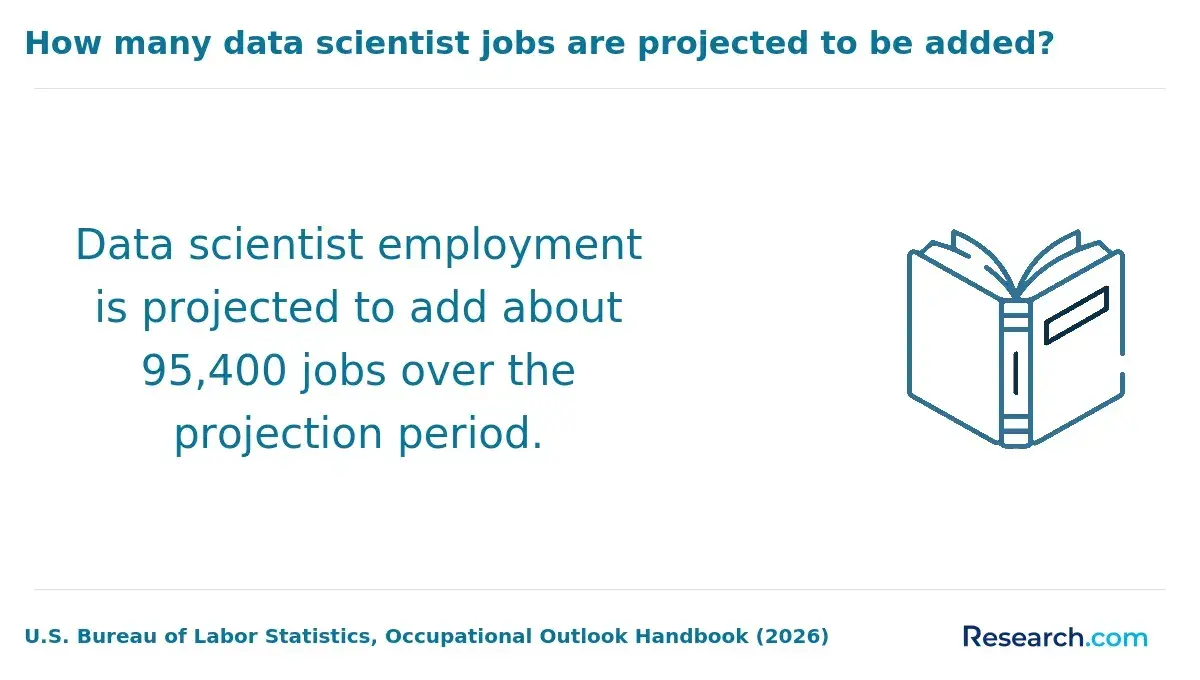
BLS projects 35% growth in data scientist employment from 2025 to 2035. That suggests broad demand for the occupation, but it does not measure openings specifically in public health or guarantee employment for graduates. Public health hiring also depends on the needs and budgets of individual employers.
For a more useful local picture, review current postings at the kinds of organizations where you want to work. Note whether they ask for epidemiology, statistical programming, secure health data handling, or evaluation experience, then compare those requirements with each program's required courses and project opportunities. Growing interest in AI makes this check especially important: an employer may need someone who can assess bias and explain a model's limits, not simply run a newer tool.
Do Public Health Data Scientists Need Licenses or Certifications?
There is no single professional license required for every public health data scientist role. An employer may instead require training for access to protected health information, research ethics training, or familiarity with its data-security procedures. Requirements depend on the position, the data, and applicable institutional rules.
Certificates in a programming tool or cloud platform can demonstrate specific skills, but they do not replace a degree requirement, approved data access, or evidence that you can conduct a sound analysis. Check the qualifications in your target job postings before paying for a certification. If you intend to enter a separately regulated profession, verify its licensing rules directly; a data science master's alone should not be assumed to meet them.
Other Things You Should Know About Data Science
Yes, if the dataset's terms permit your use. Document its source, limitations, cleaning decisions, and the population your findings do - and do not - represent. Public availability does not make every inference appropriate.
It depends on the role. Work with electronic health records may call for familiarity with clinical terminology and coding, while analysis of surveys or disease surveillance data may not. Check the data types named in target job postings.
Only if the institution and data holder authorize the proposed use and required privacy and research-review procedures are followed. Ask a program what approved datasets online students can access before making a patient-data project central to your decision.
Favor a small number of reproducible analyses that state the health question, justify the method, examine bias or missing data, and explain findings to a nontechnical audience. Follow dataset terms and avoid publishing sensitive information.
References
- An Overview of Accreditation of Higher Education in the United States | Congress.gov | Library of Congress https://www.congress.gov/crs-product/R43826
- DAPIP | Homepage - Office of Postsecondary Education (OPE) https://ope.ed.gov/dapip/
- M.P.H. Practice Sites | University of North Dakota https://med.und.edu/education-training/public-health/masters/practicum.html
- Practicum and Capstone: COPHP MPH | Health Systems and Population Health https://hspop.uw.edu/cophpmph/program-experience/practicum-capstone/
- Department of Biostatistics - University of Pittsburgh https://catalog.upp.pitt.edu/preview_entity.php
- Certificate in Data Science Methods for Real-World Evidence in Health - School of Pharmacy https://sop.washington.edu/choice/graduate-education-training-programs/certificate-in-data-science-methods-for-real-world-evidence-in-health/
- MS in Public Health Data Science | CUNY Graduate School of Public Health & Health Policy https://sph.cuny.edu/academics/degrees-and-programs/masters-programs/ms-public-health-data-science/
- Section 1: Introduction - Master of Public Health Practicum Manual - Academic Guides at Walden University https://academicguides.waldenu.edu/masters-public-health-practicum-manual/introduction
- Public Health Data Science Concentration | UNC Gillings School of Global Public Health https://sph.unc.edu/resource-pages/public-health-data-science-concentration/
- Master of Science in Public Health Data Science | usc.edu https://keck.usc.edu/public-health-data-science-ms-program/


