2027 Online Data Science Master's After a Bachelor's in Astronomy: Prerequisites and Program Fit

Co-Founder and Chief Data Scientist
An astronomy bachelor's degree can be a strong starting point for an online data science master's, but it does not settle the admissions question. Your preparation may be strongest in mathematics and scientific computing, while programs may expect coursework in areas your degree did not require.
This guide helps astronomy graduates identify gaps, compare programs on technical depth and flexibility, and decide whether a data science master's fits their intended career.
Key Things You Should Know
- An astronomy degree does not automatically qualify or disqualify you; compare your transcript and projects with each program's stated mathematics, statistics, and programming expectations.
- Prioritize programs that add skills you lack - often databases, software engineering, or applied machine learning - rather than paying to repeat quantitative work you have already done.
- The U.S. Bureau of Labor Statistics projects 35% growth in data scientist employment from 2025 to 2035, but that occupation-wide forecast does not predict an individual graduate's job prospects.
Can you pursue an online data science master's with an astronomy bachelor's degree?
Yes, potentially. An astronomy major's work may include calculus, linear algebra, physics, numerical methods, coding, and analysis of noisy observations. Those are relevant foundations for data science, but astronomy curricula differ, and admissions policies differ by program. The degree title alone is not proof that you meet every prerequisite.
Start with your transcript, not assumptions about your major. Identify where you learned statistics, probability, and programming, then note whether you applied them in research or substantial projects. An applicant who modeled telescope observations in Python may be well prepared for computational work yet still need formal probability coursework or experience querying relational databases. Choose a program based on that specific gap, not a generic claim that astronomy graduates need to start over.
What prerequisites do online data science master's programs require?
Requirements vary: a subject may be a formal admission prerequisite at one school and material taught after enrollment at another. The comparison below separates preparation astronomy graduates may already have from gaps worth checking before applying.
| Area to check | Possible astronomy preparation | Potential gap |
| Calculus and linear algebra | Physics and computational coursework | Documented coursework if a program requires specific classes |
| Probability and statistics | Measurement uncertainty or statistical analysis in research | Formal probability, inference, or experimental design |
| Programming | Scientific Python or simulation code | Software testing, collaborative development, or another required language |
| Data management | Working with observation files or research archives | SQL, relational databases, and production data pipelines |
If a prerequisite is missing, ask admissions whether an accredited course taken before enrollment would satisfy it. A short course or self-directed project can strengthen your preparation and application, but it may not replace a required transcripted course. Keep course descriptions and project documentation so an advisor can assess what your astronomy work covered.
How do you choose an accredited online data science master's program?
First, verify the university's institutional accreditation through the institution and its accreditor. Then check that the university can enroll students living in your state; institutional accreditation and state authorization answer different questions. Neither, by itself, establishes that the curriculum fits your goals.
Compare required courses and available electives against your gap list. An astronomy graduate with substantial scientific programming may benefit more from rigorous statistics, databases, and team-based engineering projects than from introductory coding alone. Check whether courses are offered often enough to follow your intended pace, whether live sessions are required, and whether you can complete a project using relevant scientific data.
A data science degree is not the only possible route if your target is specialized AI work. Use choosing an AI education path with career goals in mind to assess that alternative, then compare the actual required courses - not just the degree names.
Which data science courses prepare astronomy graduates for technical careers?
The most valuable courses depend on what your astronomy degree already covered. If you have built statistical models of observations, an introductory modeling course may add less than coursework that teaches you to manage data reliably or evaluate models outside a research setting.
Look for substantive work in statistical inference, machine learning evaluation, databases and SQL, data engineering, and software practices such as testing and version control. For each course, examine assignments and prerequisites: a passing mention of a tool is not equivalent to building and evaluating a working system. A strong project might combine a reproducible data pipeline with a model, an appropriate baseline, and an explanation of measurement error or bias.
If infrastructure is your main gap and your goal is AI development, compare data science curricula with AI master's options for building data infrastructure skills. Choose the curriculum that supplies enough depth and project practice for your target role.
What admission requirements apply to astronomy graduates applying for data science master's programs?
Check each program's current admissions page for required prior coursework, minimum academic standards, recommendations, statements, tests, and application dates. Do not assume that a quantitative degree waives a listed course or that research experience substitutes for one.
Your application should make transferable skills legible to reviewers who may not know astronomy methods. The following steps help connect your background to the program's requirements.
- Match each stated prerequisite to a transcripted course and retain its catalog description if the course title is ambiguous.
- Describe a research or class project in terms of the data, code, statistical method, validation, and your individual contribution.
- Ask admissions in writing how it evaluates any missing prerequisite and whether a proposed course would meet the requirement.
A common mistake is submitting a sophisticated astronomy project without explaining the underlying data-science work. Another is completing a noncredit course before checking whether the program accepts it for a formal prerequisite.
How do online and campus-based data science master's programs compare?
For an astronomy graduate, the important distinction is access to the learning and project experience you need, not an assumption that either format is inherently more rigorous. Compare the same courses, faculty access, project requirements, and career support across the formats you are considering.
An online program may be easier to combine with employment or ongoing research, but live class times, group work, and exams can still constrain your schedule. A campus-based program may make in-person collaboration or local research connections easier, though attendance and relocation may add costs. Ask both programs whether students can pursue projects with scientific datasets and how they receive technical feedback.
How long do online data science master's programs take and cost?
There is no reliable single duration or price for all programs. Required credits, course availability, enrollment pace, prerequisites, and institutional pricing determine your timeline and bill. Request a course-by-course completion plan and a current tuition-and-fee schedule before treating an advertised duration or per-credit price as your expected total.
Calculate tuition for the required credits, then add mandatory fees, software or materials, any required travel, and the cost of prerequisite courses. Account for the income you may give up if you reduce work hours. If speed matters, compare online data science master's options by program length, but check whether their course sequence is feasible at your intended enrollment pace. A shorter advertised timeline is not automatically the cheaper or better-fitting route.
What careers can astronomy graduates pursue after a data science master's?
Possible targets include data scientist, research data analyst, machine learning practitioner, or data engineer, depending on the skills demonstrated and the employer's requirements. Astronomy experience may be especially useful where data are noisy, measurements have uncertainty, or scientific findings need careful interpretation. For roles outside research, show that you can also work with the relevant data systems and explain results to nontechnical stakeholders.
The U.S. Bureau of Labor Statistics projects about 24,800 data scientist openings annually, on average, from 2025 to 2035. That is an occupation-wide estimate, not a count of roles reserved for master's graduates. If you specifically want AI roles and affordability is a deciding factor, compare affordable paths to an artificial intelligence degree with data science programs on required skills and total cost.
How much can data science professionals earn after graduate school?
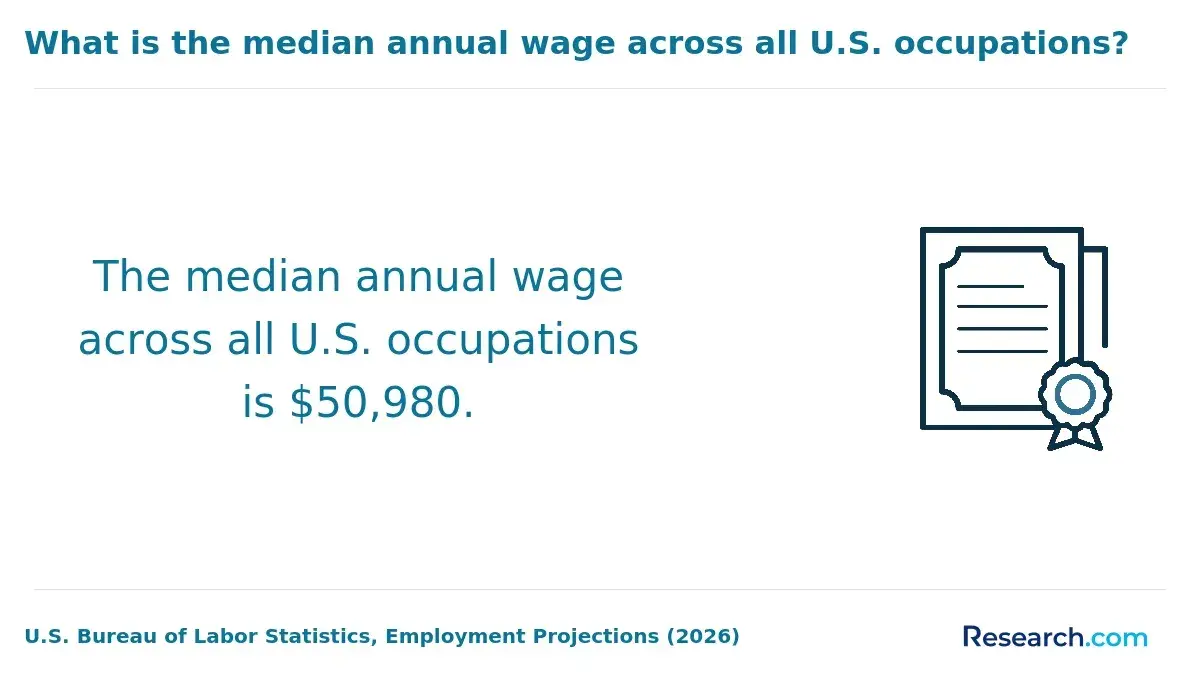
The U.S. Bureau of Labor Statistics reports a median annual wage of $120,230 for data scientists in May 2025. This describes workers across the occupation - not the starting pay of astronomy graduates or the salary increase caused by a master's degree. Experience, location, employer, and role all affect an individual offer.
For a personal financial decision, compare the program's full cost and time commitment with roles you could realistically pursue now and after graduation. If a school publishes graduate salaries, check who responded, whether they were already working in the field, and whether the figure is a salary level or an increase.
What certifications and skills strengthen a data science career?
For astronomy graduates, demonstrable skills usually provide clearer evidence of readiness than collecting credentials without a target role. A portfolio project can show how you cleaned data, handled uncertainty, selected a baseline, tested results, and documented reproducible code. Pair scientific examples with work that uses common workplace tools, such as SQL and version control, when those skills are missing from your experience.
A certification can be useful when it addresses a specific tool or platform named in jobs you want; check whether the assessment tests applied work rather than participation alone. If your goal is narrowly focused on machine learning, compare a broad data science degree with cost-conscious online ML master's study before paying for more coursework than your intended role calls for.
Other Things You Should Know About Data Science
Many graduate applications can be submitted before the bachelor's degree is awarded, but each program sets its own eligibility and final-transcript deadlines. Confirm those dates before applying.
Transfer-credit policies vary, and admission does not imply that previous graduate coursework will count toward the degree. Request a written evaluation before relying on credits to reduce cost or completion time.
Check the dataset's access terms and your research group's policies first. Publicly accessible data are a safer starting point, but you should still credit the source and avoid publishing restricted code or unpublished collaborators' work.
Diploma wording is institution-specific. Ask the university for its current diploma and transcript policies if the distinction matters to you.
References
- Online MS in Applied Data Science | Admission Requirements | University of San Diego Online Degrees https://onlinedegrees.sandiego.edu/masters-applied-data-science/apply/
- Master of Science | University of Maryland https://cmns.umd.edu/graduate/science-academy/data-science/master-science
- Prerequisite Key Topics - UVA School of Data Science https://datascience.virginia.edu/pages/prerequisite-key-topics
- MS in Data Science | Online | $9900 | Eastern University https://www.eastern.edu/academics/graduate-programs/ms-data-science
- Data Science Master's Degree Requirements | jhu.edu https://ep.jhu.edu/programs/data-science/masters-degree-requirements/
- MS in Data Science | columbia.edu https://datascience.columbia.edu/education/ms-data-science
- Tuition, Financial Aid & Scholarships - UA Online https://online.ua.edu/tuition-financial-aid-scholarships/