Ranking of the Best Scientists in the World in 2026 (5th Edition)

Co-Founder and Chief Data Scientist
On October 15, 2026, Research.com released the 2026 edition of its annual ranking of the world's top scientists, recognizing influential researchers across a wide range of scientific disciplines. This report highlights scholars whose research has made a notable impact in their respective fields and offers a snapshot of scientific contributions worldwide.
The ranking examines scientists from different countries and institutions, reflecting the global reach of academic research. By identifying leading scholars across disciplines, it helps readers explore the researchers shaping scientific knowledge and advancing their fields.
For the 2026 edition, Research.com inspected 279,971 scientist profiles from around the world. This report evaluates scholarly impact using discipline-specific H-index scores, the share of a scientist's research output within a given field, and awards. These criteria help identify researchers whose work demonstrates substantial influence in their areas of expertise.
Latest discoveries in research
Recent discoveries continue to expand scientific knowledge across physics, medicine, and other fields. In October 2026, research teams in Vienna and Beijing developed the first operational nuclear clocks, a new type of clock that measures changes inside an atom’s nucleus. Unlike traditional atomic clocks, which rely on changes involving electrons, nuclear clocks use the tiny center of an atom to keep time.
Although the technology is not yet more accurate than the best existing atomic clocks, it could eventually improve satellite navigation, help computers and communication networks keep time more precisely, and support tests of scientific theories. It may also help researchers investigate dark matter, an invisible substance that scientists believe makes up part of the universe.
In genetics, researchers have developed a new approach called a light- and sound-controlled CRISPR gene-editing tool, which allows them to switch the gene-editing tool on in selected parts of the body.
A Nature research highlight published on October 2, 2026, described how this breakthrough could help scientists study gene function and develop treatments that target specific cells while reducing unwanted changes elsewhere. Although more research is needed before the approach can be used safely in people, it could support the development of more precise treatments for genetic diseases.
The key findings for the 2026 edition of the best scientists ranking
- The United States leads the ranking with 557 scientists among the top 1,000, followed by the United Kingdom with 103.
- Harvard University ranks first among institutions, with 66 scientists included in the ranking.
- Professor Walter C. Willett of Harvard University retains his position as the world's number one scientist, with a H-index of 417.
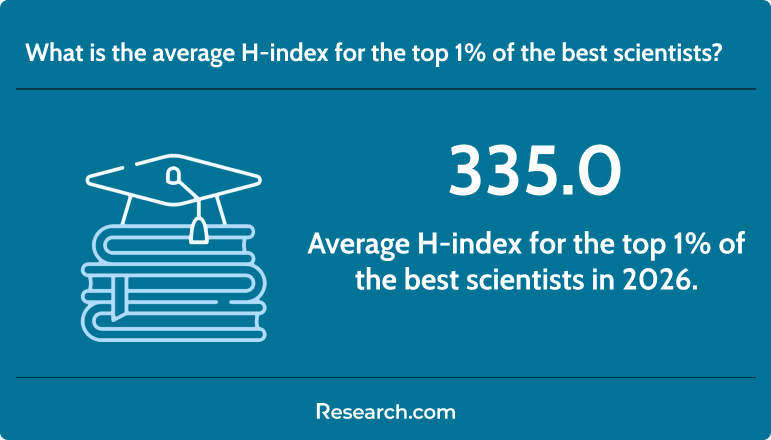
- The average Discipline H-index for the top 1% of scientists is 335, compared with 190.93 across the full top 1,000 ranking.
- Scientists in the top 1% average 485,447.7 citations and 1,953.8 publications, compared with 172,391.5 citations and 1,114.75 publications across the full ranking.
The full ranking for the 2026 list of best scientists can be found here:
WORLD’S BEST SCIENTISTS RANKING
Countries with the highest number of leading scientists
The United States remains the leading country in the 2026 ranking, with 557 scientists among the top 1,000. However, this is a decrease from 583 in the previous year. The country still accounts for more than half of the ranked scientists.
The United Kingdom ranks second with 103 scientists, up from 96 in the previous edition. Germany remains in third place with 56 scientists, an increase from 52. China has moved into fourth place with 40 scientists, up from 27, while the Netherlands ranks fifth with 32, compared with 30 last year.
Canada follows with 28 scientists, up from its previous total of 24, while Australia remains at 27. Italy has 19 scientists, France has 17, and Sweden rounds out the top 10 with 16. Overall, the latest figures show growth in several countries, particularly China, while the United States continues to account for the largest share of ranked scientists.
Please note that the country associated with a scientist is based on the affiliated research institution according to OpenAlex and CrossRef, not on their actual nationality.
Institutions with the highest number of leading scientists
Harvard University remains the top institution in the 2026 ranking, with 66 scientists, down from 70 in the previous edition. Stanford University and the National Institutes of Health share second place with 21 scientists each, unchanged from last year.
The University of Cambridge ranks fourth with 18 scientists, up from 17, while Mayo Clinic and the University of Oxford each have 15. MIT has 14, down from 18 last year, matching University College London and the University of California, San Diego.
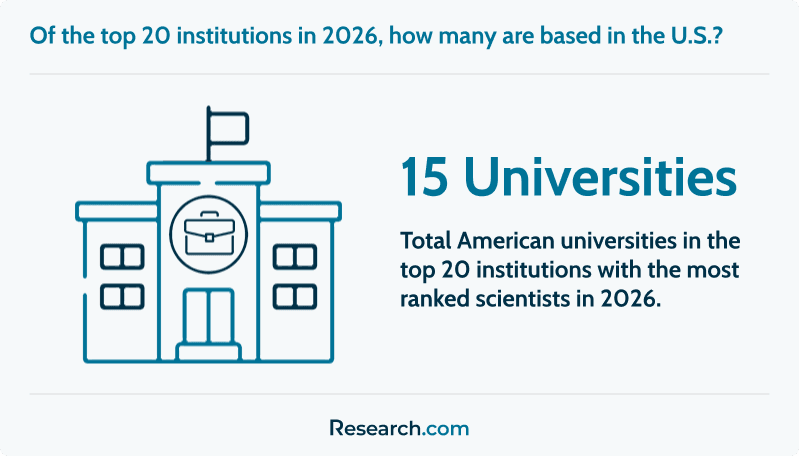
U.S. institutions continue to dominate, accounting for 15 of the top 20 institutions listed. The University of California, Berkeley, and the University of California, San Francisco each have 13 scientists, while the Icahn School of Medicine at Mount Sinai has 12. Johns Hopkins University, Northwestern University, and Imperial College London each have 11.
Yale University, the University of Texas MD Anderson Cancer Center, Duke University, and the University of California, Los Angeles each have 10, while Brigham and Women's Hospital rounds out the list with nine. The results show that leading research talent remains concentrated at major U.S. institutions, although prominent universities and medical centers in the United Kingdom also maintain strong representation.
Digital access and global learning through online universities
Digital education gives students more ways to access academic resources and connect with knowledge beyond their local institutions through online universities. These connections can support scientific learning by making research findings and academic discussions more accessible.
UNESCO's 2026 Higher Education Global Trends Report draws on data from 146 countries. It reports that global higher education enrollment reached 269 million students in 2024, while only one in five higher education institutions had a formal AI strategy. These figures highlight the scale of higher education and the need for institutions to strengthen their digital approaches.
For online universities, digital resources can help students access scholarly publications, develop technical skills, and engage with academic communities. Although research opportunities vary by program, these resources can connect learners with scientific discussions and materials across geographical boundaries.
H-index ranking—leaders, averages, and distribution
Professor Walter C. Willett of Harvard University leads both the global ranking and North America, holding first place with a H-index of 417.
Europe's top-ranked scientist is Professor Guido Kroemer, affiliated with Université Paris Cité in France. He ranks 10th worldwide, with a H-index of 307 in biology and biochemistry.
With a H-index of 245, Professor Takashi Taniguchi leads the featured scientists from Asia. He is affiliated with Japan's National Institute for Materials Science and ranks 55th globally.
In Oceania, Professor Richard M. Ryan of Australian Catholic University ranks 193rd worldwide. His H-index stands at 211 in psychology.
South Africa's University of Cape Town is home to Professor Dan J. Stein, the featured scientist for Africa. He holds a global rank of 271, with a H-index of 201 in medicine.
For the Middle East, Professor Vinod Kumar Gupta of King Abdulaziz University in Saudi Arabia ranks 335th worldwide. His H-index is 197 in chemistry.
Brazilian researcher Professor Cesar G. Victora represents South America. Affiliated with the Federal University of Pelotas, he ranks 965th globally and has a H-index of 167 in medicine.
The average Discipline H-index for the top 1% of scientists is 335, compared with 190.93 across the entire top 1,000 ranking. The top 1% of scientists average 485,447.7 citations and 1,953.8 publications each. Across all 1,000 ranked scientists, the averages are 172,391.5 citations and 1,114.75 publications. These highlight differences in research output and citation impact between the leading 1% and the full ranking.
You can learn more about the methodology used to create this report here.
About Research.com
All research was coordinated by Imed Bouchrika, Ph.D., a computer scientist with a well-established record of collaboration on a number of international research projects with different partners from the academic community. His role was to make sure all data remained unbiased, accurate, and up-to-date.
Research.com is the number one research portal for science and educational rankings. Our mission is to make it easier for professors, research fellows, and students to progress with their research and find the top experts in a wide range of scientific disciplines. Research.com is also a leading educational platform that helps students find the best colleges, academic opportunities, and career paths.