2027 One Course vs. Two Courses per Term in an Online Data Science Master's

Co-Founder and Chief Data Scientist
Taking two online data science courses per term may shorten the path to graduation, but it can also put programming assignments, exams, and group projects on the same calendar. For working professionals, the better pace depends less on ambition than on available study time, course sequencing, and how the program bills tuition. This guide helps you compare both options and choose an initial course load you can sustain.
Key Things You Should Know
- One course per term usually offers more room for a full-time job and demanding technical coursework; two can reduce the number of terms needed if required courses are available when you need them.
- For a program requiring N courses, the idealized timeline is N terms at one course per term versus approximately N ÷ 2 terms at two. Prerequisites, course rotation, and breaks can change either timeline.
- Compare the complete bill, not just tuition per credit: term-based fees, enrollment minimums, and financial-aid rules can make the two paces cost different amounts.
How Many Courses Should You Take Per Term in an Online Data Science Master's?
Start with one course if you have not recently combined graduate-level math or coding with full-time work, or if your weekly availability changes unpredictably. Consider two if you have a dependable study schedule, the prerequisites for both courses, and enough flexibility to handle deadlines that collide. Neither pace is universally better.
Before committing, read the program's academic calendar and ask an advisor which courses are offered each term. A two-course plan is only faster when the courses you need can actually be taken together. Check whether classes meet live, exams have fixed windows, and the program permits a change in course load after enrollment.
The comparison below isolates the scheduling trade-off. It is not a promise about the workload or completion time of any particular program.
| Consideration | One course per term | Two courses per term |
| Academic focus | More time to concentrate on one subject | More material and potentially overlapping deadlines |
| Calendar | More terms if courses are continuously available | Fewer terms if sequencing permits |
| Schedule disruption | One course affected by a difficult work period | Two courses may be affected at once |
Is One Course or Two Courses Better for Working Professionals?
One course is generally the safer initial choice when work involves travel, on-call duties, seasonal peaks, or unpredictable overtime. Two may be suitable for someone with protected study hours, relevant technical experience, and an employer willing to accommodate occasional academic deadlines. A flexible job title alone does not establish that the schedule is flexible.
For either pace, compare the published class format with your actual workweek. Recorded lectures do not necessarily mean flexible exams or group meetings. If scheduling around employment is the main obstacle, explore data science graduate study around work commitments, then confirm the policies of programs on your shortlist.
A practical test is to put work shifts, commuting, caregiving, and fixed class activities on a calendar before adding study blocks. If two courses fit only by assuming every week at work will be quiet, begin with one and reassess after a term.
How Long Does an Online Data Science Master's Take at Each Pace?
Graduation time depends on the number of required courses, term length, course availability, and whether you enroll during optional terms. Mathematically, taking two courses each term can complete a fixed course requirement in about half as many terms as taking one. That estimate stops being reliable when a prerequisite is offered only in certain terms, a capstone has its own sequence, or the program limits simultaneous enrollment.
Ask for a term-by-term plan at both paces, showing required courses rather than just a stated "time to completion." Also check the maximum time allowed to finish the degree. A slower plan is viable only if it fits that limit, including any anticipated breaks.
Finishing sooner may reduce the number of terms in which you pay recurring fees, but it does not automatically make a program affordable. Use an online data science master's affordability guide to build a shortlist, then obtain each school's current bill and course-availability plan for your intended pace.
What Is the Workload for One Versus Two Data Science Courses?
No single weekly-hour estimate applies across online data science master's programs. A course centered on mathematical proofs may demand a different kind of preparation from one built around coding projects; a capstone may add coordination with teammates or an external partner. Two courses can feel like more than twice the strain of one when major submissions fall in the same week.
To assess workload before registration, request recent syllabi for the courses you expect to pair. Pay particular attention to these features because they determine whether work can be spread across the term:
- Assignment and exam dates, including fixed-time or proctored assessments.
- Expected programming, mathematics, and reading preparation.
- Group-project meeting requirements and whether teammates can work asynchronously.
- Policies for late work, extensions, and dropping a course.
A common mistake is pairing two unfamiliar technical subjects simply because their lectures are asynchronous. If the syllabi show concurrent projects or you need substantial prerequisite review, take one first or choose a less demanding pairing with an advisor.
How Much Does Course Load Affect Online Master's Tuition Costs?
If a school charges the same tuition per credit regardless of pace, taking the same required credits at one or two courses per term may leave base tuition unchanged. Total cost can still differ. Per-term fees may accumulate over a longer enrollment, while a faster pace may affect your ability to use employer reimbursement or pay without borrowing. Institutions set these policies individually.
The table separates charges that often respond differently to course load. Use your program's current tuition and fee schedule to calculate both plans; do not treat either column as a quoted price.
| Cost component | Why pace may matter |
| Per-credit tuition | May remain the same for an unchanged credit requirement; verify any enrollment-based rate. |
| Per-term mandatory fees | May be paid more often on a longer plan. |
| Materials and technology | May be required at either pace, though payment timing can differ. |
| Financing and employer support | Borrowing costs and reimbursement timing depend on individual circumstances and policies. |
If you are considering a less expensive degree as an alternative to accelerating this one, compare total tuition for affordable ML master's programs on the same tuition-and-required-fees basis. An ML curriculum is not interchangeable with every data science curriculum, so compare course fit as well as price.
Which Courses Are Included in an Online Data Science Master's?
Course requirements vary, but a data science master's may combine statistics, programming, data management, machine learning, electives, and a project or capstone. For the one-versus-two decision, the important detail is sequence: a foundational statistics or programming course may need to precede an advanced elective, and a capstone may require earlier coursework.
Read the catalog's prerequisites and course rotation together. If your goal is a particular role, use career-oriented online data science degree options to identify relevant curricula, then check whether the courses you want can fit your preferred pace. Taking two courses sooner offers little benefit if it forces you to skip an important elective or overload a project term.
What Are the Admission Requirements for an Online Data Science Master's?
Admission requirements differ by institution and program. Applicants may need a bachelor's degree, transcripts, and evidence of preparation in programming or quantitative subjects; some programs specify prerequisites while others offer ways to address gaps. Review the current admissions page for each school rather than assuming that professional experience either satisfies or replaces a stated requirement.
Admission and readiness for two courses are separate questions. Even if a program admits you without a particular background, taking two technically demanding courses immediately may leave little time to close knowledge gaps. Ask whether prerequisite or bridge coursework counts toward the degree, and whether it changes your proposed graduation timeline.
How Do You Verify an Online Data Science Program's Accreditation?
Verify the institution's current accreditation through the U.S. Department of Education's accreditation database or the Council for Higher Education Accreditation, and compare the result with the school's own disclosures. Do not assume that a program's online format changes its institution's accreditation status, or that institutional accreditation means the individual data science degree has separate programmatic accreditation.
For pacing, accreditation is a baseline check, not a reason to take more courses. Also confirm that the school can enroll students in your state and ask its financial-aid office how your proposed course load is classified. Accreditation, state authorization, and eligibility for particular aid are distinct issues.
What Jobs and Salaries Can an Online Data Science Master's Lead To?
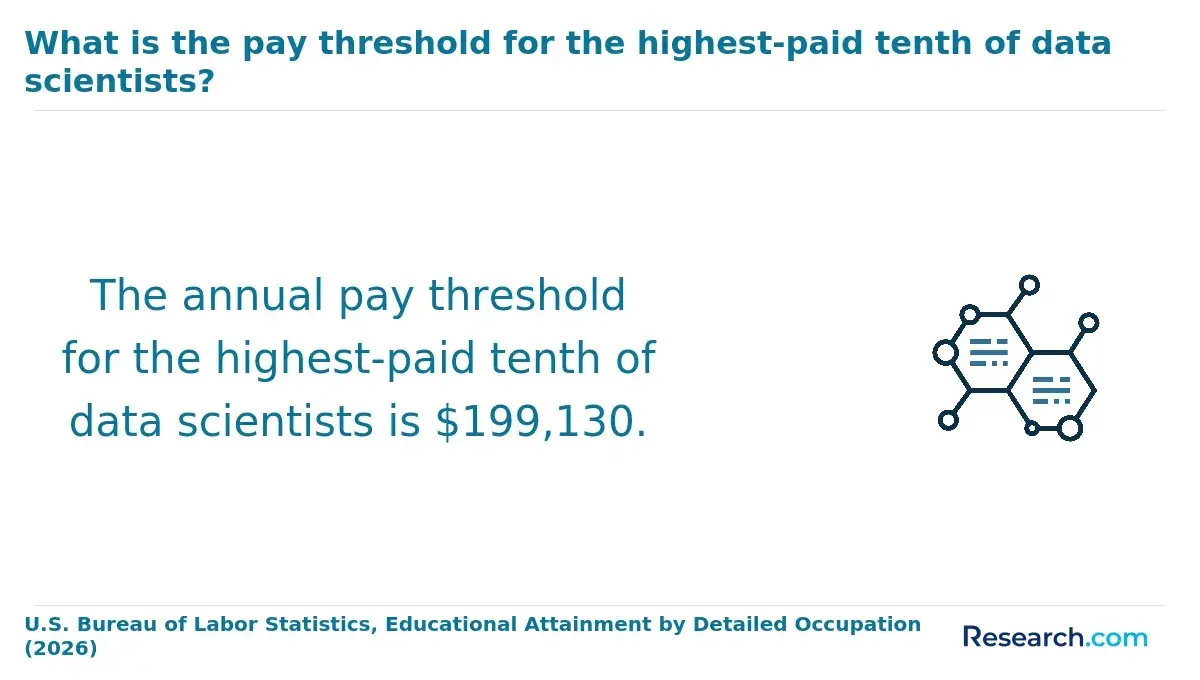
Depending on your prior experience and skills, relevant targets may include data scientist, analytics specialist, or machine learning-focused roles. The U.S. Bureau of Labor Statistics reports a $120,230 median annual wage for data scientists in May 2025. That is an occupation-wide figure, not a starting salary or a verified outcome for graduates of an online master's program.
Choose a pace that leaves room to build demonstrable skills, not merely to finish classes. For a career change, substantial projects and job-search time may matter more than graduating at the earliest possible term. If you are deciding whether a data science curriculum or an AI-focused degree better supports your target role, use AI degree comparisons based on career interests before optimizing the schedule of either option.
What Certifications Improve an Online Data Science Master's Career Path?
A certification can be useful when it verifies a tool or platform skill requested in your target job postings, but it does not replace graduate coursework, relevant experience, or a convincing project. Requirements vary by employer and role; there is no universal certification that a data science master's student needs.
Treat certification preparation as another time commitment in your course-load decision. If you plan to pursue a platform credential while changing careers, one course may preserve time for hands-on practice and applications. If you already use that platform at work, two degree courses may be a better use of the same term. Check the certification's current exam requirements before budgeting time or money for it.
Other Things You Should Know About Data Science
Possibly. Ask the program about registration limits, prerequisites, advising approval, and deadlines for changing enrollment. Do not assume that a course you want will be offered in the next term.
Not necessarily. Asynchronous classes can still have weekly deadlines, scheduled exams, or group meetings. Check the syllabus before registering.
Not always. Summer offerings and term lengths vary by school. Confirm whether required courses run in summer before including those terms in a graduation plan.
Ask about leave-of-absence rules, readmission, the maximum completion period, and any effects on financial aid. Getting those policies in writing is especially useful if your work schedule may change.
References
- Registration Actions | Rutgers University-Camden https://camden.rutgers.edu/registrar/registration-course-information/registration-actions
- Tuition and Fees - The Hub - Colorado State University https://thehub.colostate.edu/billing/tuition-and-fees/
- M.S. in Data Science, Online | virginia.edu https://datascience.virginia.edu/degrees/msds-online
- Tuition Information | Office of the Registrar | Illinois https://registrar.illinois.edu/tuition-fees/tuition-info/
- Master of Science | University of Maryland https://cmns.umd.edu/graduate/science-academy/data-science/master-science
- Admission & Requirements, Data Science | American University https://www.american.edu/programs/shared/data-science/online/curriculum.cfm
- How many hours a week do online courses require? | Penn State World Campus https://www.worldcampus.psu.edu/about-us/news-and-features/how-many-hours-a-week-do-online-courses-require
- Undergraduate Policies and Procedures | The University of Texas at Dallas https://catalog.utdallas.edu/2026/undergraduate/policies/course-policies
- What's the Difference Between Asynchronous and Synchronous Learning? | Ohio State Online https://online.osu.edu/content-hub/blogs/whats-the-difference-between-asynchronous-and-synchronous-learning/
- Tuition Overview | Student Fiscal Services - UW Finance https://finance.uw.edu/sfs/tuition-fees/tuition-overview