2027 Network Analysis in an Online Data Science Master's: Courses, Projects, and Program Selection

Co-Founder and Chief Data Scientist
Network analysis can be a substantial graduate specialty, or a brief topic inside a general data science course. If you want to study connected data, such as transactions, supply chains, or relationships among organizations, that difference matters when choosing an online master's.
This guide explains what meaningful coursework and projects look like, how to check whether an online program supports them, and when a broader data science or alternative degree may be the better fit.
Key Things You Should Know
- Look beyond course titles. A strong network analysis path combines graph concepts, statistical methods, and a project that evaluates results on connected data.
- Ask whether you can take relevant electives and complete a network-focused capstone; a topic mentioned in one class is not the same as sustained study.
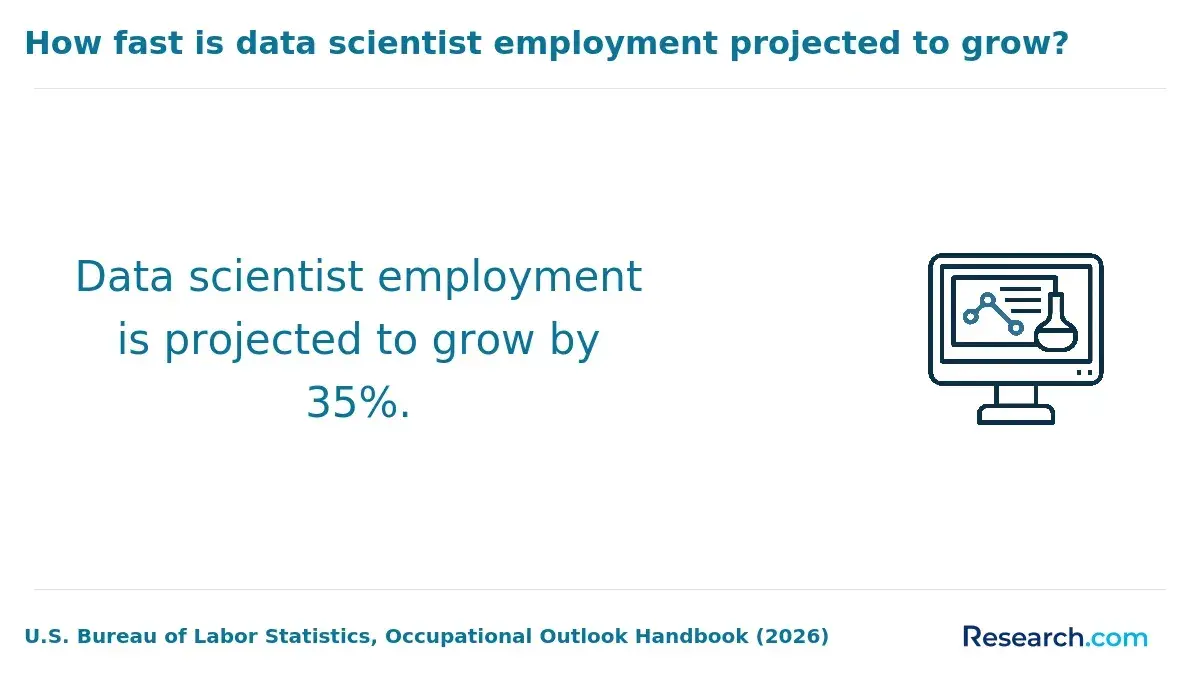
- The U.S. Bureau of Labor Statistics projects 35% employment growth for data scientists from 2025 to 2035, but that occupation-wide forecast does not measure demand for network analysis specialists.
What Is Network Analysis in an Online Data Science Master's Program?
Network analysis studies relationships as well as individual records. A network, or graph, represents entities as nodes and their connections as edges. For example, nodes might be accounts and edges might be transactions. The analytical question could be which communities of accounts interact, how information travels, or whether a connection is unusual.
Graduate-level study should go beyond drawing network diagrams. It may address graph construction, centrality and community detection, statistical models for connected data, link prediction, and the assumptions behind each method.
Students should also learn that connections are rarely independent: a conventional random train-test split can give a misleading evaluation if related edges or future information leak into training data.
This is distinct from computer network administration, which concerns the operation and security of technical infrastructure. A cybersecurity dataset can be analyzed as a graph, but a course on configuring networks is not necessarily a course on network analysis in data science.
What Courses Teach Network Analysis in Data Science Master's Programs?
Relevant material may appear under titles such as network science, graph analytics, social network analysis, data mining, machine learning, or applied statistics. The table shows what different levels of exposure can cover; it does not imply that every program offers each level.
The distinction matters when comparing catalogs: a compelling course name alone does not establish what students actually do.
| Level of exposure | Typical subject matter | Likely student work |
| Brief unit | Graph terminology and basic network measures | A visualization or short exercise |
| Dedicated course | Graph algorithms, community detection, network statistics, and method limitations | Multiple analyses of connected datasets |
| Advanced elective or substantial project | Topics such as temporal networks, link prediction, or graph machine learning | A documented model or investigation with defensible evaluation |
Preparation in Python or another programming language, linear algebra, probability, and statistics makes advanced work more accessible. Databases and data engineering also matter when relationships must be assembled from messy records.
If graph analysis is only one part of a larger pipeline you want to build, compare the relevant electives with AI master's course options for data engineering.
Request recent syllabi or assignment descriptions before enrolling. Check whether students implement and evaluate methods, rather than only run a demonstration notebook, and whether prerequisites allow you to reach the advanced elective during your degree.
What Projects Can Students Complete in Network Analysis Programs?
A useful project starts with a relationship-based question and a dataset whose edges have a clear meaning.
Possible topics include identifying communities in a citation network, studying how a supply-chain disruption could propagate, or predicting which links in a transaction network may appear next. A good project is not defined by its application alone: it needs a baseline, an evaluation suited to the question, and an explanation of what the results cannot establish.
For example, a link-prediction project should explain how negative examples were chosen and how training and test connections were separated. If time matters, testing on later observations is more convincing than letting future connections influence earlier predictions. For community detection, students should explain why the discovered groups are useful rather than treating a visually appealing plot as proof.
Before committing to a capstone topic, check the project conditions that most often determine whether it can be completed well:
- Data access: Are the relationships available, permitted for this use, and documented well enough to interpret?
- Evaluation: Is there a meaningful baseline or validation strategy, including a way to avoid leakage between related observations?
- Reproducibility: Can the work describe data preparation, code, assumptions, and limitations without disclosing protected information?
- Support: Can an instructor or advisor supervise the chosen method, even if the program does not advertise a network analysis capstone?
Projects using personal or sensitive relationships require particular care: removing names alone may not prevent people from being identified through distinctive connections.
How Do You Choose an Accredited Online Data Science Master's Program?
First, verify the institution's current institutional accreditation through the institution and its recognized accreditor. Accreditation is an important legitimacy check, but it does not establish that a particular degree teaches graph methods deeply. Also confirm that the institution can enroll students in your state and whether any campus visits are required.
Then compare programs against the work you hope to do. Ask for current syllabi, the rotation of relevant electives, and recent capstone examples.
Confirm whether network-focused work can count toward degree requirements, whether its courses are available online, and whether you can complete the prerequisites in sequence. A program with a dedicated elective you cannot fit into your schedule may be less useful than one with flexible project supervision.
Choose a data science master's when you want network analysis alongside statistical modeling and broad analytical practice. If your goal is specifically to develop AI systems, compare online AI degree options as well, but inspect their graph-related coursework rather than assuming an AI title includes network science.
What Are the Admission Requirements for an Online Data Science Master's?
Requirements vary by program. Schools may ask for a bachelor's degree, transcripts, evidence of quantitative and programming preparation, recommendations, and a statement of purpose. Some specify prerequisite courses; others assess readiness through prior study or professional experience. Do not assume that relevant work automatically fulfills a formal prerequisite.
For a network analysis goal, assess your readiness in three areas: programming to clean and join records, statistics to evaluate claims, and mathematics to understand graph methods. If you have a gap, ask admissions staff whether a course must be completed for eligibility or is simply recommended preparation.
A small, documented graph project can demonstrate interest and skill, but it should not be presented as a substitute for a requirement unless the program explicitly accepts it.
How Do Online and Campus Data Science Master's Programs Compare?
The degree format does not, by itself, determine network analysis depth. Compare actual access to electives, faculty guidance, computing resources, and project collaborators.
An online program with a suitable course sequence and remote capstone support can be a better match than a campus program whose graph courses are unavailable to master's students; the reverse can also be true.
Online study may suit students who need to remain employed, but flexibility has limits. Confirm whether relevant classes require live attendance, whether group projects span time zones, and whether the capstone requires scheduled meetings.
Students weighing those constraints can compare master's-level data science study for working adults. Campus study may be preferable when in-person research groups, local industry projects, or face-to-face supervision are central to your plans.
How Long Does an Online Data Science Master's Take and Cost?
Completion time depends on required credits, course availability, and whether you study full- or part-time. A network analysis elective offered infrequently can delay the path you want even when the degree's advertised timeline looks workable. Ask for a sample sequence that includes the prerequisites, desired elective, and capstone.
To compare costs, calculate required tuition and mandatory fees for the full degree using each school's current published rates. Then account separately for materials, software or computing needs, possible travel, and financing costs.
Rates and fee rules can change; confirm whether an online student pays different rates based on residency and whether employer assistance applies. If price is a binding constraint, budget-friendly ML master's programs under $20,000 offer an alternative comparison, but verify that any lower-cost option also teaches the graph methods you need.
A common mistake is comparing one school's tuition-only figure with another school's total estimated cost. Use the same cost categories and a feasible course schedule for each program before deciding which is more affordable.
What Careers Can Network Analysis Skills Support After Graduation?
Network analysis can support work in fraud analytics, recommendation systems, supply-chain analysis, research analytics, and some cybersecurity analytics roles. Job titles are not standardized: employers may seek a data scientist, machine learning engineer, research scientist, or analyst to solve a relationship-based problem without using "network analysis" in the title.
Match the project portfolio to the role. A fraud-oriented project should address rare events, evaluation, and the cost of false alerts; a research project may require stronger statistical interpretation. Broader software and data engineering skills can be as important as graph methods when a role involves production systems.
If you are deciding between a data science degree and a more specialized AI route, use career-focused artificial intelligence degree selection to frame that broader choice. For either degree, inspect actual job descriptions and compare their required skills with the courses and projects you can complete.
What Salary Can Data Science Graduates Expect in Network-Focused Roles?
The U.S. Bureau of Labor Statistics reports a $120,230 median annual wage for data scientists in May 2025. That is an occupation-wide measure, not a starting salary, a graduate outcome, or a salary specific to network analysis. It is most useful as context for roles classified as data scientist, not as a forecast of what an individual degree will pay.
Actual offers depend on experience, responsibilities, employer, and location. When a program publishes graduate salaries, check who was surveyed, the response rate, when salaries were measured, and whether respondents already worked in the field. A salary level after graduation does not show how much of any change the degree caused.
What Certifications and Professional Standards Apply to Network Analysis Careers?
There is no single certification that establishes competence across network analysis roles. An employer may value a platform credential when a job uses a particular cloud service, database, or analytics tool, but that credential is not a substitute for selecting methods appropriately and evaluating their results. Check job postings in your target field before paying for one.
Professional practice matters especially when edges represent people, accounts, or sensitive transactions. A credible analyst documents data provenance, obtains appropriate access, limits exposure of personal information, tests for misleading results, and communicates uncertainty. For program selection, look for these practices in project requirements and feedback, not only in a general ethics course description.
Other Things You Should Know About Data Science Programs
No. Network analysis studies patterns of relationships in data. Computer networking focuses on systems that transmit data. A project can combine them, but the curricula serve different purposes.
Not necessarily. They may be relevant to an advanced machine learning goal, but graph construction, simpler methods, and sound evaluation are valuable foundations. Choose advanced topics based on the problems you want to solve.
No. A graph database can help store and query connected data, but many analyses can be completed with appropriate files, conventional databases, and analytical software. The data's size and intended workflow should drive the tool choice.
Only if the collection and intended use comply with the platform's terms, applicable requirements, and your institution's policies. Public visibility does not automatically make relationship data appropriate to collect, publish, or share.
References
- The Analysis of Social Networks - PMC - NIH https://pmc.ncbi.nlm.nih.gov/articles/PMC2799303/
- Master's in Data Science | utexas.edu https://cdso.utexas.edu/msds
- Network Analysis 101 | Washington University in St. Louis https://cphss.wustl.edu/methodsandstrategies/social-network-analysis/network-analysis-101/
- Courses | Master of Science in Data Science | University of Connecticut https://masters.datascience.uconn.edu/courses/
- Course Selection (Academics) | Virginia State University https://www.vsu.edu/chss/departments/mass-communications/advising/academics/course-selection-academics.php
- Social Network Analysis | Columbia University Mailman School of Public Health https://www.publichealth.columbia.edu/research/population-health-methods/social-network-analysis
- Prerequisite Key Topics - UVA School of Data Science https://datascience.virginia.edu/pages/prerequisite-key-topics