Online MBA in Sustainability: admissions guide for public sector professionals

Co-Founder and Chief Data Scientist
Government sustainability work often requires more than environmental expertise: leaders must defend budgets, manage contracts, and turn policy into workable operations. An online MBA in sustainability may help, but admission standards and the value of its business curriculum vary by school.
This guide is for public sector professionals deciding whether to apply. It explains how to assess eligibility, prepare a stronger application, compare program formats and costs, and determine whether an MBA—or a more focused qualification—better supports your next role.
Key Things You Should Know
- Admission typically centers on a bachelor's degree and an application showing professional readiness; work experience, testing, prerequisites, and interview policies vary by school.
- A sustainability elective is not necessarily a formal concentration. Verify the online curriculum and whether it addresses public budgets, procurement, and implementation.
- The U.S. Bureau of Labor Statistics reports a $126,520 median annual wage for management occupations in May 2025, not for sustainability MBA graduates; use your agency's pay structure to assess potential returns.
What Is an Online MBA in Sustainability, and Who Is It For?
An online MBA in sustainability combines a general management degree with study of how organizations account for environmental and social impacts. Depending on the school, sustainability may be a named concentration, a set of electives, or a theme within a general MBA. Those are different levels of specialization, so inspect the degree requirements rather than relying on the program's marketing language.
The strongest fit for a public sector applicant is often a role that already combines mission delivery with management: overseeing a municipal fleet, administering energy-efficiency contracts, managing facilities, or coordinating a resilience initiative. The MBA can strengthen budgeting, operations, and organizational-change skills. It is less direct preparation for someone seeking environmental engineering, scientific research, or a policy-analysis role that requires deeper technical training.
If your main concern is meeting general MBA entry criteria, business-school options for online MBA programs with accessible admissions can provide a starting point. Treat admissions accessibility and sustainability curriculum as separate checks; an accessible MBA is not necessarily a sustainability MBA.
Is an Online MBA in Sustainability Accredited and Recognized?
An online MBA can be a recognized graduate degree when its institution holds accreditation from an accreditor recognized by the U.S. Department of Education. Business-school accreditation—such as AACSB, ACBSP, or IACBE—is a separate distinction; its scope may cover the business school or particular programs. Accreditation does not certify a sustainability concentration on its own.
Before applying, confirm the institution's current accreditation status with the accreditor, then ask whether the online MBA is included in the business school's accreditation scope. Check the school's catalog for the exact degree and concentration name. If you seek advancement in government, also read the vacancy announcement or your agency's education policy: an accredited MBA may meet a degree requirement without satisfying a position's separate requirements for technical education or specialized experience.
What Careers Can Public Sector Professionals Pursue With This MBA?
The most plausible next move builds on your existing function. A procurement specialist might pursue responsibility for sustainable purchasing; a facilities manager might lead building-efficiency initiatives; and a program manager might oversee climate-adaptation or resource-management projects. These paths rely on agency experience as well as business skills. An MBA alone does not qualify someone for a regulated technical position or guarantee a management promotion.
Consider whether you want internal advancement or a move to a utility, contractor, nonprofit, or private employer. Internal advancement depends heavily on classification rules, vacancies, and documented specialized experience. A sector change may depend more on translating public procurement, stakeholder, and compliance experience into the hiring organization's language.
Public health professionals have an additional choice between general management and clinical leadership. For government-employed nurses considering that distinction, a guide to business graduate programs for career growth can help frame it; neither an MBA nor a sustainability concentration replaces a required nursing credential.
The MBA core generally develops managerial accounting, finance, operations, strategy, analytics, and leadership. A sustainability study may apply those tools to resource efficiency, supply chains, environmental risk, reporting, or organizational change. Course titles and depth differ: a management course on emissions decisions is not equivalent to technical training in emissions measurement or environmental law.
For government work, examine how assignments handle constraints that private companies may not share. A useful project might compare the life-cycle costs of fleet options while accounting for procurement rules, public reporting, and service reliability. Ask whether you can use a public agency problem for a capstone, how data confidentiality is handled, and whether faculty can supervise work involving public accountability rather than only corporate ESG reporting.
There is no universal admissions standard for this specialization. Schools commonly evaluate an applicant's bachelor's degree, academic record, résumé, and statement of purpose. Some require recommendations, an interview, GMAT or GRE scores, or particular professional experience; others waive or do not require testing. A nonbusiness bachelor's degree does not automatically prevent admission, though a school may require or recommend preparation in accounting, economics, or quantitative work.
Public sector applicants should show both management potential and a credible reason for choosing sustainability coursework. A strong application connects specific responsibilities—such as administering a grant, managing a vendor, or presenting a budget—to skills the MBA would develop. It should distinguish measurable contributions from an agency-wide result you did not personally control.
Use this preparation sequence to separate official requirements from steps that strengthen your candidacy:
- Check each school's current online MBA catalog for degree eligibility, experience expectations, tests or waivers, prerequisites, deadlines, and whether the sustainability concentration is available online.
- Ask admissions staff how nonbusiness coursework and government experience are evaluated; obtain written clarification for any ambiguous requirement.
- Prepare a résumé and statement with specific budget, procurement, leadership, or implementation examples, and choose recommenders who can verify your contribution.
- If quantitative coursework is a weak spot, review accounting and spreadsheet-based analysis before enrolling; do not assume an external course will satisfy a formal prerequisite.
If testing or undergraduate grades are a concern, a guide to online MBA programs with accessible admissions may broaden your search. Confirm each school's current policy directly; an admissions-friendly general MBA may not offer the specialization you need.
Online study may let you remain employed and apply assignments to current agency work. It does not necessarily mean self-paced study: live classes, group meetings, exams, and residencies can conflict with legislative cycles, emergency response, or field assignments. Campus study may make in-person networking and recruiting easier but could require commuting, relocation, or time away from work.
Before choosing, request a sample term schedule, confirm required attendance and campus visits, and ask whether online students receive the same career-service access as campus students. If you need to change sectors, compare actual employer engagement and project opportunities—not just course content. If you plan to remain in your agency, scheduling fit and the ability to apply coursework at work may matter more.
For government-employed nurses whose goal also includes clinical leadership, fast-track MBA options for working adults degree programs illustrate a different path: an MSN/MBA dual degree. Check nursing eligibility and the curriculum carefully; a faster dual degree is not automatically a better route into sustainability management.
Completion time depends on required credits, course sequencing, and whether you study part time or accelerate. A concentration can extend the timeline if its courses rotate infrequently. Ask for a term-by-term plan based on your intended course load, including what happens if work obligations force you to pause.
Compare the full expense, not a tuition headline: required fees, books and software, travel for any residency, and borrowing costs can change the decision. Request the school's current total-cost estimate and verify whether published tuition is charged per credit, course, or term. When reviewing affordable MBA schools, recalculate the cost for the specific online MBA and your enrollment pace.
Ask your agency whether education assistance covers this degree, whether approval is required before enrollment, and whether reimbursement carries grade, service, or repayment conditions. Then compare your likely out-of-pocket cost with the advancement path actually available under your employer's pay and hiring rules. If the immediate need is one skill—such as public procurement analysis—a graduate course or employer training may cost less than a full MBA.
There is no single reliable salary for sustainability MBA graduates in government. Pay depends on occupation, agency, location, grade or classification, supervisory responsibility, and prior experience. The U.S. Bureau of Labor Statistics reports a $126,520 median annual wage for management occupations in May 2025. That figure covers many management jobs across the economy; it is neither a public sector sustainability salary nor an estimate of what the MBA will add to your pay.
For a useful personal comparison, find the posted pay range for the role you could realistically pursue after graduation and check its experience requirements. Compare that range with your current compensation and the degree's net cost. If the target job requires years of specialized experience you do not yet have, do not count its upper pay range as an immediate MBA return.
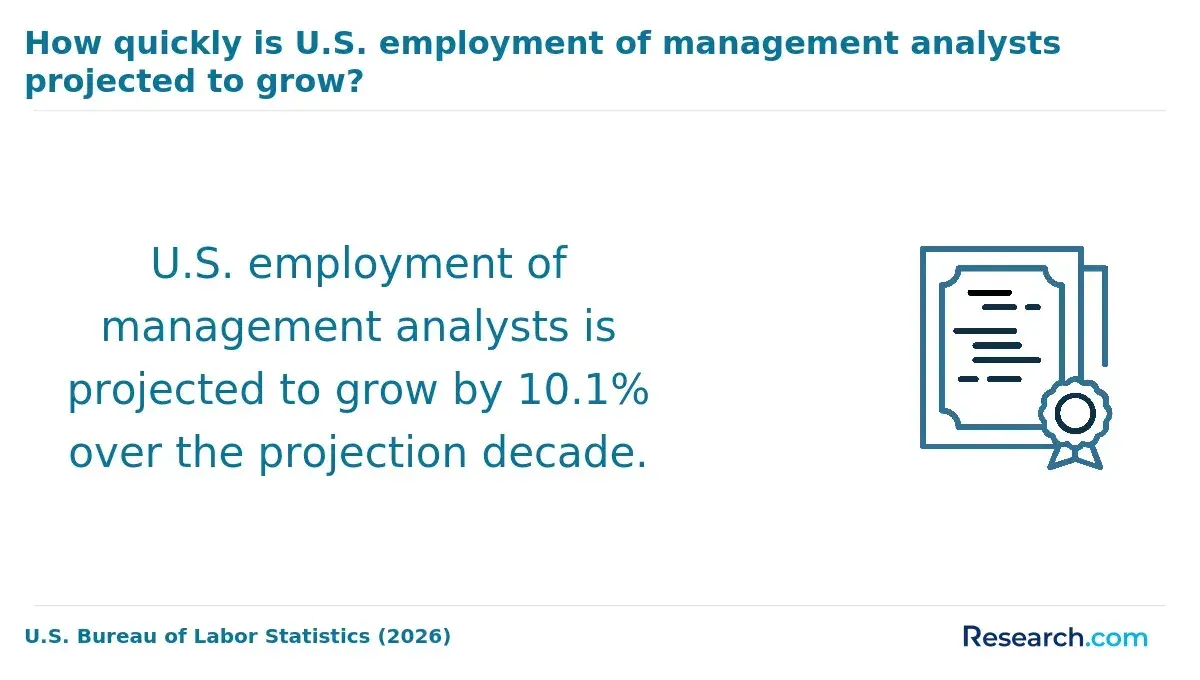
Sustainability and ESG work spans multiple occupations rather than one standardized job category, so broad management projections cannot establish demand for a particular title. The Bureau of Labor Statistics projects about 1.1 million openings annually in U.S. management occupations from 2025 to 2035, reflecting both growth and replacement needs. That indicates a broad management labor market, not 1.1 million sustainability openings.
For government-focused planning, examine current postings from the agencies and organizations you would consider. Note whether they ask for budgeting and operations leadership, environmental subject expertise, procurement experience, or a specific technical qualification. Use those requirements to test whether an MBA closes your main gap—or whether experience and more focused study would do more.
Which Certifications Support Sustainability Careers in Government?
A certification can complement an MBA when it demonstrates a skill used in your target role. LEED credentials may be relevant to public buildings; a Project Management Professional credential may suit experienced project leaders; and procurement or energy-management credentials may fit particular agency functions. Each has its own eligibility and maintenance rules, so check the credentialing body and the job posting before committing.
Choose the qualification that addresses the employer's actual requirement. If postings emphasize managing cross-agency projects, project-management experience and a relevant credential may be more direct than another degree. If they emphasize portfolio budgets, organizational strategy, and leading teams, an MBA may offer broader preparation. Neither route substitutes for experience or a legally required professional license.
Other Things You Should Know About MBA
That depends on the school. Ask for the exact diploma and transcript wording if it matters for an employer's education review.
Only with the approvals your agency requires. Discuss confidentiality, public-records obligations, and data-use restrictions with your supervisor before sharing work materials with classmates or faculty.
Enrollment itself may not require permission, but tuition assistance, use of work time, and outside-activity rules can require approval. Check your agency's policies before making commitments.
Enrollment does not itself establish eligibility. Public Service Loan Forgiveness depends on qualifying loans, employment, repayment conditions, and required payments; review your individual loan situation before relying on it to finance the degree.
- Chapter 3 - Courses and Enrollment, Full Course of Study, and Reduced Course Load | USCIS https://www.uscis.gov/policy-manual/volume-2-part-f-chapter-3
- Types of Financial Aid: Grants, Work-Study, and Loans | studentaid.gov https://studentaid.gov/understand-aid/types
- General Schedule Qualification Policies | U.S. Office of Personnel Management https://www.opm.gov/policy-data-oversight/classification-qualifications/general-schedule-qualification-policies/
- Cost of Attendance (Budget) | 2025-2026 Federal Student Aid Handbook https://fsapartners.ed.gov/knowledge-center/fsa-handbook/2025-2026/vol3/ch2-cost-attendance-budget
- GRE and GMAT Test Score and Waiver Options | umn.edu https://carlsonschool.umn.edu/graduate/resources/gre-gmat-test-score-waivers
- GMAT and GRE Waiver Policies | JHU Carey Business School https://carey.jhu.edu/admissions/gmat-gre-waiver-policies
- Online MBA in Environmental Social Governance | WP | WPUNJ https://online.wpunj.edu/degrees/business/mba/esg/
- How to Apply for a Master of Global Policy Studies: DC Concentration | LBJ School of Public Affairs https://lbj.utexas.edu/mgps-dc-concentration-how-apply
- What makes someone a good candidate for a GRE/GMAT waiver? | Harvard Kennedy School https://www.hks.harvard.edu/admissions-blog/what-makes-someone-good-candidate-gregmat-waiver
- Tuition and Financial Aid | Hubert H. Humphrey School of Public Affairs https://www.hhh.umn.edu/tuition-and-financial-aid