
Best Online MBA in Artificial Intelligence for Business Programs for Nonbusiness Bachelor’s Graduates

Co-Founder and Chief Data Scientist
A nonbusiness bachelor's degree can be an asset in an AI-focused MBA: employers need people who understand both a field of work and how to apply new tools responsibly. The challenge is finding an online program that teaches business fundamentals as well as AI decision-making, without assuming you already know accounting or finance.
This guide explains which program claims deserve scrutiny, how to assess your preparation and total cost, and when an MBA is a better choice than a shorter or more technical qualification.
Key Things You Should Know
- A nonbusiness bachelor's degree does not, by itself, rule out an AI-focused online MBA; compare each school's experience expectations and foundation-course policies.
- Prioritize a verified online MBA with substantive AI coursework over a general MBA advertised alongside a noncredit AI certificate or a single elective.
- The Bureau of Labor Statistics reports a $126,520 median annual wage for US management occupations in May 2025 - not an expected salary for AI-focused MBA graduates.
What is an online MBA in artificial intelligence for business?
It is a management degree that combines an MBA core - such as accounting, finance, strategy, operations, and leadership - with coursework on applying artificial intelligence to business decisions. Schools may call the AI component a concentration, specialization, track, or set of electives. Those labels are not interchangeable: check which courses count toward the degree and whether the credential will formally identify an AI focus.
For a nonbusiness graduate, the strongest fit is often a program that develops both managerial fluency and the ability to evaluate AI use cases, implementation costs, data risks, and organizational change. It is not necessarily training to build machine-learning models. If your goal is to become an AI engineer or researcher, a technical master's degree or substantial computing preparation is usually more direct.
Before comparing speed, establish that a program actually contains the education you need. If it does, you can then assess whether accelerated online MBA programs leave enough time to master unfamiliar business subjects while working.
Can nonbusiness bachelor's graduates enroll in an AI-focused online MBA?
Yes, provided they meet the particular school's admissions requirements. An MBA is not restricted to business majors. A graduate of engineering, nursing, psychology, the humanities, or another field may bring valuable knowledge of an industry, its customers, or its operating constraints. What differs is the preparation each applicant may need before tackling graduate finance, accounting, and quantitative analysis.
Compare your transcript with the curriculum rather than assuming you must start over. An engineering graduate may be comfortable with statistics but new to managerial accounting; a healthcare professional may understand workflow and regulation but need practice interpreting financial statements. Ask whether the school requires prerequisite courses, offers introductory modules, or expects students to learn foundational material within the MBA core. Also check whether its cohort is designed for experienced professionals or accepts applicants earlier in their careers.
Which online MBA programs in artificial intelligence for business are accredited?
There is no responsible nationwide "best" ranking without checking each school's current online catalog, AI course requirements, and accreditation record. One program to investigate is the University of North Texas online MBA in Artificial Intelligence, offered through its G. Brint Ryan College of Business. The college holds AACSB business accreditation. Confirm directly that the AI concentration is available in the online format for your intended start term and review its current degree plan before treating it as an eligible choice.
This is a deliberately narrow candidate list, not evidence that no other suitable programs exist. An analytics-focused online MBA should not be relabeled an AI concentration merely because an AI topic appears in one course. Likewise, institutional accreditation and specialized business-school accreditation answer different questions. Use the school's current catalog and the accreditor's directory to check the degree and accreditation separately.
The following comparison distinguishes an identifiable candidate from other options worth researching; it does not assign unsupported rankings or prices.
| Option to evaluate | What may make it a fit | What to verify before applying |
| University of North Texas online MBA in Artificial Intelligence | A named AI-focused MBA candidate at an AACSB-accredited business college | Current online availability, required AI courses, total tuition and fees, scheduling, prerequisites, and career support for online students |
| Another online MBA with a formally designated AI concentration | May suit applicants seeking both a broad MBA and AI-specific study | The concentration's exact title, online course availability, required credits, accreditation, and whether courses run often enough for the intended timeline |
| Online MBA with analytics coursework but no formal AI concentration | May be sufficient for a data-informed management goal | Whether relevant AI instruction is credit-bearing and substantial enough for your career objective; do not assume it awards an AI designation |
For nonbusiness applicants, the best eligible program is the one that closes your management knowledge gaps without charging you for an AI label unsupported by the curriculum. Request a current course map and a full cost estimate from every school on your shortlist.
The MBA core should teach you to read financial results, assess markets, allocate resources, lead teams, and justify strategy. The AI-focused portion should help you identify useful applications, evaluate data quality and vendor claims, weigh implementation costs, measure results, and address privacy, bias, security, and oversight. Exact courses vary by school; a concentration title alone does not establish technical depth.
Look for a project that connects both halves of the degree. For example, a former teacher might assess an AI-supported service process by estimating its cost, defining measures of success, and planning staff training - not simply demonstrating a tool. Ask to see course descriptions and project examples so you can distinguish hands-on business application from broad discussion of AI trends.
Requirements vary by institution. Common application materials include an accredited bachelor's degree, transcripts, a résumé, a statement of purpose, and recommendations. A school may also consider work experience, an interview, a GMAT or GRE score, or an available test waiver. Do not assume that every AI concentration requires coding experience - or that a test waiver applies to every applicant.
Before applying, ask admissions staff whether nonbusiness applicants must complete accounting, economics, statistics, or other foundation work; whether those courses add tuition or time; and what professional experience the program expects. If your academic record is a concern, compare published online MBA programs for low-GPA applicants while checking each school's actual policy rather than assuming a particular cutoff or waiver.
Your application should connect your existing discipline to a plausible business goal. Evidence that you have improved a process, managed stakeholders, interpreted data, or influenced a decision can be more persuasive than a general claim that AI is a growing field.
Time to completion depends on required credits, course sequencing, foundation work, and whether you study part time or at an accelerated pace. An AI course offered infrequently can delay graduation even when the MBA core is flexible. Ask for a term-by-term plan based on your intended start date and realistic course load.
Compare the total amount you would pay, not a per-credit figure alone. Include mandatory fees, any additional foundation courses, materials or software, required travel, and financing costs. Employer reimbursement can change the decision substantially, but confirm its annual limit, grade rules, and repayment conditions. For a framework to compare affordable MBA schools, review online MBA tuition and total cost; then obtain program-specific estimates directly from each institution. Without verified current price schedules, naming a cheapest AI-focused MBA would be misleading.
Neither format is inherently better. Online study may let you remain employed and apply lessons immediately. A campus-based MBA may offer easier access to in-person recruiting, internships, and frequent peer interaction - advantages that can matter if you are attempting a substantial career change rather than advancing within a familiar industry.
Compare actual delivery rules before deciding. "Online" can still mean scheduled live classes, team meetings across time zones, or a required visit. Ask whether online students can use the same career advisers, recruiting events, and applied projects as campus students. If you are choosing between two different business disciplines rather than delivery formats alone, career-focused choices in MBA programs for marketing managers may provide a useful comparison, though a dual degree also demands a separate cost-and-time calculation.
The most realistic opportunities build on work you already know. A clinician or healthcare administrator might help evaluate AI-enabled operations; an engineer might lead product or process initiatives; and a communications professional might manage responsible adoption in marketing. Potential roles include product manager, business transformation manager, operations manager, and AI program manager, depending on prior experience and the employer's expectations.
The degree can help you frame a business case and lead implementation, but it does not replace technical experience for machine-learning engineering roles or automatically qualify you for senior management. Seek projects that demonstrate a measurable business problem, an appropriate AI application, and sound governance. If your goal is specifically healthcare administration rather than AI leadership, compare budget-conscious MBA program choices among the top online MBA programs online MBA programs before paying for a different specialization.
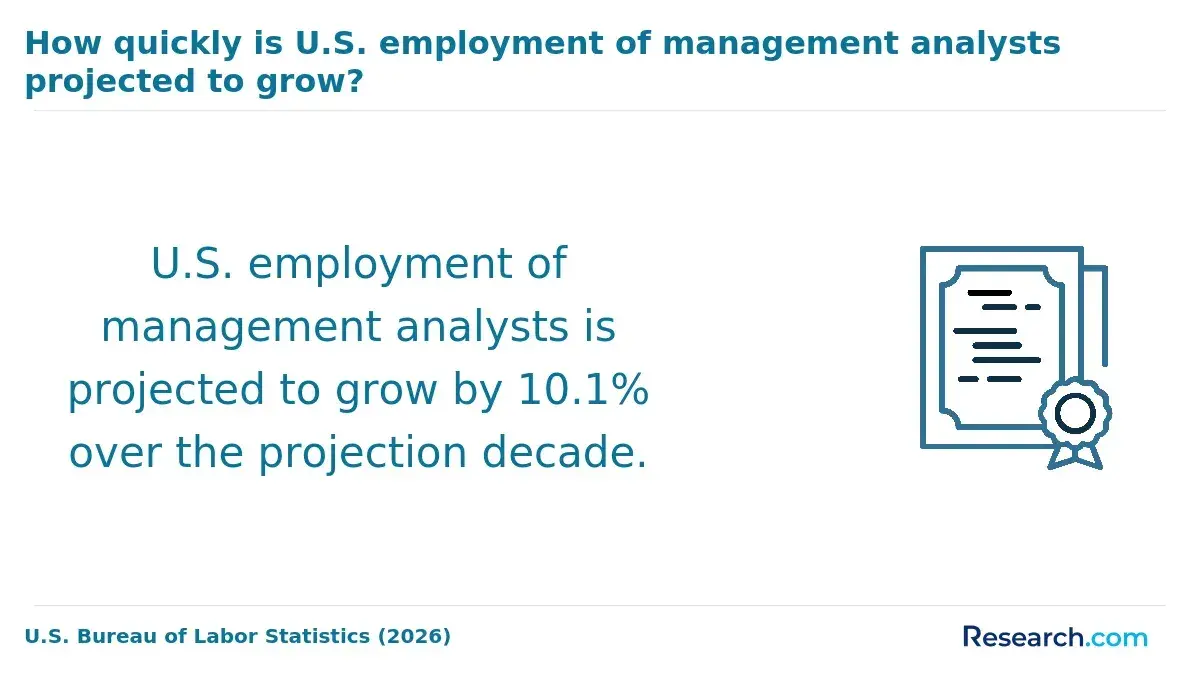
US management occupations are projected to grow faster than the average for all occupations from 2025 to 2035, according to the Bureau of Labor Statistics. That broad outlook indicates opportunities across management, not a forecast of openings reserved for AI-focused MBA holders.
There is no single reliable salary for graduates of this specialization. Pay depends on occupation, location, industry, responsibility, and experience before the MBA. The Bureau of Labor Statistics reports that US management occupations had a median annual wage of $126,520 in May 2025, compared with $50,980 for all occupations. Those figures describe employed workers in broad occupational groups; they are neither starting salaries nor evidence that an MBA caused a pay increase.
For a useful personal estimate, identify jobs you could plausibly qualify for after graduation, compare their posted pay with your current compensation, and account for tuition and time spent studying. If the target jobs primarily require technical model-building, an AI-focused MBA may offer a weaker financial case than technical training.
What certifications strengthen an AI-focused MBA career?
Choose a credential for a specific skill gap, not because it contains "AI" in its name. A project-management certification may help someone coordinating implementations; a cloud or AI fundamentals credential may help a manager communicate with technical teams; and a data-analytics certificate may help an applicant who has not worked with business data. Check eligibility rules and renewal requirements before paying.
Certifications can supplement an MBA, but they do not make a novice an experienced AI practitioner. If you already have business leadership experience and only need to evaluate AI vendors or oversee a limited deployment, a targeted course plus a documented workplace project may be a more efficient next step than a full degree.
Other Things You Should Know About MBA
Possibly. Schools set their own rules on eligible courses, grades, credit limits, and how recently the work was completed. Ask for a written evaluation before assuming transferred credits will shorten the degree.
That depends on the institution's diploma and transcript policies. Request a sample credential or written confirmation if the distinction matters to you.
Not necessarily. Business-oriented courses may use browser-based tools rather than locally trained models. Ask for the program's current hardware, software, and access requirements before buying equipment.
Ask how often AI courses run, how much work is collaborative, whether projects use realistic business problems, and what career support online students actually receive. Their experience can reveal scheduling and support issues a course catalog cannot.
- DAPIP | Homepage - Office of Postsecondary Education (OPE) https://ope.ed.gov/dapip/
- Types of Financial Aid: Grants, Work-Study, and Loans | studentaid.gov https://studentaid.gov/understand-aid/types
- Cost of Attendance (Budget) | 2025-2026 Federal Student Aid Handbook https://fsapartners.ed.gov/knowledge-center/fsa-handbook/2025-2026/vol3/ch2-cost-attendance-budget
- Online MBA in Business Artificial Intelligence - SUU https://online.suu.edu/degrees/business/mba/artificial-intelligence-business/
- Prospective Student FAQs | School of Computational Science and Engineering https://cse.gatech.edu/prospective-student-faqs
- Course and Program Format Definitions | UMaine Online https://online.umaine.edu/courses-and-program-format-definitions/
- Artificial Intelligence in Business | Minnesota Carlson https://carlsonschool.umn.edu/graduate/masters/business-analytics-ai/curriculum/artificial-intelligence
- Trinity Policies for Online Teaching and Learning | trinitydc.edu https://discover.trinitydc.edu/catalog-25-26/online-teaching-and-learning-policy/
- Online MBA in Artificial Intelligence | USI https://online.usi.edu/degrees/business/mba/artificial-intelligence/


