Online MBA in Artificial Intelligence for Business: Admissions Guide for International Applicants

Co-Founder and Chief Data Scientist
An online MBA focused on artificial intelligence can let you study at a US university without leaving your job or home country. But eligibility to enroll, recognition of your previous degree, live-class schedules, and access to career services can differ substantially by school.
This guide explains what international applicants typically need, which policies must be checked with each university, and how to judge whether an AI-focused MBA fits your career plans better than a more technical degree or a shorter course of study.
Key Things You Should Know
- Admission usually starts with a recognized bachelor's degree and an application showing academic and professional readiness; English tests, GMAT or GRE policies, and credential evaluations vary by university.
- Before paying an application fee, confirm that the school permits enrollment from your country, that required live sessions fit your time zone, and that the AI concentration is available in the online MBA.
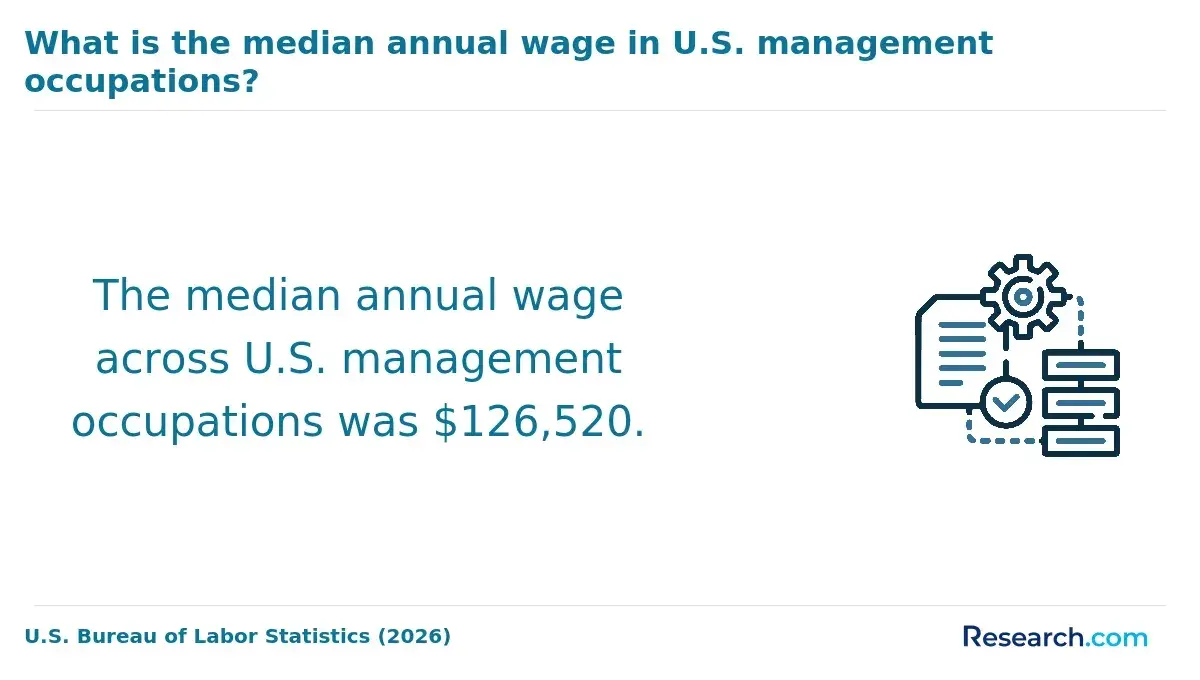
- A US online MBA does not itself provide a US visa or work authorization. For salary context, the US Bureau of Labor Statistics reports a $126,520 median annual wage for management occupations in May 2025 - not for AI MBA graduates specifically.
What is an online MBA in artificial intelligence for business?
It is a graduate business degree that combines a broad MBA core - such as finance, strategy, operations, and leadership - with coursework on using AI in organizations. Depending on the school, that coursework may form a named concentration, a track, an elective group, or a few individual classes. Those labels are not interchangeable: an AI elective alone does not make a degree an "MBA in AI."
The emphasis is generally managerial. Students may assess AI use cases, implementation costs, data risks, and organizational change rather than train or engineer advanced machine-learning models. If your goal is to become an AI researcher or machine-learning engineer, examine a technical master's degree and its prerequisites instead.
Is an online AI-focused MBA accredited and recognized in the United States?
Accreditation depends on the university, not on the words "online" or "AI" in a program's name. Check that the institution holds accreditation recognized by the US Department of Education or the Council for Higher Education Accreditation. Separately, a business school may hold specialized accreditation, such as AACSB, ACBSP, or IACBE; institutional and business-school accreditation serve different purposes.
Ask whether the online MBA awards the same degree as the school's other MBA formats and whether the AI concentration appears on the transcript or diploma. US accreditation does not guarantee that an employer, licensing authority, or education ministry in your home country will treat the credential in a particular way. If recognition matters for a specific promotion or further degree, obtain that decision-maker's requirements before enrolling.
What are the admission requirements for international applicants?
Most applicants should expect a review of their prior degree, academic record, professional experience, and reasons for pursuing an MBA. The precise standard belongs to the university: do not assume that every AI-focused MBA requires a business bachelor's degree, coding experience, a minimum number of work years, or an entrance exam.
The distinction below helps you separate common application considerations from policies that require confirmation at each school.
| Admissions area | What to check with the program |
| Prior education | Accepted degree equivalents, minimum grades, and any business or quantitative prerequisites |
| Work experience | Whether experience is required, preferred, or considered alongside academic preparation |
| GMAT or GRE | Whether testing is required, optional, or eligible for a waiver for your applicant category |
| Application review | Essay, recommendation, interview, and deadline requirements |
| Overseas enrollment | Whether the university can enroll students living in your country throughout the program |
A stronger application connects your existing work to a specific AI business problem - for example, evaluating automation in operations or governing customer-data use. If testing cost affects your shortlist, compare online MBA options with no GMAT requirement, then verify the current policy for international applicants directly with each school.
Document rules differ, especially for records issued outside the United States. Start collecting materials before the deadline so translations or evaluations do not delay review. A typical preparation checklist is:
- Obtain transcripts and proof of degree completion from every institution the MBA requires you to report; ask whether records must come directly from the institution.
- Check whether documents not issued in English need certified translations and whether the school requires original-language copies as well.
- Prepare a current résumé, statement or essays, and recommenders if requested; explain the business decisions you want to make with AI.
- Confirm any identity-document, English-test, credential-evaluation, or application-fee requirements before submission.
Use the name on your application consistently with your academic records, or ask admissions how to document a name change. Keep copies of every submitted item and note which materials must be sent by a third party rather than uploaded by you.
Some do, but neither requirement is universal. A university may accept specified English-language tests, grant an exemption based on prior education, or apply other evidence standards. Studying at an English-speaking institution does not automatically qualify you for an exemption; ask which countries, institutions, and instructional-language records its policy covers.
A credential evaluation helps a school interpret education completed under another system. Programs may assess records themselves or require a report from an approved evaluator. If an outside evaluation is required, confirm the accepted provider and whether the school wants a document-by-document or course-by-course report before purchasing one. Also check test-score validity periods and whether results must arrive by the application deadline.
The MBA core develops the financial, strategic, operational, and leadership judgment needed to make business decisions. AI-focused study may then examine where predictive or generative systems add value, how to assess vendors and data quality, and how to manage privacy, bias, security, and employee adoption. The balance varies by program; review required courses rather than relying on the concentration title.
Look closely at the assessments. A project that asks you to justify an AI investment and design its governance can be valuable for a manager, while a program with substantial programming and statistics may better suit someone seeking hands-on technical depth. Applicants in a regulated field should also compare credentials against their actual career goal: for example, MSN/MBA dual-degree programs address a different combination of nursing and business preparation, not an AI specialization.
Completion time depends on required credits, course sequencing, start dates, and how many classes you take while working. An advertised accelerated pathway may depend on a heavy course load or limited entry dates. Compare the published plan with your actual availability; a list of accelerated online MBA programs is a starting point, not proof that every applicant can finish on its fastest schedule.
There is no single dependable price for this degree type. Request a written estimate covering total required credits, tuition charged per credit or term, mandatory fees, materials and software, and any travel for required residencies. Ask whether international students pay a different rate, how exchange-rate changes and payment methods affect your budget, and whether scholarships or employer funding apply to students studying overseas. US federal student aid should not be assumed available to non-US citizens; eligibility depends on federal rules and individual status.
The better format depends on where you intend to work and how much in-person access you need. This comparison highlights differences an international applicant should investigate, rather than features guaranteed by either format.
| Consideration | Online MBA studied overseas | Campus-based degree in the US |
| Location and work | May allow you to keep your current job, subject to the school's overseas-enrollment policy | Requires relocation and planning around applicable immigration rules |
| Schedule | Live classes and group work may occur outside your local working hours | In-person classes and activities require local attendance |
| Career access | Recruiting, internships, and alumni events may be remote or restricted by location | May offer more in-person access, though opportunities and eligibility still vary |
| Costs beyond tuition | May include technology, payment, or occasional travel costs | Also requires budgeting for relocation and living expenses |
Enrollment in a US online program does not itself confer permission to enter, remain in, or work in the United States. If you hope to work there after graduation, ask the university's international-student office about the implications of the specific program and study format and seek qualified immigration advice when needed. If you already have a realistic location for campus study, comparing lower-cost MBA choices in North Carolina can illustrate how local options differ from studying online abroad; check each program's actual AI coursework.
Potential paths build on prior experience. A marketing professional might lead AI-assisted customer analysis; an operations manager might oversee process automation; a technology or product professional might move toward AI product strategy or implementation leadership. Employers may still expect domain expertise, management experience, or technical skills for a particular role. An MBA concentration alone does not qualify someone to build advanced AI systems or move directly into senior leadership.
For US salary context, the Bureau of Labor Statistics reports a median annual wage of $126,520 for management occupations in May 2025. That figure covers a broad occupational group - not international applicants, AI roles, or MBA graduates specifically - and should not be used as a personal post-degree salary forecast. Evaluate prospective roles using the location, experience level, and work authorization relevant to your job search.
How can international applicants choose a reputable online AI business MBA?
Build a shortlist around your intended work, not the AI label alone. Request answers in writing when a policy could determine whether you can enroll or use the degree. This sequence keeps the most consequential checks ahead of application spending:
- Verify institutional accreditation, the exact online MBA credential, and whether AI is a formal concentration, track, or set of electives.
- Confirm eligibility to study from your country, required live-session times, group-work expectations, and any campus visits.
- Ask admissions which degree records, translations, English evidence, evaluations, tests, and deadlines apply to you.
- Compare required courses and projects with the business problems you want to manage; ask which career services are accessible from overseas.
- Obtain a total-cost estimate and check recognition with employers or authorities important to your career plans.
For the financial comparison, use the same definition of total cost across schools; an online MBA tuition and total cost guide can help identify expenses to ask about. If your main goal is technical AI development, a specialized degree may be more direct. If you already have business authority and need one targeted skill, an individual course or employer training may be a better investment than a full MBA.
Other Things You Should Know About MBA
Some schools accept applications from students in their final term, but admission may be conditional on submitting proof of graduation before enrollment. Confirm the program's deadline for final records.
Possibly. Transfer limits, eligible courses, minimum grades, and whether credits can replace AI concentration requirements are school-specific. Request a course-by-course review before counting on a shorter path.
Deferral policies vary. Ask whether an offer can be moved to a later start date and whether scholarships, tuition rates, or admission conditions would change.
Not necessarily. Requirements depend on the software and assessments used. Ask for the program's current device, internet, and software specifications, including whether required tools work in your country.
- Chapter 3 - Courses and Enrollment, Full Course of Study, and Reduced Course Load | USCIS https://www.uscis.gov/policy-manual/volume-2-part-f-chapter-3
- Frequently Asked Questions | Study in the States https://studyinthestates.dhs.gov/tools-menu/frequently-asked-questions
- Student Visa | state.gov https://travel.state.gov/content/travel/en/us-visas/study/student-visa.html
- Instructions for Graduate Applicants | Graduate School https://gradschool.unc.edu/admissions/instructions/
- English language proficiency - UC Admissions https://admission.universityofcalifornia.edu/admission-requirements/international-applicants/english-language-proficiency-toefl-ielts.html
- Cost of Attendance | ucsd.edu https://fas.ucsd.edu/cost-of-attendance/index.html
- GRE and GMAT Test Score and Waiver Options | umn.edu https://carlsonschool.umn.edu/graduate/resources/gre-gmat-test-score-waivers
- MBA: Artificial Intelligence (AI) | St. Thomas Aquinas College https://stac.edu/program/mba-artificial-intelligence/
- English Proficiency | Graduate Education - Georgia Tech https://grad.gatech.edu/english-proficiency
- Online MBA in AI for Business at USCA https://online.usca.edu/degrees/business/mba/artificial-intelligence-business/