
Online MBA in Sustainability: Admissions Guide for Military Veterans

Co-Founder and Chief Data Scientist
Military leadership can translate well to sustainability work, but an online MBA is not automatically the right bridge into a civilian role. Veterans need to check whether a program teaches the business skills their target job requires, recognizes their experience in admissions, and fits both their schedule and education benefits.
This guide explains how to evaluate online sustainability MBA programs, prepare an application, confirm GI Bill eligibility, and compare the degree with more direct career options.
Key Things You Should Know
- Confirm that the specific online MBA is VA-approved and ask the school's certifying official to estimate your benefits; veteran status alone does not establish GI Bill or Yellow Ribbon eligibility.
- Use the application to translate military responsibilities into evidence of budgeting, logistics, leadership, and measurable results; a sustainability background is not universally required.
- The Bureau of Labor Statistics projects about 1.1 million annual openings across management occupations from 2025 to 2035, but that broad figure is not a forecast of sustainability MBA jobs.
What is an online MBA in sustainability for military veterans?
An online MBA in sustainability combines general business management with coursework on environmental and social risks, resource use, and long-term business strategy. Depending on the school, sustainability may be a formally named concentration, an elective group, or simply a topic within broader courses. Check the degree requirements rather than relying on the program's marketing language.
For veterans, the degree may be useful when military experience already includes managing people, procurement, facilities, energy use, or supply chains, and the next goal requires stronger civilian business fluency. It is less direct preparation for jobs centered on environmental science, engineering, or regulatory practice. A general MBA can also be sufficient if a prospective employer values management experience more than a named sustainability concentration.
How can veterans use GI Bill benefits for an online sustainability MBA?
Eligible veterans may use Post-9/11 GI Bill benefits toward an approved online MBA, but payment depends on their individual entitlement, the school and program, enrollment level, and applicable VA rules. Tuition coverage, a books-and-supplies payment, and a housing allowance are distinct benefits. An exclusively online course load generally receives a different housing-allowance treatment from qualifying in-person attendance; do not budget using a campus housing estimate.
Before committing, ask the school's VA certifying official whether the specific online MBA is approved, how each term's enrollment will be certified, and whether any required courses or residencies change the estimate. Obtain your VA eligibility determination and compare it with an itemized school bill. If tuition exceeds the applicable GI Bill payment, ask whether the school participates in Yellow Ribbon for this program and whether you meet its eligibility conditions; participation and available contributions vary. Also ask how withdrawing from a course could affect payments or create a debt.
What accreditation should veterans look for in an online sustainability MBA?
First, verify that the university holds recognized institutional accreditation. Then check whether its business school has specialized accreditation, such as AACSB, ACBSP, or IACBE, if that distinction matters to your target employers or future study plans. Business-school accreditation is not the same as institutional accreditation, and neither proves that a particular sustainability concentration is offered online.
Accreditation and VA approval answer different questions. Confirm institutional status through the accreditor or U.S. Department of Education, and confirm benefit eligibility for the specific program with the school's VA certifying official. If an employer requires a particular accreditation, obtain that requirement in writing before applying.
Requirements vary by university, but applications commonly ask for a bachelor's degree and transcripts, a résumé, a statement of purpose, and recommendations. Some schools request an interview or GMAT/GRE scores; others offer waivers or do not require a test. Professional-experience expectations and prerequisite courses also vary. Military service can provide relevant management experience, but it does not automatically satisfy every school's policy.
Prepare the application around evidence a civilian admissions reader can assess. These steps strengthen an application without implying that every school requires them:
- Translate rank and unit terminology into team size, budget or asset responsibility, decisions made, and measurable outcomes without disclosing sensitive information.
- Connect one or two experiences - such as logistics efficiency, installation operations, or risk management - to a specific civilian sustainability goal.
- Check whether you need preparation in accounting, finance, statistics, or economics, especially if your prior degree did not cover them.
- Confirm each school's test policy, deadlines, transcript requirements, recommendation rules, and any military or veteran application support.
If your undergraduate grades are a concern, look for graduate business admissions options while checking each program's current requirements. Strong recent coursework and clear evidence of professional growth may help, but admission is never assured.
The MBA core usually develops managerial judgment through accounting, finance, strategy, operations, marketing, analytics, and organizational leadership. Sustainability coursework may apply those tools to supply-chain decisions, energy and resource costs, corporate reporting, stakeholder expectations, or climate-related business risk. Depth differs substantially: an elective is not equivalent to a formal concentration with multiple required courses.
Look for assignments that match your intended transition. A veteran targeting operations leadership may benefit more from a project evaluating procurement trade-offs than from a broad survey of sustainability concepts. Ask whether online students can complete relevant consulting projects, work with external organizations, and use the same career resources as other MBA students. If your real objective is customer research or brand management rather than sustainability operations, compare marketing-focused business master's degrees instead of choosing a concentration that does not fit the job.
Completion time depends on required credits, course sequencing, and whether you study full-time or part-time. An accelerated calendar may shorten time to graduation but leave less room for work, reserve obligations, or a civilian job search. Compare the published course schedule - not just the advertised minimum duration - with one-year online MBA programs if finishing quickly is a priority.
For cost, request a term-by-term estimate that separates tuition and mandatory fees from books, technology, and any required travel. Then subtract only benefits and employer assistance you have confirmed. Ask what happens financially if you change your course load or pause enrollment. A lower tuition price may not be the cheaper choice if required travel, limited course availability, or reduced benefit payments increase your out-of-pocket cost.
The better format depends on where you live, how you learn, and how much help you need making a civilian career transition. The comparison below identifies differences to verify with each school; online delivery alone does not establish scheduling flexibility or equal recruiting access.
| Decision factor | Online MBA | Campus MBA |
| Schedule | May allow remote participation, but live sessions, group work, and residencies can still be required. | Typically requires more predictable on-site availability. |
| Career transition | Can suit veterans staying employed; ask about access to recruiting and experiential projects. | May offer more face-to-face recruiting and cohort contact; access varies by program. |
| GI Bill housing allowance | Exclusively online attendance is treated differently under VA rules. | Qualifying in-person attendance may produce a different allowance; verify your circumstances. |
A veteran seeking a major industry switch should pay particular attention to employer connections, not just convenience. Experienced leaders considering an executive format can also compare affordable online executive MBA programs, while checking whether their schedules and career services support the intended transition.
Potential paths include sustainability-focused operations, supply-chain management, corporate sustainability program management, and energy or facilities strategy. A veteran who managed logistics or installations may have a more direct route into related civilian operations work than into a specialized environmental role. Employers may still expect familiarity with their industry, reporting practices, or applicable regulations.
For a substantial career change, compare job postings with your current experience before choosing electives. Look for opportunities to produce work samples, build a civilian network, and explain military achievements in commercial terms. Veterans interested specifically in hospital operations or healthcare sustainability should compare MBA pathways for healthcare leaders; a sustainability concentration alone may not supply the sector knowledge those employers seek.
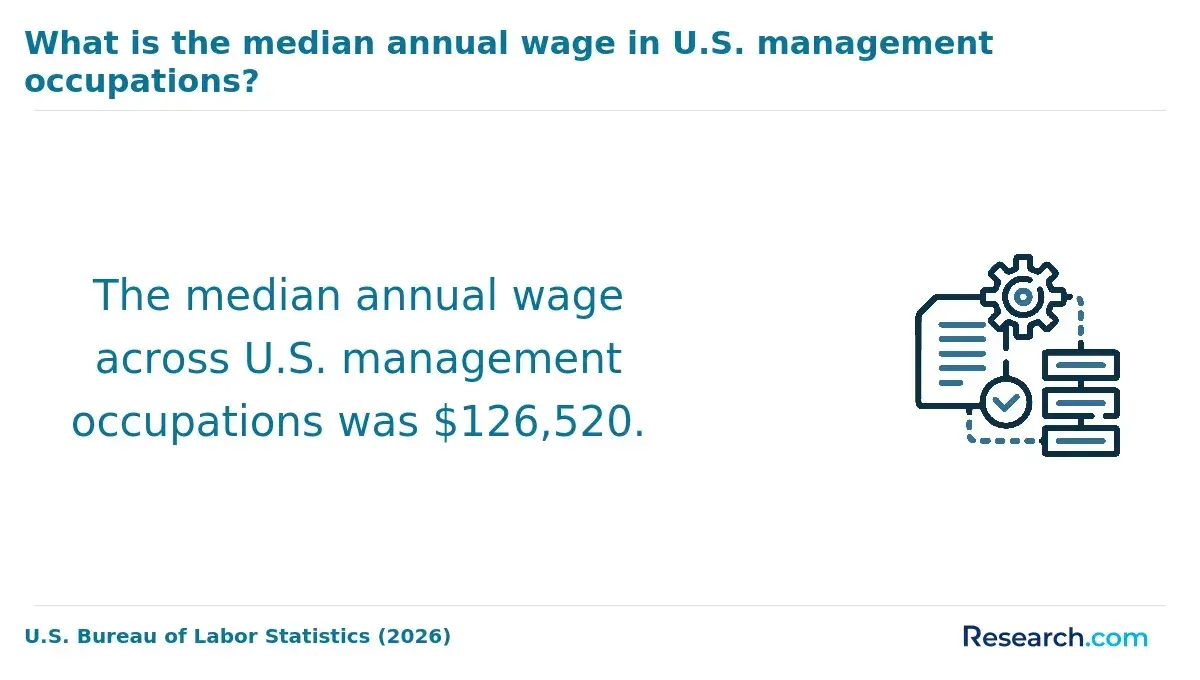
There is no single salary or employment forecast for "sustainability MBA graduates." Pay depends on the occupation, industry, location, responsibilities, and prior experience. The Bureau of Labor Statistics reports a May 2025 median annual wage of $126,520 for management occupations, compared with $50,980 across all occupations. Those figures describe broad occupational groups - not MBA graduates or new entrants to sustainability - and should not be used as a personal salary estimate.
BLS projects management employment to grow faster than the average for all occupations from 2025 to 2035, with about 1.1 million openings annually on average from growth and replacement needs. That supports looking at management as a broad labor market, not assuming comparable demand for every sustainability title. For a useful earnings comparison, research the specific civilian roles and locations you can realistically pursue before estimating whether MBA costs are worthwhile.
Which sustainability certifications complement an online MBA for veterans?
Choose a certification to address a demonstrated job requirement, not simply to add credentials. For building and facilities work, a LEED credential may be relevant; for project delivery, a project-management credential may help demonstrate a separate competency. Sustainability reporting or environmental-management training may be more relevant for other roles. Each credential has its own eligibility, exam, and renewal rules, which should be checked with its issuing organization.
An MBA develops broader business decision-making; a certification can signal narrower knowledge. If postings for your target role consistently ask for a particular technical skill that the MBA does not teach, targeted coursework or supervised experience may be a better first investment than an additional degree.
Other Things You Should Know About MBA
Ask each school about its graduate transfer-credit policy. Military training may support admission or demonstrate experience, but it should not be assumed to replace graduate MBA courses.
Ask about leave, reentry, course withdrawal, and tuition-refund policies before enrolling. Contact the school's VA certifying official promptly because an enrollment change may affect benefit payments.
It may be for an eligible veteran whose employment plan supports the proposed education. Eligibility and approval are individualized, so discuss the degree with a VA counselor before relying on this funding.
Generally, you can ask the school's accessibility office about accommodations without putting medical details in your admissions essay. Benefit applications and accommodation requests follow separate processes.
- Post-9/11 GI Bill (Chapter 33) | Veterans Affairs https://www.va.gov/education/about-gi-bill-benefits/post-9-11/
- Three things Veterans should include on their resume and in an interview - VA News https://news.va.gov/44487/three-things-veterans-should-include-on-their-resume-and-in-an-interview/
- Military & Veteran Benefits - Rice Business https://business.rice.edu/military/benefits
- Academic Residencies, Labs, and Intensives Requirements | Academics at Walden University https://academics.waldenu.edu/handbook/learning-modalities/residency-lab-intensive-requirements
- Online MBA in Corporate Sustainability - SOU https://online.sou.edu/degrees/business/mba/corporate-sustainability/
- Application Tips for Student Veterans - Harvard Law School https://hls.harvard.edu/bernard-koteen-office-of-public-interest-advising/interviewing-programs-and-job-fairs/application-tips-for-student-veterans/
- Application Instructions and Deadlines | University of Maryland School of Nursing https://www.nursing.umaryland.edu/admissions/apply/
- Application Requirements | Columbia University School of Professional Studies https://sps.columbia.edu/admissions/certificate-certification-applicants/application-requirements
- Graduate Student Requirements | Manhattan University https://manhattan.edu/graduate/admissions/graduate-requirements
- Crafting Your Career Post-Service: Expert Tips for Veterans' Resumes - GGU Military https://military.ggu.edu/blog/crafting-your-career-post-service-expert-tips-for-veterans-resumes


