
Online MBA in Technology Management: admissions guide for military veterans

Co-Founder and Chief Data Scientist
Military leadership can be a strong foundation for an online MBA in technology management, but it does not tell you which programs will admit you - or whether their training fits your civilian career goal. Admissions policies, technology coursework, schedules, and veterans' benefits vary by school. This guide explains how to present your service experience, assess academic readiness, verify program quality, and compare the costs and career value of enrolling. It is designed for veterans moving into civilian work as well as those advancing in an existing technology or management role.
Key Things You Should Know
- A bachelor's degree and an application are common starting points; work-experience, GMAT/GRE, prerequisite, and interview policies vary by MBA program.
- Translate military responsibilities into evidence of budgets, teams, systems, and measurable decisions - but do not assume service alone meets a school's experience requirement.
- Confirm VA approval and your own benefit eligibility before comparing net costs. The May 2025 median wage for all US management occupations was $126,520, not a predicted salary for MBA graduates.
What is an online MBA in technology management for military veterans?
It is a business administration degree that combines a broad MBA core with coursework on managing technology, digital initiatives, innovation, or information systems. Schools may call the focus technology management, information technology management, or something similar. Check the official degree plan: a named concentration is different from a general MBA that offers one technology elective.
For veterans, the degree can provide civilian business language for work involving communications systems, logistics technology, cyber operations, procurement, or complex programs. It generally prepares students to make organizational and financial decisions about technology; it is not, by itself, advanced training in software engineering or hands-on cybersecurity.
Choose the qualification that matches the target role. A technical master's degree may better suit someone seeking deep engineering expertise. For a veteran pursuing healthcare leadership, accelerated online MSN-MBA dual-degree programs represent a different, nursing-specific route rather than a substitute for a technology management concentration.
How does an online MBA in technology management benefit military veterans?
The most useful benefit is a bridge between demonstrated leadership and civilian business decisions. A veteran who coordinated a systems rollout, for example, may already know how to manage risk and stakeholders; MBA coursework can add financial analysis, vendor evaluation, and market context. Applied projects can also give that veteran a work sample understandable to civilian employers.
The value depends on the career move. For advancement from a technology or operations role into management, the MBA may address a clear skills gap. For a switch into software development or another technical specialty, it may leave the main hiring gap untouched. Veteran advising, accessible faculty, and career staff who understand military-to-civilian résumés can matter as much as the concentration label.
What are the admissions requirements for an online technology management MBA?
There is no universal veterans' admissions standard. Programs commonly request a bachelor's degree, transcripts, a résumé, and written statements; some request recommendations or an interview. Minimum GPA rules, professional-experience thresholds, GMAT/GRE policies, and deadlines are school-specific. Military service may count as professional experience, but applicants should ask each school how it evaluates their particular duties.
A business bachelor's degree is not universally required. Veterans whose undergraduate majors were outside business can compare online MBA options for nonbusiness majors, then check whether a prospective program requires foundation courses or simply recommends preparation in accounting and quantitative work.
For a stronger application, distinguish documented experience from a claim of general leadership. The following preparation sequence addresses common application components; it is not a list of requirements imposed by every school.
- Confirm each program's current degree, experience, testing, prerequisite, document, and deadline policies with admissions.
- Translate military titles into civilian responsibilities, stating team size, budget authority, technology scope, and outcomes only where you can substantiate them.
- Use the statement of purpose to connect a specific civilian role to the MBA core and the program's verified technology coursework.
- Ask recommenders who know your decision-making and collaboration to provide concrete examples; refresh accounting or statistics skills if needed.
If you earned credits at multiple institutions during service, request every required transcript early. Ask whether the school reviews military training for graduate credit, but do not assume such credit can replace MBA courses.
Recognition has two separate checks. First, verify that the university holds institutional accreditation recognized by the US Department of Education. Second, check whether its business school or program holds specialized accreditation, such as AACSB, ACBSP, or IACBE, if that matters to you or a target employer. Institutional accreditation does not automatically mean the business school has specialized accreditation.
Also confirm that the online MBA and its advertised technology concentration are actually offered by that institution. Ask whether the credential or transcript identifies the concentration and whether online students can access the same relevant courses. Accreditation supports a quality review; it does not guarantee admission, employer preference, VA payment, or a promotion.
The degree format affects access to classes, recruiting, and benefits - not just commuting. This comparison identifies questions worth resolving before a veteran chooses between formats; individual programs can differ substantially.
| Factor | Online MBA | Campus-based MBA |
| Schedule | May offer recorded work, but live meetings, team projects, or residencies may still be required. | Often requires scheduled on-campus attendance; some evening and part-time options exist. |
| Career access | Remote advising and networking may be available; confirm access to employer recruiting and projects. | May make in-person events easier to attend; access still depends on the specific school. |
| Post-9/11 GI Bill housing allowance | Exclusively online enrollment generally uses the distance-learning rate when the student otherwise qualifies. | Qualifying in-person enrollment may use a location-based rate, subject to VA rules and individual eligibility. |
For veterans working irregular hours, online MBA programs with asynchronous classes may be easier to schedule. "Asynchronous" does not eliminate deadlines or group coordination. Request a sample course calendar and ask about mandatory visits before committing.
The MBA core typically develops management skills through accounting, finance, marketing, operations, strategy, and organizational leadership. Technology-focused courses may address information systems, digital transformation, technology strategy, innovation, analytics, or governance. Names and depth vary: one school may require several concentration courses while another offers only electives.
Look for assignments that connect both halves of the degree, such as evaluating a technology investment, managing implementation risks, or building a business case for a new system. Veterans with substantial operational experience may find those projects more useful than introductory leadership content. Conversely, applicants without recent quantitative coursework should inspect finance and analytics syllabi before deciding how to prepare.
Completion time depends on the program's credit requirements, course sequence, and whether you study full- or part-time. A faster advertised pathway may assume a course load that conflicts with work, caregiving, or benefit-eligibility plans. Ask how often required technology courses run and whether a deployment, job change, or other interruption would delay graduation.
For cost, compare total required tuition and fees, not the per-credit price alone. Add books and software, required travel, and any financing costs; then subtract only funding for which you have confirmed eligibility. A search for affordable AACSB-accredited online MBA programs can help establish comparison candidates, but verify current prices and whether each candidate offers the technology coursework you want.
Request a written cost estimate for your intended pace. If an employer reimburses tuition, check grade requirements, payment timing, and any obligation to remain employed. Do not treat a tuition-only quote as your full cost of attendance.
Eligible veterans may be able to use Post-9/11 GI Bill benefits at a VA-approved institution and program. Eligibility, the percentage of benefits payable, remaining entitlement, and enrollment intensity are individual matters. Before enrolling, confirm the program with the school's certifying official and check your benefit status with VA.
The Post-9/11 GI Bill can cover tuition and mandatory fees subject to applicable rules and limits. A monthly housing allowance, when payable, differs for exclusively online study: the distance-learning rate is capped at half the national average allowance. Adding an in-person course does not automatically produce a particular location-based payment; VA enrollment rules and course certification control. Yellow Ribbon funding may help eligible students at participating schools with certain uncovered charges, but participation and awards vary.
Ask the certifying official which charges will be reported to VA, when enrollment will be certified, and what you would owe if benefits do not cover the full bill. Veterans considering Veteran Readiness and Employment should discuss that separate program with a VA counselor before assuming the same funding arrangements apply.
A realistic next role depends more on prior responsibility and technical familiarity than on the concentration name alone. A veteran with systems implementation experience might pursue technology program or operations management; one with procurement and vendor oversight might target technology sourcing or product operations. IT management roles commonly require substantial relevant technical experience, which an MBA does not replace.
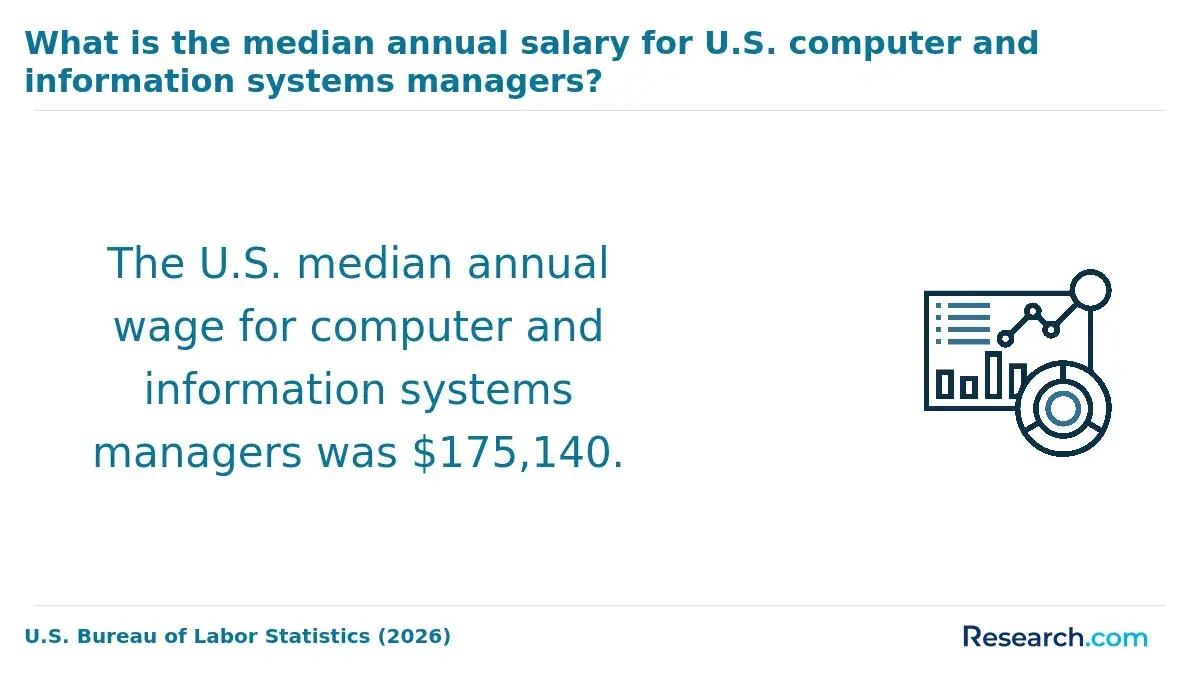
The US Bureau of Labor Statistics reports a $126,520 median annual wage for all management occupations in May 2025. That broad occupational figure includes people without MBAs and many roles unrelated to technology; it is not an expected starting salary or an MBA earnings estimate. BLS projects management occupations overall to grow faster than average from 2025 to 2035, but a veteran should still check the requirements and pay range for the specific job and location being targeted.
For a veteran already established in nursing, technology management is not automatically the best path into hospital leadership. Comparisons of business graduate programs for career growth in nursing may be more relevant to a clinically focused goal. For other applicants, a project-management credential, technical training, or a targeted course may address a narrower hiring gap at lower cost than an MBA.
How do veterans choose a reputable online technology management MBA?
Build a shortlist around the civilian job you want, then test each program against evidence rather than a "military-friendly" label. The most useful comparison combines academic fit, admissions feasibility, benefit coverage, and access to employers.
- Identify target job postings and note which responsibilities require business management, technical depth, or prior industry experience.
- Verify institutional accreditation, the online MBA's actual technology curriculum, and any specialized business-school accreditation you value.
- Ask admissions how military experience is evaluated and request a sample schedule, including live sessions, projects, and campus requirements.
- Confirm program approval, your individual VA eligibility, Yellow Ribbon participation if relevant, and an itemized estimate of your remaining cost.
- Ask career services how online veterans can use coaching, alumni contacts, projects, and employer events; seek outcomes for comparable students if the school collects them.
Favor a program when its coursework closes a demonstrated skills gap and its schedule and net cost are workable. If your principal barrier is a missing technical skill or civilian work sample, gain that experience first or consider a more focused qualification.
Other Things You Should Know About MBA
Often, yes. Check the school's enrollment rules and any service-specific education approval requirements. Plan for schedule changes before committing to a course load.
It is not generally an MBA admissions requirement. Describe the responsibilities and judgment associated with your work without disclosing classified or restricted information.
Possibly, but graduate transfer and prior-learning rules are school-specific. Request a formal evaluation; do not assume military training will waive MBA core or concentration requirements.
Sometimes, subject to the employer's policy and VA payment rules. Tell the school's certifying official about both sources so you can understand how eligible charges will be handled.
- How Do I Get College Credits For My Military Service? | Veterans Affairs https://www.va.gov/resources/how-do-i-get-college-credits-for-my-military-service/
- JST: Joint Services Transcript | militaryonesource.mil https://www.militaryonesource.mil/benefits/joint-services-transcript/
- Military Training Evaluation Program (MTEP) | dantes.mil https://www.dantes.mil/credit4training/
- MBA Programs for Veterans - Lehigh College of Business https://business.lehigh.edu/academics/graduate/masters-programs/veterans
- 8 Resume Writing Tips for Veterans | Baker College https://services.baker.edu/TDClient/1973/Portal/KB/Article/163449/8-Resume-Writing-Tips-for-Veterans
- Tests & Waivers - NYU Stern - New York University https://www.stern.nyu.edu/programs-admissions/masters-programs/ms-accounting/admissions/tests-waivers
- How to Get College Credit for Your Military Service - ASU Online https://asuonline.asu.edu/newsroom/online-learning-tips/military-credits-college-degree/


