2027 Is an Online Ed.D. in Leadership and Learning in Organizations a Good Fit for University Assessment Directors?
Audited and Verified:
Our Editorial and Data Verification Process
Research.com uses government datasets, official education statistics and primary institutional information to support its career and degree guides. Our review process checks factual accuracy, occupational definitions, source dates and the requirements associated with the credentials discussed.
How This Article Was Fact-Checked
Our editorial team verifies salary estimates, employment projections, education requirements and program information against original data providers and official organizations. Salary figures are checked against the relevant occupational definitions and reporting periods. Information about licensure, accreditation and required in-person training is reviewed separately.
Fact-checked and verified on:

Co-Founder and Chief Data Scientist
University assessment directors already know how to collect evidence of student learning. The harder career decision is whether a doctorate would help them turn that evidence into institution-wide improvement - or simply add a costly credential to skills they already use.
This article examines where an online Ed.D. in Leadership and Learning in Organizations can add value, where it may leave technical gaps, and when another path makes more sense. It also gives working directors concrete ways to evaluate programs against their responsibilities, schedules, and advancement goals.
Key Things You Should Know
- An Ed.D. is a strong fit when an assessment director wants to lead cross-campus change and applied inquiry, not merely become more proficient with reporting tools.
- The U.S. Bureau of Labor Statistics reports a 2025 median annual salary of $104,590 for postsecondary education administrators; that broad occupational figure is not a predicted salary for assessment directors or Ed.D. graduates.
- Before enrolling, verify the program's research methods, assessment-relevant projects, live-session requirements, total cost, and rules for using institutional data.
Is an online Ed.D. in Leadership and Learning in Organizations a good fit for university assessment directors?
Yes, conditionally. An Ed.D. can be worthwhile for a director who already manages assessment work and wants to lead broader decisions about learning, faculty development, institutional effectiveness, and organizational change. It is less compelling if the immediate goal is to master a statistical technique, satisfy a reporting deadline, or gain a promotion for which the employer values experience more than a doctorate.
University assessment typically involves defining learning outcomes, supporting faculty in evaluating them, interpreting evidence, and helping departments use findings. A leadership and learning doctorate shifts the emphasis from producing assessment reports to understanding why evidence does - or does not - change practice. That distinction matters when a director has influence across academic units but limited authority over curricula, budgets, or faculty decisions.
The best route depends on the work the director wants to do next. These options differ in what they develop and in the evidence of readiness an employer is likely to seek.
| Goal | Potentially useful route | Important limitation |
| Lead institution-wide learning improvement | Practice-oriented Ed.D. with organizational change, evaluation, and applied inquiry | A degree does not confer authority over faculty or academic governance. |
| Develop advanced research methods or pursue a research-intensive faculty career | Research-oriented PhD | May require a different time commitment and research agenda. |
| Improve assessment design, analytics, or accreditation practice in the current role | Focused methods training, mentoring, or professional development | May not provide the sustained leadership development of a doctorate. |
Directors comparing organizational leadership doctoral options for college administrators should prioritize programs that connect organizational learning to higher education practice, rather than assuming every broadly named leadership degree teaches academic assessment.
What does an online Ed.D. in Leadership and Learning in Organizations prepare graduates to do?
A practice-oriented Ed.D. can strengthen a director's ability to diagnose organizational problems, evaluate initiatives, engage stakeholders, and lead changes in how people learn and work. In an assessment office, that might mean investigating why departments collect outcome data but rarely use it to revise instruction. The possible causes could include unclear measures, weak feedback processes, competing priorities, or governance constraints; a doctoral project should investigate rather than presume the answer.
Applied research is particularly relevant. A director might design an evaluation of a faculty development initiative, examine how departments interpret assessment findings, or test a process for closing the feedback loop. The academic project must meet the program's requirements, while any use of student or employee information also requires appropriate institutional permission, privacy safeguards, and an ethics or research-review determination where applicable.
Coursework alone does not make someone an advanced statistician, accreditation expert, or senior administrator. Its value depends on the methods taught, the quality of faculty guidance, and opportunities to apply learning within the director's actual scope of responsibility.
What education and experience do university assessment directors typically need?
There is no universal credential for a university assessment director. Employers may seek a relevant graduate degree and experience with learning-outcomes assessment, program evaluation, institutional research, accreditation, or academic administration. Requirements vary with the institution and whether the role centers on faculty support, quantitative analysis, compliance, or campus-wide strategy.
Successful directors need to work across disciplines, evaluate the quality of measures, explain limitations in findings, and help colleagues act on evidence without overstating what it proves. They also need familiarity with academic governance and student-record privacy. A doctorate may strengthen candidacy for some senior roles, but demonstrated results - such as improving an assessment process or leading a credible evaluation - often matter more than the degree title alone.
A director considering doctoral study should compare target job postings with their existing record. If the main gaps are data analysis or accreditation procedures, targeted training may be more direct. If the gap is leading complex, evidence-informed change across units, an applied doctorate has a clearer purpose.
Online delivery can let a director remain employed and apply coursework to current institutional challenges. It does not necessarily mean self-paced study: live seminars, cohort projects, advisor meetings, and campus convenings may still be required. A campus-based program may offer easier in-person access to research communities, but could require commuting or a work arrangement that is impractical for a full-time director.
Compare actual obligations rather than format labels. Ask each program for its live-class schedule, attendance policy, travel requirements, research supervision model, and plan for completing a project if you change employers. Include travel and time away from work when evaluating the cost of an online education doctorate; the lower-friction format is not automatically the less expensive one.
Course names and required sequences vary. Relevant offerings may cover organizational leadership and change, adult learning, program evaluation, qualitative and quantitative methods, and research ethics. For an assessment director, the crucial question is not whether a catalog mentions "data," but whether instruction develops the ability to choose defensible measures, interpret imperfect evidence, and guide improvement across academic units.
Read syllabi and project requirements where available. A program with strong change-leadership coursework but limited evaluation methods may suit a director seeking broader administration; one with substantial research design and faculty supervision may better support an assessment-focused applied project. Confirm whether desired courses are required, regularly available electives, or part of a formally awarded concentration.
Requirements differ by institution and entry term. Programs may review prior graduate education, professional leadership experience, transcripts, recommendations, a statement of purpose, and evidence of readiness for applied research. An education master's degree, a particular test score, or a fixed number of years in a director role should not be assumed to be universally required.
Assessment directors can make a stronger application by describing a specific leadership challenge: who must use assessment evidence, what decision remains unresolved, and what authority the applicant has to investigate it. Do not promise access to restricted student records or present a proposed doctoral project as already approved. Applicants returning after unfinished doctoral study can separately investigate all-but-dissertation education doctorate admission options, while obtaining written confirmation of eligibility and any credit evaluation from each school.
Completion time and price depend on the program's required coursework, enrollment pace, tuition structure, fees, and final project. Published schedules may not account for delays in obtaining project approval, accessing institutional data, or coordinating work across academic calendars. Ask for the program's current degree plan and full tuition and fee schedule rather than relying on an advertised completion timeline.
For a working director, the financial comparison should include required travel, continuation charges if the project takes longer, and any reduced earnings from changing workload. Employer assistance can change the calculation, but confirm annual limits, eligibility rules, and repayment obligations in writing. Resources on funding for higher education leadership doctorates can help frame those questions; aid and employer reimbursement are not guaranteed.
The most natural next steps build on existing higher education experience: broader institutional effectiveness leadership, assessment across multiple colleges or campuses, academic affairs administration, or consulting on evaluation and improvement. Some directors may move into faculty development or organizational learning roles if they can demonstrate relevant work beyond assessment reporting.
These paths demand different evidence. An institutional effectiveness leader may need experience coordinating accreditation and planning; a consultant needs credible projects and client-facing skills; a senior academic administrator typically needs substantial management, budget, and governance experience. An Ed.D. can support those transitions, but it does not substitute for responsibility already exercised or qualify its holder for a regulated education role.
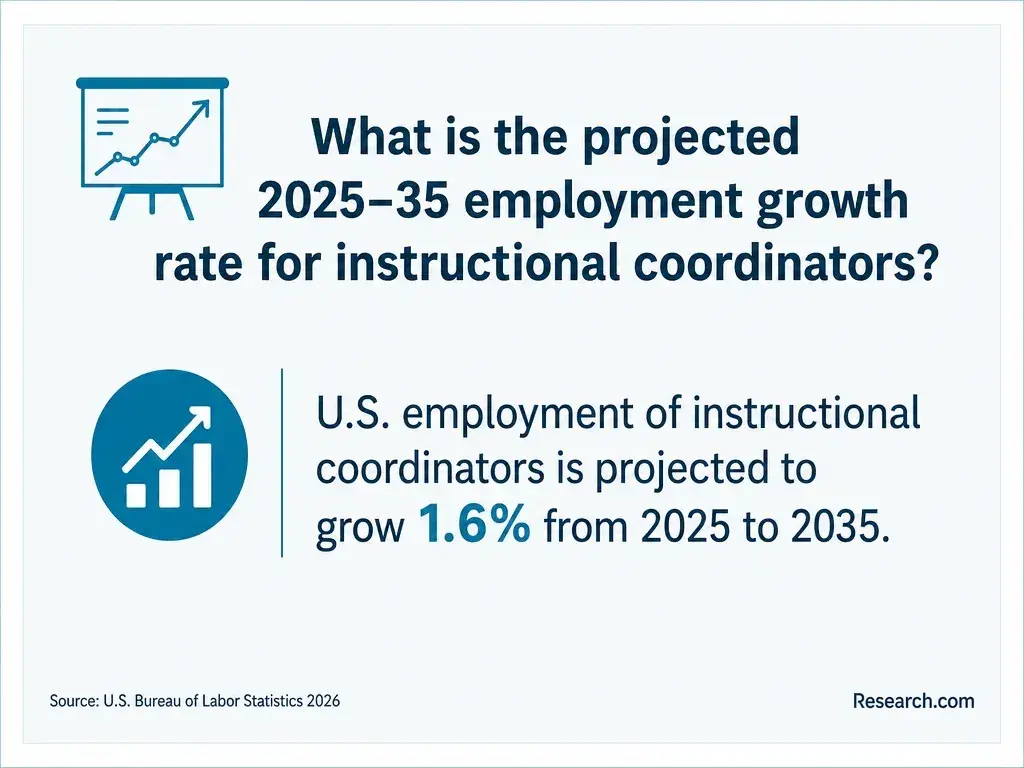
There is no reliable single salary for assessment directors who earn an Ed.D. The closest broad U.S. Bureau of Labor Statistics category, postsecondary education administrators, had a median annual salary of $104,590 in 2025, with projected employment growth of 1.8% from 2025 to 2035. That category includes jobs beyond assessment, so neither figure measures the degree's payoff.
Pay depends on institution, location, role scope, supervisory and budget responsibility, and the employer's compensation structure. To evaluate financial value, compare actual salary bands for positions you would pursue with the program's full cost and your employer's advancement rules. Do not assume the doctorate will produce a raise.
How can you choose an accredited online Ed.D. program for assessment leadership?
Start by confirming the institution's recognized accreditation through the accreditor and the school's published information. Then verify the exact degree awarded, delivery requirements, curriculum, project format, and whether the program prepares students for any occupation-specific credential you need. Institutional accreditation alone does not establish a specialized assessment curriculum or licensure eligibility.
Use the following checks to separate a useful applied doctorate from a program that merely has an appealing leadership title:
- Ask for required course descriptions and identify where measurement, evaluation, organizational change, and research ethics are taught.
- Request the current handbook's rules for the final project, faculty supervision, campus visits, and completion after an employer change.
- Ask whether an assessment-office project is permissible and who decides on site access, student-data use, confidentiality, and ethics review.
- Compare the complete cost and employer support with the responsibilities and salary bands of your target roles.
Directors with a firm budget ceiling can screen inexpensive Ed.D. pathways to consider, then verify each candidate's current charges and assessment-relevant preparation directly with the institution. The best fit is the program whose academic obligations and applied opportunities match a specific leadership goal you can realistically pursue.
Other Things You Should Know About EdD Leadership
No. Doctoral work may improve evaluation and change-leadership skills, but accreditation duties require familiarity with the institution's accreditor, standards, evidence expectations, and review process.
Only if your institution authorizes that use and the material complies with applicable privacy and confidentiality rules. Removing names alone may not make a small-group dataset safe to share.
Not always. The project's purpose, methods, participants, and intended use affect the determination. Follow your university's review process and your doctoral program's requirements rather than deciding on your own that it is exempt.
Begin by asking what decisions faculty need the measures to inform and what concerns they have about workload or interpretation. Co-designing a limited, useful pilot is generally more credible than imposing another reporting template.
- Accreditation in the U.S. | ed.gov http://www.ed.gov/laws-and-policy/higher-education-laws-and-policy/college-accreditation/accreditation-in-the-us
- Program: Education, EdD | south.edu https://catalog.south.edu/preview_program.php
- Frequently asked questions about undergraduate assessment | umn.edu https://slo.umn.edu/additional-resources/faq
- UNC EdD Online: Organizational Learning and Leadership https://online.unc.edu/online-doctoral-programs/online-edd-organizational-learning-and-leadership/
- Employer Tuition Reimbursement: How It Works and How to Pay for College | Winston-Salem State University https://ramsonline.wssu.edu/blog/employer-education-benefits/
- Institutional Effectiveness | Texas A&M University-Victoria https://www.tamuv.edu/institutional-research-effectiveness/institutional-effectiveness/
- Doctor of Educational Leadership (Ed.D.) | sage.edu https://www.sage.edu/academics/doctorate-programs/doctor-of-educational-leadership/
- Student Workload in Online Learning | Florida Gulf Coast University https://www.fgcu.edu/digitallearning/online-education/student-workload-in-online-learning
- Organizational Leadership (Ed.D.) - Graduate Admissions | Stockton University https://www.stockton.edu/graduate/ed-d-organizational-leadership.html
- Major Program Assessment: The Basics | osu.edu https://asccas.osu.edu/assessment/major-program-assessment-basics