2027 Does a Public Health BS Prepare You for Public Health Survey Administration?

Co-Founder and Chief Data Scientist
A public health survey can fail even when its questions look sound: inconsistent recruitment, unclear consent, or mishandled responses can undermine the results. If you are considering a public health BS to do this work, the useful question is which survey tasks the degree teaches - and which require supervised practice. This guide connects coursework to field responsibilities, realistic first jobs, and the program features worth checking before you enroll. It also explains when targeted training may be a more direct route.
Key Things You Should Know
- Yes, for supervised entry-level work: A public health BS can prepare you to recruit participants, administer approved questionnaires, document responses, and follow privacy procedures; it does not by itself qualify you to lead a survey study.
- Practice is the deciding factor: Look for an internship or project involving a real survey protocol, interviewer training, quality checks, and secure data handling - not just a statistics course.
- Match the degree to the task: A conventional BS commonly takes four years of full-time study, but someone who already has a bachelor's degree may be better served by targeted methods training and supervised experience.
Does a Public Health BS Prepare You for Public Health Survey Administration?
Yes - usually for administering a survey under an established protocol, not for independently designing and directing one. Public health survey administration means carrying out the practical steps that turn a questionnaire into usable population-health information: contacting eligible people, explaining participation, asking questions consistently, recording responses, tracking nonresponse, and protecting data.
A BS gives those tasks context. Students can learn why sampling matters, how wording affects measurement, and why a survey about health behaviors must be respectful and accessible. Readiness still depends on what the student has actually done. Someone who has practiced a scripted interview, resolved a data-entry discrepancy, and documented an escalation to a supervisor has stronger evidence than someone who has only discussed surveys in class.
Before accepting a placement or job, distinguish administering an approved instrument from deciding whom to sample, changing questions, making consent determinations, or interpreting results for policy. Those decisions may require additional methods expertise and organizational approval. If your goal is advanced study design rather than field administration, compare the curriculum and entry requirements of public health graduate programs with accessible entry; graduate admission alone does not establish survey-design expertise.
What Public Health Survey Skills Does a Bachelor's Degree Teach?
The most useful BS-level skills combine public health reasoning with reliable field procedures. The table separates what coursework can introduce from the evidence that shows you can perform a task under supervision.
| Survey task | Relevant preparation | Useful evidence of readiness |
| Recruit and communicate with participants | Health communication, community engagement, and eligibility rules | Supervised practice using an approved recruitment script |
| Administer questions consistently | Measurement, questionnaire wording, and interviewer effects | Mock interviews and feedback on protocol adherence |
| Manage responses | Data literacy, missing-data codes, and confidentiality | Accurate entry and documented quality checks in an authorized system |
| Explain what results can mean | Sampling, descriptive statistics, and sources of bias | A brief report that states limitations without claiming causation |
Not every BS teaches survey programming, complex sampling, weighting, or advanced analysis. If you want to move from field operations into those responsibilities, compare actual course sequences and projects - not concentration names alone. The specialization choices in public health graduate study can help frame that later decision, but a graduate degree is not necessary for every administration role.
What Jobs Can You Get With a Public Health BS and Survey Experience?
A BS plus documented survey practice can be relevant to survey interviewer, field data collector, research assistant, program assistant, and community-health evaluation support roles. Employers may use different titles for similar work, so read the duties: an entry-level hire might schedule interviews, follow recruitment scripts, monitor completed questionnaires, or flag missing responses for a supervisor.
These jobs are not interchangeable with independent survey researcher, epidemiologist, or research-director positions. A posting that expects original sampling plans, statistical weighting, grant leadership, or responsibility for human-subjects oversight calls for different preparation or experience. Conversely, a person with community outreach or customer-service experience may already have valuable interviewing skills and need only protocol, privacy, and data-quality training rather than another bachelor's degree.
For applications, describe a concrete contribution - such as completing interviewer training or checking records against a protocol - without disclosing participant information. If you later seek research leadership, evaluate graduate methods training and work experience first; cost-conscious public health doctoral advancement is a separate, later-stage decision, not a prerequisite for collecting survey responses.
Course titles vary, but an effective sequence starts with introductory public health and statistics, then adds epidemiology or research methods, followed by social and behavioral health, evaluation, or a survey-methods elective. Statistics helps you understand what a response represents; methods coursework helps you recognize selection and measurement problems; communication coursework helps you administer sensitive questions without improvising the instrument.
The strongest applied course or placement lets you practice against a documented protocol and receive feedback. Ask whether students learn to test a questionnaire, use skip patterns, record refusals, check incomplete records, and report problems without altering responses. A class project using classmates as respondents is useful practice, but it is not automatically authorized community research or evidence of experience with restricted health data.
If an employer wants a particular skill, compare the missing competency with the cost and time of a full degree. A statistics course, interviewer training, and a supervised placement may suffice. If you later consider an MPH, review applying to an MPH with incomplete prerequisites rather than assuming an undergraduate elective satisfies every graduate program's rules.
There is no general US professional license required simply to administer a public health survey. Employers and study teams can, however, require protocol-specific interviewer training, privacy training, human-subjects training, or authorization to use a data system. A training certificate documents completion of that training; it does not grant permission to recruit participants or access records outside an approved project.
Credentials such as CPH or CHES serve different professional purposes and are not universal requirements for survey administration. Likewise, a research degree is not a license: low-cost PhD study in public health may be relevant to a long-term research career, but it is not a substitute for study-specific training and supervision. Check each job posting and the responsible organization's procedures rather than paying for a credential on the assumption that every survey employer requires it.
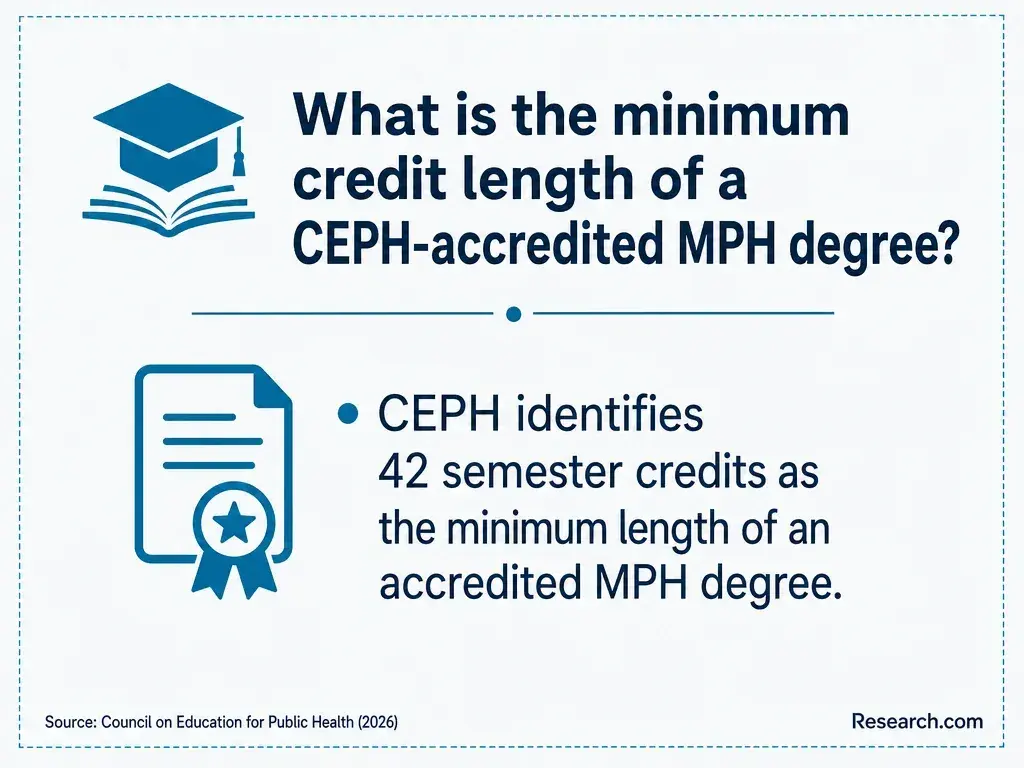
CEPH accreditation is a useful signal that an accredited school or program has been evaluated against public health education standards. It does not certify an individual graduate as a survey administrator, and a university's institutional accreditation does not tell you whether its specific public health BS falls within CEPH's accredited scope.
Check CEPH's current directory and the institution's program information for the exact school, unit, program, and degree you would enter. Then examine the curriculum and applied opportunities directly: accreditation does not establish that a BS offers survey methods, an interviewer placement, or access to a community partner. If you are also considering graduate study, apply the same scope check when using Master of Public Health affordability comparisons; price and accreditation answer different questions.
Choose the format that lets you complete both the coursework and credible survey practice. An online BS may offer location flexibility, but live classes, group projects, proctored assessments, and an in-person internship can still constrain your schedule. A campus program may make faculty projects and local placements easier to find, but proximity alone does not guarantee a survey assignment.
Ask each program who finds placements, whether remote interviewing or data-quality work can count, when required activities occur, and what support is available if a partner site falls through. If you work or provide care for others, compare the actual weekly commitments and travel requirements before treating "online" as synonymous with asynchronous.
Graduate funding is a separate issue from undergraduate format. If an online MPH may follow your BS, a public health graduate scholarship eligibility guide can help you identify questions for that later choice; do not assume graduate awards apply to a bachelor's program.
Requirements depend on the institution and whether students enter the major directly or apply after completing prerequisite coursework. Schools may review prior grades, general-education work, and courses such as introductory statistics or biology. Admission to the university is not always the same as admission to the public health major.
If you have college credit, request an official degree audit showing which credits are accepted, which satisfy major or general-education requirements, and which courses remain. This matters more to survey preparation than the raw number of accepted credits: a transferred statistics course might count as elective credit without meeting the major's methods requirement. Ask the registrar or transfer office about equivalencies and the public health department about substitutions and course sequencing.
A later MPH application is evaluated under its own standards. Guidance on improving low-GPA MPH application prospects should not be mistaken for the admissions policy of a BS program.
A conventional full-time bachelor's pathway commonly takes four years, while transfer credit, part-time attendance, prerequisite sequencing, and course availability can change the time remaining. An internship may also require hours that do not fit neatly around paid work. Get a term-by-term plan from the school before estimating your graduation date.
Compare total expected charges, not just advertised tuition: include mandatory fees, books or software, commuting or campus visits, and any costs of completing fieldwork. Ask whether the survey-related placement is paid, whether you must locate the site, and how many terms of tuition your plan requires. Comparing public health bachelor's tuition rates is a starting point, but your approved credits and remaining requirements determine your likely bill.
If you already hold a bachelor's degree, calculate the cost of targeted coursework and supervised experience before committing to a second BS. The lower-cost route is the one that closes your actual skill gap and meets the jobs you intend to pursue - not necessarily the one with the lowest advertised tuition rate.
What Are the Salary and Job Outlook for Survey Researchers?
The US Bureau of Labor Statistics tracks survey researchers as an occupation, but that category is not a salary measure for public health BS graduates or entry-level interviewers. It includes work across subject areas and levels of responsibility. Its published median wage and employment projections are useful context when considering a research career, not a reliable estimate of what your first survey-administration offer will pay.
For a near-term decision, compare local postings for the exact duties you can perform, including whether work is temporary, hourly, travel-intensive, or tied to a funded project. Check the BLS Occupational Outlook Handbook's latest survey researcher profile for its wage reference year, projection period, and typical education before using its figures. If you are considering graduate school for higher-responsibility roles, a public health master's degree investment guide can inform the cost side of that choice; neither occupation-wide wages nor a degree guarantee a particular salary.
Other Things You Should Know About Public Health
Possibly. Community organizations and research teams may use trained volunteers, but they must authorize your tasks and explain their consent, supervision, and data-handling procedures. Do not collect responses independently on an organization's behalf.
Usually you can describe your methods and contributions, subject to the project's rules. Use an approved, redacted example or a clearly labeled practice instrument; never include identifiable responses or restricted materials without permission.
Use only the approved translated instrument and the study's language-access procedure. Being conversationally fluent does not authorize you to translate questions or consent language during an interview.
No. Online surveys remove some interviewer tasks but create others, including accessibility checks, invitation tracking, duplicate-response controls, and support for people who have trouble using the form.
- A guide for the design and conduct of self-administered... - PMC https://pmc.ncbi.nlm.nih.gov/articles/PMC2474876/
- Competencies for Public Health Professionals | cdc.gov https://www.cdc.gov/infrastructure/training-professional-development/competencies-for-public-health-professionals.html
- Informed Consent FAQs | hhs.gov https://www.hhs.gov/ohrp/regulations-and-policy/guidance/faq/informed-consent/index.html
- CAHPS Survey Design and Administration | Agency for Healthcare Research and Quality https://www.ahrq.gov/cahps/surveys-guidance/survey-methods-research/index.html
- Survey Methods Research | Census.gov https://www.census.gov/topics/research/survey-methods.html
- Competencies | Public Health and Preventive Medicine https://www.upstate.edu/public-health/education/public-health/competencies.php
- Consent - Research at the UW https://research.washington.edu/research/hsd/guidance/consent/
- Informed Consent - Qualitative Data Repository | QDR https://qdr.syr.edu/node/20544
- Public Health - College To Career - Georgia State University https://collegetocareer.gsu.edu/public-health/
- Online Bachelor of Science in Public Health | UC News https://www.online.uc.edu/degrees-programs/bachelors/bs-public-health.html