2027 Can You Complete an SLP Master's Without Campus Visits? Coursework and Clinical Requirements

Co-Founder and Chief Data Scientist

Reviewed by Rhea Paul, PhD
SLP Education & Research Expert
An online speech-language pathology (SLP) master's can reduce or eliminate travel for classes, but it cannot make clinical preparation entirely virtual. The key distinction is between campus visits and in-person patient care: some programs have no required residencies, while nearly all require supervised clinical experiences at approved sites.
This guide helps prospective SLP students evaluate remote coursework, placements, accreditation, state licensure compatibility, and the questions to ask before committing to a program.
Key Things You Should Know
- Many online SLP master's programs deliver academic courses remotely and may require no campus residency, but supervised clinical placements generally involve in-person work with clients.
- ASHA certification standards require at least 400 supervised clinical clock hours, including 375 hours of direct client contact and 25 observation hours; limited simulation may count when a program documents it appropriately.
- Campus-free does not automatically mean licensure-ready: confirm CAA accreditation, state authorization, your state's licensing rules, placement support, travel expectations, and total clinical-site costs before enrolling.
Can you finish an SLP master's fully online without campus visits?
Yes, it is possible to finish some SLP master's programs without visiting the university's campus. A no-residency format typically means lectures, discussions, assignments, advising, and examinations are completed online. It does not mean the degree can be completed without leaving home or without in-person clinical training.
For most students, the practical answer is: no campus travel may be possible, but local or regional travel for practicum and externship is still likely. Clinical sites can include schools, outpatient clinics, hospitals, rehabilitation facilities, early-intervention programs, and university-affiliated clinics. A placement may be near your home, but availability is not guaranteed.
Programs use several delivery models. The differences below matter more than an "online" label because they determine whether the program fits a working adult, parent, military family, or student living far from campus.
| Format | Coursework delivery | Campus travel | Clinical training | Best fit |
| No-residency online | Online, often with scheduled live sessions | None stated by the program | In-person placement near the student when available | Students who can complete local clinical rotations |
| Low-residency online | Primarily online | One or more required immersions or skills intensives | In-person placement plus possible campus simulation | Students able to plan and fund periodic travel |
| Hybrid program | Mix of online and campus instruction | Regular or periodic travel may be required | In-person placement | Students within practical distance of campus |
| Campus-based program with online courses | Some remote courses | Usually substantial | In-person placement | Students seeking traditional campus access |
A program may change its residency, course-meeting, or placement policies by cohort. Get the current cohort calendar in writing rather than relying on an older webpage, a social-media post, or the general meaning of "online."
Which parts of an SLP master's can be completed remotely?
Remote delivery works well for much of the academic portion of an SLP master's. Programs commonly use learning-management systems, recorded lectures, live videoconference meetings, online case discussions, digital anatomical models, and virtual collaboration tools. However, remote does not always mean self-paced. Many cohorts require attendance at live classes, group work, proctored assessments, or scheduled clinic conferences.
The following components are commonly suitable for remote study, subject to each program's design and state authorization status.
- Foundational courses in speech, language, swallowing, phonetics, neuroscience, research methods, and evidence-based practice.
- Academic assignments such as literature reviews, treatment plans, diagnostic reports, case analyses, and professional writing.
- Faculty advising, peer collaboration, guest lectures, and some case-conference meetings.
- Selected simulation activities, standardized-patient exercises, and telepractice observations.
Before assuming a course is flexible, ask whether it has synchronous meetings, required participation times, and a time-zone expectation. This is especially important for students comparing online speech language pathology programs, because admissions accessibility and schedule flexibility are separate issues.
Remote coursework can be a strong fit for disciplined students who can protect study time and participate actively online. It may be less suitable for applicants who need frequent in-person faculty contact, prefer immediate access to campus labs, or cannot reliably attend live sessions during the program's scheduled hours.
Which clinical requirements still require in-person training for SLP students?
SLP students must develop clinical judgment, interpersonal communication, assessment, treatment, documentation, ethics, and professional behavior with real clients across different ages and needs. For that reason, the central clinical portions of an entry-level master's degree generally require supervised direct service, even when the academic curriculum is online.
In-person requirements commonly include observation, screening, assessment, therapy, family or caregiver communication, team collaboration, and supervision conferences at an approved site. Telepractice may be part of a rotation, but it remains a supervised clinical service rather than a substitute for all hands-on preparation.
This comparison separates educational activities that may occur remotely from those that normally require a student to engage in a real clinical setting.
| Requirement area | Can it occur remotely? | What students should confirm |
| Didactic coursework | Often yes | Live attendance rules, exams, group work, and technology requirements |
| Clinical observation | Sometimes | Whether virtual observation is accepted by the program and properly documented |
| Simulation | Sometimes | How many hours may count and whether the activity meets program standards |
| Direct client contact | Sometimes through telepractice, often in person | Site approval, supervisor credentials, documentation, and client population access |
| Practicum and externship | Usually requires an in-person site component | Placement location, travel, schedule, and who secures the site |
A common mistake is treating "local placement" as a promise of a placement in your preferred city, school district, or work schedule. Clinical education is constrained by site contracts, supervisor availability, client needs, background checks, immunization requirements, and state rules. Ask what happens if the program cannot secure a suitable site near you and whether a delayed placement delays graduation.
How do practicum, externship, and internship hours work in SLP programs?
Clinical education is usually sequenced from observation and early supervised practice to more advanced practicum and externship experiences. Terminology differs by school: one program may call a placement an internship, while another uses practicum or externship. What matters is the experience itself, the supervision, the clock-hour documentation, and whether it supports certification and licensure requirements.
For ASHA certification, students must complete at least 400 supervised clinical clock hours. That total includes at least 375 hours of direct client contact and 25 hours of guided clinical observation. These are minimum national certification standards, not a promise that every state board, employer, or school will treat every type of experience identically.
Students should understand how each phase usually works before choosing among online speech therapy programs. The financial trade-off is not only tuition: unpaid clinical hours can reduce work availability and create transportation, housing, childcare, compliance, and travel costs.
| Clinical phase | Typical purpose | Where it may occur | Key planning issue |
| Observation | Learn clinical procedures and professional conduct | Clinic, school, hospital, or approved virtual setting | Documented observation hours and supervisor verification |
| Early practicum | Build supervised assessment and treatment skills | University clinic or community partner | May occur during daytime business hours |
| Advanced practicum | Work with broader populations and disorders | Schools, medical settings, rehabilitation, or private practice | Site availability may determine timing and commute |
| Externship or internship | Apply skills in a substantial field placement | Affiliated off-campus clinical site | Often resembles a full-time professional schedule |
Programs may assist with placements, require students to identify prospects, or use a shared model. "Students find their own placement" can be workable for someone with strong local professional contacts, but it introduces risk. Obtain a clear answer about who contacts sites, who signs affiliation agreements, whether you may use your workplace, and how long contracting can take.
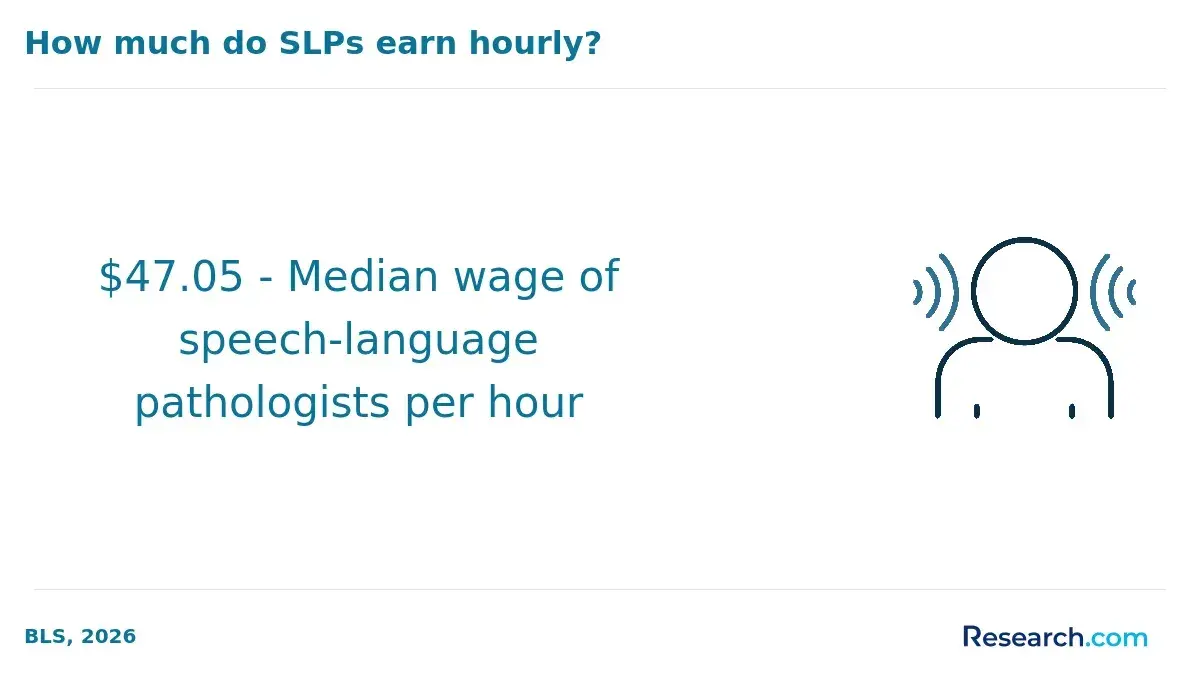
The career outlook can make the investment attractive for qualified candidates, but it should not override placement realities. The U.S. Bureau of Labor Statistics reports a median annual wage of $97,870 for speech-language pathologists in May 2025 and projects 17% employment growth from 2025 to 2035. Those national figures do not predict an individual's pay, which varies by setting, geography, experience, and credentials; they do indicate sustained demand for professionals who can complete the required education and licensure steps.
What accreditation standards affect online SLP master's programs?
Accreditation is the first screening criterion for an SLP master's program. The Council on Academic Accreditation in Audiology and Speech-Language Pathology (CAA), part of ASHA, accredits graduate education programs in the field. A CAA-accredited program is designed to meet educational standards that support the pathway to ASHA certification and professional practice.
Do not confuse institutional accreditation, programmatic accreditation, candidacy, and state authorization. Institutional accreditation concerns the university broadly. CAA accreditation concerns the professional SLP program. Candidacy may indicate that a newer program is progressing through review, but applicants should read the school's exact status and understand the implications for their cohort before relying on it.
CAA standards affect online programs because delivery method does not remove responsibility for qualified faculty, assessment of student learning, clinical education oversight, student support, and documented outcomes. A high-quality online program should be able to explain how it evaluates clinical competence rather than simply how it streams lectures.
Use this sequence to reduce accreditation risk before paying an application fee.
- Verify the program's current status through ASHA's CAA or EdFind directory and compare it with the university's own disclosure.
- Confirm that the specific degree and delivery pathway you plan to enter are covered, not merely another campus or related program.
- Ask whether accreditation, candidacy, or any teach-out arrangement applies to your entering cohort through graduation.
- Save the written response and review it alongside your state board's licensing requirements.
A red flag is a school that makes broad claims about preparing students for practice but does not clearly identify its programmatic accreditation status, clinical-hour structure, or state-by-state professional licensure disclosures.
How do state licensure rules shape campus and clinical requirements?
State licensure rules shape the real value of an online format. Most states require a graduate degree in speech-language pathology, supervised professional experience after graduation, an examination requirement, and other conditions such as background checks or continuing education. The details vary by jurisdiction, and school-based credentials may involve an education agency in addition to a professional licensing board.
A university may be accredited yet unable to enroll residents of every state in a particular online program. State authorization rules, placement agreements, and professional licensure disclosures can limit enrollment or clinical placement options. If you expect to move, check both your current state and the state where you expect to seek a license.
These questions help turn a vague "licensure eligible" claim into an enrollment decision.
- Does the university accept students who reside in my state at the time I apply and throughout the program?
- Does the school state that its curriculum meets, is intended to meet, or has not been determined to meet my state's SLP licensure educational requirements?
- Can clinical placements occur in my state, and are there restrictions on telepractice, supervisors, or school placements?
- What additional post-graduation clinical fellowship, examination, fingerprinting, or educator-credential requirements will my state impose?
Get answers from the program's licensure disclosure contact and the relevant state board. Admissions staff can explain program policy, but the licensing authority makes the final determination. Keep copies of course descriptions, clinical-hour records, supervisor documentation, and official disclosures in case you later apply in another state.
Which programs offer no-residency or low-residency SLP formats?
Programs sometimes market themselves as "online," "distance," "low-residency," or "no-residency," but these labels are not standardized. A true no-campus-visit format should state that no on-campus immersion, orientation, assessment, simulation intensive, or graduation-related academic requirement is mandatory. It may still require clinical travel and may schedule live online meetings.
Rather than selecting a program solely because it uses a no-residency label, compare the published cohort calendar and clinical-placement policy. This matters especially for applicants considering accelerated speech pathology programs: a shorter academic timeline can concentrate course loads and clinical commitments, making the format less flexible than it first appears.
Use the following distinctions when evaluating programs that advertise minimal travel.
| Program claim | What it may mean | Verification question |
| Fully online | Academic courses are delivered online | Are there any required campus visits, intensives, or in-person assessments? |
| No residency | No university-campus attendance is required | Does this apply to every cohort and all clinical-preparation activities? |
| Low residency | Most courses are online with planned in-person sessions | How many visits, where, when, and at whose expense? |
| Clinical placement near home | The program seeks local sites when feasible | Who guarantees nothing, and what is the backup if local placement fails? |
| Flexible schedule | Some online access is asynchronous | Which courses, clinics, and meetings require daytime or live attendance? |
The best no-campus option is usually a program that is transparent about what remains in person. It is not necessarily the program with the fewest stated visits if that program gives vague answers about placements, eligibility, or clinical scheduling.
How do telepractice and campus simulations count toward clinical preparation?
Telepractice is the delivery of speech-language services at a distance using communication technology. When conducted through an approved placement with appropriate supervision, documentation, privacy safeguards, and client consent, telepractice can provide meaningful direct clinical experience. It can be especially relevant in rural areas and for clients who have transportation or mobility barriers.
Simulation is different. It uses standardized patients, role-play, computer-based cases, mannequins, or structured scenarios to develop skills in a controlled environment. Simulation can help students practice interviewing, clinical reasoning, counseling, and response to unusual cases before working with clients.
For ASHA certification standards, a limited portion of direct client-contact hours may be obtained through clinical simulation. Programs commonly reference a maximum of 75 simulation hours toward the direct-contact requirement, subject to the standards and documentation in effect for the student. Simulation should therefore be viewed as a supplement to, not a replacement for, extensive supervised client care.
Technology can improve access, but it adds responsibilities. Students should ask about secure platforms, accessibility procedures, equipment expectations, state telepractice rules, supervisor observation methods, and whether a site's telepractice cases will meet the program's population and competency requirements. Do not assume a telehealth placement eliminates travel; some sites still require onsite orientation, equipment training, or occasional in-person services.
What should you verify before enrolling in a no-campus SLP program?
Before enrolling, verify the program details that affect graduation, licensure, and your ability to manage the clinical schedule. A short call with admissions is useful, but follow up by email so you have written confirmation of policies that apply to your cohort and state.
These checks identify the most consequential risks in a no-campus SLP program.
- Confirm current CAA accreditation status and the status that will apply to your cohort.
- Review the program's professional licensure disclosure for your state and confirm that residents of your state may enroll.
- Request the full calendar of campus visits, online live sessions, examinations, skills assessments, and clinical terms.
- Ask for the clinical-placement policy, including who secures sites, expected commute, placement timing, and consequences of a delayed site match.
- Calculate total attendance costs beyond tuition, including technology, background checks, immunizations, liability insurance, parking, mileage, temporary housing, and lost work hours.
- Confirm whether prerequisite or leveling courses are required and whether they add time or cost before graduate clinical coursework begins.
- Ask how the program supports students who relocate, lose a site, need accommodations, or cannot complete a clinical rotation as scheduled.
Also compare the program's schedule against your real availability. Clinical placements frequently follow client-service hours rather than evening or weekend preferences. Students who must retain full-time work should ask for examples of the weekly time commitment during the most intensive practicum term, not only the average number of credits per semester.
How can you compare online SLP programs by flexibility and clinical access?
Flexibility is not one feature. It is a combination of travel expectations, live attendance, pacing, placement support, state eligibility, and cost exposure. A program with no campus visits may be less practical than a low-residency program if it offers limited placement help or schedules clinical work at times you cannot attend.
This comparison framework helps applicants assess options consistently instead of relying on marketing terms. Complete it using each school's current catalog, clinical handbook, tuition page, and licensure disclosures.
| Decision factor | More flexible signal | Potential trade-off or red flag |
| Campus requirement | No required campus travel documented for your cohort | Unclear intensives, assessments, or orientation requirements |
| Course schedule | Published live-session times and meaningful asynchronous access | Frequent required daytime sessions not disclosed early |
| Clinical placement | Clear placement coordination and contingency process | Student must secure sites with little institutional support |
| State compatibility | Written enrollment and licensure disclosure for your state | "Not determined" status or inability to place students in your state |
| Program pace | Part-time or planned sequence that fits work and caregiving obligations | Accelerated pace that conflicts with full-time clinical rotations |
| Total cost | Transparent tuition, fees, travel, and clinical compliance costs | Only per-credit tuition is advertised without required extras |
| Career planning | Preparation aligns with intended clinical setting and state pathway | Program cannot explain how graduates meet local requirements |
Compare at least two or three programs using the same questions. If career outcomes are part of your decision, review the settings and responsibilities associated with speech language pathologist jobs, then confirm that your planned program and placements support the population and setting you hope to enter.
The strongest choice is usually the one with the clearest written answers, not the broadest promise of convenience. For many applicants, a low-residency program with dependable placement coordination is a better investment than a nominally no-campus program with uncertain clinical access.
Other Things You Should Know About Speech Language Pathology
Some students work during didactic terms, especially in part-time programs. However, practicum and externship schedules often occur during daytime client-service hours and can be demanding. Ask each program for a typical clinical-term schedule before assuming full-time employment is realistic.
Possibly, but only if the site, supervisor, client population, learning activities, and conflict-of-interest safeguards meet program requirements. Employment at a school, clinic, or healthcare organization does not automatically make it an approved student placement.
Graduates may pursue certification when they complete an appropriately accredited graduate program and meet applicable certification requirements, including clinical education, examination, and post-graduate clinical fellowship requirements. Online delivery alone does not prevent eligibility; program accreditation and documented requirements matter.
Notify the university before moving. The new state may affect your enrollment authorization, clinical-placement eligibility, telepractice rules, and eventual licensure pathway. Obtain updated written confirmation from the program and review the destination state's licensing rules.
References
- Master of Science in Speech-Language Pathology https://chp.musc.edu/programs/master-science-speech-language-pathology
- FAQs - UW Speech-Language Pathology Master's Degree https://www.speech-pathology-masters.uw.edu/admissions/faqs
- Master of Science in Speech-Language Pathology https://www.muw.edu/slp/graduate/
- U.S. Department of Labor, Bureau of Labor Statistics. (2026). Speech-language pathologists. Occupational Outlook Handbook. https://www.bls.gov/ooh/healthcare/speech-language-pathologists.htm
- Council on Academic Accreditation in Audiology and Speech-Language Pathology. (2026). Programs. American Speech-Language-Hearing Association. https://caa.asha.org/programs/
- American Speech-Language-Hearing Association. (n.d.). Council on Academic Accreditation accredited program listing. https://apps.asha.org/eweb/ashadynamicpage.aspx?caacat=slp&site=ashacms&webcode=caalisting