2027 Best Stackable Credentials for Low Student Debt

Co-Founder and Chief Data Scientist
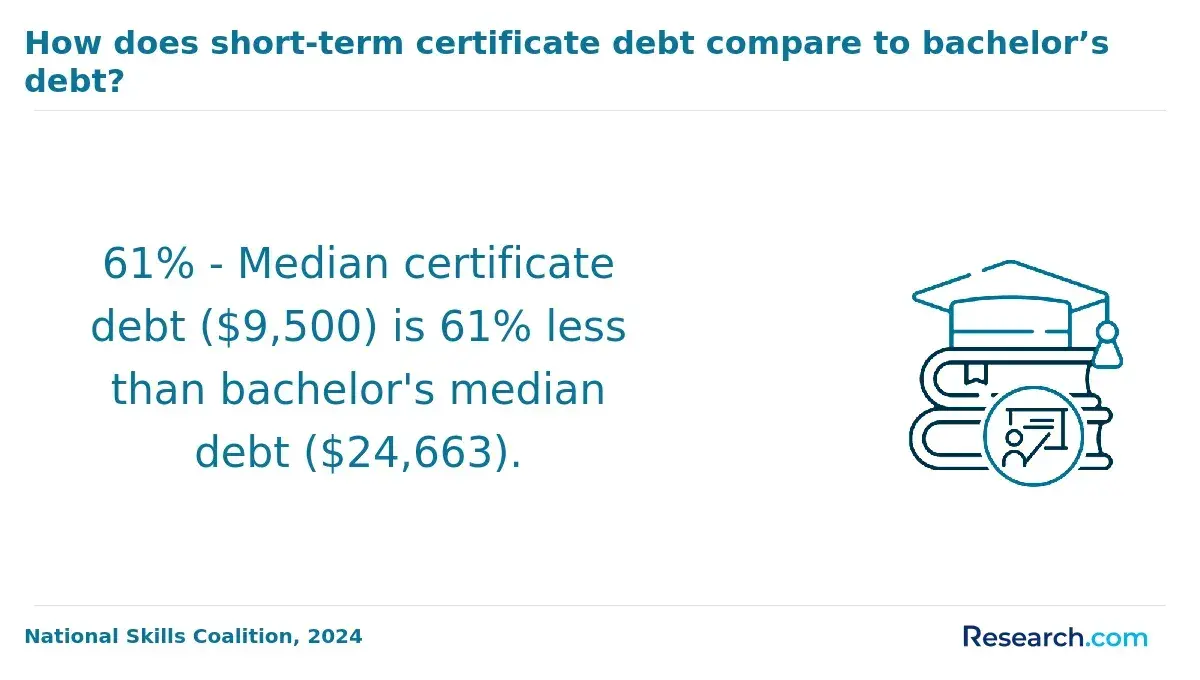
Choosing between a short certificate and a longer degree can determine whether you enter the workforce quickly or take on debt before knowing a field fits. Stackable credentials let students earn a usable certificate, work, and apply eligible credits toward a larger credential later. Federal Student Aid reported that Americans held about $1.77 trillion in federal student loan debt at the end of 2024, making cost-conscious pathways especially important.
This guide helps career changers, recent graduates, and working adults compare affordable stacks, recognition requirements, and realistic next steps.
Key Things You Should Know
- For the lowest borrowing risk, start with a credit-bearing certificate tied to a local employer need, then confirm in writing that every course applies to the next certificate or associate degree.
- High-value stacks often combine an entry credential with a required industry exam or license pathway: BLS reported May 2024 median pay of $62,350 for electricians and $94,260 for dental hygienists, but program completion alone does not guarantee either role.
- Federal aid is generally available only through eligible institutions and eligible programs; noncredit bootcamps and standalone vendor certificates may require cash payment, employer support, or private financing.
Top 10 Best Stackable Credentials for Low Student Debt
Popular Trade School Programs
Trade stacks commonly begin with a basic welding, HVAC, electrical, industrial maintenance, or construction certificate and progress to an advanced certificate or associate degree. Community colleges may award academic credit, while union apprenticeships combine paid work with related instruction. Electrical and plumbing work usually requires supervised hours and state or local licensing beyond school. Choose these paths when hands-on work and local employment demand matter more than remote flexibility. Compare tool fees, lab charges, apprenticeships, and the school's relationship with licensed employers before enrolling.
Healthcare Programs
Healthcare stacks can move from nursing assistant or medical billing coursework into practical nursing, registered nursing prerequisites, health information, or allied-health associate programs. A college certificate may be credit-bearing; a national certification is separate and may require an exam. Clinical programs often require immunizations, background checks, drug screening, CPR training, and in-person placements. Students seeking licensure should verify that the program meets their state board's education rules before paying. Online theory courses can lower commuting costs, but clinical hours cannot usually be completed entirely online.
Criminal Justice / Law Programs
Stackable options include criminal justice certificates, paralegal studies certificates, legal office technology, cybersecurity foundations, and associate degrees. A paralegal certificate can build job-ready legal research and document skills, but it does not authorize someone to practice law or provide legal advice independently. Police, corrections, and court roles may impose separate academy, background, fitness, or agency requirements. Students should favor programs with clear transfer maps into an associate or bachelor's degree, especially if they may later pursue supervisory, investigative, or legal-support positions.
Arts & Design Programs
Graphic design, digital media, UX foundations, photography, animation, and web production certificates can stack into an associate degree or portfolio-focused specialization. These fields reward demonstrable work, so software access, portfolio reviews, internships, and instructor feedback can matter as much as credential length. A noncredit provider certificate may teach a tool quickly but may not transfer into college credit. Choose a credit-bearing stack when you want an academic fallback; choose a short professional course when you already have a portfolio and need a specific software or workflow skill.
What are stackable credentials and how do they reduce student debt?
Stackable credentials are intentionally connected educational awards that can be earned in stages. A student may complete an entry-level college certificate, apply its credits to an advanced certificate, and then apply the same credits toward an associate degree. The goal is to create milestones with labor-market value rather than requiring payment for a full degree before a student can test a career direction.
They can reduce student debt when the first step is affordable, leads to work or employer tuition assistance, and transfers without loss of credit. They do not automatically reduce debt: repeating courses, paying for unneeded credentials, borrowing for living costs, and enrolling in a nontransferable program can erase the advantage.
The distinction below matters because providers use similar language for different products.
| Option | What it usually represents | Debt-management value |
| Credit-bearing college certificate | A transcripted academic award that may apply to a degree | Often the strongest option when a written transfer map exists |
| Industry certification | A professional credential awarded by a certifying body, often after an exam | Can improve employability but usually does not create college credit by itself |
| Noncredit career certificate | Completion credential from a college or training provider | May be fast and lower priced, but aid and transfer options can be limited |
| Associate degree pathway | A sequence of college credits culminating in a two-year degree | Useful when early credentials apply fully and employment can support continued study |
Before enrolling, ask the registrar - not only a recruiter - for the course-by-course stack map, the expiration period for credits, and whether a future degree requires separate admission.
Which stackable fields offer the best salary growth with minimal borrowing?
The best salary-growth stack is not simply the field with the highest occupational median wage. It is the path where entry training is affordable, local demand is credible, required licensing is attainable, and the next credential adds a clear responsibility or pay opportunity. BLS May 2024 data place the median annual wage for electricians at $62,350; this is occupational data, not an expected wage for every certificate holder, and electricians typically need apprenticeship training and licensure.
For many low-borrowing students, these comparisons clarify the trade-offs.
| Field | Low-debt entry point | Next stack | Important limitation |
| Electrical or HVAC | Pre-apprenticeship or technical certificate | Apprenticeship, advanced technical certificate, associate degree | Licensing and paid supervised hours vary by jurisdiction |
| Health information | Medical billing, coding, or records certificate | Health information associate degree or specialty certification | Employer preferences and certification requirements differ by role |
| IT support and cybersecurity | Credit certificate plus entry industry certification preparation | Networking, cloud, cybersecurity, or associate degree | Portfolios and hands-on experience remain important |
| Paralegal support | Legal office or paralegal certificate | Associate or bachelor's coursework, specialized legal technology skills | Does not qualify a graduate to practice law |
Students who prioritize flexible technology work can also compare degrees for remote work, while remembering that remote availability depends on the employer and job function, not the credential title.
Avoid borrowing for a "high-demand" label alone. Review local job postings, ask whether employers hire certificate holders, and compare the program's total price with the wages available during training.
How do online stackable credential programs compare to campus options?
Online stackable programs can reduce commuting and scheduling barriers, especially for general education, business, IT, legal research, and health-information coursework. Campus and hybrid formats are usually stronger for laboratory skills, clinical practice, shop training, equipment access, and face-to-face employer connections. A fully online format is not automatically cheaper once technology, proctoring, software, and required in-person intensives are included.
This comparison highlights where delivery mode should influence a low-debt decision.
| Decision factor | Online option | Campus or hybrid option |
| Best fit | Working adults and theory-heavy, digital subjects | Students needing labs, clinicals, shops, or structured support |
| Cost considerations | Potential savings on commuting and housing | Potential access to included equipment and local placements |
| Transfer verification | Confirm modality does not change credit or licensure acceptance | Confirm campus courses fit the same written pathway |
| Career preparation | May require self-directed portfolio and networking work | May offer more direct practice and employer contact |
Students who want a compressed degree route rather than a sequence of certificates can review 1 year associate degree programs. Confirm whether an advertised accelerated timeline assumes transfer credit, prior learning, or a full-time course load.
What accreditation should stackable credential programs have to be recognized by employers?
Employer recognition begins with the type of credential and the authority behind it. For a credit-bearing college certificate or associate degree, look for institutional accreditation recognized by the U.S. Department of Education or the Council for Higher Education Accreditation. Programmatic accreditation matters when a profession, employer, or state licensing board requires it - for example, many nursing and allied-health pathways have field-specific approval or accreditation expectations.
For an industry certification, verify the certifying organization, exam eligibility, renewal rules, and whether local employers actually request it. For apprenticeships, confirm registration with an appropriate state or federal apprenticeship system where relevant.
Use this sequence before you apply:
- Identify the exact job title and the state where you plan to work.
- Check the licensing board, employer postings, or union requirements for required education and exams.
- Verify the institution's accreditation and the program's approval directly with the relevant authority.
- Get written confirmation that the credential is transcripted and stackable if future degree progress matters.
Red flags include vague claims that a program is "accredited" without naming the accreditor, promises of licensure without state-specific confirmation, and transfer claims not supported by a written agreement.
How much do stackable credential programs cost and what financial aid is available?
Total cost includes more than tuition. Calculate tuition and mandatory fees, books, tools, uniforms, testing, background checks, transportation, software, clinical costs, and income lost if class times reduce work hours. A short program with higher tuition may still be less costly than a longer one only if it prevents repeated coursework and creates a credible route to paid employment.
Federal aid may be available when a student attends an eligible school in an eligible program, generally after submitting the FAFSA. Eligibility, loan limits, and aid offers depend on the institution and student circumstances. Workforce Innovation and Opportunity Act funding, state grants, union sponsorship, Veterans benefits, and employer tuition assistance may also apply, but availability varies.
Compare the funding routes before using private loans.
| Funding source | Best use | Question to ask |
| Federal grants and loans | Eligible credit-bearing programs at eligible institutions | Is this exact certificate eligible, not just the college? |
| Employer assistance | Workers building skills aligned with their current employer | Is there a work-commitment or grade requirement? |
| Workforce or state aid | Eligible local occupations and qualifying residents | Does funding cover tuition, supplies, exams, or all three? |
| Payment plan | Students able to pay from earnings without high-interest borrowing | Are there enrollment, late-payment, or finance charges? |
Federal Student Aid's 2024 federal portfolio total of roughly $1.77 trillion is a reminder to borrow only after exhausting grants and comparing the program's full price. It does not mean every borrower faces the same balance or repayment terms.
What admission requirements and prerequisites do stackable credential programs typically have?
Admission requirements depend on whether the credential is a college award, an apprenticeship, or a vendor training course. Open-access community college certificates may require a high school diploma or equivalent and placement assessment, while selective clinical programs can require prerequisite science courses, minimum grades, background screening, and separate program admission. Industry training may instead require only payment, basic computer skills, or prior work experience.
Applicants with weaker academic records should distinguish general college admission from admission to the specific credential. Resources on universities that accept 2.0 GPA can help identify broader admission options, but they do not override competitive program prerequisites or licensing standards.
Before applying, collect the following information from the school:
- The minimum education, placement, GPA, prerequisite-course, and background requirements for the exact program.
- Whether transfer credit, prior learning assessment, military training, or an existing certification can shorten the sequence.
- Whether admission to the entry certificate guarantees, reserves, or does not affect admission to the next credential.
Do not pay a deposit based on an assumption that a certificate automatically grants entry to nursing, dental hygiene, or another limited-enrollment program.
What are the typical program lengths and course structures for stackable credentials?
Stackable programs range from a few courses to a multi-year sequence. A noncredit microcredential may take weeks; a college certificate commonly takes one or more terms; an associate degree usually requires substantially more credits and may take longer when studied part time. The practical timeline depends on course sequencing, clinical or lab availability, prerequisites, transfer credit, and whether students can attend full time.
Students who need a rapid starting point should compare the calendar, not marketing language. Guides to easiest online degrees that pay well may offer alternatives, but "easy" should never replace checking academic workload, employer recognition, and total borrowing.
A well-designed stack generally follows a usable progression:
- Complete foundational courses that count toward multiple later awards.
- Earn an entry certificate only after confirming its job relevance and transcript status.
- Work, gain supervised experience, or pursue a related certification when that improves eligibility.
- Return for the advanced certificate or associate degree only when the next step supports a defined career goal.
Ask whether courses are offered every term. A nominally short certificate can take much longer if a required lab is offered once each year.
What careers, certifications, and licenses can stackable credentials lead to?
Stackable credentials can lead to entry-level work, advancement training, a professional certification exam, an apprenticeship, or further college study. The outcome depends on the field's hiring rules. A certificate can teach skills and document completion; it is not the same as a state license or a certification awarded by an independent professional body.
The examples below separate educational preparation from common additional requirements.
| Credential pathway | Potential career direction | Possible additional requirement |
| HVAC or electrical certificate | Technician helper, apprentice, or maintenance trainee | Employer training, apprenticeship, supervised hours, and licensing where required |
| Medical coding or health-information certificate | Billing, records, coding support, or patient-access roles | Employer-preferred coding certification may require an exam |
| Paralegal studies certificate | Paralegal or legal assistant support work | Employers may prefer experience, a degree, or voluntary certification |
| Digital design certificate | Junior design, production, content, or web-support work | Portfolio, software proficiency, and relevant work samples |
For context, BLS reported a May 2024 median annual wage of $61,010 for paralegals and legal assistants. That figure covers the occupation as a whole; pay varies by region, experience, employer, and qualifications, and a certificate alone may not meet every employer's expectations.
How can students choose reputable low-cost stackable credential programs with strong outcomes?
A reputable low-cost stack has transparent pricing, a documented academic pathway, appropriate recognition, and outcomes evidence that fits your goal. Lowest tuition is not always lowest total cost if credits do not transfer, required supplies are expensive, or the program does not meet licensing rules.
Use these practical checks to compare finalists before committing:
- Request a written estimate of tuition, fees, books, equipment, exams, and required in-person costs for every stage of the stack.
- Match the curriculum to local job postings and ask which employers interview or hire students from the program.
- Confirm institutional accreditation, program approval, and state licensure eligibility directly with the relevant authority.
- Obtain a course-by-course transfer or articulation map showing exactly how completed credits apply to the next credential.
- Ask for completion, job-placement, and licensure-exam information with definitions, reporting periods, and cohort sizes.
- Compare net price after grants, not sticker tuition, and avoid private borrowing until lower-cost aid options are clear.
Common mistakes include treating a vendor badge as transferable college credit, assuming online clinical training is fully remote, and comparing only tuition. A stronger decision is to choose the smallest recognized first step that preserves a verified route to the next level.
Other Things You Should Know About
They can be worthwhile when each completed credential has a clear purpose, the courses apply to a larger award, and the total cost is lower than taking disconnected programs. They are less useful when credits expire, do not transfer, or do not meet employer or licensing requirements.
Possibly. Federal aid generally requires an eligible student, institution, and program. Some short or noncredit programs are not eligible, so confirm aid eligibility for the exact certificate before enrolling.
A certificate is usually awarded by a school after completing coursework. A certification is usually awarded by a professional organization after meeting its standards, often including an exam. One may prepare you for the other, but they are not interchangeable.
Theory-heavy fields such as IT support, business operations, health information, and some legal-support programs may offer flexible online or evening coursework. Trades and clinical healthcare programs often require fixed labs, shop sessions, or placements, so schedule requirements should guide the choice.
References
- Beyond ROI: What the Metrics Academies are Revealing About Credentials of Value and Economic Mobility https://economic-mobility.wested.org/beyond-roi-what-the-metrics-academies-are-revealing-about-credentials-of-value-and-economic-mobility/
- USHE initiative helps students earn meaningful credentials on their way to a degree - Utah System of Higher Education https://ushe.edu/stackable-credentials-help-students-earn-credentials-on-their-way-to-a-degree/
- Building Stackable Credentials That Truly Deliver Value and Economic Mobility: 7 Steps for Success https://mcacs.talentfirst.net/building-stackable-credentials-that-truly-deliver-value/
- What Are Stackable Credentials and Why Do They Matter? https://www.pltw.org/blog/what-are-stackable-credentials
- What are Stackable Credentials? https://assess.com/stackable-credentials/
- The Impact of Student Debt on the Low-Wage Workforce https://workrisenetwork.org/working-knowledge/impact-student-debt-low-wage-workforce
- Investing in Value Policy Brief - HCM Strategists https://hcmstrategists.com/investing-in-value-roi
- Stackable Credentials: Living Links Between Learning and Work https://www.cael.org/resouces/pathways-blog/stackable-credentials-living-links-between-learning-and-work
- Rethinking Credentialing in Higher Education for the 21st Century https://moderncampus.com/blog/rethinking-credentialing-for-the-21st-century.html
- Essential Questions for Employment: High-Quality Postsecondary Education and Workforce Training - StriveTogether https://strivetogether.org/resources/employment-playbook-essential-questions-for-employment-high-quality-postsecondary-education-and-workforce-training/