2027 Best Online Stackable Credentials With No Campus Visits Required

Co-Founder and Chief Data Scientist
Choosing a short online credential is difficult when providers use similar terms but offer very different credit, transfer, and career value. Fully online stackable credentials let learners complete smaller certificates or microcredentials that may build toward a larger credential without campus attendance. This matters as employers increasingly assess demonstrable skills: the U.S. Bureau of Labor Statistics projects computer and information technology occupations to grow faster than average from 2023 to 2033.
This guide helps working adults, career changers, and degree-seekers compare pathways, costs, recognition, and realistic next steps.
Key Things You Should Know
- Choose a credit-bearing stack only when the school confirms in writing which completed courses apply to the next certificate or degree; noncredit microcredentials can build skills but usually do not transfer as college credit.
- "No campus visits" does not mean "no in-person requirements": healthcare, skilled trades, and licensure pathways may require clinical placements, labs, exams, background checks, or state-approved practical training.
- Cost and earnings vary sharply by field. For context, BLS reported a May 2024 median annual wage of $104,420 for computer and information technology occupations, but a short credential alone does not automatically qualify a learner for those roles.
Top 10 Best Online Stackable Credentials With No Campus Visits Required
Popular Trade School Programs
Healthcare Programs
Online stackable healthcare programs commonly include medical billing and coding, health information management, healthcare administration, public health, and patient navigation. A certificate may stack into an associate or bachelor's degree when it is credit-bearing. These options suit administrative and information-focused roles. Clinical careers such as nursing, dental hygiene, radiologic technology, and medical assisting generally require in-person skills labs and supervised clinical practice, even if lectures are online. Confirm whether coursework prepares you for an industry certification exam, rather than assuming the school-issued certificate is itself a certification.
Criminal Justice / Law Programs
Common online stacks include criminal justice certificates that lead to associate or bachelor's coursework, legal studies certificates, paralegal studies, homeland security, cybersecurity, and corrections administration. They can help current public-service workers build academic credit or develop specialized knowledge. They do not independently confer police authority, attorney licensure, or paralegal certification. Prospective paralegals should verify employer expectations and whether a program meets American Bar Association standards where that distinction matters. Background checks, agency hiring rules, and state requirements can affect employment separately from program completion.
Arts & Design Programs
Online stacks in graphic design, UX design, digital marketing, animation, photography, and web content production often begin with short portfolio-focused certificates and progress to larger academic credentials. They are useful when learners need targeted software, design-process, or project-management skills. Employers commonly review portfolios alongside credentials, so select programs with assessed projects and feedback rather than only video modules. A fully online format can support digital creative work well, but learners should budget for required software, hardware, portfolio hosting, and time to produce original work.
What are online stackable credentials and how do they work for career advancement?
Online stackable credentials are smaller learning awards designed to connect in sequence. A learner might complete an entry-level certificate, apply its courses toward an advanced certificate, and then apply eligible credits toward an associate's or bachelor's degree. The stack can be academic, such as college credit certificates, or professional, such as provider-issued microcredentials that show a defined skill.
The key distinction is that a certificate documents completion of a course of study, while a certification is usually awarded by an independent professional body after meeting eligibility standards and often passing an exam. A good stack may prepare for a certification exam, but it does not replace the certification unless the provider explicitly awards it.
Stacking is most valuable for learners who need a low-commitment starting point, employer-relevant skills now, and a documented route to further education later. It is less useful when the intended occupation requires a specific degree, accredited program, supervised practice, or license from the outset.
How do fully online stackable programs compare to campus-based options for flexibility and outcomes?
Fully online programs remove commuting and scheduled campus attendance, making them practical for shift workers, caregivers, military-connected students, and learners outside a college's region. They can offer asynchronous lectures, online discussion, virtual labs, and remotely proctored assessments. However, flexibility is not the same as self-paced study: many online college courses still have weekly deadlines, group work, and fixed term dates.
Use this comparison to decide whether a no-campus pathway fits the work you want to do. Learners seeking variable pacing can also compare accredited self-paced online colleges while checking whether the particular credential is truly self-paced.
| Decision factor | Fully online stackable pathway | Campus or hybrid pathway |
| Location | No routine campus visits for eligible programs | Requires travel for some classes, labs, or services |
| Best fit | Digital, administrative, business, and IT skill development | Clinical, laboratory, studio, and hands-on technical training |
| Networking | Requires deliberate use of virtual office hours, projects, and employer events | More spontaneous in-person contact |
| Outcome limits | May not meet practical or state licensure requirements | Can include required equipment and supervised practice |
Outcomes depend more on program quality, prior experience, local hiring practices, portfolio quality, and licensure eligibility than on delivery mode alone. Ask for the exact attendance, proctoring, placement, and residency policy before paying a deposit.
What accreditation and quality standards should online stackable credential programs meet?
For credit-bearing college credentials, start with institutional accreditation recognized by the U.S. Department of Education and the Council for Higher Education Accreditation. Institutional accreditation supports confidence in academic oversight and may matter for federal aid and transfer review, but it does not guarantee another college will accept credits.
Programmatic accreditation matters when a field or employer expects it, especially in healthcare, counseling, engineering technology, and some legal or business specializations. Licensure-track programs must also be approved or accepted by the relevant state board; an institution can be accredited while a particular online program does not meet your state's rules.
Use these checks before enrollment:
- Verify the institution, credential title, and delivery format directly in official accreditation and state-authorization records.
- Request a written course map showing what stacks into what, expiration limits, minimum grades, and transfer restrictions.
- Confirm whether exam preparation, clinical placement, software, proctoring, and state-specific requirements are included or extra.
- Review instructor qualifications, assessment methods, withdrawal policies, and complaint procedures.
Red flags include vague claims about "national recognition," no named accreditor, pressure to enroll immediately, unclear total costs, and promises of a license or job without explaining external requirements.
What admission requirements and prior education do online stackable credential programs typically expect?
Admissions requirements depend on the credential type. A noncredit microcredential may require only account registration and payment. An undergraduate academic certificate commonly requires a high school diploma, GED, or college eligibility documentation; some accept learners as non-degree students. Graduate certificates generally require a bachelor's degree and may require prior coursework or professional experience.
Do not assume that GPA, standardized tests, or transfer credit rules apply uniformly. A college may admit students to a short certificate with modest requirements yet require a higher GPA or formal application to enter the degree it stacks into. International students, veterans using education benefits, and learners seeking federal aid may face additional documentation rules.
Before applying, compare the published entry requirements with the requirements for the next credential in the sequence. This prevents completing an entry certificate that cannot lead to the intended degree or advanced specialization.
How long do online stackable credentials take and what do they cost on average?
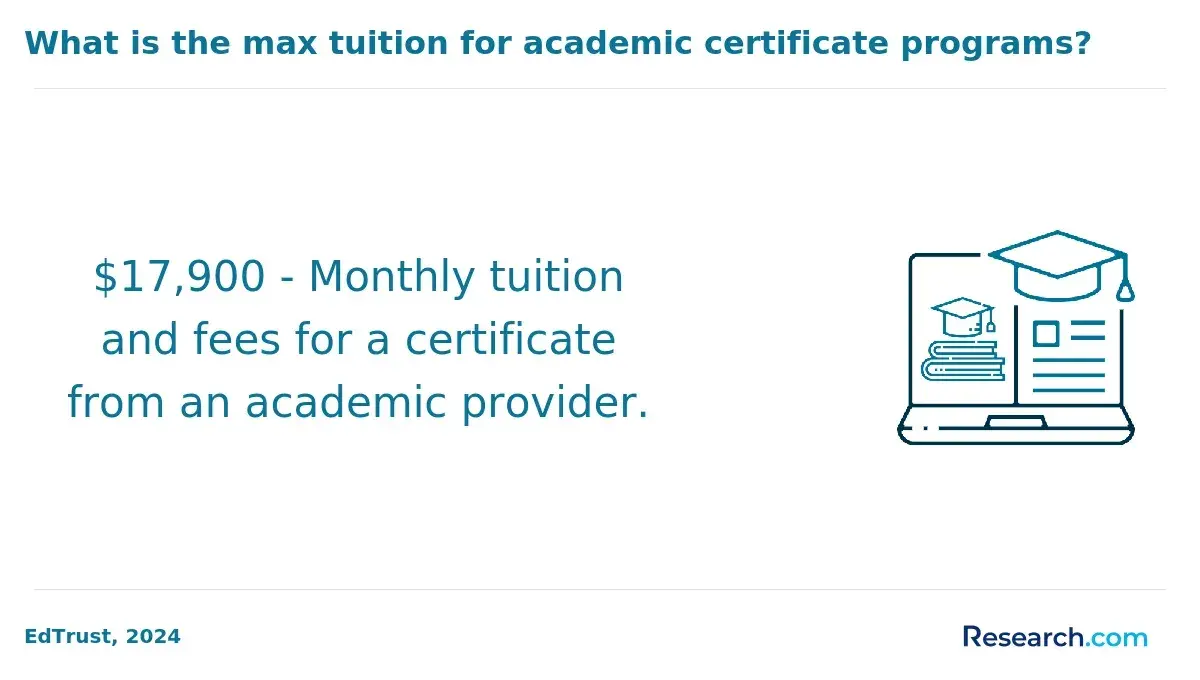
Completion time ranges from a few weeks for a noncredit microcredential to roughly one academic year for many credit-bearing certificates. A full stack takes longer because each level has its own course requirements. Tuition varies by institution, residency status, credit load, and program type; total cost also can include books, subscriptions, exam fees, equipment, and remote-proctoring charges.
This overview shows why learners should compare the total pathway rather than the promotional price of the first badge:
| Credential type | Typical pace | Cost considerations | Stacking value |
| Noncredit microcredential | Weeks to a few months | Usually charged per course; federal aid is often unavailable | May show skills but usually does not carry academic credit |
| Credit-bearing undergraduate certificate | Several months to about one year | Per-credit tuition, fees, and materials; aid eligibility varies | May apply toward a related degree under written policy |
| Graduate certificate | Often several courses across one or more terms | Graduate tuition and possible technology fees | May apply to a related master's degree if grade and time limits are met |
Federal Student Aid reported that average tuition and fees differ substantially across public, private nonprofit, and for-profit institutions, so compare net price and aid eligibility rather than assuming online is automatically cheaper. If your target role ultimately requires graduate study, compare the certificate route against an online masters degree that may provide a more direct qualification.
What curriculum and course sequencing are common in stackable certificates and microcredentials?
A well-designed stack moves from foundations to applied work and then to specialization. In an information technology pathway, for example, learners may begin with computing fundamentals, add networking or data analytics, and complete a capstone or vendor-aligned preparation course. In business, a sequence may move from communication and accounting basics to project management, analytics, or leadership.
Course sequencing matters because later courses may require minimum grades, prerequisite skills, or completed credits. Credit-bearing certificates often use transcripts and grades; noncredit programs may use completion records, skill assessments, or digital badges instead. Ask whether a badge expires, whether credits have a time limit, and whether repeated courses are required before the next level.
Strong programs assess learning through applied assignments, projects, simulations, or supervised demonstrations. Passive video completion is less persuasive to employers and less useful for learners who need a portfolio or proof of practical competence.
What careers and job roles do stackable credentials most commonly lead to?
Stackable credentials most often support roles where employers value targeted knowledge, a portfolio, prior experience, or a combination of education and certification. They can strengthen an application, support an internal promotion, or help a learner test a field before committing to a degree. They should not be treated as universal substitutes for degrees, licenses, apprenticeships, or required experience.
The roles below illustrate common directions, not guaranteed job outcomes:
| Pathway area | Potential job direction | Important qualification note |
| IT and data | Help desk specialist, junior data support, cybersecurity support | Employers may also expect projects, vendor certifications, or experience |
| Business | Administrative coordinator, project support, operations assistant | Responsibilities vary substantially by employer and industry |
| Healthcare administration | Medical billing support, patient access, records support | Clinical roles require separate education and supervised training |
| Digital design | Content creator, production artist, junior designer | Portfolio quality can be as important as the credential |
For a broader comparison of occupations and degree-linked pay, review the highest paying jobs. Use salary information as labor-market context, not as a prediction of what a specific credential will produce.
What salary ranges and earning potential are associated with stackable credential pathways?
Earning potential is tied to the occupation, location, experience, employer, and additional qualifications—not simply to completing a stackable credential. BLS reported a May 2024 median annual wage of $60,340 for all occupations, compared with $104,420 for computer and information technology occupations. That gap shows why aligning a credential with a specific role matters, but it does not mean an entry-level certificate holder will earn the occupational median.
This comparison helps put credential choices in context:
| Occupational group | May 2024 median annual wage | How to use the figure |
| All occupations | $60,340 | Broad U.S. labor-market benchmark |
| Computer and information technology occupations | $104,420 | Relevant only when a learner can meet the education, skill, and experience requirements for a specific role |
| Healthcare support occupations | $36,300 | Illustrates that healthcare credentials lead to widely different pay levels depending on occupation and licensure |
Estimate return on investment by adding tuition, fees, unpaid practice time, lost work hours, and likely financing costs. Then compare those costs with realistic local openings, entry requirements, and your current experience—not with the highest salary shown in national occupational data.
How can students choose reputable online stackable programs that support licensure or certification?
Choose a program backward from the job requirement. First identify whether your target role needs academic credit, a certification exam, a state license, a portfolio, an apprenticeship, or a degree. Then select the smallest credible credential that closes your actual skills gap and preserves a path forward.
Before you enroll, take these practical steps:
- Search job postings in your preferred location and record the recurring education, software, certification, and experience requirements.
- Get the stacking and transfer policy in writing, including course expiration dates and minimum grades.
- Ask for the full cost through completion of your intended final credential, not just the first course.
- For regulated work, confirm requirements with the state licensing board before enrolling.
- Ask whether online students receive career coaching, employer connections, tutoring, and accessible technical support.
Military-connected learners should also compare benefits policies, transfer-credit evaluation, and support services at online colleges for military. Avoid enrolling based solely on speed, a low introductory price, or an unverified claim that a credential is "accepted everywhere."
Other Things You Should Know About
Yes, for many business, IT, administrative, and digital-design credentials. Read the program's attendance and assessment policies carefully because remote proctoring, local testing, internships, labs, or clinical placements may still be required.
Sometimes. Credit-bearing certificates from an accredited institution may have a defined pathway into a related degree, but transfer is never automatic. Obtain written confirmation of applicable courses, grade requirements, and time limits.
They can be worthwhile when they match a documented employer need, lead to a recognized next step, and cost less than the value of the skills or advancement they support. They are a weaker investment when a target occupation clearly requires licensure, extensive hands-on training, or a specific degree.
A certificate program may prepare you for a separate certification exam, but completing the program does not automatically make you certified. Check the certifying organization's exam, education, experience, and renewal requirements independently.
References
- What are Stackable Credentials? https://assess.com/stackable-credentials/
- Stackable Certificates & Credentials - Complete College America https://completecollege.org/our-approach/structure/stackable-certificates-credentials/
- How to Create Stackable Credentials That Will Draw Learners to Your School https://jenzabar.com/blog/how-to-create-stackable-credentials-that-will-draw-learners-to-your-school
- Best Online Schools for Transferring Credits [2026 Guide] https://www.straighterline.com/blog/transfer-best-online-schools-for-transferring-credits
- What Are Stackable Credentials and Why Do They Matter? https://www.pltw.org/blog/what-are-stackable-credentials
- Stackable Credentials Explained https://diplomasafe.com/stackable-credentials/
- Stackable Credentials | Learn & Work Ecosystem Library https://learnworkecosystemlibrary.com/topics/stackable-credentials/
- New Report Examines How U.S. Workers and Employers View Alternative Credentials https://www.higheredtoday.org/2022/05/23/new-report-examines-how-u-s-workers-and-employers-view-alternative-credentials/