2027 Best Short Certificate Programs for Working Adults

Co-Founder and Chief Data Scientist
Working adults need training that fits around a job, leads toward a real career goal, and does not create unnecessary debt. Short certificate programs can build job-ready skills in months rather than years, but the right choice depends on whether your target role requires a license, certification exam, degree, or supervised experience.
The U.S. Bureau of Labor Statistics projects healthcare support occupations to grow faster than average from 2024 to 2034. This guide compares practical certificate options, delivery formats, costs, credentials, and career outcomes so you can choose a program with a realistic return on your time and money.
Key Things You Should Know
- Short certificates commonly take a few weeks to about one year; credit-bearing community-college certificates may stack into an associate degree, while noncredit training often does not transfer.
- For regulated careers such as medical assisting, nursing support, electrical work, and legal services, confirm state licensing-board rules and employer requirements before enrolling; a school certificate alone may not qualify you to work.
- Occupational outlook varies sharply: BLS projects medical assistant employment to grow 12% from 2024 to 2034, while some office, design, and legal-support paths may have slower growth or higher competition.
Top 10 Best Short Certificate Programs for Working Adults
Popular Trade School Programs
Trade certificates suit adults who prefer hands-on work and can attend labs, clinical sites, or employer-based training. Common options include HVAC/R technician, welding, electrical helper, plumbing, diesel technology, CNC machining, and commercial driving programs. Many take 3-12 months, although apprenticeships and state licensing can extend the path.
Choose a credit-bearing certificate if you may later pursue an associate degree; choose a short workforce program when the employer or licensing pathway clearly recognizes it. Ask whether tools, safety gear, exam fees, driving time, and required clinical or shop hours are included.
Healthcare Programs
Healthcare certificates can prepare adults for medical assisting, phlebotomy, pharmacy technician, dental assisting, sterile processing, nursing assistant, billing and coding, or practical nursing prerequisites. Programs typically require immunizations, background checks, drug screening, CPR training, and in-person clinical practice.
A certificate is educational training; national certification may be a separate exam, and state rules can differ. Medical assistant employment is projected to grow 12% from 2024 to 2034, according to BLS, but employers may prefer graduates of accredited programs. Confirm externship placement, exam eligibility, and state approval before paying.
Criminal Justice / Law Programs
Short programs in criminal justice, paralegal studies, legal assisting, court reporting support, private security, and victim advocacy can fit adults seeking public-service or legal-office roles. A legal studies certificate may strengthen administrative and research skills, but it does not authorize someone to practice law.
Security work may require state registration, fingerprinting, training hours, or firearms qualifications. Paralegal certificates are most useful when they include legal research, writing, ethics, and software training; some employers prefer candidates with a bachelor's degree or prior office experience. Verify whether the program is approved by a recognized institution or professional body.
Arts & Design Programs
Creative certificates commonly cover graphic design, digital marketing design, UX/UI fundamentals, photography, video editing, web design, interior design support, and animation. These programs work best when they produce a portfolio with employer-relevant projects, not merely completion documentation. Online formats can be convenient for software-based courses, but live feedback and portfolio reviews matter.
Graphic designers had a 2024 median annual wage of $61,300, according to BLS; that figure reflects the occupation overall, not certificate graduates specifically. Adults changing careers should pair the credential with portfolio work, freelance projects, and current software skills.
What are short certificate programs and how do they fit adult career goals?
A short certificate program is a focused course of study that awards an educational credential after completion. It is different from a professional certification, which is usually awarded by an industry organization after an exam, verified work experience, or both. Programs may be offered by community colleges, universities, trade schools, employers, unions, and private training providers.
For working adults, the best option is usually the shortest program that meets the actual hiring, licensing, or advancement requirement. Explore career-focused certificate programs alongside employer job postings to see whether a certificate, certification, apprenticeship, or degree is the better match.
| Credential type | What you earn | Best use | Key limitation |
| Academic certificate | College credential, often for credit | Entry-level training or a stackable college pathway | Transfer rules vary by institution |
| Career-training certificate | School or provider completion credential | Rapid skills training for a defined role | May not carry college credit or meet licensing rules |
| Professional certification | Industry credential after meeting external standards | Showing validated knowledge to employers | May require an exam, fees, renewal, or experience |
Choose a certificate when you need structured learning, equipment access, supervised practice, or eligibility for a next-step exam. Consider an associate degree, apprenticeship, or employer training instead when job postings consistently require them.
How do online and campus short certificate programs compare for working adults?
Online short certificates are often the strongest fit for adults with unpredictable schedules, especially in business, IT support, bookkeeping, coding, design, and medical billing. Campus or hybrid formats are usually better when competence depends on labs, equipment, clinical placements, shop safety, or direct observation.
Adults who need frequent start dates can compare online colleges starting this month, but speed should not replace checking instructor access, assignment deadlines, proctoring, and required in-person components.
| Format | Best for | Working-adult advantage | Watch for |
| Fully online | Software, business, office, and theory-based skills | Flexible location and asynchronous coursework | Limited hands-on practice and fixed exam deadlines |
| Hybrid | Programs requiring some labs or simulations | Balances flexibility with supervised practice | Travel and evening or weekend attendance |
| Campus-based | Trades, clinical training, and equipment-intensive programs | Direct access to labs and instructors | Less schedule flexibility and commuting costs |
Before enrolling, calculate weekly study time rather than focusing only on class meeting time. An accelerated online course can demand 10-20 hours each week, which may be unrealistic during overtime, caregiving, or shift-work periods.
How can you verify accreditation and program quality for short certificates?
Accreditation matters most when a program awards college credit, participates in federal aid, prepares students for a licensed occupation, or claims eligibility for a professional certification exam. Institutional accreditation evaluates the college as a whole; programmatic accreditation evaluates a particular field, such as nursing, medical assisting, or certain technical programs.
Neither is automatically necessary for every noncredit skills course, but lack of recognized oversight is a major risk when a provider makes job-placement or licensure claims.
Use these checks before you enroll:
- Confirm the institution's accreditation status through the accreditor and the U.S. Department of Education database, not only the school's website.
- Check the relevant state licensing board if the career requires a license, registration, clinical approval, or mandated training hours.
- Ask whether completion makes you eligible for a named certification exam and verify that claim with the certifying organization.
- Request the total cost, withdrawal policy, completion rate, and the exact credential name in writing.
- Review recent local job postings to confirm that employers recognize the training provider or credential.
Red flags include vague claims such as "nationally recognized" without naming the approving body, pressure to enroll immediately, unclear refund terms, and promises of guaranteed employment. A legitimate program should explain exactly what its certificate does and does not qualify you to do.
What admission requirements do short certificate programs typically have for adult learners?
Admission rules depend on the provider and credential type. Many short noncredit programs require only proof of age, identity, payment arrangements, and basic readiness. Credit-bearing college certificates may require a high school diploma or equivalent, placement assessment, transcripts, and completion of prerequisites. Selective healthcare programs can add science prerequisites, minimum grades, background checks, health records, and clinical-site requirements.
Working adults should separate admissions requirements from employment requirements. You may be admitted to an online medical billing course with no college GPA requirement, for example, while an employer may still prefer certification, prior office experience, or knowledge of a specific electronic health-record system.
| Program category | Common entry requirements | Possible additional requirements |
| Noncredit workforce certificate | Application, age or education verification | Basic skills assessment or orientation |
| College credit certificate | High school completion, application, transcripts | Placement testing and prerequisite courses |
| Clinical or regulated program | Academic prerequisites and admissions review | Background check, immunizations, CPR, drug screen, clinical clearance |
Do not assume previous college credits will transfer into a short certificate, or that a certificate will transfer into a degree. Obtain a written evaluation or published transfer policy before choosing a stackable pathway.
How long do short certificate programs take and what do they cost?
Short certificate timelines range from several weeks for a narrow software or exam-prep course to roughly one year for many college and trade certificates. Part-time evening, weekend, and asynchronous options can make the calendar longer but reduce disruption to work. Fast programs are valuable only if they include the required practice hours, clinical experience, or exam preparation for your target role.
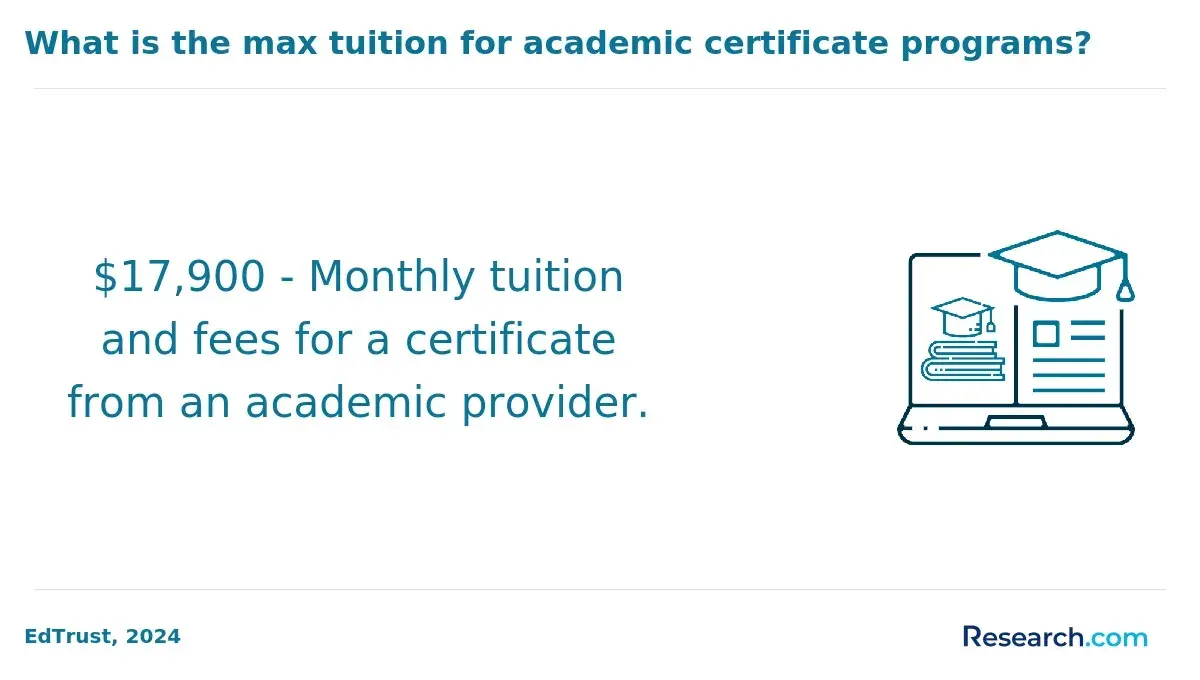
Cost includes more than tuition. College Board reported average published tuition and fees of $4,050 for in-district students at public two-year colleges in the 2024-25 academic year. That benchmark can help compare credit-bearing options, but short-program prices vary substantially by state, school, format, supplies, and required externships.
For adults prioritizing aid eligibility and lower published tuition, review cheapest online colleges and then confirm whether the specific certificate is eligible for federal aid. Many very short or noncredit programs are not.
| Cost factor | Why it changes the total | Question to ask |
| Tuition and mandatory fees | May differ for online, in-district, and out-of-district students | What is the full published program price? |
| Books, software, tools, uniforms | Often required before hands-on coursework begins | Which items must I buy myself? |
| Exams, licensing, and background checks | May be separate from tuition | Which third-party fees are required? |
| Lost work time and travel | Clinical, lab, and testing schedules can affect earnings | Are required sessions offered evenings or weekends? |
Compare net cost after employer tuition assistance, workforce grants, veterans benefits, or payment plans. Avoid borrowing for a short certificate until you have compared the total debt with local entry-level wages and the likelihood that the credential meets hiring requirements.
What coursework and skills do top short certificate programs usually include?
Top short certificate programs teach a defined set of job tasks and show how learners will practice them. Coursework varies by field, but strong programs combine technical instruction with communication, documentation, safety, digital tools, and problem-solving. For adults, the most useful curriculum is one that produces evidence you can show an employer: a portfolio, competency assessment, lab record, clinical evaluation, industry exam eligibility, or completed project.
Look for these curriculum signals when comparing programs:
- Clear learning outcomes tied to recognizable job tasks rather than broad promises of career readiness.
- Instructor feedback, supervised practice, simulations, labs, externships, or portfolio reviews appropriate to the field.
- Current software, equipment, codes, regulations, and documentation standards used by employers.
- Career preparation that includes resumes, interviewing, networking, and an explanation of realistic entry-level job titles.
Avoid programs that focus only on recorded lectures when the occupation requires physical technique, patient interaction, equipment calibration, legal procedure, or visual portfolio quality. Convenience has less value if it leaves you unable to demonstrate competence.
What careers can short certificate programs lead to for working adults?
Short certificate programs can lead to entry-level work, career pivots, or advancement within an employer, but the outcome depends on the field and the credential's recognition. Common pathways include HVAC technician trainee, welder, CNC operator, medical assistant, phlebotomist, pharmacy technician, dental assistant, medical billing specialist, legal assistant, security officer, junior graphic designer, digital content specialist, IT support technician, and bookkeeping clerk.
The following comparison helps match training length and career expectations. These are possible career directions, not guaranteed outcomes.
| Career direction | Typical training fit | When a certificate may be enough | When more education may be needed |
| Skilled trades | Hands-on certificate plus apprenticeship or employer training | Entry-level helper or trainee roles | Journeyman licensing and advanced specialty work |
| Healthcare support | Approved certificate with clinical experience | Roles with defined entry requirements | Nursing, imaging, therapy, and advanced clinical positions |
| Legal and public safety support | Certificate plus office or agency-specific training | Administrative, support, or security roles | Attorney, law-enforcement, and investigative careers |
| Digital and creative work | Certificate plus portfolio and current tools | Junior freelance or support roles | Specialized design, management, or highly competitive positions |
If your goal ultimately requires broader general education, compare an associate's degree online pathway with a standalone certificate. A stackable certificate can be a sensible first step when the college confirms how credits apply toward the later degree.
What salary ranges and job outlook are realistic after earning a certificate?
Salary data should be used as labor-market context, not as a promise that a certificate graduate will earn a particular amount. Pay depends on location, shift, union status, experience, employer, licensure, and whether the role requires a degree or additional certification.
BLS May 2024 median annual wages were $59,810 for heating, air conditioning, and refrigeration mechanics and installers; $44,200 for medical assistants; $61,010 for paralegals and legal assistants; and $61,300 for graphic designers.
Those figures describe workers across each occupation, including people with varying education and experience. They are most helpful for comparing broad career directions after you confirm that your planned credential can actually lead to the entry-level role.
| Occupation | 2024 median annual wage | 2024-2034 outlook | How to interpret it |
| HVAC mechanics and installers | $59,810 | 8% growth | Demand is favorable, but licensing and apprenticeship rules can apply. |
| Medical assistants | $44,200 | 12% growth | Growth is strong; employer preferences for accredited training can vary. |
| Paralegals and legal assistants | $61,010 | 0% growth | Pay can be solid, but openings may be competitive and degree preferences are common. |
| Graphic designers | $61,300 | 2% growth | Portfolio quality and software capability may matter more than credential length. |
For a realistic ROI estimate, review at least 10 local job postings, note their required credentials and starting pay where listed, and compare that evidence with total program cost and time away from work.
How do licensing or professional certification requirements affect program choice?
Licensing and professional certification can determine whether a short program is worth pursuing. A certificate is proof that you completed training; it may prepare you for an outside certification exam or meet part of a licensing requirement, but it is not automatically the license or certification itself. Requirements are set by states, licensing boards, employers, and certifying organizations.
Before selecting a regulated program, take these steps:
- Identify the exact job title and the state where you plan to work.
- Find the state board or agency requirement for education, clinical hours, background checks, examinations, and renewal.
- Ask the school whether its curriculum meets that requirement in your state and request confirmation in writing.
- Verify whether graduates are eligible for a specific certification examination and whether exam fees are included.
- Check whether online coursework is accepted and whether clinical placements are guaranteed or student-arranged.
Common mistakes include enrolling in an online program that lacks required in-person practice, assuming a national certification replaces a state license, and choosing an out-of-state provider without confirming local eligibility. If answers are unclear, postpone enrollment rather than hoping the credential will be accepted later.
Other Things You Should Know About
They can be worthwhile when they meet a specific employer, licensing, or career-change need at a manageable total cost. They are less useful when the target occupation requires a degree, apprenticeship, or credential the program does not provide.
The fastest option depends on local hiring needs and required training. Programs in customer support, bookkeeping, IT support, phlebotomy, commercial driving, and skilled-trade support may be relatively short, but clinical, licensing, and exam requirements can extend the timeline.
Many business, technology, design, and administrative certificates are fully online. Programs involving patient care, labs, machinery, driving, welding, or other hands-on competencies typically require campus, lab, clinical, or field attendance.
Employers may accept online certificates when the provider is credible, the curriculum matches the job, and you can demonstrate skills. For regulated roles, acceptance depends on whether the program meets state and certification requirements, not simply whether it was delivered online.
References
- Financial Aid for Adult Education https://www.vsac.org/plan/adult-learners/financial-aid
- EdAssist | Fuel Your Next Career Move: 4 Ways to Pay for Continuing Education https://www.brighthorizons.com/resources/blog/edassist/fuel-your-next-career-move-4-ways-to-pay-for-continuing-education
- In-Demand Skills for Today's New Workforce - Scholarship America https://scholarshipamerica.org/blog/in-demand-skills-for-todays-new-workforce/
- Types of Financial Aid: Loans, Grants, and Work-Study Programs https://angelo.campusesp.com/posts/1141
- How does a college degree improve graduates' employment and earnings potential? - APLU https://www.aplu.org/our-work/publicuvalues/employment-earnings/
- Can Workforce Solutions Help Me Pay for School or Certification Programs? https://workforcesolutionsrca.com/blog/can-workforce-solutions-help-me-pay-for-school-or-certification-programs
- Community College Outcomes Vary by Program and Age https://www.commerce.nc.gov/blog/2019/06/25/community-college-outcomes-vary-program-and-age
- The Most Flexible Online Teaching Programs for Busy Adults https://moreland.edu/resources/blog-insights/flexible-online-teaching-programs-busy-adults
- Financial Aid for Adult Learners - CFWV.com https://www.cfwv.com/adult-learners/financial-aid-for-adults/
- Financial Aid for Adult Learners: Grants, Scholarships & How to Pay for College (2026 Guide) https://www.straighterline.com/blog/financial-aid-resources-adults