2027 Best Certificate Programs With Academic Advising

Co-Founder and Chief Data Scientist
A short certificate can be a practical route into a new field, but the wrong program may not meet licensing, employer, or transfer requirements. Academic advising is the differentiator: it helps students map prerequisites, choose courses, and confirm career fit before spending money.
U.S. Bureau of Labor Statistics projections released in 2025 show medical assisting employment is expected to grow 12% from 2024 to 2034. This guide helps career changers, recent graduates, and working adults compare certificate types, advising quality, cost, formats, and realistic outcomes.
Key Things You Should Know
- Choose a credit-bearing academic certificate when you may later pursue an associate or bachelor's degree; choose a noncredit workforce certificate when fast, job-specific training matters more than transferable college credit.
- Strong advising should include a written education plan, prerequisite and licensure review, progress monitoring, and referrals for tutoring, financial aid, and career services - not simply help registering for classes.
- Career potential varies sharply by field: BLS projects 12% growth for medical assistants from 2024 to 2034, while some certificates prepare for roles that require additional exams, supervised experience, or state approval.
Top 10 Best Certificate Programs With Academic Advising
Popular Trade School Programs
Trade certificates commonly cover electrical, HVAC/R, welding, plumbing, industrial maintenance, and automotive technology. They are best for learners seeking hands-on entry routes and willing to complete lab work, apprenticeships, or employer training.
Advisers can verify whether a program prepares for local apprenticeship entry or a required license; a classroom certificate alone often does not. Electricians had a 2024 median annual wage of $62,350, according to the BLS, but most electrician jobs require an apprenticeship and state-specific licensing steps beyond a certificate.
Healthcare Programs
Healthcare certificates may prepare students for medical assisting, pharmacy technology, practical nursing prerequisites, sterile processing, billing and coding, or phlebotomy. They suit learners who can meet clinical, immunization, background-check, and schedule requirements.
Advising is especially valuable for sequencing science prerequisites and confirming whether a program is approved for a certification examination or state license. Medical assistants earned a 2024 median annual wage of $44,200, according to the BLS; employers may prefer or require professional certification even when a state does not.
Criminal Justice / Law Programs
Certificate and associate-level options include paralegal studies, legal studies, criminal justice, corrections, and public safety administration. These programs fit learners exploring support roles in law offices, courts, government, or community safety rather than those expecting automatic entry into licensed legal practice.
Advisers should explain background-screening policies, internship options, transfer pathways, and the distinction between paralegal education and attorney licensure. The BLS reported a 2024 median annual wage of $61,010 for paralegals and legal assistants; hiring requirements vary by employer and jurisdiction.
Arts & Design Programs
Arts and design certificates can focus on graphic design, digital media, UX foundations, photography, web production, or animation. They work best when students need a focused portfolio and software practice, not merely a course completion record.
Advisers can help students select portfolio-building electives, assess whether a certificate stacks into a degree, and identify internships. Graphic designers had a 2024 median annual wage of $61,300, according to the BLS. A certificate can demonstrate training, but a polished portfolio and relevant experience remain central to hiring.
What are certificate programs with academic advising and who are they best for?
Certificate programs with academic advising are structured educational programs that award a certificate after specified coursework or training and provide individualized guidance during enrollment. They may be offered by community colleges, universities, trade schools, hospitals, or workforce providers. Some are credit-bearing academic certificates; others are noncredit career-training certificates. Neither should be confused with a professional certification, which is usually awarded by an independent certifying body after an exam or other requirements.
They are a strong fit for adults changing careers, students testing a field before a degree, workers needing a defined skill set, and learners who benefit from a clear course sequence. They are less suitable for someone whose target occupation requires a bachelor's degree, graduate degree, apprenticeship, or license that the program does not support.
The comparison below clarifies the options an adviser should help you distinguish before enrollment.
| Program type | Typical purpose | Credit and transfer potential | Best use case |
| Credit-bearing academic certificate | College coursework in a defined subject | May apply toward a related degree, subject to school policy | Students who may continue to an associate or bachelor's program |
| Noncredit workforce certificate | Short, employment-focused skills training | Usually does not carry academic credit | Workers seeking rapid, targeted training |
| Professional certification preparation | Education aligned to an external credential exam | Depends on the provider | Fields where employers value or require certification |
Ask the adviser to identify the exact credential printed on completion, whether it carries college credit, and whether it is recognized by the employers or boards relevant to your goal.
How do online and campus certificate programs with advising compare?
Online and campus programs can award the same type of certificate, but the better choice depends on the curriculum and the support model. Online study can work well for theory-heavy fields such as business software, legal studies, coding foundations, and billing. Campus or hybrid delivery is often more practical when labs, clinical placements, equipment, studio critiques, or supervised assessments are central.
This comparison highlights the trade-off between flexibility and direct access to facilities and in-person support.
| Decision factor | Online certificate | Campus or hybrid certificate |
| Schedule | Often asynchronous, with fixed deadlines | Usually fixed class and lab times |
| Advising access | Video, phone, email, and virtual appointments | In-person meetings plus online contact |
| Hands-on requirements | May require local placements or proctored assessments | Typically uses school labs, studios, or clinical partners |
| Best fit | Self-directed learners with reliable technology | Learners needing equipment, practice, or structured routines |
Before choosing online delivery, confirm time-zone expectations, live-session requirements, placement support, and whether required fieldwork can be completed near you. Learners planning a longer pathway can also compare an online bachelor degree option if a certificate will not meet the education level commonly requested for their target role.
What accreditation and professional standards should these certificate programs meet?
Institutional accreditation matters most for credit-bearing college certificates, transfer plans, federal aid eligibility, and programs connected to regulated occupations. Verify that the college is accredited by an institutional accreditor recognized by the U.S. Department of Education or the Council for Higher Education Accreditation. For noncredit providers, focus on employer recognition, transparent outcomes, qualified instructors, and any relevant programmatic approval.
Professional standards are field-specific. Healthcare programs may need specialized accreditation, clinical-site agreements, or eligibility alignment with a certification exam. Paralegal, technical, and design programs may not require specialized accreditation, but should demonstrate current tools, faculty experience, and credible employer connections. A school's general accreditation does not automatically mean every certificate qualifies graduates for licensure or a certification exam.
Use this short verification sequence before paying a deposit.
- Identify the occupation, state, and employer type you are targeting.
- Check the licensing board or certifying organization's education requirements directly.
- Ask the school in writing whether this exact program meets those requirements and under what conditions.
- Confirm whether credits transfer to the degree program you may want later.
What admission requirements and prerequisites do certificate programs with advising typically have?
Admissions requirements depend on the provider and level of study. A community-college academic certificate may require a high school diploma or equivalent, placement review, and completion of prerequisites. A graduate certificate generally requires a completed bachelor's degree. Noncredit workforce certificates may use a simpler registration process, although health and skilled-trade programs can still require screening or prior coursework.
Common requirements deserve attention because they can change your actual start date and total cost.
- High school diploma, GED, or equivalent for many entry-level college and career programs
- Placement testing or proof of college-level reading, writing, or math readiness when required by the institution
- Prerequisite courses, particularly anatomy, math, computer applications, or technical fundamentals
- Background checks, drug screening, immunizations, CPR training, or physical-capacity documentation for some clinical placements
- Portfolio review or software familiarity for selected arts and design certificates
Do not assume a stated "open enrollment" policy means every course has immediate availability. Ask whether high-demand labs, clinical placements, or capstone classes have separate selection processes.
How long do these certificate programs take, and what do they cost?
Many career certificates can be completed in months, while credit-bearing certificates commonly take one to three semesters when studied full time. Part-time pacing, prerequisite courses, waitlists, clinical rotations, and course sequencing can extend that timeline. The program's published length is useful only if it reflects the schedule you can realistically maintain.
For price context, the National Center for Education Statistics reported average published tuition and fees of $4,050 for in-district students at public two-year institutions in 2024-25. That figure is not the price of a certificate: local residency, number of credits, supplies, testing, uniforms, tools, and travel can materially change the total.
The cost categories below help make comparisons consistent across schools.
| Cost category | Why it matters | What to confirm |
| Tuition and mandatory fees | Usually tied to credits or clock hours | Total required courses, residency rate, and annual increases |
| Books, software, tools, and equipment | Can be substantial in trades and design | Required purchases versus school-provided materials |
| Clinical, lab, and exam expenses | Often billed outside base tuition | Screening, uniforms, insurance, certification, and licensing fees |
| Lost work time and transportation | Changes affordability for working adults | Daytime labs, campus visits, and placement travel |
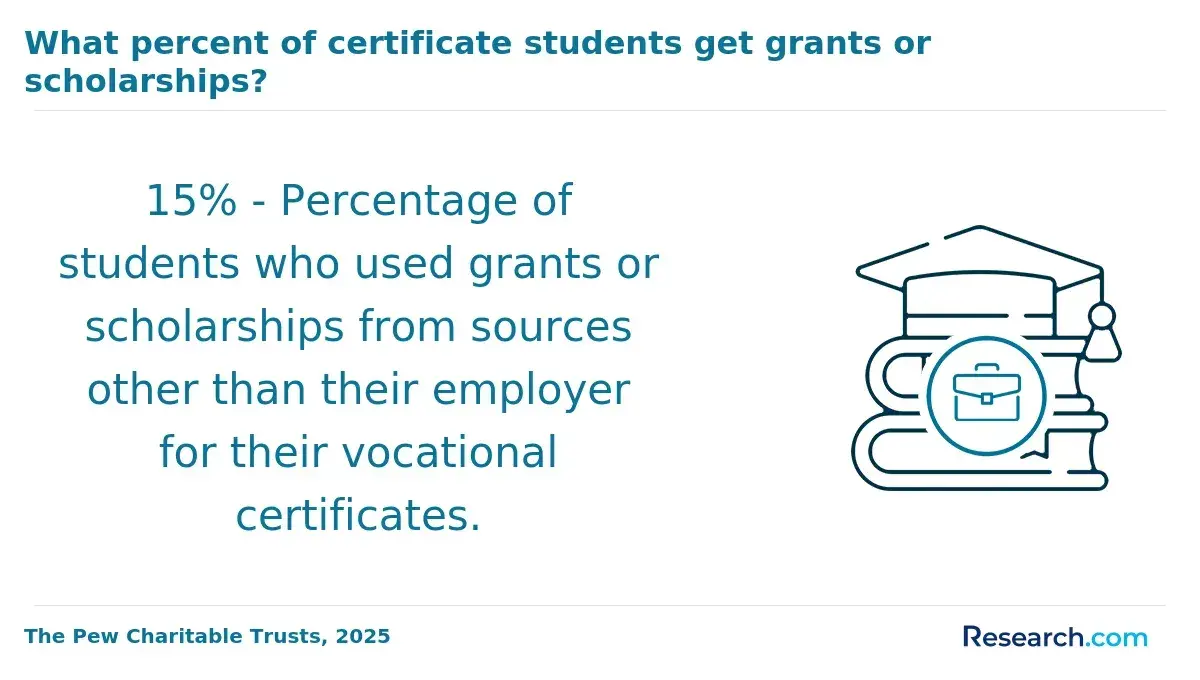
Credit-bearing students may be eligible for federal or state aid depending on the institution and enrollment status; many short noncredit programs are not. Ask about employer tuition assistance, workforce grants, payment plans, and the refund policy before borrowing. If your goal ultimately requires advanced study, compare the certificate's role with PhD online programs only when the field truly has a doctoral-level career pathway.
What coursework and advising services are included in leading certificate programs?
Leading programs combine focused instruction with advising that turns a course list into a workable plan. Coursework varies by discipline, but a credible curriculum identifies learning outcomes, assessment methods, required technology or equipment, and any practicum, lab, portfolio, or field-placement expectations. Advising should be available before enrollment as well as after a student encounters an academic or scheduling problem.
Look for the following services because each addresses a common reason students stop out or complete a credential that does not serve their goal.
- Career and goal assessment that connects the certificate to a specific job target or degree pathway
- Written course sequencing that accounts for prerequisites, limited-offering courses, and part-time study
- Transfer and stackability review for credit-bearing certificates
- Licensure and certification-exam guidance that clearly states what the program does and does not qualify students to pursue
- Early alerts, tutoring referrals, disability support, and financial-aid or payment-plan navigation
- Resume, interview, internship, portfolio, and employer-referral support where applicable
A red flag is an adviser who cannot explain the difference between finishing the program, qualifying for an external exam, and becoming eligible for a regulated job. Request those answers in writing.
What careers can certificate programs with academic advising prepare you for?
A certificate can prepare you for entry-level work, advancement in a current role, or further education, but outcomes depend on the field and local hiring standards. Employers increasingly evaluate demonstrable skills, work samples, and relevant credentials alongside formal education. In roles involving public safety, patient care, or licensed trades, legal requirements may set a higher floor than employer preference.
These examples show how to connect a certificate to a realistic next step rather than treating it as a universal job credential.
| Certificate focus | Possible entry or support roles | Important limitation |
| HVAC/R or electrical foundations | Technician helper, installer trainee, apprentice candidate | Independent work may require apprenticeship hours and licensing |
| Medical assisting | Medical assistant in clinics or physician offices | Employer and state certification expectations vary |
| Paralegal studies | Paralegal or legal assistant | It does not authorize legal practice or attorney licensure |
| Graphic or digital design | Junior designer, production artist, freelance support work | Portfolio quality and experience strongly influence hiring |
For learners prioritizing flexible employment, reviewing work-from-home degrees that pay good money can help clarify when a short certificate is enough and when a broader degree may offer better access to remote professional roles.
What salary ranges and job outlook are associated with careers from these certificates?
Salary and outlook data describe occupations, not guaranteed results for certificate completers. Pay varies by state, employer, experience, schedule, union status, and whether a worker holds a required license or certification. Use national figures as a starting point, then compare local job postings and wage data before deciding on a program.
The following BLS 2024 median annual wages and 2024-34 employment projections offer a practical market snapshot for occupations commonly related to these fields.
| Occupation | 2024 median annual wage | Projected employment change, 2024-34 | Certificate-alone caution |
| Electricians | $62,350 | 9% | Most positions require apprenticeship training and licensing. |
| Heating, air conditioning, and refrigeration mechanics and installers | $59,810 | 8% | EPA or other credentials may be required for particular work. |
| Medical assistants | $44,200 | 12% | Certification preferences and scope rules vary by employer and state. |
| Paralegals and legal assistants | $61,010 | 0% | Education requirements differ across law firms and agencies. |
| Graphic designers | $61,300 | 2% | A portfolio and experience may matter as much as the certificate. |
The strongest return on investment usually comes from matching the certificate to a documented local requirement, a clear promotion path, or a stackable degree plan - not from selecting a field solely because of a national wage figure.
How can you choose a reputable certificate program with strong academic advising support?
A reputable program makes its credential, total costs, support services, and career limitations easy to verify. Start with your desired occupation, then work backward: identify the minimum education, licensing, certification, experience, and schedule requirements before comparing schools. A not-for-profit institution may be one option to evaluate alongside public colleges and specialized providers; this guide to a not-for-profit online university can support that broader school comparison.
Use these questions in an admissions or advising meeting to separate strong support from marketing claims.
- What exact certificate will I receive, and is it credit-bearing, noncredit, stackable, or eligible for transfer?
- Which jobs, certification exams, licenses, or apprenticeships does this program specifically prepare me to pursue, and what additional requirements remain?
- What is the full estimated cost, including materials, exams, clinical requirements, tools, and transportation?
- How often can I meet an academic adviser, and will I receive a written completion plan?
- What happens if I fail, withdraw from, or cannot schedule a required lab, practicum, or clinical course?
- Can you provide completion, placement, and licensure-exam information using clear definitions and the most recent reporting period?
Avoid schools that promise employment, obscure extra charges, pressure you to sign quickly, or cannot document accreditation and eligibility claims. The best option is the one whose advising, schedule, total cost, and recognized outcome match your specific next step.
Other Things You Should Know About
Not always. Some providers offer only enrollment assistance, while stronger programs assign advisers who help with course sequencing, academic progress, transfer planning, and career or licensure questions. Ask what advising is included and how appointments are scheduled.
It can, but only when the certificate is credit-bearing and the receiving institution accepts the courses. Obtain written confirmation of transfer or stackability before enrolling, especially if you expect to pursue an associate or bachelor's degree.
Employers generally care more about the provider's credibility, applicable skills, required approvals, and your portfolio or experience than delivery format alone. For regulated fields, confirm that online coursework and local placements meet state or certifying-body requirements.
Sometimes, but not automatically. A certificate may satisfy an education requirement, prepare you for an exam, or meet only part of the process. Verify exam eligibility, supervised-hour requirements, background rules, and state regulations directly with the relevant authority.
References
- 4 Challenges Derailing Advisors and Strategies to Fix Them https://www.civitaslearning.com/blog/4-challenges-derailing-academic-advisor-effectiveness-and-how-to-fix-them/
- Importance of Academic Advising: Why it is Important | Webber International University https://www.webber.edu/importance-of-academic-advising/
- Academic Advising Delivers Success | Edcor https://www.edcor.com/blog/academic-advising-delivers-success/
- Academic Advisor Training & Certificate | DC Education Group https://www.dceducationgroup.com/retention-advisor-certificate
- Department of Political Science - Sam Houston State University https://gradcatalog.shsu.edu/aadv_cert.html
- Best Academic Advising Software for Colleges (2026) https://prentus.com/blog/best-student-advising-software-for-colleges-and-universities
- Certificate Programs - National Association for College Admission Counseling (NACAC) https://www.nacacnet.org/education/certificate-programs/
- Academic Advisor Skills: What Makes a Good Academic Advisor? https://www.ivywise.com/blog/academic-advisor-skills-what-makes-a-good-academic-advisor/
- How to Become an Academic Advisor - Graduate Programs for Educators https://www.graduateprogram.org/blog/how-to-become-an-academic-advisor/
- Understanding Academic Advisor Responsibilities https://motimatic.com/industry/higher-ed/academic-advisor-responsibilities/