2027 How Much Does College Really Cost?

Co-Founder and Chief Data Scientist
College cost is not just tuition; it is the full price of earning a credential without taking on debt that limits your choices later. The College Board reported that the average estimated 2024-25 budget for an in-state student living on campus at a public four-year college was $29,910. That makes cost planning essential for students, parents, adult learners, transfer students, and military-affiliated learners. This guide explains the real expenses, how aid changes the price, and how to compare schools based on affordability, quality, and long-term value.
Key Things You Should Know
- The true cost of college includes tuition, fees, housing, food, books, technology, transportation, personal expenses, loan interest, and lost income from time spent in school.
- For 2024-25, College Board estimated average annual student budgets at $20,570 for a public two-year commuter student, $29,910 for an in-state public four-year on-campus student, and $62,990 for a private nonprofit four-year on-campus student.
- The price that matters most is net price: the cost of attendance minus grants and scholarships, not the advertised tuition or the amount a school lists before financial aid.
What major expenses make up the true total cost of attending college?
The true total cost of attending college is the school's full cost of attendance, not just tuition. Cost of attendance is the budget a college uses to estimate what one academic year will cost after adding required education expenses and reasonable living costs.
This distinction matters because two schools with similar tuition can produce very different bills. A low-tuition college in a high-rent city may cost more than a higher-tuition college where housing, transportation, or transfer credits work in your favor.
The table below breaks down the major cost categories students should include before comparing colleges. It helps you avoid the common mistake of choosing a school based only on the published tuition price.
| Expense category | What it includes | Why it affects your real cost |
| Tuition | Instructional charges per credit, semester, or year | This is usually the largest academic charge, but it may not include required fees or program-specific costs. |
| Mandatory fees | Student activity, technology, health, lab, graduation, and course fees | Fees can add hundreds or thousands to the bill and may vary by major or delivery format. |
| Housing and food | Dorms, meal plans, rent, groceries, utilities, and deposits | Living arrangements often determine whether a "cheap" college is actually affordable. |
| Books and supplies | Textbooks, digital access codes, software, lab supplies, uniforms, and equipment | Some majors have higher recurring supply costs than others, especially health, art, engineering, and science programs. |
| Technology | Laptop, internet, webcam, specialized software, repair plans, and proctoring tools | Online and hybrid programs may reduce commuting costs but increase technology requirements. |
| Transportation | Gas, parking, transit passes, flights, rideshares, and vehicle maintenance | Commuting can quietly erase savings from attending a lower-tuition campus farther from home. |
| Personal expenses | Clothing, hygiene, medical copays, child care, phone service, and basic living costs | These expenses do not disappear just because they are not paid directly to the college. |
| Loan costs | Origination fees, interest, and repayment obligations after enrollment | Borrowing can make college possible, but interest changes the final cost of the credential. |
| Opportunity cost | Reduced work hours or delayed full-time earnings while studying | Accelerated, part-time, or employer-supported options may be more valuable for working adults. |
A good estimate should separate direct costs, which are paid to the school, from indirect costs, which are paid to landlords, stores, transportation providers, or lenders. Both affect whether the college is affordable.
Before deciding, build a one-year budget and a full-program budget. The full-program view is more useful because changing majors, losing credits in transfer, or attending part time can extend your timeline and increase total cost.
How much does college cost on average at public, private, and community colleges?
Average college costs vary widely by institution type, residency status, and living arrangement. Public colleges usually offer the lowest tuition to in-state residents, community colleges often provide the lowest entry point, and private nonprofit colleges tend to publish higher prices but may offer larger institutional grants.
The table below summarizes College Board's 2024-25 published average student budgets. These figures are useful for broad planning, but your actual net price may be lower or higher depending on aid, housing, program fees, and local living costs.
| Institution type and living situation | Average published tuition and fees | Average total budget for one academic year | Best use case |
| Public two-year college, in-district commuter | $4,050 | $20,570 | Students who want a lower-cost start, career training, or transferable general education credits. |
| Public four-year college, in-state on campus | $11,610 | $29,910 | Students who qualify for resident tuition and want a traditional campus experience. |
| Public four-year college, out-of-state on campus | $30,780 | $49,080 | Students whose program, location, or career network justifies paying nonresident rates. |
| Private nonprofit four-year college, on campus | $43,350 | $62,990 | Students receiving strong institutional aid or seeking a specific academic, religious, residential, or career environment. |
The most important lesson is that tuition alone can be misleading. A community college may advertise a low tuition price, yet commuting, food, rent, child care, and lost work hours still matter. A private college may look unaffordable at first, yet a strong grant package can reduce the gap.
Use averages as a starting point, not a final answer. Your decision should be based on the net price for your household, the number of credits you need, the school's graduation and transfer outcomes, and whether the program leads to your intended career path.
How can I estimate my personal net price after financial aid and scholarships?
Your personal net price is the school's cost of attendance minus grants and scholarships you do not have to repay. It is the best number to use when comparing colleges because it reflects your likely out-of-pocket cost before loans, work income, or payment plans.
The federal Pell Grant is one reason net price can differ sharply from published price. The maximum Pell Grant for the 2024-25 award year was $7,395, which can substantially reduce costs for eligible students but usually does not cover the full cost of attendance by itself.
Use the following steps to estimate your net price before committing to a college. This sequence helps you compare offers consistently rather than reacting to the largest scholarship headline.
- Find the school's official cost of attendance for your living situation, residency status, and program.
- Complete the FAFSA as early as possible so schools can determine federal, state, and institutional aid eligibility.
- Use each college's net price calculator, entering realistic household income, assets, family size, dependency status, and academic profile.
- Separate gift aid from loans, work-study, tuition payment plans, and parent borrowing.
- Check whether scholarships are renewable and whether they require a minimum GPA, full-time enrollment, major, or campus housing.
- Estimate the full-program cost by multiplying annual net price by the realistic number of years or terms you expect to attend.
- Subtract confirmed outside scholarships, employer tuition benefits, military education benefits, or state grants only after verifying how the college applies them.
A clear aid offer should show direct charges, estimated indirect costs, grants, scholarships, loans, and remaining balance. If the school labels loans as "aid," read carefully; loans can help with cash flow, but they increase the long-term cost.
Also watch for front-loaded aid. Some colleges offer generous first-year grants that may change after the first year. Ask whether your package is typical for all four years, what happens if tuition rises, and how changing enrollment status affects eligibility.
How do online, hybrid, and campus-based programs differ in cost and value?
Online, hybrid, and campus-based programs can all be worth the cost when they match your schedule, learning style, career goal, and support needs. The cheapest format is not always the best value if it delays graduation, limits networking, or does not meet licensure or employer expectations.
For military-affiliated students, program format can be especially important because deployments, relocations, and benefits rules may affect enrollment. If that describes your situation, comparing online military friendly colleges can help you focus on schools built around flexible support, transfer credit, and veteran services.
The table below compares the cost and value trade-offs of common delivery formats. Use it to think beyond tuition and consider what you gain or give up in each model.
| Format | Typical cost advantages | Possible added costs or trade-offs | Best fit |
| Online | Lower commuting costs, flexible scheduling, ability to keep working, and possible access to in-state or flat-rate tuition | Technology requirements, proctoring fees, fewer in-person labs, and the need for strong self-management | Working adults, caregivers, military-affiliated students, and self-directed learners. |
| Hybrid | Some commuting savings while preserving in-person labs, advising, or networking | Travel costs still apply, and schedule conflicts can be harder if campus visits are required at fixed times | Students who need flexibility but benefit from occasional face-to-face support. |
| Campus-based | Direct access to labs, libraries, residential life, faculty offices, and campus recruiting | Housing, meal plans, parking, relocation, and lost work flexibility may raise total cost | Traditional-age students, lab-heavy majors, residential learners, and students seeking structured campus engagement. |
Online learning is a current cost-saving trend because more accredited colleges now offer fully online degrees, certificates, and completion pathways. However, online value depends heavily on course design, faculty access, academic advising, and whether the program is accepted by employers or licensing boards in your field.
Ask whether online students pay different fees, receive the same transcript, qualify for the same financial aid, and have access to career services. If the program requires clinical placements, student teaching, labs, or internships, confirm how those experiences are arranged in your area before enrolling.
What are common ways students and families pay for college and reduce costs?
Most families pay for college through a mix of savings, income, grants, scholarships, loans, work, tax benefits, and cost-cutting choices. The safest strategy is to maximize money that does not need repayment before using loans.
Federal loan costs also deserve close attention. For 2024-25, the fixed interest rate on new Direct Subsidized and Unsubsidized Loans for undergraduate students was 6.53%, which means borrowing can become significantly more expensive if repayment stretches over many years.
These options can reduce the amount you need to borrow. They work best when you combine several strategies rather than relying on one source.
- Apply for federal, state, institutional, and local grants before assuming loans are necessary.
- Target scholarships that match your profile, including major, location, employer, community service, first-generation status, military affiliation, or transfer status.
- Start at a community college if the credits are guaranteed to transfer into your intended bachelor's program.
- Choose in-state public options when the academic quality and career outcomes are strong enough for your goal.
- Live at home or with lower-cost housing when it does not harm your safety, study time, or access to required campus experiences.
- Use employer tuition assistance, apprenticeships, union training benefits, or reimbursement programs when available.
- Enroll full time if it helps you graduate faster, but consider part time if preserving income prevents high-interest borrowing.
- Rent or buy used textbooks, use open educational resources, and avoid unnecessary access-code purchases when instructors allow alternatives.
- Appeal your financial aid offer if your household has a documented income change, medical expense, job loss, or special circumstance.
A common mistake is treating the monthly payment as the true cost. Instead, compare total borrowed amount, interest rate, repayment timeline, and expected early-career income. Smaller monthly payments can cost more over time if they extend repayment too long.
Families should also be cautious with Parent PLUS Loans, private loans, and credit cards. These can fill gaps, but they may have higher costs, fewer protections, or less flexible repayment options than federal student loans.
How do accreditation and program quality affect college costs and long-term outcomes?
Accreditation and program quality affect whether your education is recognized, transferable, eligible for federal financial aid, and respected by employers. A low-cost program can become expensive if credits do not transfer, the credential is not accepted, or the program fails to prepare you for required licensure.
Institutional accreditation applies to the college or university as a whole. Programmatic accreditation applies to specific fields, such as nursing, education, social work, business, engineering, counseling, or allied health. Some careers require graduation from an approved or accredited program before you can sit for a licensing exam.
Program quality also includes career fit. A reputable school should help you understand realistic work environments, whether you are aiming for collaborative clinical roles, technical occupations, leadership tracks, or good jobs for introverts that fit your strengths and preferences.
Before paying an application fee or deposit, verify the quality signals that matter for your goal. These checks can prevent costly surprises after enrollment.
- Confirm the college's institutional accreditation using official accreditor or federal databases.
- Check whether your specific program has required programmatic accreditation or state approval.
- Ask whether credits are commonly accepted by public universities or graduate schools you may attend later.
- Review graduation, retention, transfer, licensure pass, job placement, and student loan repayment data when available.
- Ask employers, licensing boards, or graduate programs whether they recognize the credential.
- Read the catalog carefully for internship, practicum, clinical, portfolio, or capstone requirements.
Do not assume that private, public, nonprofit, or for-profit status alone determines quality. Some programs in every sector are strong, and some are weak. The better question is whether the program is accredited, transparent, well-supported, and aligned with the outcome you need.
How do degree level and program length influence total college expenses?
Degree level and program length shape the total cost more than many students expect. A shorter credential can be more affordable and faster to complete, but a longer degree may be necessary for careers that require licensure, advancement, or graduate study.
BLS 2024 education-and-earnings data shows why level matters but should not be oversimplified: the median weekly earnings for workers with a bachelor's degree were $1,543, compared with $1,099 for workers with an associate degree. That gap is useful context, but earnings still vary by major, occupation, region, experience, and employer.
The table below compares common credential levels and their cost implications. It can help you decide whether to start with a shorter credential, transfer later, or invest in a longer pathway from the beginning.
| Credential | Typical full-time length | Cost considerations | When it may make sense |
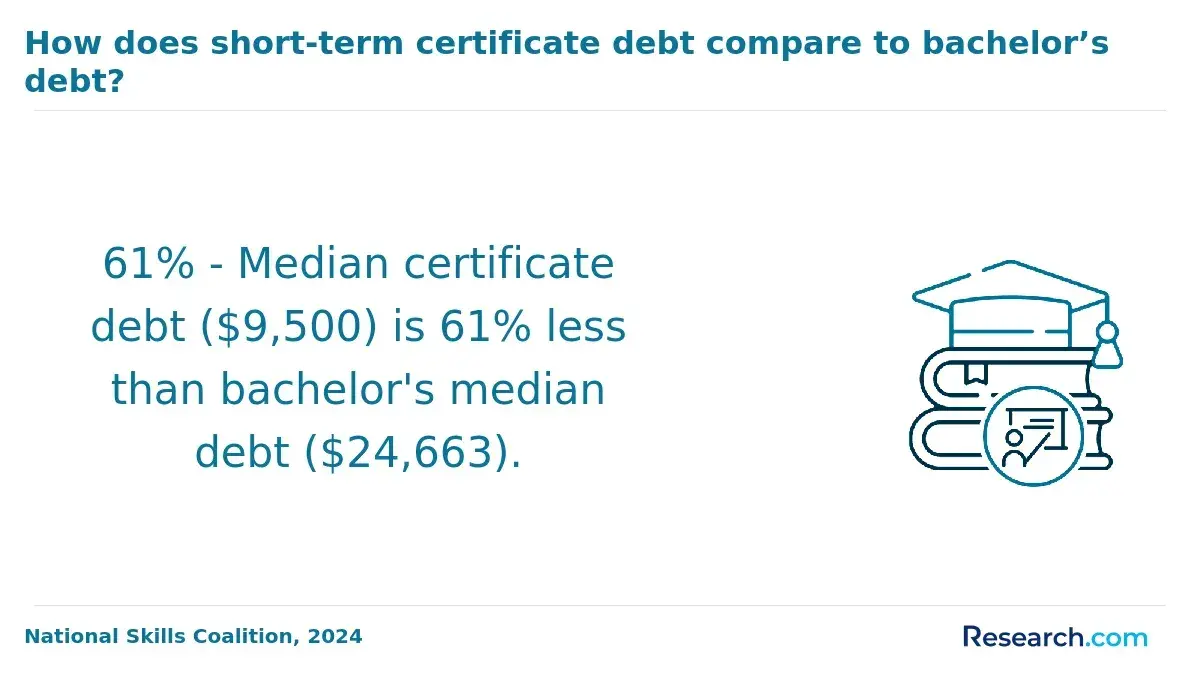
| Certificate | Months to about one year | Lower tuition and faster completion, but financial aid eligibility and transfer value vary | Career entry, skill upgrades, licensing prerequisites, or testing a field before a degree. |
| Associate degree | About two years | Often lower tuition at community colleges, with possible transfer savings if credits apply | Technical careers, transfer pathways, or students seeking a lower-cost first credential. |
| Bachelor's degree | About four years | Higher total cost, but required for many professional, business, STEM, education, and graduate-school pathways | Careers requiring a four-year degree, broader advancement options, or graduate preparation. |
| Master's degree | One to three years after a bachelor's degree | Graduate tuition can be high, and aid is often more loan-based than grant-based | Licensed professions, leadership roles, career changes, or fields where advanced credentials are expected. |
| Doctoral or professional degree | Several years after a bachelor's degree | Highest time commitment and opportunity cost, with costs depending heavily on funding and field | Medicine, law, research, academia, advanced clinical practice, or specialized professional roles. |
If you are cost-sensitive, an associate's degree can be a practical starting point when the credits transfer cleanly or the credential leads directly to employment. It is less useful if your target career requires a bachelor's degree and the transfer pathway is unclear.
Program length also depends on course availability, prerequisites, credit load, placement tests, transfer evaluations, and whether you change majors. One extra year can add tuition, fees, living costs, and lost earnings, so time-to-completion should be part of every affordability comparison.
What admissions, residency, and eligibility rules change how much I'll pay?
College price is partly determined by rules, not just by the school's advertised rates. Admissions status, residency classification, enrollment intensity, financial aid eligibility, and program prerequisites can all change what you pay.
Residency is one of the biggest cost differences at public universities. College Board's 2024-25 data placed average out-of-state public four-year tuition and fees at $30,780, far above the in-state average of $11,610, so residency classification can change the bill before aid is even considered.
Review these rules before choosing a school or moving to a new state. They can determine whether a college is truly affordable.
- Residency rules: States usually require proof of domicile, time in state, financial independence, tax records, or other evidence before granting in-state tuition.
- Admissions pathway: Direct admission to a major may cost less than entering as pre-major and spending extra terms meeting prerequisites.
- Transfer credit limits: A school may accept your credits as electives but not apply them to the degree, which can extend your timeline.
- Enrollment status: Dropping below full time can reduce aid, delay graduation, or affect housing and scholarship eligibility.
- Satisfactory academic progress: Federal aid usually requires students to maintain academic progress, complete enough credits, and finish within a maximum timeframe.
- Program eligibility: Some health, education, aviation, engineering, and public safety programs require background checks, insurance, equipment, clinical fees, testing, or state approval.
- Dependency status: FAFSA rules may treat some students as dependent even if they pay their own bills, affecting how household information is reported.
One red flag is a school that gives vague answers about residency, transfer, or licensure rules. Ask for policies in writing and compare them with the catalog, financial aid office, registrar, and program department.
If you are considering an out-of-state public university, check reciprocity agreements, regional tuition exchange programs, military residency provisions, and online tuition policies. These can lower costs, but eligibility rules are specific and should be confirmed before enrollment.
How do different majors and credentials affect earnings, debt, and return on investment?
Major choice affects college ROI because different fields have different education requirements, salary ranges, licensing rules, graduate-school expectations, and labor market demand. The right question is not "Which major pays the most?" but "Which affordable program leads to work I can realistically enter, sustain, and grow in?"
Students comparing long-term value often look at lists of highest paying jobs, but salary should be weighed alongside debt, completion probability, personal fit, and the cost of reaching the credential required for that occupation.
The table below summarizes how major categories can affect cost and ROI. It is not a ranking; it is a way to identify the trade-offs you should investigate for your specific school and career goal.
| Major or credential path | Common cost drivers | ROI questions to ask |
| Health and clinical programs | Clinical fees, uniforms, immunizations, background checks, licensing exams, and required placements | Is the program approved for licensure, and what are the pass rates and placement supports? |
| Engineering, computing, and technology | Lab fees, software, hardware, project materials, and intensive prerequisite sequences | Do students complete internships, portfolios, co-ops, or industry-recognized projects? |
| Business and accounting | Accreditation, internship access, certification preparation, and possible graduate credit needs | Does the program align with the credential or specialization you may need later? |
| Education and public service | Student teaching, testing fees, background checks, and state licensure requirements | Does the program meet certification rules in the state where you plan to work? |
| Arts, humanities, and communication | Portfolio development, equipment, internships, study materials, and networking costs | Does the program build marketable skills, work samples, and employer connections? |
| Trades and technical certificates | Tools, safety equipment, testing, licensure, and apprenticeship coordination | Does the credential lead directly to employment or stack into a higher degree? |
Debt should be proportional to the likely entry path, not only the dream outcome. A high-cost program may still be reasonable if completion rates are strong, licensing outcomes are transparent, and the career requires that credential. A low-cost program may be a poor investment if it does not lead to employment, transfer, or advancement.
Also consider non-salary value: schedule flexibility, geographic mobility, burnout risk, job stability, benefits, and future education needs. A degree is a financial decision, but it is also a work-life decision.
How can I compare schools side by side to choose an affordable, reputable option?
The best way to compare colleges is to build a side-by-side decision sheet using the same categories for every school. Focus on net price, completion likelihood, accreditation, transfer fit, career outcomes, and total debt at graduation.
If you are still narrowing your academic direction, a guide to the best degree to get can help you connect cost planning with career fit, market demand, and credential requirements before choosing a school.
Use this process when comparing final options. It turns scattered brochures and aid letters into a practical affordability decision.
- List each school's total cost of attendance for your exact situation, including housing and transportation.
- Record grants and scholarships separately from loans and work-study.
- Calculate annual net price and full-program net price based on realistic time to completion.
- Check institutional accreditation, programmatic accreditation, and state approval where relevant.
- Compare graduation, retention, transfer, licensure, job placement, and student loan repayment data when available.
- Review transfer credit evaluations before enrolling, not after your first semester starts.
- Estimate total borrowing and compare it with realistic early-career income ranges for your intended field.
- Ask current students or recent graduates about advising, course availability, hidden fees, and career support.
- Choose the school that offers the strongest combination of affordability, quality, completion support, and career alignment.
The table below highlights common comparison mistakes and better questions to ask. Use it as a final check before accepting admission or signing a loan agreement.
| Common mistake | Better comparison question |
| Choosing the lowest tuition without counting living costs | What is the full cost of attendance for my housing, food, transportation, and personal situation? |
| Comparing scholarship amounts instead of net price | After gift aid, how much will I actually pay or borrow each year? |
| Assuming all credits transfer | Which credits apply directly to my degree requirements, and which count only as electives? |
| Ignoring completion rates | How likely are students in my program to graduate on time or transfer successfully? |
| Relying only on rankings | Does this specific program have the accreditation, outcomes, support, and employer recognition I need? |
| Borrowing without a repayment estimate | What would my monthly payment and total repayment look like under realistic income assumptions? |
A reputable affordable option is not always the cheapest school, and it is not always the most selective one. It is the school that helps you finish the right credential at a manageable cost with credible academic quality and a realistic path to your next step.
Other Things You Should Know About
It depends on the school type, residency, housing, and aid. As a planning benchmark, College Board's 2024-25 estimates ranged from $20,570 for a public two-year commuter budget to $62,990 for a private nonprofit four-year on-campus budget.
It can be, but only if the debt is manageable for the career path you are pursuing. Compare total borrowing with realistic early-career income, completion rates, accreditation, and whether the credential is required for your goal.
Sticker price is the published cost before aid. Net price is the cost of attendance minus grants and scholarships, and it is the better number to use when comparing schools.
Online college can be cheaper if it reduces housing, commuting, and lost work income. However, you should still check tuition, fees, technology costs, accreditation, student support, and whether the program meets licensing or employer requirements.
References
- What's Included in the Cost of College? - ELFI https://www.elfi.com/whats-included-in-the-cost-of-college/
- Bachelor’s Degrees With the Best and Worst Return on Investment https://finance.yahoo.com/news/bachelor-degrees-best-worst-return-160849160.html
- Looking at Colleges Side by Side https://www.collegedata.com/resources/explore-your-options/looking-at-colleges-side-by-side
- Best College Comparison Tools for Finding Affordable, Right-Fit Schools https://www.road2college.com/college-comparison-tools-review/
- Eligibility rules for home fee status and student finance from the 2022 to 2023 academic year onwards https://www.gov.uk/government/publications/student-finance-eligibility-2021-to-2022-academic-year/eligibility-rules-for-home-fee-status-and-student-finance-from-the-2022-to-2023-academic-year-onwards
- College Majors and Return on Investment https://southcarolina.inviteeducation.com/articles/college-majors-and-roi/
- How to Pay for College https://www.savingforcollege.com/article/how-to-pay-for-college
- Average Cost of College [2025]: Yearly Tuition + Expenses https://educationdata.org/average-cost-of-college
- Minimum Salary Changes Announced https://www.fragomen.com/insights/minimum-salary-changes-announced.html
- Does College Pay Off? A Comprehensive Return On Investment Analysis - FREOPP https://freopp.org/whitepapers/does-college-pay-off-a-comprehensive-return-on-investment-analysis/