2027 What You Need to Know About SLP Caseloads Before Entering the Profession

Co-Founder and Chief Data Scientist

Reviewed by Rhea Paul, PhD
SLP Education & Research Expert
Imagine starting a career in speech pathology only to discover overwhelming caseloads that hinder quality care and professional growth. High caseloads often lead to burnout, missed deadlines, and reduced client progress, challenging even the most prepared clinicians.
Understanding typical caseload expectations before entering the profession is essential for managing workload and setting realistic goals. This article examines common caseload ranges, factors influencing them, and strategies to maintain a balanced practice. It aims to equip aspiring speech pathologists with the knowledge needed to navigate the demands of the field effectively.
Key Things You Should Know
- SLP caseloads in 2026 average around 45 students per clinician, exceeding recommended limits from ASHA which suggest 40 to ensure quality care.
- High caseloads correlate with increased burnout rates, with 62% of new clinicians reporting stress related to workload management in 2025 surveys.
- Emerging telepractice methods help mitigate caseload pressures by improving access and flexibility, especially in rural and underserved communities.
What are SLP caseloads?
SLP caseloads differ significantly across work environments, influenced by patient needs and resources. Professionals in school settings often handle large caseloads, sometimes exceeding 50 students with diverse communication disorders, while those in rehabilitation hospitals tend to manage fewer clients needing intensive therapy.
Caseload size guidelines in the United States emphasize balancing quantity and case complexity to maintain quality care and reduce burnout.
Average workload expectations for speech pathology professionals depend heavily on client needs. For example, managing individual therapy for post-stroke patients or individuals with traumatic brain injuries usually means fewer clients compared to group sessions in educational settings.
According to the ASHA SLP Health Care Survey Report on Caseload Trends (2019-2025), 68% of SLPs in rehabilitation hospitals reported caseload stability over the past year, though regional and institutional differences persist.
Researching educational options, such as SLP masters online programs, can prepare candidates to meet these professional demands effectively.
What is a typical SLP caseload size?
The typical SLP caseload size in the United States is about 50 students, based on data from the ASHA Schools Survey.
This number reflects the median actual caseload many speech-language pathologists face, though the average number of students on SLP caseloads that are considered manageable is closer to 40. The difference between these figures highlights the challenge of maintaining service quality while managing heavy workloads.
Caseload sizes often vary depending on the student population and district resources. For example, SLPs serving students with complex communication disorders or multiple disabilities usually report smaller caseloads to ensure effective intervention.
Conversely, those working with fewer students requiring intensive support may handle larger caseloads, sometimes exceeding the median.
Managing a caseload around 50 students typically requires SLPs to prioritize services, optimize schedules, and collaborate frequently with teachers and parents. Approximately 40 percent of their time is spent providing direct therapy, with the rest devoted to paperwork, evaluations, and consultations.
Prospective SLPs benefit from discussing typical caseload sizes and available supports during job interviews, as high caseloads are linked to burnout and reduced service quality.
For those curious about career expectations and earning potential in this field, it's helpful to explore how much do speech pathologists make. Clear communication with employers about reasonable caseloads can help maintain both professional effectiveness and job satisfaction.
How do SLP caseloads vary by setting?
SLP caseload differences across work settings and geographic locations create varying workload demands.
School-based SLPs generally carry the largest caseloads, with Indiana reporting a median of 78 students per caseload, the highest nationwide, while New York's median is 32, the lowest. These disparities influence both service quality and professional stress levels.
Typical caseload sizes for SLPs by educational and clinical environments vary widely. In schools, caseloads often exceed recommended limits due to budget and staffing shortages, limiting personalized therapy and timely intervention. Hospital and rehabilitation SLPs usually manage smaller caseloads focused on acute care, serving about 10-15 patients with diverse medical needs.
Private practice settings present more caseload variability, ranging from 20 to 40 clients depending on practice size and specialization. Early intervention caseloads tend to be smaller, averaging 15-25 clients to meet intensive developmental needs.
Exploring options such as 5 year accelerated speech pathology programs can prepare future professionals to handle caseload pressures and choose career paths aligned with their goals.
Becoming a speech-language pathologist (SLP) in the United States requires completing a master's degree accredited by the Council on Academic Accreditation in Audiology and Speech-Language Pathology (CAA).
This program typically takes two years beyond a bachelor's degree and includes coursework in anatomy, linguistics, phonetics, neuroanatomy, and clinical practice. Students must also complete clinical practicum hours, gaining hands-on experience with diverse patient populations.
After graduation, candidates enter a Clinical Fellowship, around 36 weeks or 1,260 hours of supervised professional experience designed to hone clinical skills. Licensure is mandatory in all states and requires passing the Praxis Examination in Speech-Language Pathology, administered by the Educational Testing Service.
While certification from the American Speech-Language-Hearing Association (ASHA) known as the Certificate of Clinical Competence (CCC-SLP) is not always required, it is strongly recommended for enhanced job prospects and often a prerequisite for employment.
Speech-language pathologists working in schools must satisfy additional state-specific criteria, commonly including teaching credentials or special education certification, reflecting the integration of education and child development knowledge. These licensing and certification standards for speech pathologists ensure quality care and professional readiness.
Caseload trends suggest growing stability, with healthcare SLPs reporting increased stable caseloads between 2021 and 2025, highlighting evolving demands in clinical education. Prospective students may consider exploring accelerated speech pathology programs online for flexible pathways into the profession.
Becoming a licensed speech-language pathologist (SLP) in the United States involves completing a structured educational and professional path. Candidates must earn a master's degree in speech-language pathology from an accredited program approved by the Council on Academic Accreditation in Audiology and Speech-Language Pathology (CAA).
Following this, a supervised clinical fellowship (CF) lasting about 36 weeks or 1,260 hours is required. This fellowship provides vital hands-on experience under the mentorship of a licensed clinician. Passing the national Praxis Examination in Speech-Language Pathology, administered by the Educational Testing Service (ETS), is the next crucial step.
After passing the exam, candidates apply for state licensure, which varies by state. It is essential to check each state's licensing board requirements, as some states mandate continuing education for license renewal.
Caseload management varies significantly depending on the work environment. For example, school-based SLPs in telepractice settings manage a much higher median caseload (52) compared to those in traditional schools (25), reflecting growing demand in telehealth services (ASHA 2024 Schools Survey).
Prospective SLPs should consider clinical experiences in both in-person and telepractice settings during training. This practical exposure can better prepare future clinicians for variations in caseload and service delivery methods across different workplaces.
A master's program curriculum in speech pathology develops clinical skills and scientific knowledge critical for effective practice.
Core coursework addresses anatomy and physiology of speech and hearing mechanisms, including neurological and respiratory systems. Students learn about normal and disordered communication across the lifespan, covering articulation, language, fluency, voice, swallowing, and cognitive-communication disorders.
Programs emphasize assessment tools and intervention strategies for diverse clients, such as children with developmental delays and adults with acquired brain injuries. Clinical practicum, usually exceeding 400 hours, offers supervised hands-on experience in schools, hospitals, and private settings to build professional judgment and practical skills.
Research methods and evidence-based practice are important components to ensure graduates remain current with advances in the field. Multicultural and bilingual issues are often integrated into coursework, equipping clinicians to serve varied populations. Ethical and legal standards within healthcare and educational systems are also included.
With private practice roles growing-healthcare SLPs in private practice rose from 27% in 2021 to 32% in 2025 (ASHA SLP Health Care Survey Report: Caseload Trends, 2019-2025)-many programs offer electives focused on business management and telepractice. These skills support caseload management and innovative service delivery models, preparing graduates for evolving clinical environments.
Accredited online speech pathology programs provide flexible options for students balancing work or unable to attend traditional campuses. These programs earn accreditation from the Council on Academic Accreditation in Audiology and Speech-Language Pathology (CAA), ensuring they meet essential academic and clinical standards necessary for certification and licensure.
Most online programs blend asynchronous coursework with supervised clinical practicum experiences. Students typically complete theoretical classes remotely while arranging local placements for hands-on clinical training, a mandatory step for professional certification.
Programs may offer hybrid formats involving occasional in-person intensives, or fully remote didactic learning combined with local clinical supervision.
It is crucial for students to confirm that their program's clinical components meet their state licensure board's requirements, as approved clinical hours directly affect eligibility for the Certificate of Clinical Competence from ASHA.
Clinical preparation impacts a clinician's ability to handle demanding caseloads after graduation. A 2009 PubMed study found that 60% of school-based speech pathologists with caseloads of 41-50 students experienced unmanageable workloads. Thorough training helps professionals effectively manage challenging caseloads.
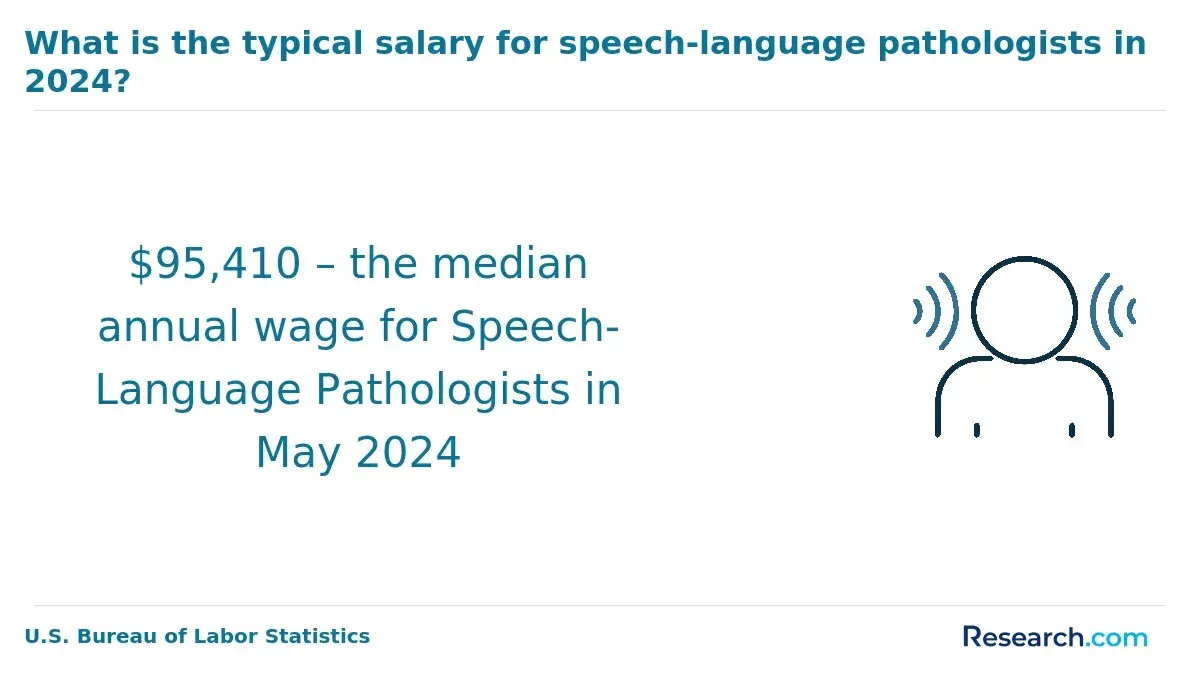
The salary for speech-language pathologists varies widely by work setting and location. The median annual wage is around $97,870, with entry-level roles starting near $65,000. Healthcare and private practice tend to offer higher pay than schools, where budgets often restrict salary scales.
Job growth in this field is expected to be robust, with employment projected to increase by 17% from 2025 to 2035, much faster than many occupations. This surge is fueled by rising demand for speech and language services in healthcare, schools, and rehabilitation facilities driven by greater awareness across all ages.
School-based speech pathologists may earn less but benefit from structured school-year schedules and state regulations. For example, in California, average caseloads reached 64 students per full-time clinician in 2025. These high caseloads influence workload and job satisfaction, which in turn affect long-term career sustainability and salary negotiations.
Higher salaries are often attainable in hospital or private clinic settings or by gaining advanced certifications. Balancing workload and compensation is essential for those planning a career in speech pathology to ensure lasting success.
Accreditation by the Council on Academic Accreditation in Audiology and Speech-Language Pathology (CAA) is essential when selecting a speech pathology program. This certification confirms that the curriculum meets national standards and prepares students for licensure and the Certificate of Clinical Competence (CCC-SLP).
Hands-on clinical practicum opportunities are crucial. Programs with diverse settings, such as schools, hospitals, and outpatient clinics, reflect current workforce trends. Telepractice, which accounted for 48% of healthcare SLP caseloads by 2025 after peaking at 60% in 2023, highlights the importance of training for remote care.
Program length and delivery options, including full-time, part-time, and online formats, affect completion time and flexibility. Faculty credentials and research opportunities are important if you aim for specialized or academic roles.
Graduate outcomes such as Praxis exam pass rates and job placement reflect program quality. Check if the program offers licensure preparation and continuing education assistance.
Financial factors include transparent tuition and scholarships. However, these should be weighed alongside accreditation and program quality.
Gather information through program visits, conversations with faculty and students, and reviewing course catalogs to ensure alignment with your career goals.
What workload challenges do new SLPs face?
Caseload size is a significant factor affecting the effectiveness and job satisfaction of new speech-language pathologists (SLPs). In some states like New Mexico, a maximum caseload of 60 SLP-only students is enforced, which includes numerous individualized education program (IEP) meetings, therapy sessions, and progress documentation.
Other states, such as New Hampshire and New Jersey, have no specific caseload limits, leading to unpredictable and often overwhelming workloads.
New SLPs face several workload challenges, including:
- Balancing high caseloads with paperwork and compliance documentation
- Allocating time for individualized therapy within limited daily schedules
- Navigating varied caseload policies without clear guidance
- Managing students with diverse communication disorders and severities
- Traveling to multiple schools or providing remote therapy
- Handling urgent interventions alongside regular caseload demands
Proactively seeking mentorship and learning efficient time-management skills can ease these pressures. It is vital to clarify caseload expectations during interviews and negotiate manageable workloads upfront.
Advocating for professional support such as administrative help and peer collaboration can reduce stress. Using documentation tools and technology can lower paperwork burdens, but only if caseloads remain reasonable.
The lack of firm caseload caps in many areas increases burnout risk for new professionals. Awareness of state regulations, like the 60-student cap in New Mexico versus flexible policies elsewhere, is crucial when evaluating job offers.
Other Things You Should Know About Speech Pathology
Effective communication skills are essential for speech pathologists to interact well with clients, families, and other professionals. Strong problem-solving abilities help in developing tailored therapy plans. Patience, empathy, and attention to detail are also critical to support diverse client needs and track progress accurately.
Yes, many speech pathologists choose to specialize in areas such as pediatric speech disorders, voice therapy, fluency, or swallowing disorders. Specialization often requires additional training or certification beyond the basic master's degree. These focused areas allow clinicians to develop deeper expertise and work with specific populations or conditions.
Speech pathologists frequently work alongside educators, occupational therapists, psychologists, and medical professionals to provide comprehensive care. Collaboration ensures that therapy goals align with overall treatment plans or educational objectives. It also helps in sharing insights that improve client outcomes and address multifaceted issues.
A manageable school caseload depends on student severity, service minutes in IEPs, evaluation duties, meeting load, documentation time, and travel between campuses. ASHA recommends using workload rather than a simple student count, because two SLPs with the same caseload can have very different weekly demands.
- U.S. Bureau of Labor Statistics - Speech-Language Pathologists https://www.bls.gov/ooh/healthcare/speech-language-pathologists.htm
- ASHA EdFind - Accredited Speech-Language Pathology Programs https://find.asha.org/ed/
- O*NET OnLine - Speech-Language Pathologists https://www.onetonline.org/link/summary/29-1127.00
- University of Wisconsin-Eau Claire - Master of Science in Speech-Language Pathology (Online) https://www.uwec.edu/speech-language-and-hearing-sciences-department/graduate-program/speech-language-pathology-online
- West Virginia University - Speech-Language Pathology, M.S. - Online https://medicine.hsc.wvu.edu/communications-sciences-and-disorders/speech-language-pathology-ms/future-students/curriculum/online-slp-program/
- James Madison University - Master of Science (M.S.) in Speech-Language Pathology (Distance Education / Online) https://www.jmu.edu/chbs/csd/online_ms/index.shtml
- Emerson College - Master of Science (M.S.) in Communication Disorders (Speech@Emerson, online) https://speech.emerson.edu/
- Auburn University, Montgomery - Master of Science in Speech-Language Pathology https://www.aum.edu/degree/ms-speech-language-pathology/