2027 Can You Switch From Teaching to Speech-Language Pathology?

Co-Founder and Chief Data Scientist

Reviewed by Rhea Paul, PhD
SLP Education & Research Expert
Many educators consider moving into speech pathology after years of teaching but feel uncertain about the transition process. The challenge often lies in understanding the educational requirements, certification, and how previous experience aligns with new career demands. Prospective career changers worry about time, costs, and program flexibility, especially when juggling current responsibilities.
This article examines viable routes for teachers to pivot into speech pathology, highlighting key academic steps and accreditation factors. It provides clear guidance on navigating this career shift efficiently while maintaining professional growth and meeting licensure standards across the United States.
Key Things You Should Know
- Switching from teaching to speech-language pathology typically requires earning a master's degree, with programs averaging 2 years and including clinical practicum hours.
- Speech-language pathologists in 2026 have a median annual salary of approximately $82,000, reflecting strong demand in healthcare and educational settings.
- State licensure and certification from the American Speech-Language-Hearing Association (ASHA) are mandatory, with about 30% of current practitioners having previous teaching experience.
Can you switch from teaching to speech-language pathology?
Transitioning from teaching to speech-language pathology requires intentional planning and fulfilling key educational and certification requirements.
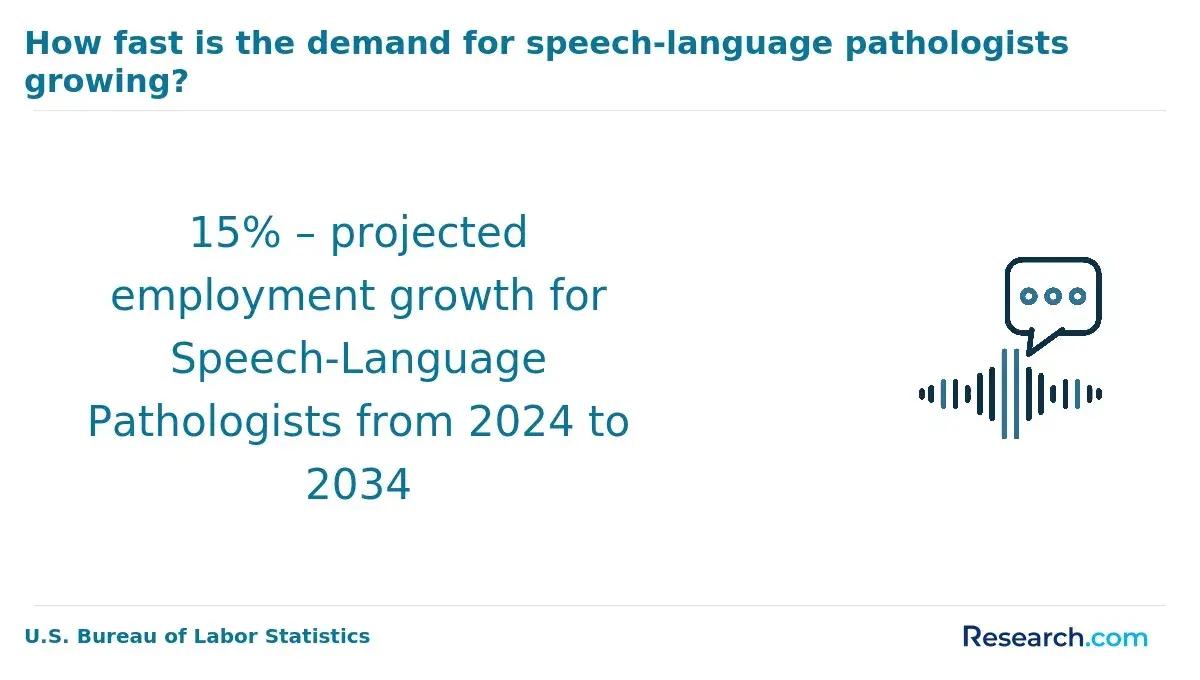
The projected 17% employment growth for speech-language pathologists from 2025 to 2035, with 28,200 new jobs expected (U.S. Bureau of Labor Statistics), makes this career switch appealing, especially for educators.
Key steps to become a speech-language pathologist after teaching include:
- Obtaining a master's degree in speech-language pathology, necessary for certification and licensure nationwide.
- Completing about 400 clinical clock hours of supervised clinical experience within the graduate program.
- Passing the Praxis exam to earn the Certificate of Clinical Competence in Speech-Language Pathology (CCC-SLP).
- Meeting state-specific licensing requirements, which might include additional supervised postgraduate experience.
Teachers with backgrounds in special education or communication disorders often benefit from relevant experience, making the transition smoother.
Returning to school for 2-3 years full-time is common, but many universities offer accelerated or part-time programs designed for working professionals. Some institutions provide conditional admission for those with teaching credentials, streamlining necessary coursework in communication sciences.
For those researching options, exploring the best online speech pathology programs can help find flexible pathways tailored to working educators.
What education is required to become a speech-language pathologist?
Becoming a licensed speech-language pathologist in the US requires completing a master's degree in speech-language pathology from an accredited program, typically spanning two years beyond a bachelor's degree.
This graduate-level training combines coursework in anatomy, physiology, speech and language development, disorders, and diagnostic methods with 400 to 600 clinical practicum hours crucial for hands-on experience and certification eligibility.
For those interested in how to become a licensed speech-language pathologist after teaching, a relevant bachelor's degree in communication sciences, education, linguistics, or psychology may fulfill prerequisites. Others might need additional courses or bridge programs designed for career changers.
After earning the degree, candidates must pass the Praxis exam in speech-language pathology and complete a supervised Clinical Fellowship year. These steps lead to state licensure and the Certificate of Clinical Competence (CCC) from the American Speech-Language-Hearing Association (ASHA), both essential for professional practice.
Speech-language pathologists earn a median annual wage of $95,410, considerably higher compared to the median $63,680 for kindergarten and elementary school teachers.
For more detailed information on how much does a speech pathologist make, visit how much does a speech pathologist make. Additional certifications or specializations, such as pediatric speech-language pathology or swallowing disorders, may require extra training but can enhance career prospects and earnings.
Do teaching credentials transfer to speech pathology programs?
Teaching credentials do not directly transfer as credits to speech-language pathology (SLP) programs, but they offer foundational skills that can support quicker entry through some prerequisite waivers or bridge programs.
Most master's level SLP programs require a bachelor's degree plus coursework in anatomy, linguistics, and audiology, which a teaching credential alone does not fulfill. However, educators bring relevant expertise such as communication, assessment, and child development that align well with speech pathology competencies and may enhance admissions profiles.
Specialized bridge or post-baccalaureate programs for licensed teachers exist, allowing faster completion of necessary coursework before graduate study.
For example, those with teaching experience in special education might meet some criteria or receive advanced standing, shortening the path toward certification. This approach illustrates how teaching experience applies to speech-language pathology certification beyond just academic prerequisites.
Licensing in speech-language pathology requires supervised clinical hours and passing the national Praxis exam. While teaching experience doesn't substitute clinical training, it can strengthen applications for internships or school-based placements.
Demand is high; 79% of school-based SLPs in the ASHA Schools Survey report more openings than qualified candidates, encouraging programs to consider candidates with teaching backgrounds favorably.
Prospective students may also explore 5 year SLP programs that combine prerequisite and graduate coursework efficiently. Checking specific program policies is key, as teaching credential transfer for speech pathology programs varies widely.
The best degree pathways for speech pathology start with earning a master's degree accredited by the Council on Academic Accreditation in Audiology and Speech-Language Pathology (CAA). This master's program in speech-language pathology (SLP) is the minimum requirement for certification and state licensure in the United States.
These programs usually take two years and include supervised clinical practicum essential for graduate clinical hours. Meeting degree requirements for speech pathology careers also involves securing clinical placements that satisfy certification board standards and understanding specific state licensure criteria.
For career changers, post-baccalaureate or accelerated master's programs tailored for non-SLP undergraduates are effective options. These acknowledge prior coursework while concentrating on core competencies.
Examples of degree pathways include accelerated master's tracks, standard master's programs requiring related prerequisites, or combined bachelor's-master's programs offering streamlined routes. Such variety addresses the top educational routes to become a speech-language pathologist.
Doctoral degrees (Ph.D. or Au.D.) target research, academia, or advanced clinical specialization, but they are not required for initial certification or entry-level practice.
Given that over half of healthcare-based SLPs report more job openings than qualified applicants nationally, finishing an accredited master's degree swiftly creates strong employment opportunities across medical, educational, and outpatient settings.
Prospective students seeking options can explore specific speech pathology graduate programs to find a path that aligns with their background and career goals.
Online and campus speech pathology programs each offer unique benefits suited to different student needs. Online programs provide flexibility for working professionals or those living far from campuses, featuring virtual simulations and remote practicum options. However, they still require in-person clinical experiences, which must be arranged near students' locations.
Campus programs offer direct access to faculty, on-site labs, and immediate clinical supervision. This setting benefits students who prefer structured learning environments and face-to-face networking, aiding practical skill development and professional connections.
Accreditation by bodies like the Council on Academic Accreditation in Audiology and Speech-Language Pathology (CAA) is essential for both formats. Students must verify that programs meet American Speech-Language-Hearing Association (ASHA) requirements for clinical hours and curricula to qualify for the Certificate of Clinical Competence (CCC).
The workforce shows a 17% job growth projected from 2025 to 2035, yet staffing shortages persist due to limited graduates from both online and campus programs. This emphasizes the importance of timely clinical placements for entering the job market quickly.
Both paths can lead to certification aligned with ASHA standards, but hands-on clinical experience remains crucial for employment success.
Speech pathology programs must be accredited by the Council on Academic Accreditation in Audiology and Speech-Language Pathology (CAA), the only accrediting body recognized by the American Speech-Language-Hearing Association (ASHA).
This accreditation ensures programs meet strict academic and clinical training standards required for eligibility to earn ASHA's Certificate of Clinical Competence in Speech-Language Pathology (CCC-SLP). Graduates from non-accredited programs cannot obtain the CCC-SLP, which is necessary for professional practice in most states.
Accredited programs combine graduate-level coursework with supervised clinical experiences, preparing students to meet ASHA's benchmarks. Requirements include a master's or doctoral degree, completion of a clinical fellowship, and passing the Praxis exam (5331) with the ASHA standard passing score of 162.
Prospective students should:
- Confirm CAA accreditation via official program websites or ASHA's accreditation directory.
- Ensure the curriculum supports eligibility for ASHA certification, including the required clinical hours and exam preparation.
- Review graduate pass rates for the Praxis exam and CCC-SLP certification.
- Consider programs that emphasize evidence-based practices, addressing the rising demand for qualified speech-language pathologists.
Choosing an accredited program validates academic quality and professional readiness according to ASHA's certification standards, avoiding risks of ineligibility for certification and licensure that can limit career prospects.
Admission to speech pathology programs generally requires a bachelor's degree in communication sciences, education, psychology, or a related area.
Applicants holding unrelated degrees might need to complete prerequisite classes such as anatomy, linguistics, and phonetics. Most programs expect a minimum GPA of 3.0 on a 4.0 scale, with competitive programs often seeking higher academic performance.
GRE scores are commonly requested, although some schools have recently made them optional or removed this requirement. Submitting two to three letters of recommendation from academic or professional sources acquainted with the applicant's skills and dedication is standard.
Practical experience through clinical observation or volunteering-usually between 25 and 50 hours-strengthens applications. This experience not only demonstrates commitment but addresses workforce shortages; the ASHA 2024 Schools Survey reports that 78.5% of school SLPs identify critical gaps nationally, with Pacific states facing intense regional demand.
Essays or personal statements must clearly present career goals and an understanding of challenges within the profession. Some programs conduct interviews to assess communication skills and readiness for graduate-level study.
International students should ensure their credentials are evaluated and meet English proficiency requirements, typically via TOEFL or IELTS.
Most speech pathology graduate programs in the U.S. require about two years of study to earn a master's degree, which is essential for clinical certification and licensure. These programs typically combine coursework, supervised clinical practice, and research.
For those transitioning from teaching, some universities offer accelerated or bridge options that credit previous education, potentially reducing completion time.
Tuition costs vary widely based on institution and location: public universities often charge between $15,000 and $40,000 for in-state students, while private schools can exceed $50,000.
Additional expenses include textbooks, fees, and clinical practicum costs. Some programs also require prerequisites beyond a teaching degree, such as anatomy, linguistics, or audiology courses, which may increase time and expenses.
Financial planning is crucial, with many students relying on federal loans, scholarships, or employer tuition assistance if currently employed in education. Balancing work and study is common but can contribute to stress and burnout.
Burnout is a notable issue in the profession. According to the American Speech-Language-Hearing Association's 2024 Schools Survey, 34% of school-based speech-language pathologists considered changing work settings, and 27% thought about leaving the field due to burnout.
Prospective students should carefully assess their support systems and strategies for maintaining work-life balance before committing to a career change.
The median annual salary for speech-language pathologists (SLPs) in the United States is about $83,000, with entry-level roles starting near $60,000 and experienced professionals earning over $100,000 in specialized or metropolitan areas. Salary differences stem from geographic location, workplace setting, and certification level.
Job growth in speech pathology is strong, projected at 17% from 2025 to 2035, much faster than average. This rise is fueled by an aging population, increased early childhood intervention needs, and growing educational support services.
In 2024, around 12% of school-based SLPs supervised speech-language pathology assistants (SLPAs), highlighting teamwork trends in addressing workforce shortages. This collaboration helps manage larger caseloads effectively in schools.
Career switchers should note the variation in salary and work environment across settings: urban hospitals often offer higher pay but more stressful conditions, while schools tend to provide steadier schedules with moderate pay.
Maximizing salary and job stability often involves earning the Certificate of Clinical Competence (CCC) from the American Speech-Language-Hearing Association and targeting high-demand specialties like pediatric speech pathology or high-need regions.
What licensing steps follow speech pathology graduation?
Graduates of speech pathology programs begin licensure by obtaining the Certificate of Clinical Competence in Speech-Language Pathology (CCC-SLP) from the American Speech-Language-Hearing Association (ASHA).
This involves completing a 36-week supervised clinical fellowship under an ASHA-certified speech-language pathologist, bridging academic knowledge with real-world practice.
Following the fellowship, candidates must pass the Praxis Examination in Speech-Language Pathology, a standardized test required by nearly all U.S. states to verify professional competence. Passing this exam is essential before applying for state licensure.
State licensure requirements commonly include submitting an application, providing proof of degree, completing supervised clinical hours, and passing the Praxis exam.
Some states, such as California and New York, require additional steps like jurisprudence exams or background checks. Early contact with specific state licensing boards helps prevent delays.
Employment for licensed speech-language pathologists in schools is often obtained through local education agencies. According to the American Speech-Language-Hearing Association's 2024 Schools Survey, 63% of school-based SLPs have union representation, which supports job stability and workplace advocacy.
Continuing education is necessary to maintain certification and licensure. Most states mandate renewal every one to three years, requiring proof of ongoing professional development. Staying current ensures adherence to both state and ASHA standards.
Other Things You Should Know About Speech Pathology
To switch from teaching to speech-language pathology in 2027, you need a master's degree in speech-language pathology. Additionally, you'll require state licensure and potentially the Certificate of Clinical Competence in Speech-Language Pathology (CCC-SLP). It's crucial to verify specific state requirements and any prerequisite coursework necessary for admission to a master's program.
Yes. In the United States, becoming a speech-language pathologist requires a master’s degree in speech-language pathology, plus supervised clinical practicum and a passing score on the Praxis Speech-Language Pathology exam. Most states also require a license from the state board of speech-language pathology and audiology.
Yes, speech pathologists can pursue specialties such as pediatric speech development, adult neurogenic communication disorders, fluency disorders, or swallowing therapy. Specialization often requires additional training and certification but allows professionals to focus on a particular client population or disorder. Specialties enhance career opportunities and expertise.
- U.S. Bureau of Labor Statistics - Speech-Language Pathologists https://www.bls.gov/ooh/healthcare/speech-language-pathologists.htm
- ASHA EdFind - Accredited Speech-Language Pathology Programs https://find.asha.org/ed/
- ETS Praxis - Speech-Language Pathology (5331) https://praxis.ets.org/test/speech-language-pathology-5331.html
- California State University-East Bay - Online Master of Science in Speech-Language Pathology https://ce.csueastbay.edu/programs/speech-language-pathology/
- University of Nebraska at Kearney - Speech-Language Pathology, Master of Science in Education (Online Track) https://www.unk.edu/online/degrees-programs/speech-language-pathology-online.php
- Abilene Christian University - Master of Science in Speech-Language Pathology (Online) https://acu.edu/academics/graduate/master-of-science-in-speech-language-pathology/
- New York University - Online MS, Communicative Sciences and Disorders (Speech@NYU) https://steinhardt.nyu.edu/degree/online-ms-communicative-sciences-and-disorders
- New England Institute of Technology - Master of Science in Speech Language Pathology https://www.neit.edu/academics/graduate-degrees/speech-language-pathology-ms