# 1 position
Humacao Community College - Electrician.
associate

Audited and Verified:
Our Editorial and Data Verification Process
Research.com uses government datasets, official education statistics and primary institutional information to support its career and degree guides. Our review process checks factual accuracy, occupational definitions, source dates and the requirements associated with the credentials discussed.
How This Article Was Fact-Checked
Our editorial team verifies salary estimates, employment projections, education requirements and program information against original data providers and official organizations. Salary figures are checked against the relevant occupational definitions and reporting periods. Information about licensure, accreditation and required in-person training is reviewed separately.
Fact-checked and verified on:

Co-Founder and Chief Data Scientist

Reviewed by Karolina Broda
Fact-Checker and Data Verification
Choosing an affordable electrician program in Humacao means looking beyond tuition: you need practical training, a realistic route to work, and a clear plan for Puerto Rico's licensing requirements. The U.S. Bureau of Labor Statistics projects electrician employment to grow 9.2% nationally from 2025 to 2035. This guide explains how to compare costs, credentials, apprenticeships, and career prospects. It also accompanies the Most Affordable Electrician Trade Schools in Humacao for 2027 ranking, created by the Research.com team of data scientists to help students make an informed choice about programs worth considering.
Expect instruction in electrical theory, circuits, blueprint reading, code use, testing, and safe installation, paired with supervised practice. The decisive question is not whether a program calls itself "electrician training," but which tasks students actually perform and whether its credential and experience fit their intended job.
A school certificate or diploma can provide a structured starting point for someone who needs foundational skills before applying for work. An associate-degree program may add broader technical coursework, but takes longer and may cost more. A registered apprenticeship combines related instruction with paid, supervised work and can suit someone ready to compete for an opening and earn while learning. Ask each provider to identify its credential, lab hours, worksite opportunities, and any credit toward an apprenticeship; do not assume credit transfers.
Potential settings include building construction, electrical contracting, facility maintenance, and industrial operations in Humacao and communities within commuting distance. Construction jobs may change worksites as projects end, while facility roles may emphasize ongoing troubleshooting and preventive maintenance. The U.S. Bureau of Labor Statistics distinguishes electricians' installation and repair work from general maintenance duties; check the job description before assuming the roles require the same preparation.
Ask programs where students complete field training and where recent completers obtained relevant work. A placement claim is more useful when it identifies the occupation, time period, and whether the job required a Puerto Rico electrical credential. If nearby openings are limited, commuting distance may matter as much as the school's location.
A reliable Humacao-specific electrician wage figure is not available here. For context - not a local pay promise - the U.S. Bureau of Labor Statistics reports a $63,190 national median annual wage in May 2025 for electricians. That figure combines workers at different experience levels and locations; a newly trained applicant should not budget on earning the national median immediately.
For a local decision, compare current electrician and trainee job postings within a commute you can sustain. Note whether pay is hourly, whether work is continuous, and whether an apprenticeship pays during training. Those details make a school's cost and any forgone wages easier to judge than a national median alone.
There is no single Humacao-wide duration. A school certificate can cover a shorter block of foundational instruction, while a diploma or associate-degree pathway generally includes more coursework; a registered apprenticeship extends learning across supervised employment and related instruction. Published calendar length is not the same as electrical lab time or documented work experience.
Request the program's actual clock or credit hours, lab schedule, attendance rules, and expected completion date for part-time students. Ask separately whether any hours count toward a registered apprenticeship or a Puerto Rico licensing requirement, and get that answer confirmed by the relevant authority or sponsor. A short course can be useful for entry-level preparation, but lists of best paying 6 month certificate programs online cannot establish that a particular electrical course provides the required practical experience.
Online coursework can make theory, calculations, and some code-study assignments easier to fit around a job. It cannot replace supervised practice in wiring, measurement, fault-finding, lockout procedures, or safe tool use. A hybrid program is credible only if it specifies where, when, and by whom those practical skills are assessed.
For a working student comparing schedules, resources on the cheapest online colleges for working students may help frame the flexibility question, but verify the electrical program's in-person requirements separately. Before paying, obtain the location and frequency of labs and any field placement. Do not assume an entirely online certificate establishes eligibility for electrical work or licensure in Puerto Rico.
No defensible Humacao-wide average is available from the information used here. A price based only on listed tuition would also understate the amount many students need to finish training and start work. Compare written, current estimates for the same credential and attendance schedule, then calculate what remains after aid - not before it.
A useful total includes mandatory fees, books, materials, tools, safety gear, travel to labs or worksites, and any applicable examination or licensing charges. Add income lost to an unpaid schedule; subtract confirmed grants or employer support. A paid apprenticeship may have a different cash-flow profile from school, although admission and completion conditions differ. Federal aid depends on both student and program eligibility, according to Federal Student Aid. An advertised option among accredited online colleges offering free enrollment applications addresses an application charge, not the full cost of electrical training.
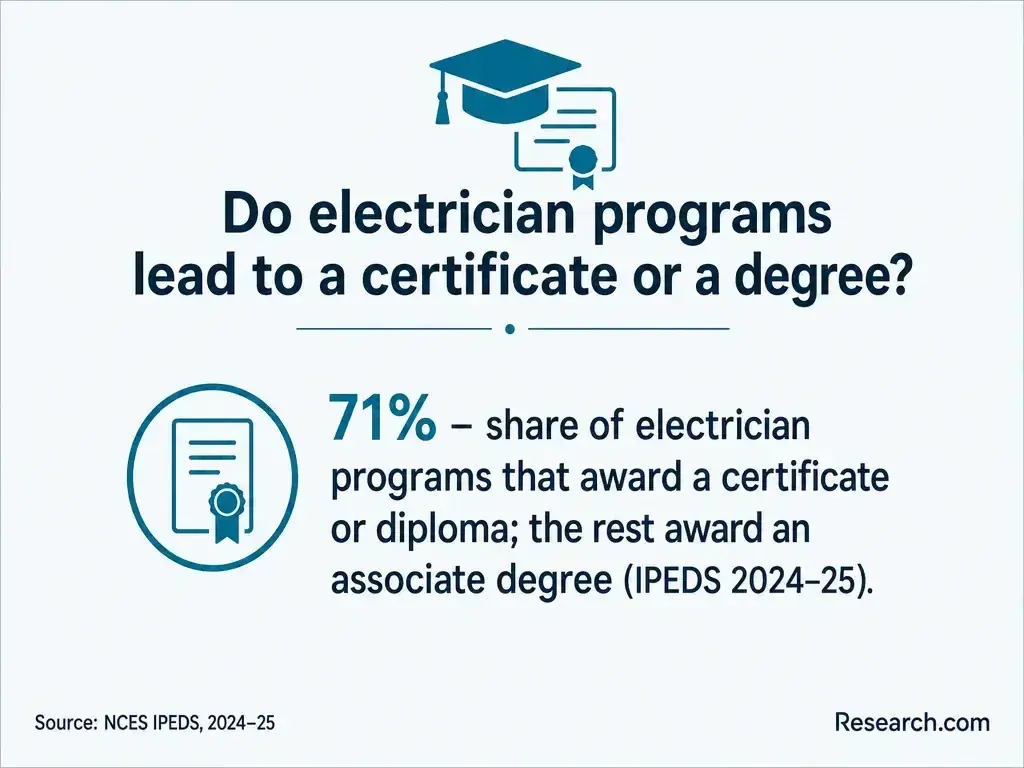
Check the exact award on the provider's program description: it could be a school certificate, diploma, or associate degree. A registered apprenticeship has a different completion credential tied to its approved training plan. An industry certificate, where offered, documents particular training or assessment; it is not the same thing as a Puerto Rico occupational license.
Institutional accreditation concerns the school, state authorization concerns its permission to operate, and apprenticeship registration concerns the sponsor's training arrangement. None substitutes automatically for another or establishes licensing eligibility. Ask for the credential's full name, who issues it, what practical competencies it documents, and whether local employers or apprenticeship sponsors recognize it.
Requirements vary by provider and pathway. Schools may request prior education records, an application, and placement information; apprenticeships may also screen for readiness to work, meet a sponsor's entry rules, and have a limited number of openings. Do not assume acceptance into a school course guarantees an apprenticeship position or a job.
Ask admissions staff whether math preparation is assessed, what physical or safety expectations apply to labs, whether tools are required on the first day, and whether classes or placements have separate entry conditions. For an apprenticeship, ask the sponsor how applicants are selected and when paid work begins. These answers help prevent paying for instruction you cannot attend or apply toward your goal.
A useful curriculum connects circuit theory and electrical calculations to safe, observable work: reading plans, selecting and using tools, installing components, testing circuits, diagnosing faults, and applying the codes relevant to the worksite. The U.S. Bureau of Labor Statistics identifies installation, inspection, testing, and repair among electricians' core duties.
Compare programs by their lab tasks, not just course titles. Ask whether students wire and troubleshoot working setups, receive instructor feedback, and practice jobsite safety before a field placement. If your target is industrial maintenance rather than residential construction, seek training on the equipment and troubleshooting tasks that match that setting.
Puerto Rico regulates electrical practice. Before enrolling, check the current requirements for the work and occupational credential you intend to pursue with Puerto Rico's Junta Examinadora de Peritos Electricistas. Training, documented experience, examinations, and an issued occupational license are distinct steps; a school completion certificate alone should not be treated as permission to perform regulated work independently.
Ask the licensing authority which education and experience it accepts, how experience must be documented, and which examination or application rules apply to your intended role. Ask the school or apprenticeship sponsor what evidence it provides for each step. Verify the rules again before applying: a claim about "license preparation" is not a licensing decision.
Start with the job you want, then work backward from its practical skills and Puerto Rico credential requirements. An affordable ranking narrows the price search; it cannot tell you whether a course offers enough supervised wiring practice or whether you can afford its schedule.
Use the following checks when speaking with a school or apprenticeship sponsor:
Be wary of guaranteed earnings, vague "fully online electrician" claims, or an inability to identify where practical training occurs. General searches such as what is the easiest bachelor degree to get do not answer the trade-specific question: whether this training prepares you for the electrical work you intend to do.
Entry-level work may involve assisting experienced electrical workers and building documented, supervised experience. With further training and the credentials required for a particular role, a worker may pursue installation, troubleshooting, industrial electrical work, supervision, or independent practice where authorized. Progression depends on demonstrated skill, opportunities for supervised work, and Puerto Rico's applicable rules - not simply on how quickly a school issues a certificate.
Choose introductory training if you need a foundation before seeking an employer. Compare apprenticeships if earning during structured work-based learning is essential. If you already have electrical experience, ask a sponsor whether documented prior learning can affect placement rather than paying to repeat basic instruction. A search for a cheap online phd is unrelated to the practical training and occupational authorization needed for these electrical career paths.
The U.S. Bureau of Labor Statistics projects 9.2% national growth for electricians from 2025 to 2035. That supports considering the occupation, but it does not predict the number of openings in Humacao or guarantee a position after training. Local hiring depends on projects, employers, and the distance you can travel.
Before committing to a program, review current openings across your realistic commuting area and note their experience and credential requirements. Ask prospective training providers how they connect students with supervised work. If most suitable openings require experience you will not gain in the course, a work-based pathway may deserve priority over a cheaper classroom-only option.
Investing in training is a consequential decision. Research.com created this ranking to help readers compare electrician programs against other programs in the same occupation and location, rather than against unrelated trades. The team draws on education, cost, debt, and occupational-training sources and checks the relevance of each measure before presenting results.
The most affordable ranking scores tuition, cost of attendance, median student debt, and federal loan default rates; an entropy-based method gives more weight to measures that distinguish programs. Unlike Research.com's best-program rankings, its affordability score does not include accreditation or other quality measures. Only programs reporting completions to IPEDS are eligible, so an apprenticeship or other provider missing from the ranking is not necessarily unavailable or unsuitable.
The following sources inform Research.com's trade-school ranking work. Several cover other trades and should not be mistaken for electrician-specific approval or licensing authorities:
Use the ranking as a cost-focused shortlist, then verify current program charges, hands-on instruction, and Puerto Rico licensing relevance directly. More detail about Research.com's approach appears on its methodology page.
# 1 position
# 2 position
Compare a school's net total cost with paid apprenticeships and employer-sponsored training. The lowest tuition is not necessarily the lowest-cost route once tools, travel, and earnings during training are considered.
Online lessons can cover some theory, but electrical installation and troubleshooting require supervised practical training. Confirm Puerto Rico credential requirements before treating any online course as a route to regulated work.
No. A school credential and occupational licensure are separate. Confirm applicable training, experience, examination, and application requirements with Puerto Rico's Junta Examinadora de Peritos Electricistas.
School may suit someone who needs structured introductory instruction; an apprenticeship combines paid work with training but requires securing a place. Compare admission, practical experience, net cost, and how each route supports your intended credential.
No. Ranking eligibility requires IPEDS-reported completions, which do not cover every apprenticeship or other training provider. Assess an unlisted option against the same cost, training, and credential checks.