Choosing an online counseling master's program is not just about finding a convenient schedule: the degree must support the license you want in the state where you intend to practice. This guide explains costs, clinical training, accreditation, and career outcomes across the South. It also features the 2027 Best Online Marriage, Couple, And Family Counseling Degree Programs Ranking in the South, created by the Research.com team of data scientists to help students make an informed choice about which programs are worth considering.
Key findings about online Marriage, Couple, and Family Counseling degrees in South
The U.S. median annual wage for marriage and family therapists was $66,940 in May 2025; projected employment growth is 14% for 2025-2035 (U.S. Bureau of Labor Statistics). Neither figure predicts an individual graduate's earnings or job prospects.
Online coursework does not remove in-person clinical training. Compare placement support and confirm that the degree meets the requirements of the state where you plan to seek licensure.
For a 2027 applicant, the most useful comparison is total cost through graduation and licensure preparation - not tuition alone. New graduate borrowers generally cannot rely on Graduate PLUS loans under rules effective July 2026 (Federal Student Aid).
What can I expect from an online Marriage, Couple, and Family Counseling degree in South?
Expect a clinically oriented master's degree combining relationship-focused theory, assessment, ethics, and supervised work with clients. "Online" usually describes the academic coursework; practicum and internship still require approved clinical experience, and some programs also require campus visits or live online sessions. Confirm the precise attendance requirements before applying.
Program titles matter. A marriage, couple, and family counseling degree may be a counseling program with a relational specialty, while a marriage and family therapy degree may follow a different accreditation and licensing pathway. The distinction is especially important in the South: a student living in Louisiana but planning to practice in Virginia should assess the Virginia license first, not assume a Louisiana-based curriculum will transfer without review (Virginia Board of Counseling; Louisiana Licensed Professional Counselors Board of Examiners).
This path best fits people who want to provide therapy to couples, families, or individuals and can accommodate supervised clinical work. Someone seeking nonclinical family-support work, or unable to arrange a local placement, should compare less clinically intensive degrees before committing.
Where can I work with an online Marriage, Couple, and Family Counseling degree in South?
Marriage and family therapists work in settings including outpatient care, individual and family services, private practice, and healthcare organizations (U.S. Bureau of Labor Statistics, Occupational Outlook Handbook). A graduate may first work under supervision before qualifying for independent practice; a degree alone is not a license.
Location changes the practical options. A student near a large metropolitan area may have more potential placement sites to investigate, while a rural student may need to ask whether the program approves nearby clinics, community agencies, or eligible telehealth placements. Approval depends on the program, site, supervisor, and applicable state rules - not simply on whether remote therapy is available.
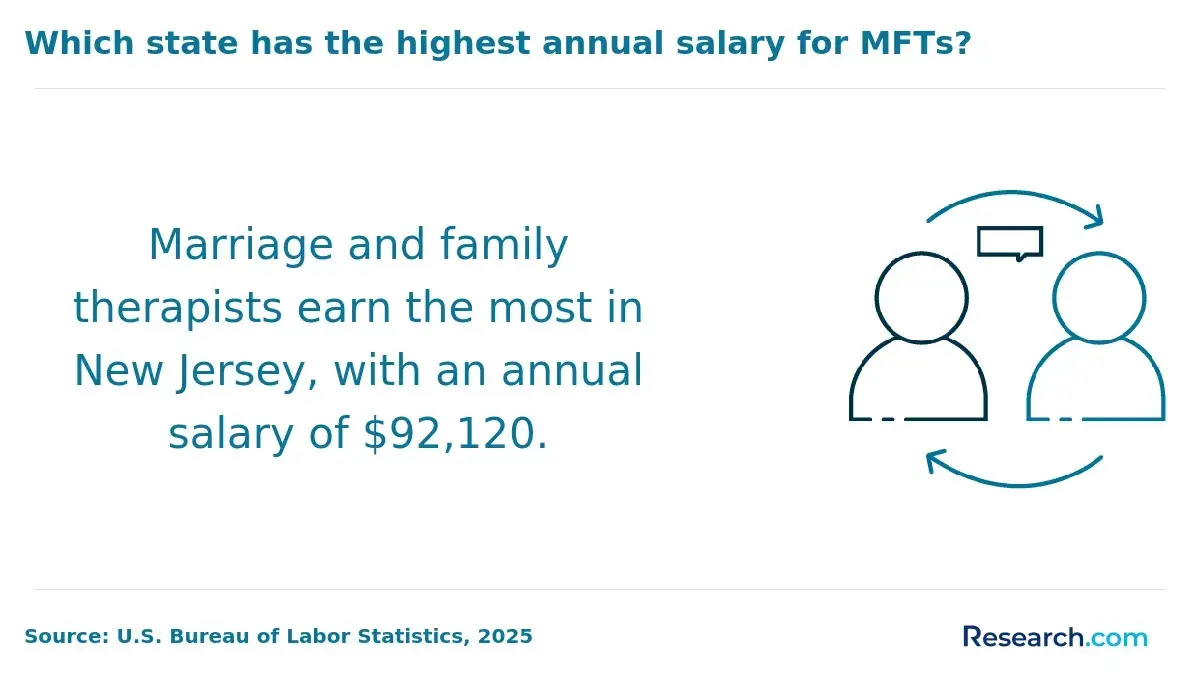
The national median annual wage for marriage and family therapists was $66,940 in May 2025 (U.S. Bureau of Labor Statistics, Occupational Employment and Wage Statistics). This is a median for employed people in the occupation, not a starting salary or a South-specific estimate. Earnings can differ by state, setting, experience, and whether a clinician is licensed for independent practice.
For a realistic return-on-investment comparison, estimate likely earnings in the state and setting where you intend to work, then account for tuition, fees, travel, unpaid clinical hours, borrowing, and earnings forgone while studying. Compare those costs with your current earnings over a realistic time horizon; the occupational median alone cannot tell you whether a particular degree will pay off.
The two programs below warrant different questions from prospective students. Their published structures point to distinct ways of pursuing relationship-focused training; neither should be treated as automatically qualifying a graduate for every Southern state license.
University of Holy Cross: Its M.A. in Counseling places marriage, couple, and family counseling within a broader counseling degree (University of Holy Cross, program information). That structure may appeal to applicants comparing counseling identities or licensure goals; ask the university for the current track curriculum, online attendance rules, and written guidance for your intended state before enrolling.
Regent University: Its M.A. specifically names Marriage, Couple & Family Counseling and incorporates a Christian perspective into counselor preparation (Regent University, program information). That focused identity may suit students seeking relational counseling in a faith-integrated curriculum; compare its clinical-placement and residency requirements with the University of Holy Cross option, particularly if you will complete training outside Virginia.
A clinical counseling master's typically takes about 2-3 years of full-time study; part-time enrollment can take longer. Course sequencing and the availability of an approved practicum or internship site may matter more than the speed of online classes. An advertised accelerated schedule is useful only if you can complete its clinical requirements without interrupting work or relocating.
When comparing the fastest marriage, couple, and family counseling programs, request a term-by-term plan showing when clinical training starts. Ask how long students typically wait for placements and whether a delayed placement changes tuition or graduation timing.
Both formats can teach clinical concepts and lead to supervised training. The key difference is where academic instruction occurs - not whether students must develop clinical skills with real clients. This comparison helps identify which format better fits your location and schedule.
Decision factor
Online program
On-campus program
Course access
Can reduce routine travel; live sessions or residencies may still apply
Requires regular access to campus
Clinical placement
May allow an approved site near home; support varies by program
May offer established relationships near campus; availability still varies
Best fit
Students who need location flexibility and can secure local clinical training
Students who prefer in-person instruction and can use the school's local network
A common mistake is choosing an online school because it accepts students in your state without confirming that it can arrange or approve clinical training there. Ask separately about enrollment authorization, placement availability, and licensure alignment.
There is no single trustworthy tuition average for all online marriage, couple, and family counseling programs across the South. Schools publish prices using different credit loads, fees, and residency rules, and public universities may charge different rates by residency. A meaningful comparison therefore requires a current, program-specific estimate through graduation, not just a per-credit price.
Ask each school to itemize tuition, mandatory fees, travel for any campus attendance, books, clinical-placement expenses, and the cost of additional terms if training is delayed. The most affordable marriage, couple, and family counseling programs can help build a shortlist, but compare final net cost after aid. A lower advertised tuition may not be the least expensive route if it requires substantial travel or extends time away from paid work.
Eligible graduate students can investigate federal Direct Unsubsidized Loans, institutional scholarships or assistantships, employer tuition benefits, and aid offered by their state or school. Federal eligibility depends on factors including the institution, program, and student's status; complete the FAFSA and obtain the school's written aid offer before comparing net costs (Federal Student Aid).
Graduate PLUS availability has changed. Under federal rules taking effect July 1, 2026, new graduate borrowers generally cannot use Graduate PLUS loans. Limited transitional eligibility may apply to a student who received a qualifying Direct Loan for the same program before that date, subject to time limits and other conditions (Federal Student Aid). Ask the financial aid office to confirm your eligibility rather than building a budget around a loan you may not receive.
View the chart data as a table
Best score by program (Source: Research.com)
Category
Value
Regent University
92.24
University of Holy Cross
93.37
Clinical master's programs generally require a bachelor's degree and an application that may include transcripts, recommendations, a statement of purpose, and an interview; prerequisites and minimum academic standards are school-specific (University of Holy Cross; Regent University, admissions information). A psychology major is not necessarily required, but applicants changing fields should check for required background courses.
Admission is only the first threshold. Ask whether the school can enroll residents of your state, approve a nearby clinical site, and document how its curriculum addresses your intended license. The easiest marriage, couple, and family counseling programs may help applicants assess access, but easier admission does not resolve placement or licensure barriers.
Expect coursework in counseling theories, family systems, couples interventions, human development, assessment, research, multicultural practice, and professional ethics, followed by supervised practicum and internship. Exact titles and clinical-hour requirements depend on the program and the licensure pathway (CACREP; COAMFTE; individual program curricula).
Compare syllabi rather than course names alone. A student targeting marriage and family therapist licensure should check whether the required clinical training covers the client populations, supervision, and relationship-focused content the intended state board requires. A course called "family counseling" by itself does not establish eligibility.
Some schools offer marriage, couple, and family counseling as a track within a counseling master's; others offer a degree devoted to that focus. Related options can include clinical mental health counseling or marriage and family therapy. The best choice depends less on the label than on the work you want to do and the credential your state regulates.
These pathways are not interchangeable. CACREP accredits counseling programs, while COAMFTE accredits marriage and family therapy programs (CACREP; COAMFTE). State boards determine which educational routes they accept. If you may move between Southern states, ask each program for written licensure disclosures covering both your current state and a plausible destination.
Start with the license and state where you plan to practice, then work backward to the degree. Rankings can narrow the field, but the right investment is a program you can finish, afford, and use toward your goal.
Check the intended state board's education, supervised-experience, and examination rules; ask the school how its specific program addresses each education requirement.
Verify institutional accreditation and the status of any programmatic accreditation the school claims, including whether it applies to your exact degree or track (U.S. Department of Education; CACREP; COAMFTE).
Get written details on clinical-site approval, supervision, required campus attendance, and whether students in your state can complete every requirement.
Compare total net cost, likely completion time, borrowing, lost earnings, and your current income with plausible post-degree earnings; request program-level outcomes when available.
The most valuable marriage, couple, and family counseling programs offer another comparison lens. Avoid treating an institutional ranking, a broad accreditation claim, or a national salary median as proof that a particular program will deliver the license or financial return you need.
View the chart data as a table
Wage range - Marriage & Family Therapists (U.S., BLS May 2025) (Source: BLS)
Category
Value
10th percentile
44,650
Median
66,940
90th percentile
123,730
A common goal is practice as a marriage and family therapist, but the appropriate route depends on the state's license and the degree's content. Counseling graduates may instead pursue a professional counselor license if their education and supervised experience meet that board's rules (Virginia Board of Counseling; Louisiana Licensed Professional Counselors Board of Examiners). Neither license follows automatically from graduation.
Someone aiming for independent clinical practice should prioritize licensure fit and the quality of supervision. Someone drawn to community family services or support roles should compare job descriptions first: a clinical master's may be more training - and expense - than the desired position requires. Future private practitioners should also plan for the supervised period and the business demands of practice, not only the degree.
View the chart data as a table
Projected job growth 2025-2035 - Marriage & Family Therapists (U.S.) (Source: BLS)
Category
Value
Marriage & Family Therapists
14
All occupations
3
U.S. employment of marriage and family therapists is projected to grow 14% from 2025 to 2035 (U.S. Bureau of Labor Statistics, Employment Projections). That national projection suggests sustained demand for the occupation, but it does not show how many openings will be available in a particular Southern community or to graduates who have not yet obtained a license.
Before selecting a program, review current vacancies in the area where you want to work and note their license, supervision, and experience requirements. Compare those requirements with the school's clinical training plan. This is particularly important if you hope to train in one state and seek work in another: regional demand cannot compensate for a mismatch with the destination state's licensing rules.
2027 Best Online Marriage, Couple, And Family Counseling Degree Programs Ranking in the South
Investing in graduate education is a consequential decision, especially when a program's coursework and clinical placements may determine whether a student can pursue licensure. Research.com developed this ranking to make program comparisons more transparent, checking outcomes, accreditation, eligibility for federal aid, and cost rather than relying on reputation alone.
The Best ranking begins with a graduate-outcomes-and-accreditation score: program completion contributes 40%; employment or doctoral admission, 20%; applicable licensure-exam pass rates, 20%; CACREP programmatic accreditation, 16%; and institutional Title IV eligibility, 4%. Weights are adjusted when a criterion does not apply. Program cost then contributes about 7% of the final score. The same approach applies to online and on-campus programs; other Research.com rankings order programs by the dimension named in their titles.
The Research.com team used these data sources to build and check the ranking:
IPEDS database: institutional enrollment, completion, and cost reporting.
Peterson's database: program and institutional information used in comparisons.
The ranking gives readers a starting point for a shortlist, not a substitute for checking a specific program's current tuition, delivery requirements, and fit with a state licensing board. See the Research.com methodology for more on how rankings are created.
# 1 position
University of Holy Cross
Master
MA in Counseling: Marriage, Couple, & Family specialization
Delivery mode: online
93.37
/ 100
Final score
Program length
three years
Specialization
Marriage, Couple, and Family Counseling
Required credits
60 semester credits
GPA range
3.00 - 4.00
Program completion rate
100% (2024-25)
Employment or doctoral admission
100% (2024-25)
Application deadline
rolling
Application process
direct
GRE
no
Prerequisites
Bachelor's degree from a regionally accredited university.
Additional requirements
Two-page letter of application, unofficial bachelor's transcript, current resume, and three recommendation forms; submitted via online application plus email to the Department Chair.
Accreditation
Accredited by the Council for Accreditation of Counseling and Related Educational Programs (CACREP), with institutional accreditation from the Southern Association of Colleges and Schools Commission on Colleges (SACSCOC).
University of Holy Cross earned a Research.com Counseling Program Score of 93.37/100, supported by 100% program completion rate and 100% employment or doctoral admission rate. The program is CACREP-accredited, valid through 2031-10-31.
Hold a B.A. or B.S. from a regionally accredited college or university (counseling, psychology or related human behavioral fields desirable; other fields considered); minimum 3.0 GPA for all undergraduate coursework.
Additional requirements
Program requirement: two on-campus one-week residencies (Residency A and B, Virginia Beach, VA), held in January/August, 8 a.m.-5 p.m..
Accreditation
Accredited by the Council for Accreditation of Counseling and Related Educational Programs (CACREP), with institutional accreditation from the Southern Association of Colleges and Schools Commission on Colleges (SACSCOC).
Regent University earned a Research.com Counseling Program Score of 92.24/100. The program is CACREP-accredited, valid through 2032-10-31.
Frequently asked questions about online Marriage, Couple, and Family Counseling degree in South
Can I become a licensed therapist with an online degree?
Possibly, if the specific degree, clinical training, and subsequent supervised experience satisfy your intended state board's rules. Online delivery alone neither establishes nor prevents eligibility; request written program guidance and verify it with the board.
Are clinical placements completed online?
Online courses do not usually eliminate supervised client work. Ask whether the program approves a site near you, who must supervise you, and whether any campus attendance is required.
Should I choose counseling or marriage and family therapy?
Choose based on the license and roles you want in your intended state. Compare the board's accepted degrees and accreditation requirements before deciding between a counseling track and a marriage and family therapy program.
Is a faster program a better investment?
Not necessarily. A shorter schedule can reduce time out of the workforce, but only if you can meet its course and clinical-placement demands without costly delays.
Will a Southern program qualify me to practice throughout the South?
No. Licensure is state-specific, and states can evaluate coursework and supervision differently. Check the requirements of every state where you realistically expect to practice.
See What Experts Have To Say About Studying Counseling