Choosing an online counseling master's program in Winston-Salem is not just a question of convenience: the wrong specialization can leave you with a degree that does not fit your intended license or job. This guide accompanies the 2027 Easiest Online Master's in Counseling Degree Programs Ranking in Winston-Salem, created by the Research.com team of data scientists to help students make informed choices about programs worth considering. You'll learn how to compare clinical, school, and rehabilitation counseling options by requirements, cost, training, and career fit.
Key findings about online Counseling degrees in Winston-Salem
Start with the intended credential: North Carolina clinical mental health counselor licensure, school counselor licensure, and rehabilitation counseling lead to different requirements and roles.
The featured master's options generally require about 60 graduate credits; online coursework does not eliminate supervised, in-person fieldwork (Winston-Salem State University; Wake Forest University).
National median annual pay in May 2025 was $59,350 for substance abuse, behavioral disorder, and mental health counselors and $64,330 for school and career counselors and advisors. Those occupational medians are not starting-salary promises for Winston-Salem graduates (U.S. Bureau of Labor Statistics).
What can I expect from an online Counseling degree in Winston-Salem?
An online counseling master's combines graduate coursework with supervised practice. "Online" describes how much academic instruction is delivered remotely; it does not mean clinical sessions, school placements, or supervision can all be completed from home. For someone already working in Forsyth County, the decisive question is whether a program's placement schedule and approved sites fit their life.
The three featured paths serve different goals. Wake Forest University offers online school counseling and mental health counseling programs, while Winston-Salem State University offers a rehabilitation counseling master's. Clinical mental health counseling is oriented toward assessment and treatment; school counseling focuses on students' academic, career, and social-emotional development; rehabilitation counseling addresses disability, access, and employment. Compare the curriculum against the specific credential you want, rather than assuming any counseling degree is interchangeable (Wake Forest University; Winston-Salem State University).
Where can I work with an online Counseling degree in Winston-Salem?
Winston-Salem offers more than one type of placement and eventual workplace. Clinical trainees may look to behavioral health agencies, community providers, and health systems such as Novant Health or Atrium Health Wake Forest Baptist; school counseling candidates need suitable K-12 settings, including opportunities within or beyond Winston-Salem/Forsyth County Schools. Rehabilitation counselors may work with disability-service providers, vocational rehabilitation agencies, or healthcare organizations. These are examples of local employment settings, not promises of openings or approved internships.
Ask each program which local sites it has approved and who secures a placement. That matters especially if you cannot travel outside the Winston-Salem area or leave a weekday job for required supervised hours.
Pay depends on the occupation and work setting, not simply the degree title. The following national figures are May 2025 occupational medians - not Winston-Salem wages or earnings guaranteed to new graduates - and can help you compare the economic direction of different specialties (U.S. Bureau of Labor Statistics, Occupational Outlook Handbook).
Potential path
U.S. median annual pay, May 2025
How to use the figure
Substance abuse, behavioral disorder, and mental health counseling
$59,350
Relevant context for clinical mental health or addiction goals; roles and license requirements vary.
School and career counseling and advising
$64,330
Useful for comparing school-focused careers, but includes roles beyond K-12 schools.
Rehabilitation counseling
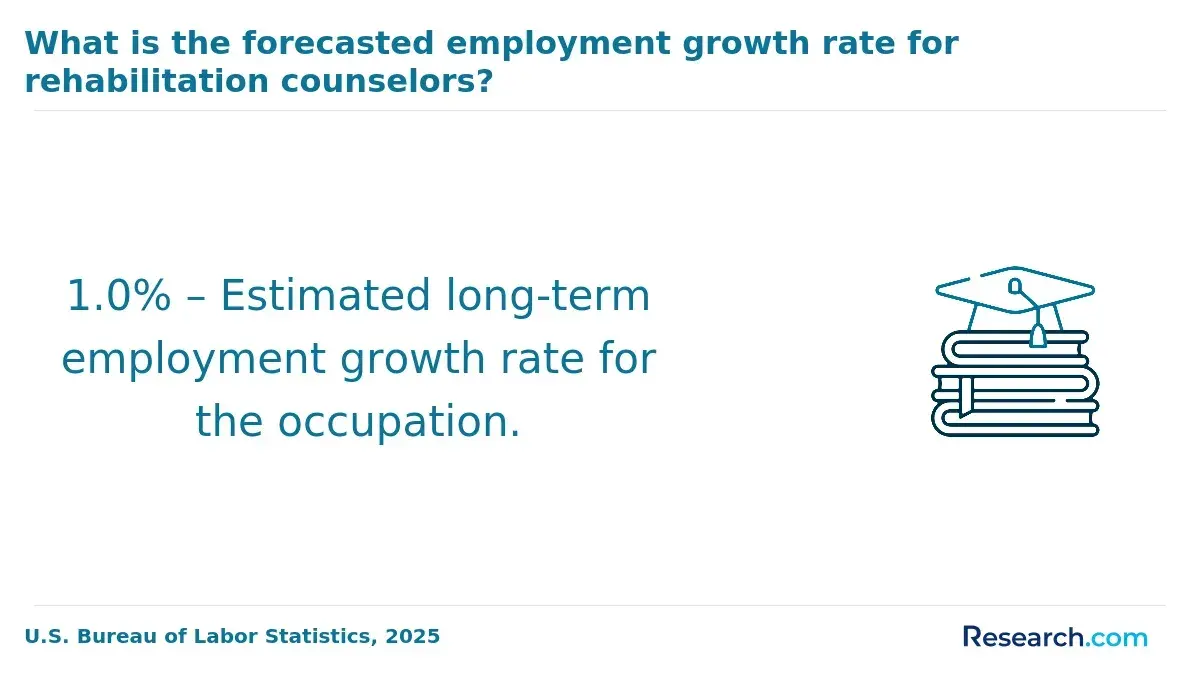
$46,850
Relevant to disability and vocational-rehabilitation work; it is not a pay forecast for every graduate.
Before borrowing against an expected salary, look at actual postings for your target role and experience level in Forsyth County. A national median describes workers across career stages and locations.
The strongest distinction among these programs is which professional setting each prepares you to enter, not a claim that one is universally easier. Their published program descriptions point to different training priorities (Winston-Salem State University; Wake Forest University).
Winston-Salem State University, M.S. in Rehabilitation Counseling: Its 60-credit rehabilitation-focused curriculum centers counseling in the context of disability and vocational goals. Compared with the two Wake Forest paths, it is the more direct subject-matter fit for students seeking rehabilitation or disability-services work; verify how its courses align with any additional clinical license you want.
Wake Forest University, online School Counseling: This 60-credit school-focused route prepares students for counseling work with K-12 pupils rather than a general clinical caseload. Choose it if school counselor licensure is the goal, and confirm placement and North Carolina educator-licensure arrangements before enrolling.
Wake Forest University, online Mental Health Counseling: Its 60-credit clinical pathway focuses on preparation for mental health counseling practice rather than school employment or vocational rehabilitation. It is the closer fit for prospective clinical counselors, who should still have the North Carolina licensing board review the degree's current coursework and supervised-practice requirements.
Credit totals alone do not establish equal cost, scheduling, or license eligibility. Request each program's current degree plan and placement policies before treating these options as substitutes.
A counseling master's of roughly 60 credits commonly takes about two years of full-time study; part-time study can take three years or longer, depending on course sequencing and fieldwork. Those are planning ranges, not advertised completion guarantees for any featured program. A job-friendly course schedule may still require substantial daytime availability once practicum or internship begins.
If finishing sooner is important, compare the fastest counseling programs by their actual calendar, not credits alone. Ask whether required courses run every term, whether summer enrollment is necessary, and when placements can begin. Acceleration helps only if you can complete supervised training without disrupting work or delaying graduation.
Online and campus-based counseling degrees can cover comparable professional content, but their logistics differ. Online study can reduce commuting for coursework; campus study may make scheduled face-to-face contact and nearby placement coordination simpler. Neither format removes the need to practice counseling skills, receive supervision, and complete approved field experiences.
For a Winston-Salem resident, an online program based elsewhere may offer more specialization choices without a move, but it can transfer placement-finding work to the student. Ask how live classes, any campus visits, supervisor approval, and local fieldwork are handled. Choose the format whose entire training schedule works - not just the format of its lectures.
There is no single dependable Winston-Salem average price for these distinct graduate programs. A useful comparison is each school's published total expected program cost: required credits multiplied by the applicable graduate tuition rate, plus mandatory fees, books, travel, and any placement-related expenses. Confirm whether an online rate differs from campus tuition and whether North Carolina residency changes the rate at public Winston-Salem State University; do not assume the same pricing rules apply at private nonprofit Wake Forest University (institutional tuition schedules).
Use the most affordable counseling programs as a starting point, then request a term-by-term estimate for your enrollment pace. Lower tuition can lose its advantage if required travel, an extra term, or reduced working hours raise the total cost.
Graduate students should begin with the FAFSA and compare each school's aid offer, including scholarships, assistantships, employer tuition benefits, and federal Direct Unsubsidized Loans. Check eligibility and annual borrowing limits with Federal Student Aid. Scholarships may reduce cost; loans postpone payment and accrue interest under their applicable terms (Federal Student Aid).
Do not build a 2027 funding plan around unrestricted Graduate PLUS access. Under federal changes effective July 1, 2026, new graduate borrowers generally cannot take out Graduate PLUS loans. A limited exception can apply to students who were enrolled in the same program and received a qualifying Direct Loan before that date, for the permitted continuation period. Have the school's financial aid office confirm your individual status and any alternative funding gap before paying a deposit (Federal Student Aid).
View the chart data as a table
Wage range - Mental Health Counselors in North Carolina (BLS OEWS, May 2025) (Source: BLS)
Category
Value
10th percentile
37,440
25th percentile
45,100
Median
55,490
75th percentile
68,610
90th percentile
86,010
Applicants generally need a bachelor's degree and must submit the materials required by each program, which may include transcripts, recommendations, a statement of purpose, a résumé, and an interview. A bachelor's in psychology is not necessarily required, but prerequisite coursework and admission standards are program-specific. Verify the current requirements directly with Winston-Salem State University or Wake Forest University rather than treating a ranking position as evidence of an easy application.
For clinical goals, admissions is only the first checkpoint. North Carolina's Board of Licensed Clinical Mental Health Counselors sets educational and subsequent supervised-practice and examination requirements for clinical licensure; a degree alone is not a license. School counselor licensure follows North Carolina Department of Public Instruction rules. Ask a prospective program to identify the credential its curriculum is designed to support and what graduates must do after the degree (North Carolina Board of Licensed Clinical Mental Health Counselors; North Carolina Department of Public Instruction).
Expect courses in counseling theories, ethics, assessment, research, group work, and human development, followed by supervised practicum and internship. What changes your career options is the specialized content: clinical mental health study emphasizes diagnosis and treatment planning; school counseling addresses school systems and pupil support; rehabilitation counseling covers disability and vocational needs (Wake Forest University; Winston-Salem State University).
Request the current course sequence, not just a catalog list. Some specialized classes or field experiences have prerequisites, and a missed offering can affect your graduation date - particularly if you attend part time.
The main choice here is between clinical mental health, school, and rehabilitation counseling. Clinical mental health is the appropriate starting comparison for prospective therapists; school counseling fits people committed to K-12 settings; rehabilitation counseling fits those interested in disability-related services and employment. Addiction or marriage and family work may call for additional coursework, a different credential, or another license, depending on the position and state (North Carolina Board of Licensed Clinical Mental Health Counselors; North Carolina Department of Public Instruction).
A certificate can develop an existing professional's skills, but it should not be assumed to replace a qualifying master's degree for a regulated counseling role. If you are uncertain about your setting, compare actual job duties and license rules before choosing the seemingly broadest-sounding concentration.
The best choice is the program that gets you toward your intended credential at a manageable total cost and schedule. Start with the best counseling programs, then test each candidate against these questions:
Credential: Does the current curriculum meet the education requirements of the North Carolina board or school-licensure authority relevant to your goal? Ask for written, program-specific guidance.
Accreditation: Confirm institutional accreditation and check the particular program's CACREP status in the accreditor's directory; do not infer programmatic accreditation from a university's accreditation (CACREP; U.S. Department of Education).
Placement: Who finds and approves supervised sites near Winston-Salem, and can required hours fit around your job?
Full cost: Compare net tuition after aid, required fees, travel, borrowing, and income forgone during fieldwork - not the advertised per-credit price alone.
Completion risk: Ask about course availability, part-time sequencing, and whether any prior graduate credits will transfer before relying on a shortened plan.
A common mistake is choosing on ranking or tuition alone and checking license alignment after enrollment. If a school cannot clearly explain its placement process or intended licensing pathway, resolve that uncertainty before committing.
View the chart data as a table
Pay vs projected growth by counseling career path (U.S., BLS) (Source: BLS)
Name
Median annual wage (USD/year)
Projected growth (%)
Mental Health Counselors
59,350
18
School & Career Counselors
64,330
3
Rehabilitation Counselors
46,850
2
Marriage & Family Therapists
66,940
14
Psychologists
99,110
6
Postsecondary Teachers
85,330
7
A master's can support different career paths, but the degree title does not automatically authorize practice. Clinical mental health counselors may pursue roles in outpatient care or community behavioral health after meeting applicable licensing requirements. School counselors work within education systems under school-licensure rules. Rehabilitation counselors may support clients navigating disability, independent living, or employment; particular jobs can carry their own credential expectations (U.S. Bureau of Labor Statistics; North Carolina licensing authorities).
To judge whether this is a worthwhile investment, compare the most valuable counseling programs against your likely career path. Consider baseline earnings, expected post-degree opportunities, aid, debt, completion probability, time out of work, and how long you expect to use the credential. A lower-cost degree that does not qualify you for your target role is not a bargain.
View the chart data as a table
Admissions GPA by program (Source: Research.com)
Category
Value
Winston-Salem State Univ
2.7
Wake Forest University
3
Wake Forest University
3
National projections show strong demand for some counseling work, but specialties differ. The U.S. Bureau of Labor Statistics projects employment for substance abuse, behavioral disorder, and mental health counselors to grow 18% from 2025 to 2035. That is a national occupational projection, not a forecast of openings in Winston-Salem or a guarantee of a first job.
Local opportunity depends on the settings you can enter: behavioral health providers, schools, and disability-service organizations recruit for different credentials and schedules. Search current Forsyth County job postings for your intended title, note the required license and experience, and ask programs where recent students completed placements. That gives you a more useful local signal than applying a national growth rate to the city.
2027 Easiest Online Master's in Counseling Degree Programs Ranking in Winston-Salem
Research.com recognizes that a master's degree is a substantial investment. Its counseling rankings draw on education and outcomes data to help readers compare programs on more than convenience or reputation. The Best ranking first combines program completion (40%), employment or doctoral admission (20%), applicable licensure-exam results (20%), CACREP programmatic accreditation (16%), and institutional Title IV eligibility (4%); weights are adjusted when a measure does not apply. Program cost then contributes about 7% of the final score. The same approach applies to online and on-campus programs, while other rankings emphasize the dimension named in their titles.
The team used the following data sources to check program characteristics and support credible comparisons:
IPEDS database - institutional enrollment, completions, and reported costs.
Use the ranking to narrow your options, not as a substitute for confirming a program's current admission rules, field-placement support, and eligibility for your intended license. "Easiest" should not be read as a promise of admission or an easier route to licensure. More detail on Research.com's approach appears in its methodology.
# 1 position
Winston-Salem State University
Master
Master of Science in Rehabilitation Counseling
Delivery mode: online
54.60
/ 100
Final score
Program length
minimum of two and half (2.5) to three (3) years of full-time study
Specialization
Rehabilitation Counseling
Required credits
63 semester credits
Acceptance rate
40%
GPA range
2.70 - 4.00
Program completion rate
80.6% (2024-25)
Licensure exam pass rate
91% (2024-25)
Application deadline
Fall: Apr 15; Spring: Nov 15; Summer: Apr 1
Application process
direct
GRE
yes
Prerequisites
Baccalaureate degree from a regionally accredited college or university.
Additional requirements
Acceptable GRE score (within last five years), minimum cumulative GPA of 2.7, interview with Rehabilitation Counseling faculty, application, resume, three professional references, two sets of official transcripts from each college attended.
Accreditation
Accredited by the Council for Accreditation of Counseling and Related Educational Programs (CACREP), with institutional accreditation from the Southern Association of Colleges and Schools Commission on Colleges (SACSCOC).
Winston-Salem State University earned a Research.com Admissions Accessibility Score of 54.6/100, supported by a minimum GPA of 2.7 and 40% acceptance rate. The program is CACREP-accredited, valid through 2028-03-31.
# 2 position
Wake Forest University
Master
Online Master of Arts in Counseling - School Counseling Track
Delivery mode: online
51.40
/ 100
Final score
Program length
3 years (part-time)
Specialization
School Counseling
Required credits
60 semester credits
GPA range
3.00 - 4.00
Program completion rate
83% (2024-25)
Employment or doctoral admission
75% (2023-24)
Application deadline
Spring 2027: Nov 1, 2026; Summer 2027: Mar 1, 2027 (preferred Feb 1, 2027); Fall 2027: Jul 10, 2027 (preferred Jun 1, 2027)
Application process
direct
GRE
no
Prerequisites
Bachelor's degree from an accredited institution; cumulative undergraduate GPA above 3.0.
Additional requirements
Resume/CV; personal statement; three letters of recommendation; $80 application fee; virtual interview with enrollment advisor; background check.
Accreditation
Accredited by the Council for Accreditation of Counseling and Related Educational Programs (CACREP), with institutional accreditation from the Southern Association of Colleges and Schools Commission on Colleges (SACSCOC).
Wake Forest University earned a Research.com Admissions Accessibility Score of 51.4/100, supported by a minimum GPA of 3 and 83% program completion rate. The program is CACREP-accredited, valid through 2034-10-31.
# 3 position
Wake Forest University
Master
Master of Arts in Counseling
Delivery mode: online
51.40
/ 100
Final score
Program length
3 years (part-time)
Specialization
Clinical Mental Health Counseling
Required credits
60 semester credits
GPA range
3.00 - 4.00
Licensure exam pass rate
100% (2023-24)
Application deadline
Spring 2027: Nov 1, 2026; Summer 2027: Mar 1, 2027 (preferred Feb 1, 2027); Fall 2027: Jul 10, 2027 (preferred Jun 1, 2027)
Application process
direct
GRE
no
Prerequisites
Bachelor's degree from an accredited institution
Additional requirements
Bachelor's degree from accredited institution; cumulative undergraduate GPA > 3.0; resume or CV; personal statement; three letters of recommendation; $80 application fee; virtual interview with enrollment advisor; background check
Accreditation
Accredited by the Council for Accreditation of Counseling and Related Educational Programs (CACREP), with institutional accreditation from the Southern Association of Colleges and Schools Commission on Colleges (SACSCOC).
Wake Forest University earned a Research.com Admissions Accessibility Score of 51.4/100, with a minimum GPA of 3 among the verified supporting factors. The program is CACREP-accredited, valid through 2034-10-31.
Frequently asked questions about online Counseling degree in Winston-Salem
Is an online counseling master's easier than an on-campus one?
Not necessarily. Remote coursework may simplify attendance, but admissions standards, academic work, and supervised fieldwork still apply. Compare the complete schedule rather than the delivery label.
Can I become a therapist with a school counseling degree?
Do not assume so. School counselor and clinical mental health counselor credentials have different requirements in North Carolina. Confirm the intended license and required coursework with the relevant authority before enrolling.
Can I complete fieldwork in Winston-Salem?
Possibly, if the program approves an appropriate site and supervisor. Ask whether it helps secure local placements and whether required hours are available when you can attend.
Is CACREP accreditation required for every counseling job?
Requirements depend on the credential and employer. Check the program's current status and North Carolina rules for your specific path; institutional accreditation and CACREP programmatic accreditation are different checks.
Should I choose the least expensive program?
Choose the lowest total-cost option that fits your credential, placement needs, and ability to finish. Include aid, fees, travel, borrowing, and lost earnings in the comparison.
See What Experts Have To Say About Studying Counseling