A counseling doctorate can prepare you to teach, supervise clinicians, lead programs, or conduct research - but it may be an expensive detour if your goal is simply to begin practicing. This guide compares Tennessee doctoral options through their career fit, accreditation, cost, and licensing implications. It also features the 2027 Best Doctorate in Counseling Degree Programs Ranking in Tennessee, created by the Research.com team of data scientists to help students make an informed choice about which counseling programs are worth considering.
Key findings about Counseling degrees in Tennessee
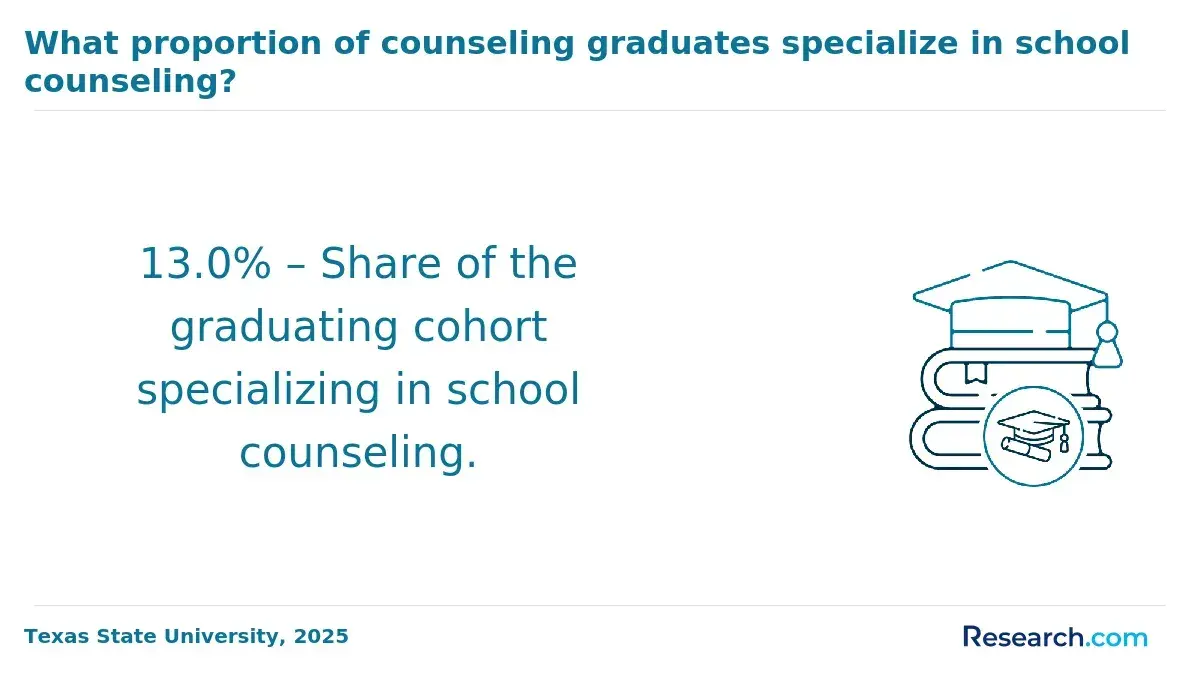
For a prospective counselor, a doctorate is not necessarily the next licensing step: Tennessee licensure and school-counselor credentialing follow different rules, so verify the relevant pathway before applying (Tennessee Board for Licensed Professional Counselors; Tennessee Department of Education).
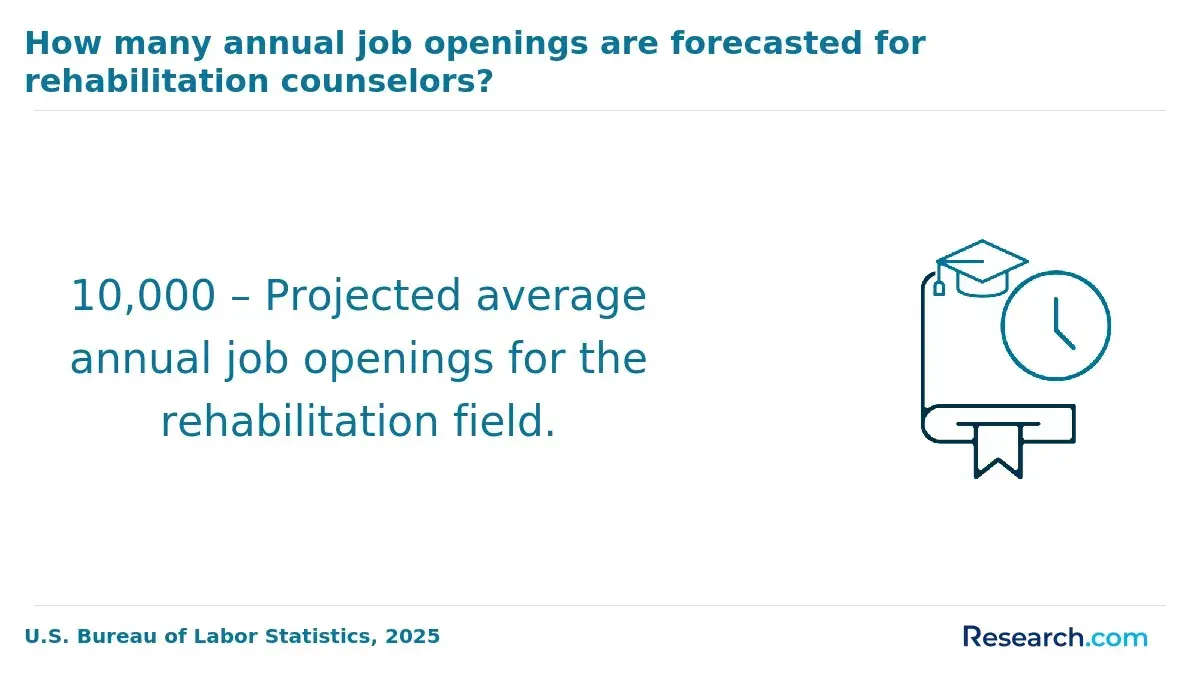
The national May 2025 median was $75,350 for the occupational category used here as a counselor-education career proxy, versus $59,350 for the category covering mental health and addiction counselors. These are occupation-wide medians, not doctoral graduate salaries (U.S. Bureau of Labor Statistics).
Compare Tennessee programs by intended role - counselor education, supervision, or clinical counseling teaching - not degree title alone. A funded, longer research doctorate and a shorter self-funded option can have very different total costs.
What can I expect from a Counseling degree in Tennessee?
A counseling doctorate generally develops advanced skills in research, teaching, supervision, and professional leadership. That differs from a practice-oriented master's degree, which is ordinarily the more direct starting point for someone seeking initial counselor licensure. Tennessee offerings include doctoral programs framed around counselor education and supervision, as well as clinical counseling, teaching, and supervision (University of Tennessee-Knoxville; Tennessee Tech University; University of Memphis; Trevecca Nazarene University).
Expect substantial independent work: evaluating research, teaching or supervising under guidance, and completing a dissertation or other program-required doctoral project. If your objective is private clinical practice rather than faculty or supervisory work, compare the doctorate's added responsibilities and cost with what you could achieve through the appropriate master's degree, licensure, and experience.
Where can I work with a Counseling degree in Tennessee?
Possible settings include university counselor-education departments, community mental health organizations, hospitals, school systems, government agencies, and private practices. The setting depends as much on your existing clinical credential and experience as on the doctorate. Tennessee's separate pathways for professional counseling licensure and school-counselor credentials mean a doctoral diploma alone does not establish eligibility for either role (Tennessee Board for Licensed Professional Counselors; Tennessee Department of Education).
Location also affects fit. A student seeking university teaching should investigate faculty openings and willingness to relocate, while someone intending to keep a Tennessee clinical job may place greater weight on a format that accommodates continued practice. Ask programs where recent doctoral graduates work rather than assuming local openings match the program's emphasis.
There is no single "counseling doctorate salary." Pay follows the occupation, employer, location, and experience; national occupational medians should not be read as starting salaries or as a doctoral earnings premium. The table separates potential career directions so you can compare the appropriate benchmark (U.S. Bureau of Labor Statistics, May 2025 wages; 2025-2035 projections).
Potential direction
U.S. median annual pay, May 2025
Projected U.S. growth, 2025-2035
How to use the figure
Counselor education; postsecondary teaching proxy
$75,350
2.5%
A broad occupational benchmark, not a counselor-education faculty offer.
Mental health or addiction counseling
$59,350
18%
Relevant to clinical practice, which may not require a doctorate.
School counseling
$64,330
3%
Applies to the school-counselor occupation, not automatically to doctoral graduates.
The stronger projected growth for mental health and addiction counseling indicates demand in that occupation, not that a doctorate is required to capture it. For a personal return-on-investment estimate, compare realistic Tennessee job offers against your current earnings and the debt and working time you would give up.
These Tennessee options differ most usefully in how they frame doctoral preparation. The distinctions below describe program emphases, not a claim that any degree guarantees a faculty appointment or clinical credential; confirm current requirements directly with each department (University of Tennessee-Knoxville; Tennessee Tech University; University of Memphis; Trevecca Nazarene University).
University of Tennessee-Knoxville: Its PhD is explicitly in counselor education. That framing makes it a relevant comparison for applicants whose central goal is to develop as counselor educators and researchers; ask how doctoral teaching and dissertation mentorship are arranged.
Tennessee Tech University: The program's counseling-and-supervision emphasis puts supervision directly in the degree's stated focus. Practicing counselors aiming to train or oversee other clinicians should compare its supervised learning requirements with programs framed principally around counselor education.
University of Memphis: Its counselor education and supervision PhD combines both roles in the named degree. Applicants who want to keep faculty teaching and professional supervision options open should examine the current curriculum and available faculty research matches.
Trevecca Nazarene University: Its clinical counseling, teaching, and supervision program explicitly connects clinical work with instruction and oversight. It merits consideration by working clinicians seeking that combination; compare the actual course schedule, required in-person activities, and total price with public-university offers.
Program titles identify emphasis, but they do not establish how much teaching, supervision, or funded research a student will receive. Request current handbooks and written funding terms before treating any of these distinctions as a deciding advantage.
Plan on roughly three to five years for a counseling doctorate after a relevant master's degree, with part-time study or dissertation delays potentially extending that timeline. This is a planning range, not a published completion time for any school. Coursework, supervised teaching or field activities, research milestones, and the dissertation can all affect the finish date.
Ask each Tennessee program for its required credits, residency rules, typical time to completion, and dissertation continuation fees. A faster-looking course sequence is not necessarily the faster degree if research support is limited or required campus visits disrupt your work.
Online study can make doctoral coursework more accessible to a counselor who must keep working or lives far from a campus. Campus study may make regular faculty contact, teaching assignments, and research collaboration easier. Neither format eliminates the need to check dissertation support, supervision arrangements, synchronous meeting times, or required visits.
Delivery format also does not establish licensing eligibility. If you need a Tennessee clinical credential, compare the curriculum and your prior master's preparation with the Tennessee board's requirements; if you intend to practice elsewhere, check that state's board too (Tennessee Board for Licensed Professional Counselors). The better format is the one you can complete while obtaining the mentorship and experiences your intended job requires.
A single average would conceal the most important price differences: public-university residency rates, private-university charges, credit requirements, funding, and time spent enrolled. NCES/IPEDS reports graduate tuition at the institutional level, but that figure is not necessarily the price of a particular counseling doctorate. Request a current program-specific estimate rather than applying an institutional average to your budget (National Center for Education Statistics, IPEDS).
Compare the full cost of completion: tuition and mandatory fees, dissertation-stage charges, travel, books, and any earnings lost to required coursework or teaching. For a public program, confirm whether you qualify for Tennessee resident tuition and whether an assistantship changes your net charge. The most affordable counseling programs comparison is a useful price shortlist, but your written funding offer determines what you would actually pay.
Start with program assistantships, tuition support, scholarships, and paid research or teaching work; ask whether funding is guaranteed, renewable, or contingent on annual availability. Eligible graduate students may also use federal Direct Unsubsidized Loans after completing the FAFSA, subject to federal rules. Confirm current borrowing options and limits with Federal Student Aid and the university aid office rather than assuming a loan will cover every expense (Federal Student Aid).
Do not build a doctoral budget around Tennessee scholarships designed primarily for undergraduate study. Compare each offer by net tuition, stipend, required work hours, and years of support. A larger stipend may be less valuable if it requires duties that slow dissertation progress or replaces work you would otherwise keep.
View the chart data as a table
Best score distribution across ranked programs (Source: Research.com)
Category
Value
85-85
3
86-86
0
87-87
1
88-88
0
89-89
1
Expect programs to review a relevant graduate degree, transcripts, professional goals, recommendations, and evidence that your research interests fit available faculty. Some may also require a counseling license, clinical experience, interviews, or particular prerequisite courses; these are program-specific admissions questions, not statewide rules.
Before applying, distinguish admission from licensure preparation. Tennessee's professional counseling board sets credential requirements separately from universities, and the state education department governs school-counselor credentials (Tennessee Board for Licensed Professional Counselors; Tennessee Department of Education). Ask whether your existing master's training satisfies the prerequisites for your intended credential and whether any doctoral coursework would address a documented gap. Do not assume admission resolves either issue.
Doctoral study commonly includes advanced counseling theory, research design, quantitative or qualitative methods, counselor education, supervision, ethics, and dissertation work. Programs may also require teaching practica, advanced clinical study, or leadership coursework. The mix matters: a prospective faculty member needs meaningful teaching and research development, while a future clinical supervisor should scrutinize how supervision skills are taught and assessed.
Read the current course sequence alongside the faculty roster. A named supervision course is less informative than knowing who teaches it, whether you practice supervision under observation, and how the experience fits your professional credential.
Tennessee applicants can compare emphases in counselor education, counseling and supervision, and clinical counseling with teaching and supervision. An emphasis in a program title is not necessarily a formal concentration, so verify whether it changes required courses, fieldwork, or dissertation opportunities (University of Tennessee-Knoxville; Tennessee Tech University; University of Memphis; Trevecca Nazarene University).
Choose based on the role you want after graduation. For university teaching, prioritize research mentorship and supervised instruction. For clinical leadership, investigate supervisor preparation and whether you must already hold a practice license. If you mainly want to provide therapy, first test whether a master's-to-licensure path meets your goal at substantially less cost.
The best fit is the program that advances a defined career goal at a manageable total cost - not automatically the highest-ranked or lowest-tuition choice. Use rankings to form a shortlist, then ask each school for evidence that bears on your decision. The
most valuable counseling programs
Work through these checks before accepting admission:
Identify your target job and confirm whether it requires a doctorate, a clinical license, a school credential, or some combination.
Check institutional accreditation and the program's current CACREP status where relevant; do not assume accreditation of a master's program also covers its doctorate (CACREP; U.S. Department of Education).
Request written details on credits, delivery, dissertation support, teaching or supervision experience, completion patterns, and graduate destinations.
Compare net cost and likely debt with your baseline earnings, expected post-degree earnings, opportunity cost, completion likelihood, and the years over which you expect to benefit; discounting future earnings provides a more cautious return-on-investment estimate.
A common mistake is choosing on tuition or ranking alone while overlooking unfunded dissertation years. Another is assuming a doctorate cures an unrelated master's-level licensing deficiency. Verify both before committing.
View the chart data as a table
Median wage by counseling career path (U.S., BLS May 2025) (Source: BLS)
Category
Value
Psychologists
99,110
Postsecondary Teachers
85,330
Marriage & Family Therapists
66,940
School & Career Counselors
64,330
Mental Health Counselors
59,350
Rehabilitation Counselors
46,850
A doctorate can support applications for counselor-education faculty posts, clinical supervision, program leadership, research, and advanced practice where the graduate also holds the required license. These paths have different entry requirements: universities may evaluate publications and teaching, while clinical employers may require an active practice credential and documented supervisory experience.
For an established Tennessee counselor, the key question is which new responsibility the degree would make attainable. If your intended promotion depends mainly on licensure or supervised experience, pursuing those requirements first may produce a better return. If you want to teach future counselors and produce research, a doctorate is much more directly aligned with the goal.
The national 2025-2035 projection is 18% growth for the occupational category covering mental health and addiction counselors, compared with 2.5% for the category used here as a counselor-education career proxy (U.S. Bureau of Labor Statistics). That contrast matters because clinical demand does not automatically create a proportionate number of doctoral faculty positions. The projections describe U.S. occupations, not Tennessee-specific vacancies or placement odds.
Assess the local market by job type: ask Tennessee programs about recent graduates' employers, then examine actual postings in the communities where you would work. If you need a faculty appointment but cannot relocate, investigate that constraint before enrolling. To gauge which programs attract applicant interest, you can also review the most popular counseling programs; popularity is not evidence of available jobs.
2027 Best Doctorate in Counseling Degree Programs Ranking in Tennessee
Investing in a doctorate is a consequential decision. Research.com designed its counseling rankings to help readers compare program outcomes, accreditation, and cost rather than rely on reputation alone. Its team checks multiple education datasets to improve the quality, credibility, and accuracy of the comparison.
The Best ranking first combines program completion (40%), employment or doctoral admission (20%), applicable licensure exam pass rates (20%), applicable CACREP programmatic accreditation (16%), and institutional Title IV eligibility (4%). Weights are adjusted when a measure does not apply; cost then contributes approximately 7% of the final score. Online and campus programs use the same method. Other Research.com rankings order programs by the dimension named in each ranking. The underlying sources are:
IPEDS database - institutional enrollment, completions, and financial information.
A ranking is a starting point, not a substitute for checking a doctorate's current curriculum, funding offer, and fit with your intended job. Read more about the approach on the Research.com methodology page.
# 1 position
The University of Tennessee-Knoxville
Doctor
PhD in Counselor Education
Delivery mode: campus
89.65
/ 100
Final score
Program length
3-4 years full-time
Specialization
Counselor Education and Supervision
Required credits
73 semester credits
GPA range
3.00 - 4.00
Program completion rate
100% (2024-25)
Employment or doctoral admission
100% (2024-25)
Application deadline
November 1 (Fall entry only)
Application process
direct
GRE
no
Prerequisites
Master's degree in counseling or a closely related profession, preferably from a CACREP-accredited program, prior to beginning the program
Additional requirements
Resume/CV, Letter of Introduction, Ethical Integration Statement, transcripts, three completed references (at least two by deadline); GRE not required; if invited, on-campus interview including a 2-3 page written response to a case study
Accreditation
Accredited by the Council for Accreditation of Counseling and Related Educational Programs (CACREP), with institutional accreditation from the Southern Association of Colleges and Schools Commission on Colleges (SACSCOC).
The University of Tennessee-Knoxville earned a Research.com Counseling Program Score of 89.65/100, supported by 100% program completion rate and 100% employment or doctoral admission rate. The program is CACREP-accredited, valid through 2028-10-31.
# 2 position
Tennessee Tech University
Doctor
Counseling and Supervision - Ph.D.
Delivery mode: campus
87.19
/ 100
Final score
Specialization
Counselor Education and Supervision
Required credits
60 semester credits
GPA range
3.50 - 4.00
Program completion rate
100% (2024-25)
Employment or doctoral admission
100% (2024-25)
Application deadline
December 1
Application process
direct
GRE
optional
Prerequisites
Master's degree in counseling or closely related program from an accredited institution
Additional requirements
Three letters of recommendation, statement of purpose, CV/resume, writing sample, optional GRE, interview, transcripts, proof of residency
Accreditation
Accredited by the Council for Accreditation of Counseling and Related Educational Programs (CACREP), with institutional accreditation from the Southern Association of Colleges and Schools Commission on Colleges (SACSCOC).
Tennessee Tech University earned a Research.com Counseling Program Score of 87.19/100, supported by 100% program completion rate and 100% employment or doctoral admission rate. The program is CACREP-accredited, valid through 2032-03-31.
# 3 position
University of Memphis
Doctor
Ph.D. in Counselor Education and Supervision
Delivery mode: campus
85.99
/ 100
Final score
Program length
typically 3 to 4 years in full-time residence
Specialization
Counselor Education and Supervision
Acceptance rate
33.3%
Application deadline
March 1
Application process
direct
GRE
no
Prerequisites
Master's degree in counseling (concentration open) from a CACREP or CORE-accredited program; students without all key elements of a CACREP-accredited degree may need additional coursework.
Additional requirements
Transcripts of all colleges attended (undergraduate and graduate), three letters of recommendation, a personal statement, writing sample, resume; qualified applicants invited to campus interview.
Accreditation
Accredited by the Council for Accreditation of Counseling and Related Educational Programs (CACREP), with institutional accreditation from the Southern Association of Colleges and Schools Commission on Colleges (SACSCOC).
University of Memphis earned a Research.com Counseling Program Score of 85.99/100. The program is CACREP-accredited, valid through 2027-10-31.
# 4 position
Trevecca Nazarene University
Doctor
Ph.D. in Clinical Counseling: Teaching and Supervision
Delivery mode: campus
85.82
/ 100
Final score
Program length
About 3 years
Specialization
Counselor Education and Supervision
Required credits
66 semester credits
Application process
direct
GRE
yes
Prerequisites
Master's in counseling, MFT, or similar from a regionally accredited institution; most CACREP master's prerequisites, incl. diversity, development, group, career, ethics, research, assessment, and two semesters of practicum/internship.
Additional requirements
Coursework Verification form and program approval before applying; official transcripts; official GRE (V+Q 300+, Analytical Writing 3.5+ expected, 4 preferred); three recommendation forms (one character reference); 400-word Letter of Intent.
Accreditation
Accredited by the Council for Accreditation of Counseling and Related Educational Programs (CACREP), with institutional accreditation from the Southern Association of Colleges and Schools Commission on Colleges (SACSCOC).
Trevecca Nazarene University earned a Research.com Counseling Program Score of 85.82/100. The program is CACREP-accredited, valid through 2032-10-31.
# 5 position
Trevecca Nazarene University
Doctor
Ph.D. in Clinical Counseling: Teaching and Supervision
Delivery mode: hybrid
85.82
/ 100
Final score
Program length
can be completed in about three years
Specialization
Counselor Education and Supervision
Required credits
66 semester credits
Application process
direct
GRE
yes
Prerequisites
Master's in counseling, MFT, or similar from a regionally accredited institution; most CACREP master's prerequisites, incl. diversity, development, group, career, ethics, research, assessment, and two semesters of practicum/internship.
Additional requirements
Coursework Verification form and program approval before applying; official transcripts; official GRE (V+Q 300+, Analytical Writing 3.5+ expected, 4 preferred); three recommendation forms (one character reference); 400-word Letter of Intent.
Accreditation
Accredited by the Council for Accreditation of Counseling and Related Educational Programs (CACREP), with institutional accreditation from the Southern Association of Colleges and Schools Commission on Colleges (SACSCOC).
Trevecca Nazarene University earned a Research.com Counseling Program Score of 85.82/100. The program is CACREP-accredited, valid through 2032-10-31.
Frequently asked questions about Counseling degree in Tennessee
Do I need a doctorate to become a licensed counselor in Tennessee?
Not necessarily. Tennessee's professional counseling licensure has its own education, examination, and supervised-experience requirements. Check your intended credential with the Tennessee Board for Licensed Professional Counselors before choosing a degree.
Does a counseling doctorate qualify me to be a Tennessee school counselor?
Not automatically. School-counselor credentialing is a separate Tennessee Department of Education pathway. Confirm its preparation and endorsement requirements even if a doctoral program includes counseling coursework.
Is CACREP accreditation the same as university accreditation?
No. CACREP accredits eligible counseling programs; institutional accreditation applies to the university. Check both where relevant, including the status of the specific degree rather than another program at the same school (CACREP; U.S. Department of Education).
Can I earn a counseling doctorate while working?
Possibly, depending on course scheduling, residency, supervised activities, and dissertation demands. Ask for the actual weekly schedule and required campus visits before assuming an online or part-time option will fit your job.
Is a Tennessee counseling doctorate worth the cost?
It may be if it supports a specific teaching, research, or leadership goal and the net cost is sustainable. For someone seeking only initial clinical practice, compare the appropriate master's and licensure path first; national counselor salaries do not establish a doctoral pay premium.
See What Experts Have To Say About Studying Counseling